Croton Gorge – Serendipity

When I embarked upon this walk in Croton Gorge I didn’t have high expectations. I’d been there many times and thought that I must already have come across everything of interest. However, one of the great things about photography is that no matter how many times you’ve visited a place there’s always something new. It might be detail you’ve missed, or a different viewpoint on something you’ve already seen, maybe different light makes something familiar feel new. Or it might just be something that was there in plain sight and you just missed it.

This post provides an example of the final point above. Anyone who reads this blog (if indeed anyone does) will know that I’m fascinated by cemeteries. I’d been along this trail many times and had never noticed this solitary grave stone by the side of the house. I didn’t see any other markers, and I’m not sure if anyone is actually buried here, or whether it’s a cenotaph (i.e. a memorial for people who are actually buried elsewhere). I suspect that missed this in the past because it was in shade and less noticeable. This time the sun was reflecting of the polished surface of the gravestone. You could hardly miss it.

I searched the internet to try to find additional information about the family and came across an obituary in the New York Times for Egon H. Ottinger dated October 1992. It reads:

Egon H. Ottinger; Insurer, 93

Egon H. Ottinger, a former chairman of Frank B. Hall & Company, a leading marine insurance company, died on Monday at Phelps Memorial Hospital in North Tarrytown, N.Y. He was 93 years old and lived in Croton-on-Hudson, N.Y.

Mr. Ottinger died of complications from a recent fall, said Carolyn B. Handler, a family spokeswoman.

A native of Newport, R.I., Mr. Ottinger devoted his career to the marine insurance industry. He began at 16 as a clerk and by 1919 was writing marine cargo contracts for the Hall concern, which is now a division of the Aon Corporation.

He became a vice president there in 1935, a director in 1940 and president in 1961. He was the company’s chairman from 1964 to his retirement in 1969.

His wife, the former Lilyan Leaders, died in 1983. There are no immediate survivors.

As noted in the obituary Frank B. Hall company is now a division of Aon Corporation. In the 1980s the Hall company seems to have gone through troubled times as noted in a piece in the New York Times (See: Frank B. Hall) dated May 28 1986. This same article mentions that the company was based in Briarcliff Manor, NY co-incidentally somewhere we have lived for the past almost 20 years.
Woodlawn Cemetery – Samuel Untermeyr

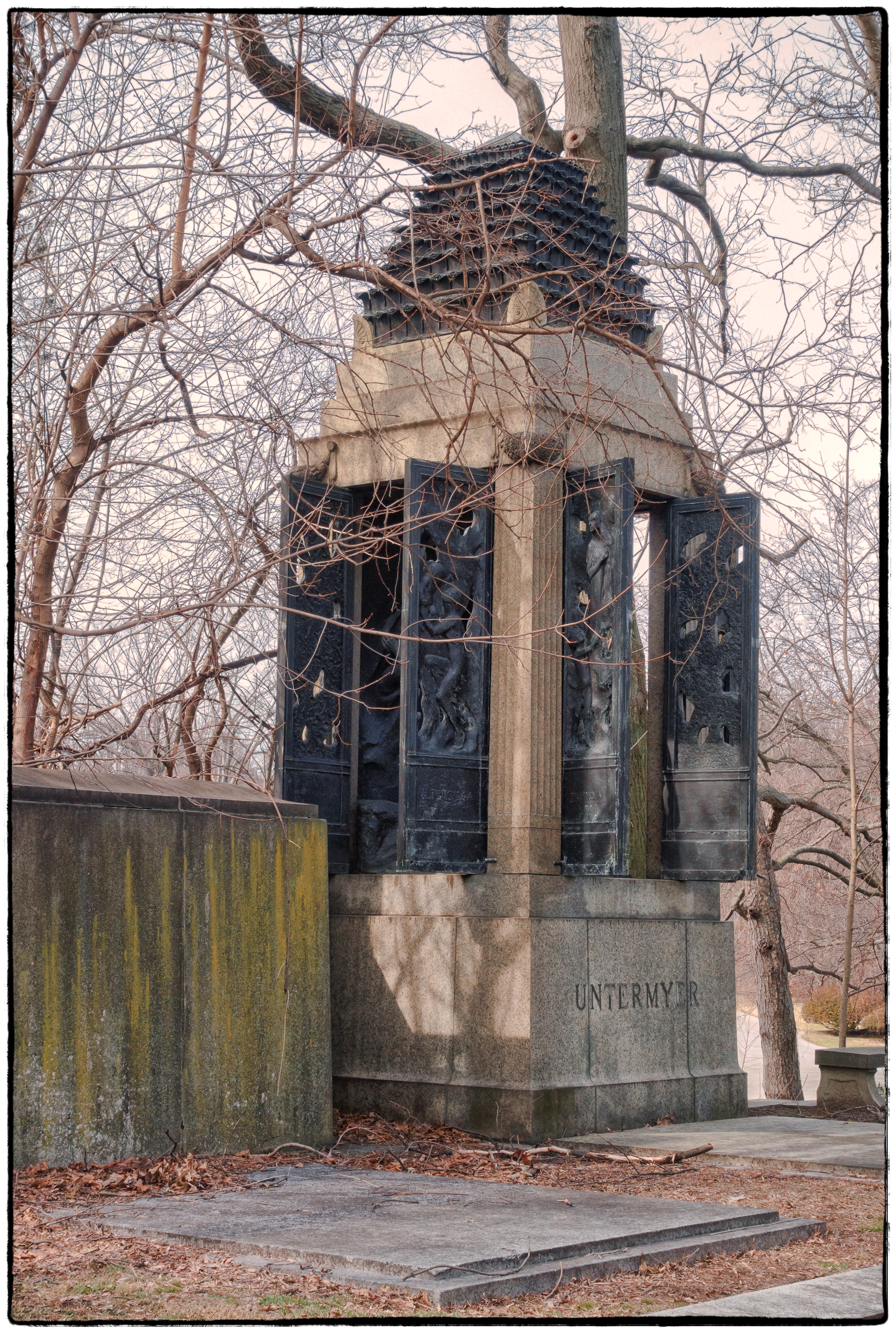
We almost missed this one! We were on our way out of the cemetery when, almost simultaneously, George and myself caught sight of what looked like a very strange monument tucked away to our left. We decided to check it out, and I’m glad we did.

It turned out to be the final resting place of Samuel Untermeyr (March 6, 1858 – March 16, 1940).

According to the Untermyer Conservancy Website:

Samuel Untermyer was born in Virginia in 1858, and moved to New York City after the Civil War. He was a partner in the law firm of Guggenheimer, Untermyer & Marshall, and was the first lawyer in America to earn a one million dollar fee on a single case. He was also an astute investor, and became extremely wealthy.

Initially he was a corporate lawyer, but later in his career he became a trust-buster. The lead counsel for the Pujo Investigation, he was instrumental in the establishment of the Federal Reserve System, and advocated for the regulation of stock exchanges and other legal reforms. He was an influential Democrat and a close ally of Woodrow Wilson.
Samuel Untermyer was one of the most prominent Jews of his day in America. He was a prominent Zionist, and was President of the Keren Hayesod. In addition, he was the national leader of an unsuccessful movement in the early 1930s for a worldwide economic boycott of Germany, and called for the destruction of Hitler’s regime.

His wife, Minnie Untermyer, was at the center of cultural circles in New York City. She was one of a small group of women that transformed the New York Philharmonic in 1909, and brought Gustav Mahler to conduct the orchestra. She was also President of the American Poetry Society, and a patroness of artists and dancers in New York. She supported women’s suffrage and was able to offer her husband’s legal skills and significant financial support to groups supporting women’s right to vote.

Samuel Untermyer was also passionately interested in horticulture. He famously said that if he could do it over again, he would want to be the Parks Commissioner in New York City! Unlike most wealthy garden-owners, Untermyer was expertly knowledegable about gardening. The level of connoisseurship at the Untermyer Gardens was nationally famous, and many great gardeners got their training there.

The National Register of Historic Places Registration Form for Woodlawn provided the following information:

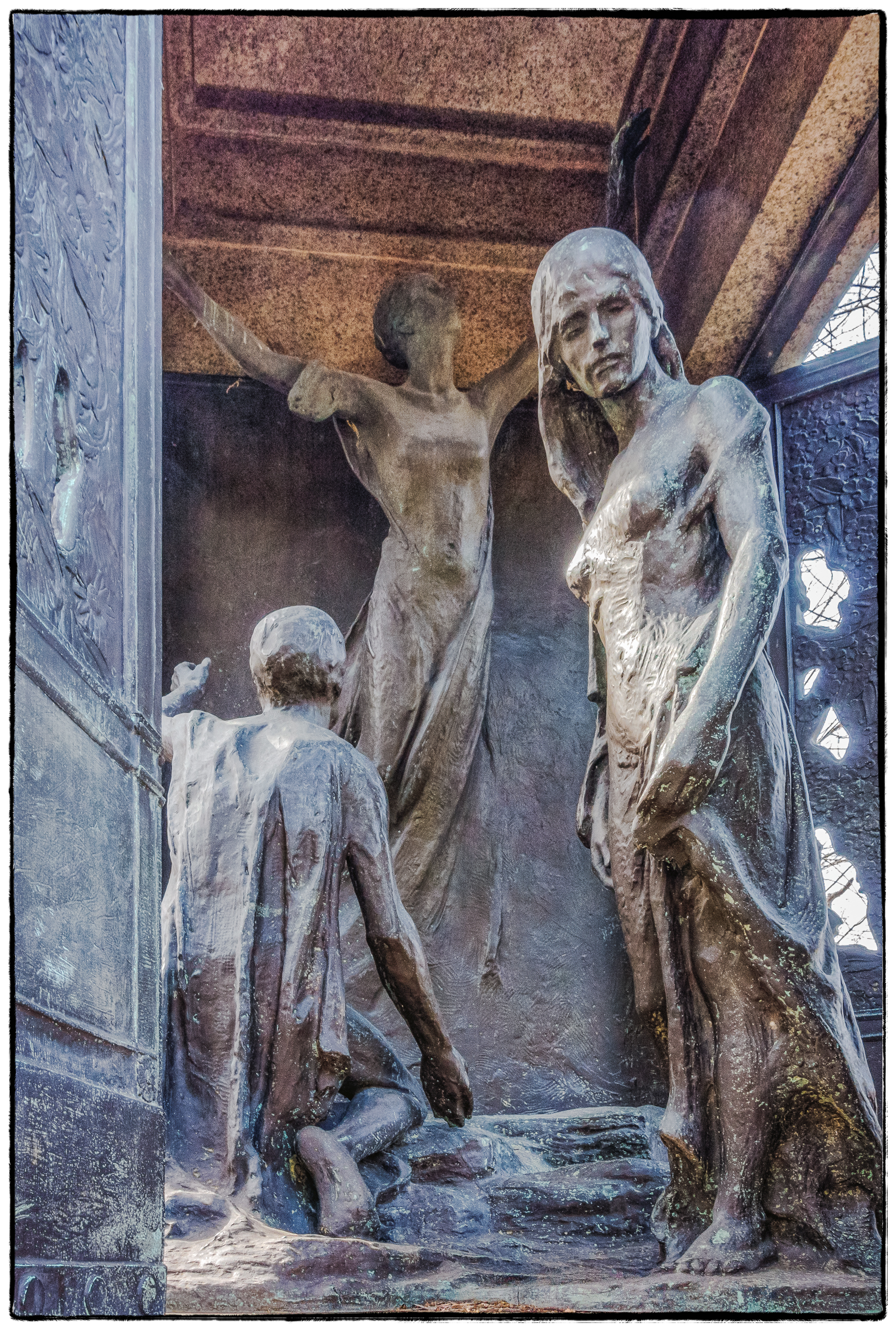
The Samuel Untermyer monument … is sited on a 22,000 square foot private lot. The monument was designed by architect Paul Chaflin (1925) and fabricated by Maine & New Hampshire Granite Company in crystal blue German granite. The monument features a bronze fountain and sculpture by Gertrude Vanderbilt Whitney (1925). The monument is U-shaped in plan, with one side of the U occupied by a set of stepped grass terraces edged in stone, ascending to a circular courtyard. The courtyard is bordered by a low granite wall and paved with stones set in a Star of David pattern with a planting of boxwood. At the center of the courtyard is the bronze fountain, sculpted as an urn with three lion busts as feet. The U continues to the area of interments, which is marked at the end with a vertical tower. The tower is open on three sides with elaborate bronze doors decorated with figures depicting the stages of a woman’s life, floral symbols, and Greek inscriptions. Fluted square columns with festoons at their top mark each of the four corners of the tower and support the steeply stepped, ornate bronze roof. The center is occupied by a sculpture of a woman ascending to the afterlife with two figures in the foreground; one is on his knees, the other is standing. The Untermeyer name is inscribed on the base of the tower.

This striking sculpture above is by Gertrude Vanderbilt Whitney is also buried at Woodlawn buried with her husband, Harry Payne Whitney. We didn’t bump into their grave site.

As mentioned above Samuel Untermyer was also the former owner of one of my favorite places to visit in the lower Hudson Valley: Untermyer Gardens. I’ve posted about it many times:

Untermyer gardens revisited – ruined gatehouse
Untermyer gardens revisited – waterlily
Untermyer gardens revisited – stone lion
Untermyer gardens revisited – a couple of mosaics
Untermyer gardens revisited – the temple of love
Untermyer gardens revisited – the vista
Untermyer gardens revisited – the walled garden
Untermeyr gardens revisited – overview
Upcoming visit to Untermyer Park
Untermyr Park, Yonkers, NY

This post concludes the marathon series from Woodlawn Cemetery. I’d like to go back sometime: to see some of the monuments I missed; take some pictures of the statuary, flowering shrubs and trees.

Next on the list – Green-Wood Cemetery in Brooklyn (unless I manage to get to Père Lachaise Cemetery in Paris first).

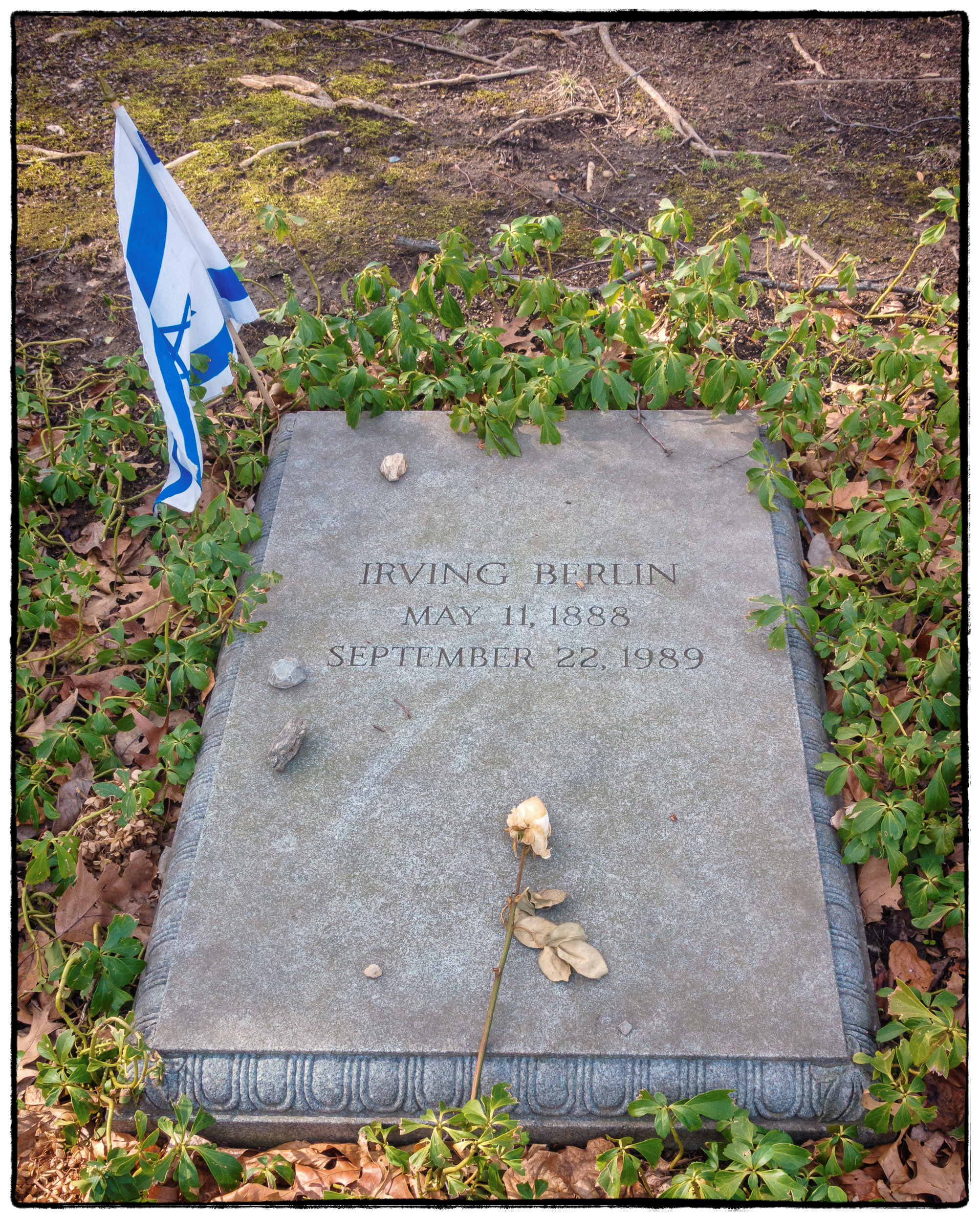
Woodlawn Cemetery – Irving Berlin

While not actually in ‘jazz corner’ Irving Berlin’s grave is only a short distance away. It’s easy to miss – a very simple marker for a very remarkable man. Look at the dates on the marker. He lived to be 101!

Wikipedia says of him:

Irving Berlin (born Israel Isidore Baline; May 11, 1888 – September 22, 1989) was an American composer and lyricist, widely considered one of the greatest songwriters in American history. His music forms a great part of the Great American Songbook. Born in Imperial Russia, Berlin arrived in the United States at the age of five. He published his first song, “Marie from Sunny Italy”, in 1907, receiving 33 cents for the publishing rights, and had his first major international hit, “Alexander’s Ragtime Band” in 1911. He also was an owner of the Music Box Theatre on Broadway.

“Alexander’s Ragtime Band” sparked an international dance craze in places as far away as Berlin’s native Russia, which also “flung itself into the ragtime beat with an abandon bordering on mania.” Over the years he was known for writing music and lyrics in the American vernacular: uncomplicated, simple and direct, with his stated aim being to “reach the heart of the average American,” whom he saw as the “real soul of the country.” In doing so, said Walter Cronkite, at Berlin’s 100th birthday tribute, he “helped write the story of this country, capturing the best of who we are and the dreams that shape our lives.”

He wrote hundreds of songs, many becoming major hits, which made him “a legend” before he turned thirty. During his 60-year career he wrote an estimated 1,500 songs, including the scores for 19 Broadway shows and 18 Hollywood films, with his songs nominated eight times for Academy Awards. Many songs became popular themes and anthems, including “Easter Parade”, “White Christmas”, “Happy Holiday”, “This Is the Army, Mr. Jones”, and “There’s No Business Like Show Business”. His Broadway musical and 1942 film, This is the Army, with Ronald Reagan, had Kate Smith singing Berlin’s “God Bless America” which was first performed in 1938. Celine Dion recorded it as a tribute, making it no. 1 on the charts after the September 11 attacks in 2001. In 2015, pianist and composer Hershey Felder began touring nationwide as a one-man show, portraying Berlin and performing his songs.

Berlin’s songs have reached the top of the charts 25 times and have been extensively re-recorded by numerous singers including Eddie Fisher, Al Jolson, Fred Astaire, Ethel Merman, Louis Armstrong, Frank Sinatra, Dean Martin, Deana Martin, Ethel Waters, Elvis Presley, Judy Garland, Barbra Streisand, Linda Ronstadt, Rosemary Clooney, Cher, Diana Ross, Bing Crosby, Rita Reys, Frankie Laine, Johnnie Ray, Billy Eckstine, Sarah Vaughan, Nat King Cole, Billie Holiday, Doris Day, Jerry Garcia, Willie Nelson, Bob Dylan and Ella Fitzgerald. Composer Douglas Moore sets Berlin apart from all other contemporary songwriters, and includes him instead with Stephen Foster, Walt Whitman, and Carl Sandburg, as a “great American minstrel”—someone who has “caught and immortalized in his songs what we say, what we think about, and what we believe.” Composer George Gershwin called him “the greatest songwriter that has ever lived”, and composer Jerome Kern concluded that “Irving Berlin has no place in American music—he is American music.”.

Someone had placed an Israeli flag on his grave, which seems appropriate as him name actually was Israel.

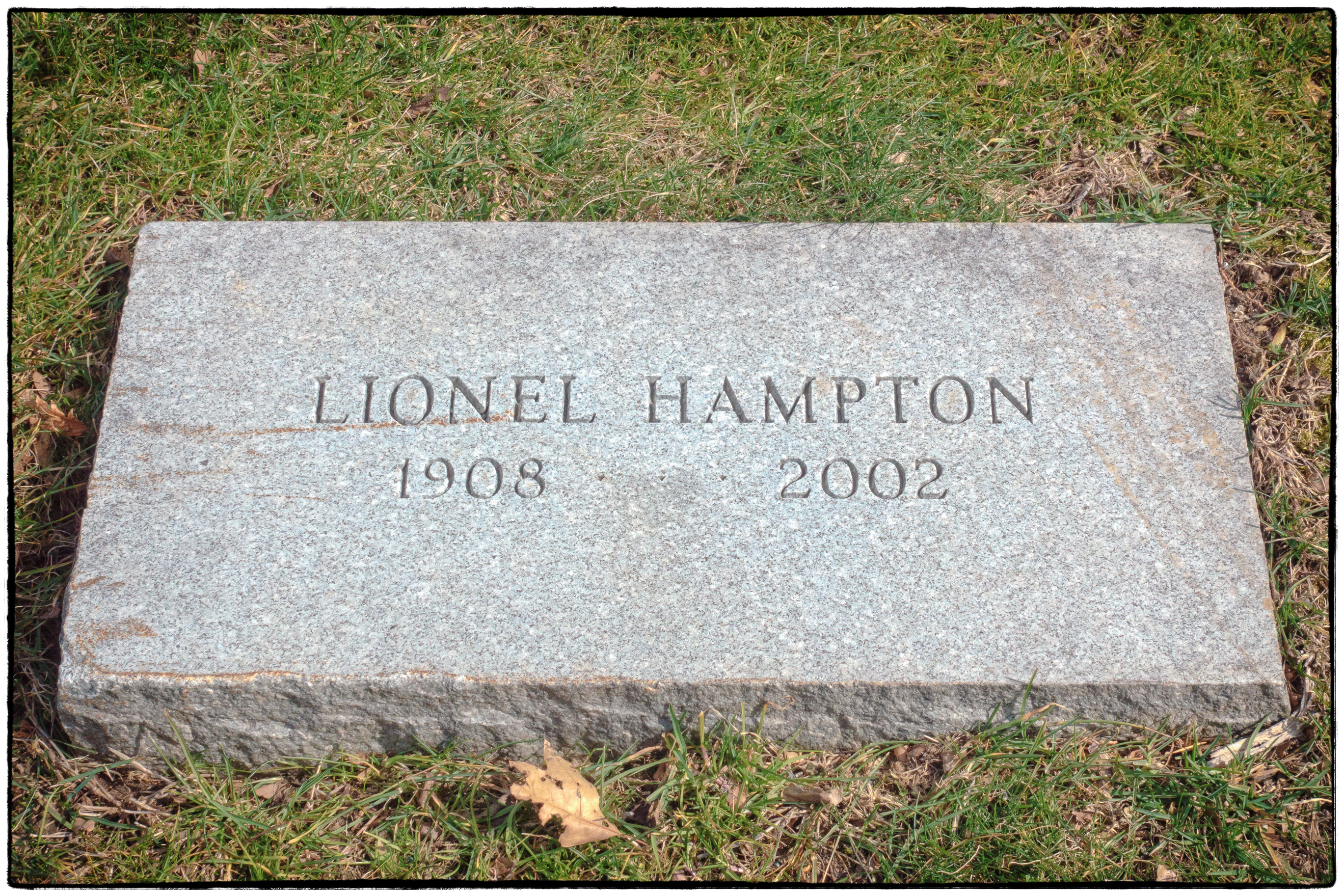
Woodlawn Cemetery – Lionel Hampton

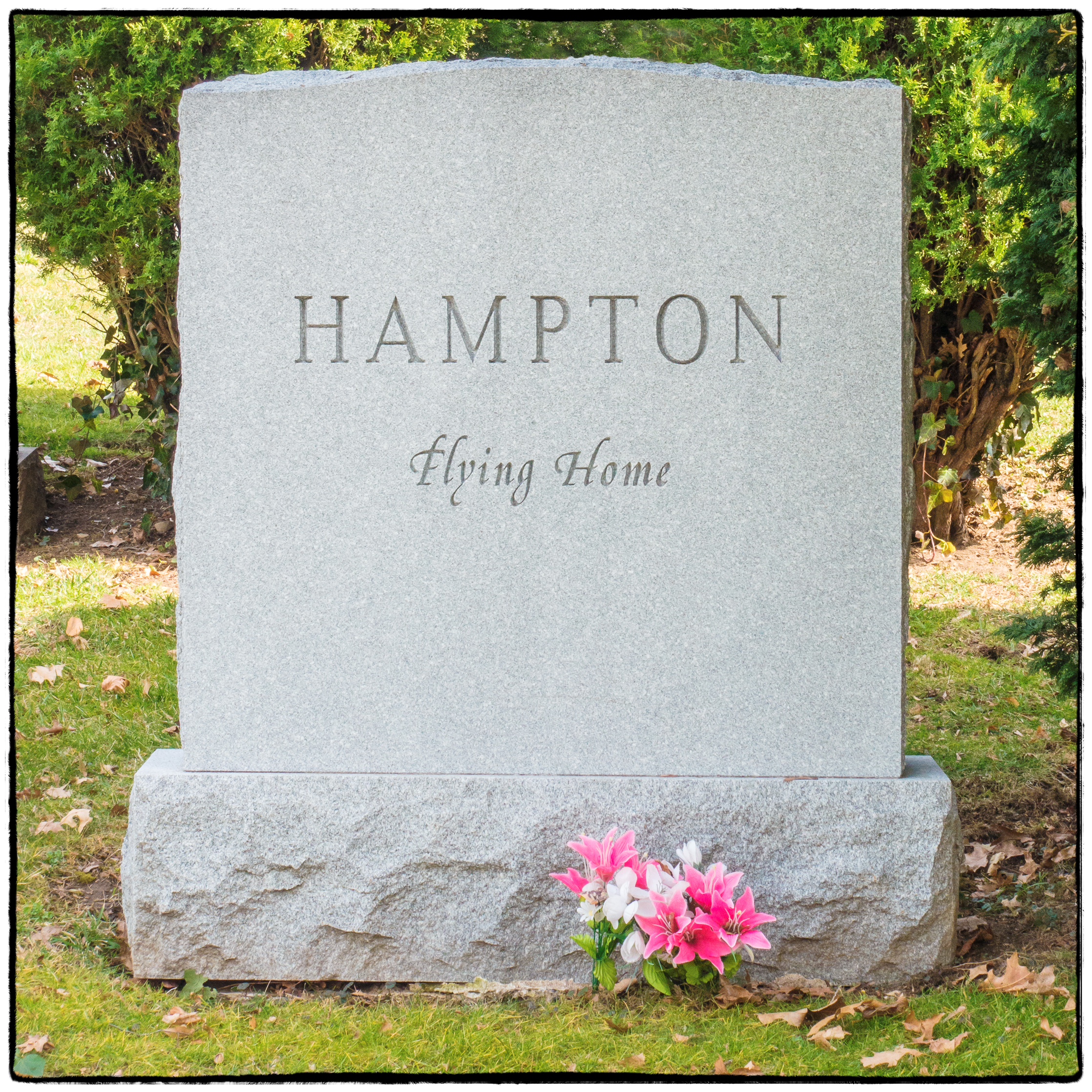
Also in ‘jazz corner’ lies famous xylophonist/vibraphonist Lionel Hampton.

His ‘Find a Grave’ entry reads:

Birth: Apr. 20, 1908, Louisville, Jefferson County, Kentucky, USA. Death: Aug. 31, 2002, New York, New York County (Manhattan), New York, USA.

Jazz Musician, Bandleader and Vibraphone Virtuoso. His career as a Jazz musician lasted nearly seven decades beginning in Chicago culminating in international fame. Lionel Hampton lifted the vibes to a place of honor in small-group and big-band jazz. Although born in Kentucky, he considered Birmingham, Alabama his hometown. His father was singer-pianist Charles Hampton who enlisted in the army during World War I, first declared MIA, then dead. The lure of jobs in the industrial North in the postwar induced his mother Gertrude to relocate to Chicago. A brief stay in Kenosha, Wisconsin was his first chance at a formal music lesson when a Dominican nun at Holy Rosary Academy taught him the essentials of playing drums. While attending St. Monica’s Catholic School in Chicago, he began selling papers, a pre-requisite for being in the Chicago Defender’s Newsboys Band. First he helped carry the bass drum and then played the snare drum. His break came in Los Angeles after his wife Gladys encouraged him to buy a vibraphone and learn to play. While performing at the Paradise nightclub, Benny Goodman and his group walked in, stepped onto the stage and began playing with the band. Thus, Lionel joined another black, Teddy Wilson in the Benny Goodman band. Hampton then appeared with the Goodman quartet at the Pennsylvania Hotel in New York – The first time that black and white ever played a major commercial booking – the racial barrier was broken. In 1940, Lionel formed his own big band which almost instantly became a leader in the Jazz field. ‘Sunny Side of the Street, Central Avenue Breakdown, his signature tune, Flying Home, and Hamp’s Boogie-Woogie’ all became top-of-the-chart best-sellers upon release. As a composer and arranger, he wrote more than 200 works including a major symphonic work, ‘King David Suite.’ Asked by US President Dwight D. Eisenhower, he served as goodwill ambassador for the United States and his group made many tours to Europe, Africa, the Middle East and the far East. With the shadows of old age covering him, he made his last public appearance at the Moscow Jazz Festival. Illness caught up with him. Admitted to Mount Sinai Medical Center in New York, he passed away at the age of 94. Lionel was accorded a New Orleans style Jazz funeral in Manhattan. A ‘Jazz Funeral’ procession formed outside Harlem’s historic Cotton Club. A nine-member band, playing Blues and dirges followed behind Hampton’s white wooden hearse as it was drawn by two horses toward Manhattan’s Riverside Church. The service laced with Jazz music was led by Rev. James A. Forbes Jr. Many speakers gave tribute to Lionel Hampton before the 2,000 mourners packed inside the upper Manhattan landmark which overlooks the Hudson River, including former US President George Bush. However, it was the music that dominated the two-hour service – A parade of jazz greats: pianist Hank Jones, saxophone player, Illinois Jacquet, trumpeters Clark Terry, Jon Faddis and Roy Hargrove all former associates. Interment followed beside his wife Gladys who died in 1971. She had served as his personal manager, a brilliant businesswoman who was responsible for raising the money to start the band. Honors and awards: President George Bush appointed him to the Board of the Kennedy Center, Washington D.C. The National Medal of the Arts was presented in 1977 by President Clinton at the White House. A vibraphone he played for 15 years was put into the National Museum of American History at the Smithsonian in Washington D.C. He used his own money to construct an affordable housing unit in Harlem. His greatest legacy: He began working with the University of Idaho in the early 1980s to establish his dream for the future of music education. In 1985, the University named its jazz festival for him, and in 1987 the University’s music school was named the Lionel Hampton School of Music. Now, the University has launched a multi-million dollar project that will provide a ‘home for jazz,’ housing the university’s Jazz Festival, its School of Music, and its International Jazz Collections, all designed to help teach and preserve jazz. (bio by: Donald Greyfield)

The wording on the upright stone reads “Flying Home”, one of his biggest hits.

I saw him perform once. It was early in the 2000s and somehow our New Year’s Eve plans had been messed up leaving us with nothing to do. I would have been fine staying home, but my wife always feels that would should celebrate such occasions. So we checked around and found that the Lionel Hampton Orchestra was playing at the nearby Tarrytown Hilton (now the Doubletree). I’m not all that fond of jazz, but I’d heard Lionel Hampton before, and I’ve always liked the Xylophone/Vibraphone. And in any case beggars can’t be choosers. So off we went. It was a typical New Year’s Eve celebration with food, drinks, party favors, hats, noise makers etc. and, of course, the orchestra. What I hadn’t considered was just how old Mr. Hampton was – in his 90s already at that point. When it came time to perform two people assisted him up onto the stage, and there he sat throughout the performance. I can’t recall whether or not he actually played anything, but I have a vague memory that he did, but he was just a shadow of his former self (who I had seen perform in his younger days on the TV). At one point during the performance he fell off his chair and had to be helped up again. Having seen videos of him in his heyday it was all a bit sad, but then I guess he was able to do what he presumably loved (performing that is) pretty much right up to the end. He passed away soon afterwards in 2002. I’ll always remember him the way he was in the video above.

Woodlawn Cemetery – Edward Kennedy “Duke” Ellington

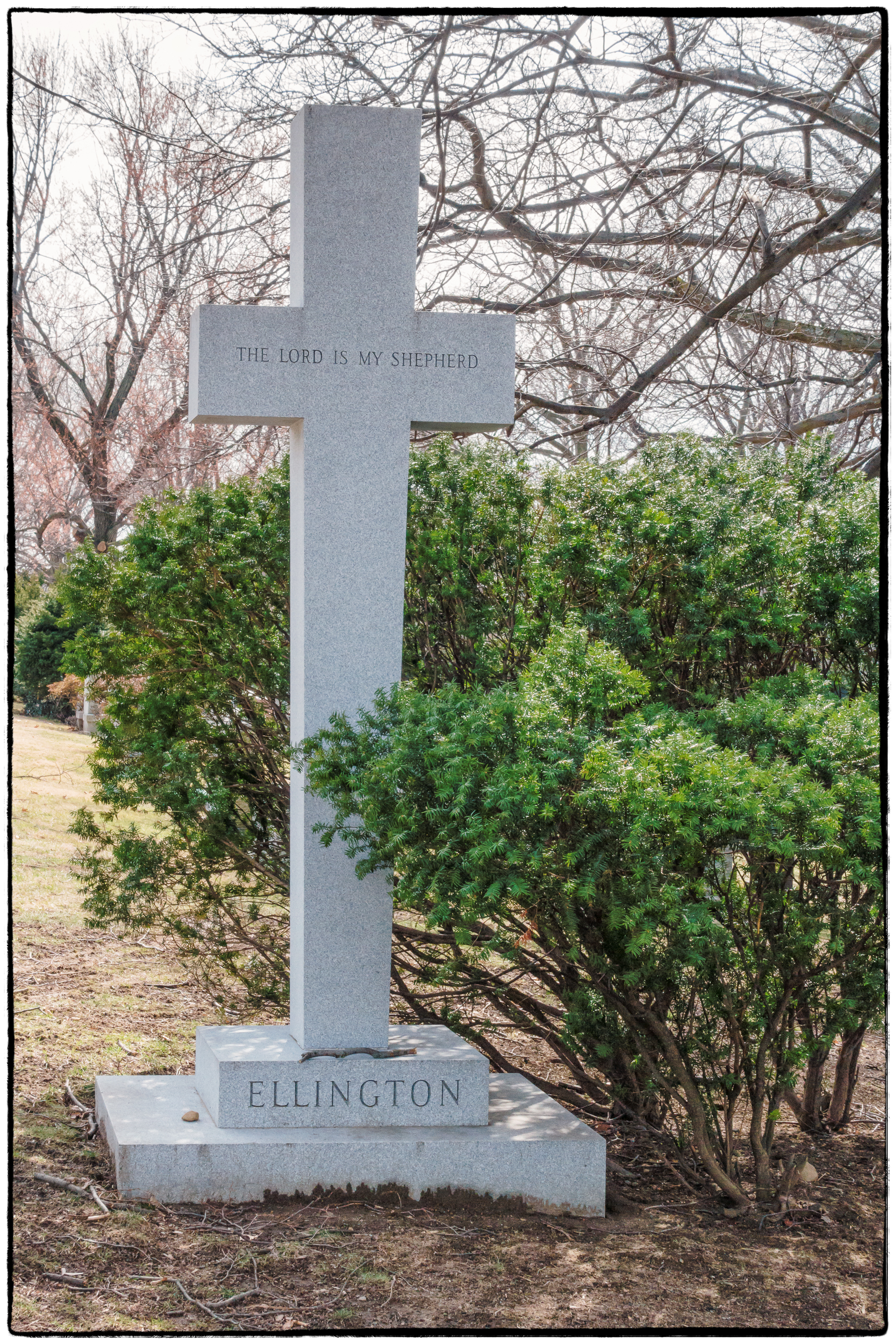
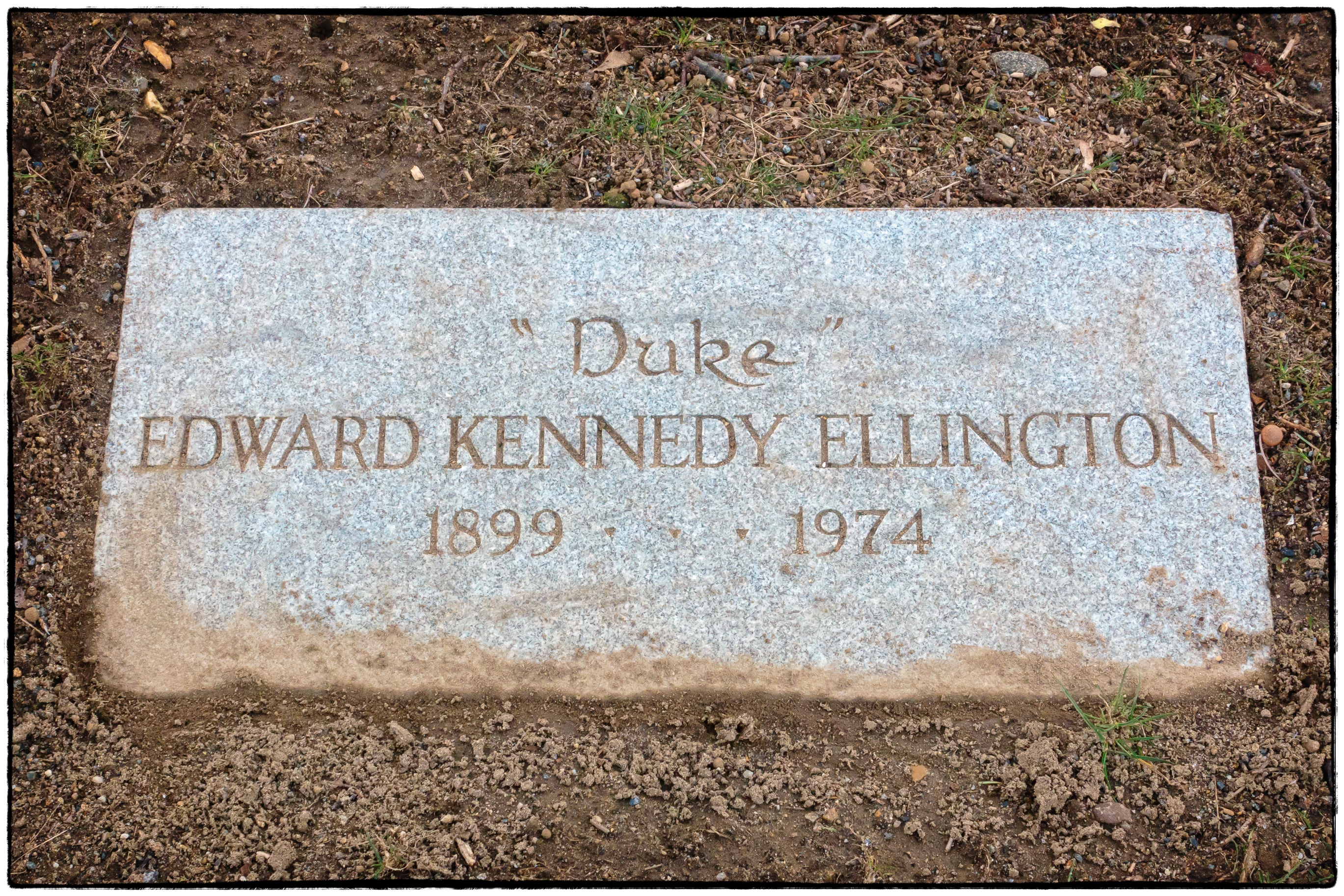
Mere steps away from Miles Davis lies another jazz great: Edward Kennedy “Duke” Ellington (April 29, 1899 – May 24, 1974).

The biography on his official website describes him as follows:

Duke Ellington called his music “American Music” rather than jazz, and liked to describe those who impressed him as “beyond category. He remains one of the most influential figures in jazz, if not in all American music and is widely considered as one of the twentieth century’s best known African American personalites. As both a composer and a band leader, Ellington’s reputation has increased since his death, with thematic repackagings of his signature music often becoming best-sellers. Posthumous recognition of his work include a special award citation from the Pulitzer Prize Board.

Consider

• President Lyndon Johnson presented Duke Ellington with the President’s Gold Medal in 1966.
• President Richard M Nixon presented Duke Ellington with the Medal of Freedom in 1969.
• Duke Ellington received 13 Grammy Awards.
• Duke Ellington received the Pulitzer Prize
• Was awarded the French Legion of Honor in 1973.
• Has a United States Commemorative stamp with his image on it issued in 1986.

Duke Ellington influenced millions of people both around the world and at home. He gave American music its own sound for the first time. In his fifty year career, he played over 20,000 performances in Europe, Latin America, the Middle East as well as Asia.

Simply put, Ellington transcends boundaries and fills the world with a treasure trove of music that renews itself through every generation of fans and music-lovers. His legacy continues to live onand will endure for generations to come. Winton Marsalis said it best when he said “His music sounds like America.” Because of the unmatched artistic heights to which he soared, no one deserved the phrase “beyond category” more than Ellington, for it aptly describes his life as well. He was most certainly one of a kind that maintained a llifestyle with universal appeal which transcended countless boundaries.

Duke Ellington is best remembered for the over 3000 songs that he composed during his lifetime. His best known titles include; “It Don’t Mean a Thing if It Ain’t Got That Swing”, “Sophisticated Lady”, “Mood Indigo”, “Solitude”, “In a Mellotone”, and “Satin Doll”. The most amazing part about Ellington was the most creative while he was on the road. It was during this time when he wrote his most famous piece, “Mood Indigo”which brought him world wide fame.

When asked what inspired him to write, Ellington replied, “My men and my race are the inspiration of my work. I try to catch the character and mood and feeling of my people”.

Duke Ellington’s popular compositions set the bar for generations of brilliant jazz, pop, theatre and soundtrack composers to come. While these compositions guarantee his greatness, whatmakes Duke an iconoclastic genius, and an unparalleled visionary, what has granted him immortality are his extended suites. From 1943’s Black, Brown and Beige to 1972’s The Uwis Suite, Duke used the suite format to give his jazz songs a far more empowering meaning, resonance and purpose: to exalt, mythologize and re-contextualize the African-American experience on a grand scale.

Duke Ellington was partial to giving brief verbal accounts of the moods his songs captured. Reading those accounts is like looking deep into the background of an old photo of New York and noticing the lost and almost unaccountable details that gave the city its character during Ellington’s heyday, which began in 1927 when his band made the Cotton Club its home. ”The memory of things gone,” Ellington once said, ”is important to a jazz musician,” and the stories he sometimes told about his songs are the record of those things gone. But what is gone returns, its pulse kicking, when Ellington’s music plays, and never mind what past it is, for the music itself still carries us forward today.

Duke Ellington was awarded the Grammy Lifetime Achievement Award in 1966. He was later awarded several other prizes, the Presidential Medal of Freedom in 1969, and the Legion of Honor by France in 1973, the highest civilian honors in each country. He died of lung cancer and pneumonia on May 24, 1974, a month after his 75th birthday, and is buried in the Bronx, in New York City. At his funeral attendedby over 12,000 people at the Cathedral of St. John the Divine, Ella Fitzgerald summed up the occasion, “It’s a very sad day…A genius has passed.”

The monument is a little more complex than the photos above suggest. There are actually two crosses, one on each side of a hedge. Directly in front of the hedge is a magnificent tree and in front of that are a number of grave markers (including Ellington’s own; Duke’s parents James Edward Ellington and Daisy Kennedy Ellington; and Evie Ellington (Beatrice Ellis). Evie and Duke were never married, but they were together for the rest of their lives) like the one in the first picture.