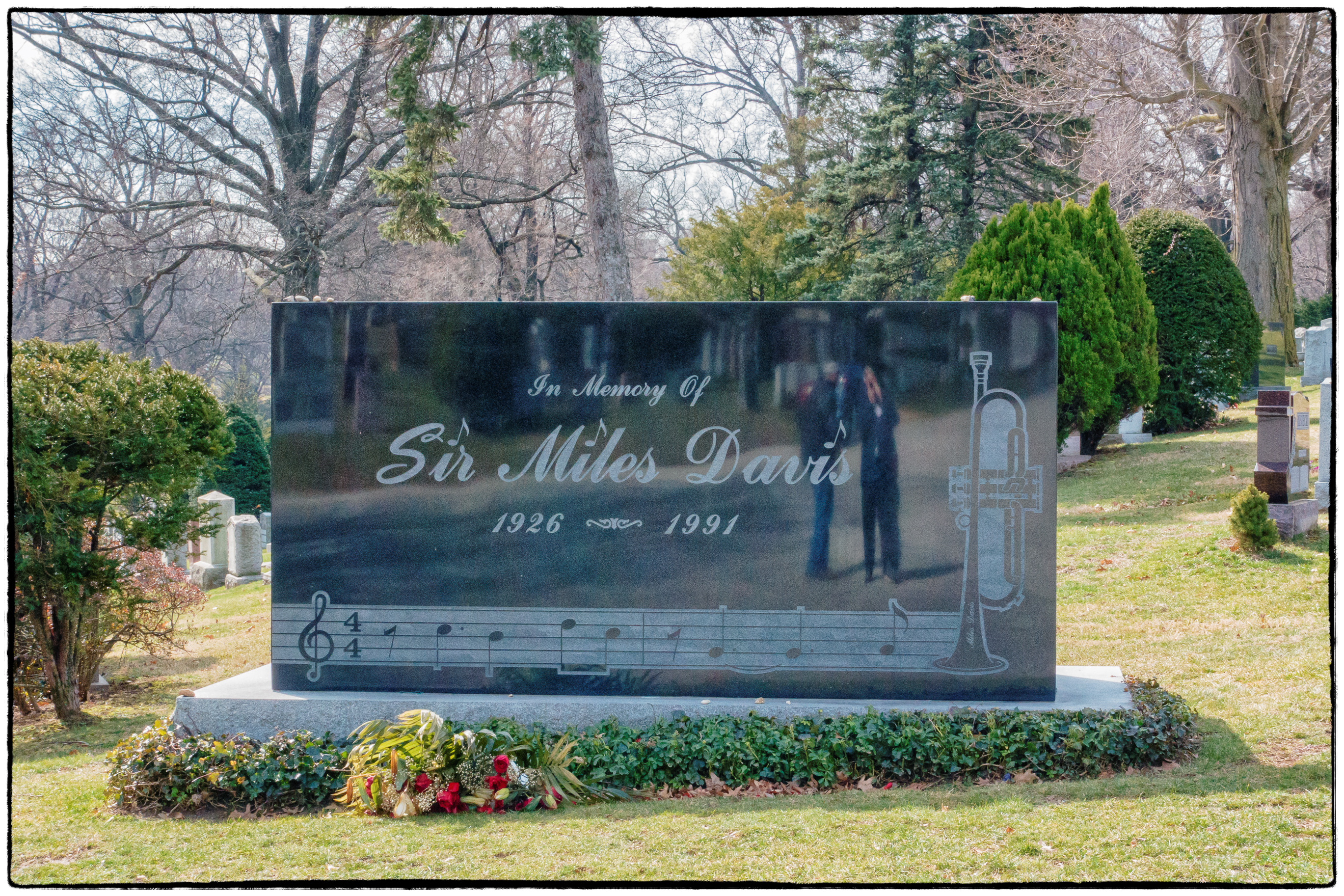
Woodlawn Cemetery – Miles Davis

Our next stop was the well-known “Jazz Corner”. Keister describes it as follows:

Up until the Reformation in the sixteenth century there were few formal cemeteries. Most people were buried in small family plots or were unceremoniously disposed of. However, the elect and the well-to-do were often buried inside churches. Travelers to Europe often remark about vising cathedrals and seeing flat grave markers on the floors, crypts on the walls, and tombs and sarcophagi ringing the interior of the cathedral. And just like real estate, the placement of earthly remains was all about location, location, location. The closer to the altar, the better chance of being inched towards the heavens by the parishioners’ prayers. The intersection of Fir, Wild Rose, Alpine and Hillcrest Plots at Woodlawn has become a sort of outdoor cathedral for fallen jazz greats. And if there is an altar, it has to be Miles Davis’s black granite tombstone.

His ‘Find a grave’ entry reads:

Birth: May 26, 1926, Alton, Madison County, Illinois, USA. Death: Sep. 28, 1991, Santa Monica, Los Angeles County, California, USA.

Jazz Musician. The son of a middle-class dentist from Alton, Illinois, he won a scholarship to Julliard in 1944, but there is no evidence that he ever attended the institution. Rather, upon his arrival in New York, he joined up with the modern jazz leader Charlie Parker, joining his “All-Star” quintet on trumpet. Quickly learning that he would never be able to match Parker’s technical virtuousity, Davis adopted a cooler, more laid back approach to his solos, playing very few notes and concentrating on harmony and tone, often employing a characteristic Harmon mute. He would explore these ideas further in 1949 with a nine-piece band under the direction of Gil Evans. This ensemble echewed the blues-based tonality common to most previous jazz styles, opting instead for a “cooler” timbre which would lend its name to their best-known recording, “Birth of the Cool.” He led more traditional jazz quintets through the 1950s, but would reach an epiphany leading a sextet of renowned musicians in 1958 and 1959. With John Coltrane on tenor saxophone, Julian “Cannonball” Adderly on alto sax, Bill Evans on piano, Paul Chambers on bass, and Jimmy Cobb on drums, the group explored “modal” pieces, replacing the traditional ideas of chord progression with patterns based on scales. Their 1959 album, “Kind of Blue”, is widely regarded as the greatest jazz album of all time. Miles Davis would lead similar groups through the 1960s, including such luminaries as Herbie Hancock, Ron Carter, Jack DeJohnette, Chick Corea, Joe Zalwinul, Wayne Shorter, and John McLaughlin. In the late 1960s, his style radically changed, embracing the influences of Jimi Hendrix and Sly Stone to create the embryonic style of jazz-rock, also known as fusion, as exemplified on his albums “In a Silent Way” (1969) and “Bitches Brew” (1970). He would continue in this style until a self-imposed retirement in 1976. Miles Davis returned to recording in 1982 with “The Man With the Horn,” this time playing in a more commercial jazz-pop idiom. He would continue with such lighter fare until his death from pneumonia in 1991. (bio by: Stuthehistoryguy)

To my eternal regret I seem to have turned this solemn picture into a selfie. I didn’t notice until I looked at it on the computer that my friend George and I are reflected in the brightly polished marble.
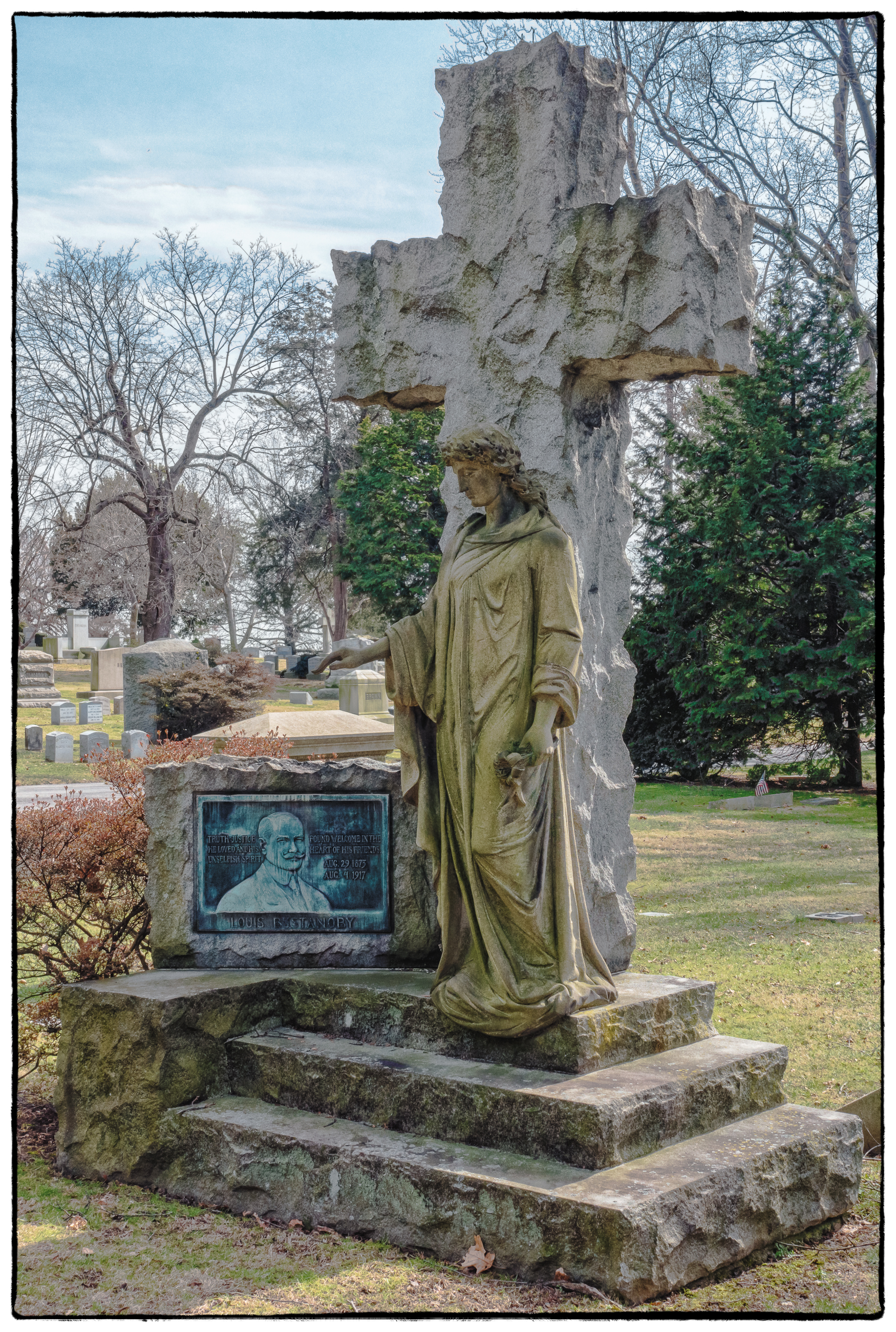
Woodlawn Cemetery – Louis Bustonoby Monument

We were wandering around trying to find Irving Berlin’s grave when I came across this monument. What caught my attention was the combination of a rough hewn cross; a standing figure; and a metal (brass?) plaque bearing Mr. Bustanoby’s likeness and the words: TRUTH JUSTICE HE LOVED AND HIS UNSELFISH SPIRIT FOUND WELCOME IN THE HEART OF HIS FRIENDS. AUG 29 1873 – AUG 4 1917.

This marker, however, represents something which I always find to be very appealing: a minor monument (it doesn’t even make the rather extensive list in the National Register of Historic Places Registration Forms for Woodlawn), which has an interesting story behind it.

A post on The Historians entitled LOST INGREDIENTS: Forbidden Fruit has this to say about him:

Basque-born Louis Bustanoby, who owned the Café des Beaux Arts at 80 West 40th Street in New York before his untimely death, in 1917, at the age of 44 in his apartment above the restaurant. Opened in 1901, Bustanoby’s establishment was considered one of the city’s finest “lobster palaces”. The famed dining duel between Diamond Jim Brady and actress Lillian Russell took place there. But it was in 1911, that the restaurateur came up with the perfect business model: he added a dance floor in the cellar that employed “gigolos” to escort a new clientele through the latest dance steps. The most famous gigolo was the young and then-unknown Rudolph Valentino.

His new clientele? Women. Bustanoby (nicknamed: Bust Anybody) installed the world’s first lady’s bar, a place where respectable women could drink the offerings of bartenders François and Gabriel, who catered to their whims. Sazeracs, New Orleans Fizzes, and vividly-hued concoctions where the most popular after an afternoon of shopping. As Françcois noted: “They wanted pearl-colored drinks, amethyst drinks, opaline drinks, and it keeps the establishment busy trying to think up new color combinations.”

Even before the ladies’ bar was open, Bustanoby offered a Forbidden Fruit Cocktail—reputedly his own invention—so wives could savor a special sip whilst their husbands mused over a cognac or other strong digestif. We’ve only found one recipe for this libation in Boston restaurateur Louis Muckensturm’s 1906 book Louis’ Mixed Drinks:

Forbidden Fruit. Take half a grapefruit. Remove the pulp and turn the skin inside out, so as to form a small bowl. Put in two lumps of sugar and two liqueur-glasses of brandy. Set fire to the brandy, and when burnt pour the liquid in a liqueur-glass and serve while hot. For each extra person add one liqueur-glass of brandy and half a lump of sugar.

The restaurant must have been quite something. On the Town in New York: The Landmark History of Eating, Drinking and Entertainments from the American Revolution to the Food Revolution by Michael and Ariane Batterberry. describes it as follows:

Forty-second Street became the hub of the new theatres and the great “entrance” restaurants. Principal among these were Shanley’s, on that part of Times Square then called Longacre Square, run by the Shanley brothers; Churchill’s known for its impeccable food and popular owner, “Cap Churchill” and ex-policeman; and Bustanoby’s Cafe des Beaux Arts, on Fortieth Street and Sixth. Jacques (Note: opinions seem to vary as to whether it was Louis or Jacques who founded the women’s bar) Bustanoby introduced the first and possibly the last women’s bar, at which only women could order, and for which his license was almost revoked. The lawyer who defended him on the occasion was none other than the young James. J. Walker. Dancing between course proved a more felicitous innovation and, to cut the ice, the host himself executed exhibition numbers with musical comedy stars. Bustanoby also featured “soirees artistiques” at which Lillian Russell, Anna Held, Maxine Elliot, Douglas Fairbanks, David Warfield, Vernon and Irene Castle and Isadora Duncan all performed. Reggie Vanderbilt staged his horse-show parties at the Beaux Arts, clearly the right place for cutting up, and on historic evening he led in a hansome cab horse to be the guest of honor.

I also came across this little tidbit from New York Times, Monday, August 1917:

Woman Hints at Murder. Telephones Coroners Office Louis Bustanoby Was Poisoned.

A woman called the Coroner’s office last night and told Jacob Anekstein the Coroner’s cleark that she knew that Louis Bustanoby, the restauranteur who died on Saturday in his apartment 80 West Fortieth Street, had been killed by slow poisoning.

Anekstein asked her who she was and she replied that she was Mr. Bustanoby’s sister-in-law nd hung up the telephone received. Anekstein traced the call to a public booth in a drug store at 180th Street and Broadway. Coroner Hellenstein was told of the mysterious call, and he asked the Detective Bureau to make an investigation.

Later the Coroner said Mr. Bustanoby had been sick for six years and had been attended by some of the best physicians in New York and that they had reported to him that Mr. Bustanoby had died of natural causes. He intimated that no attention wold be paid to the woman’s request for an autopsy.

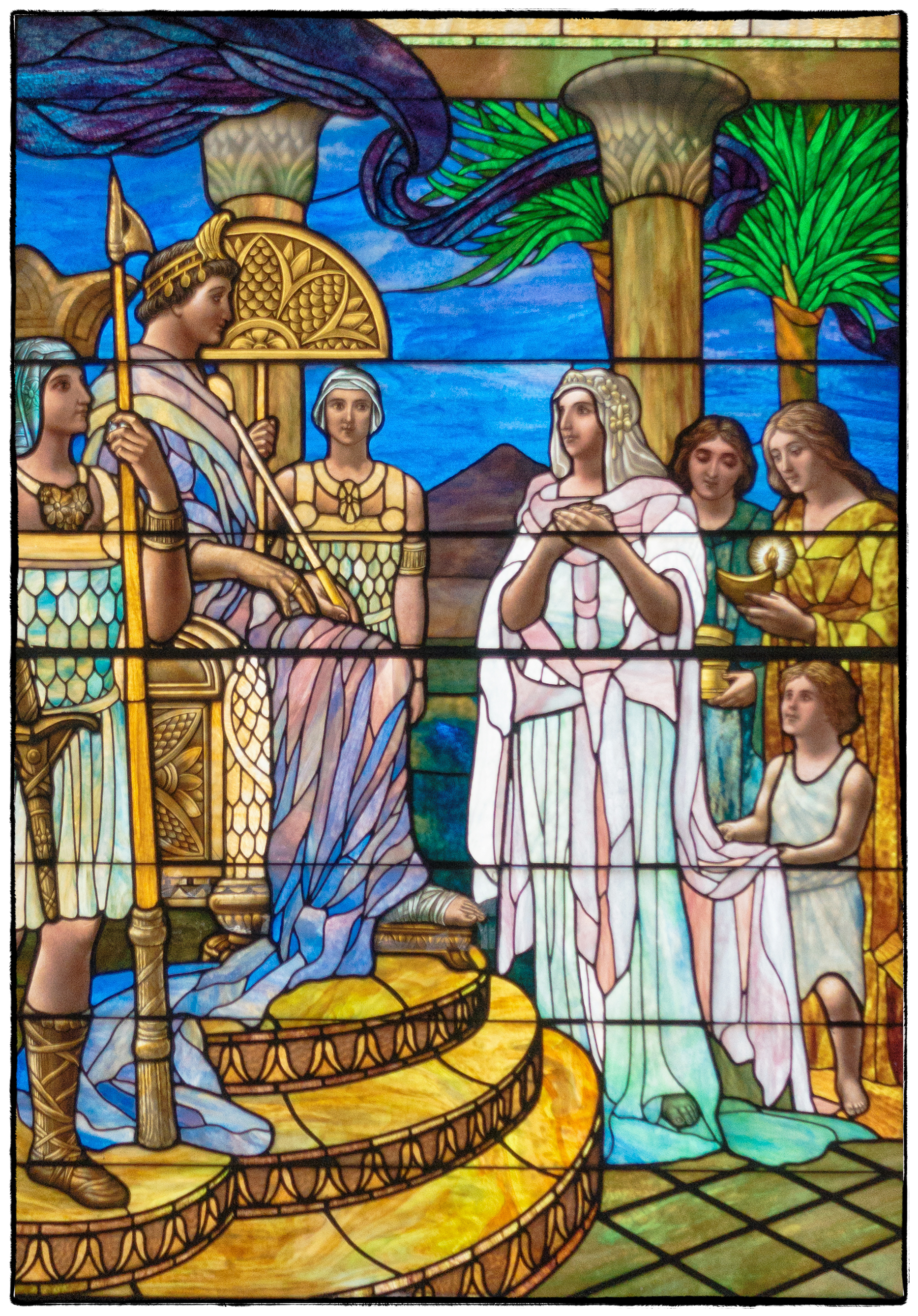
Woodlawn Cemetery – Stained Glass

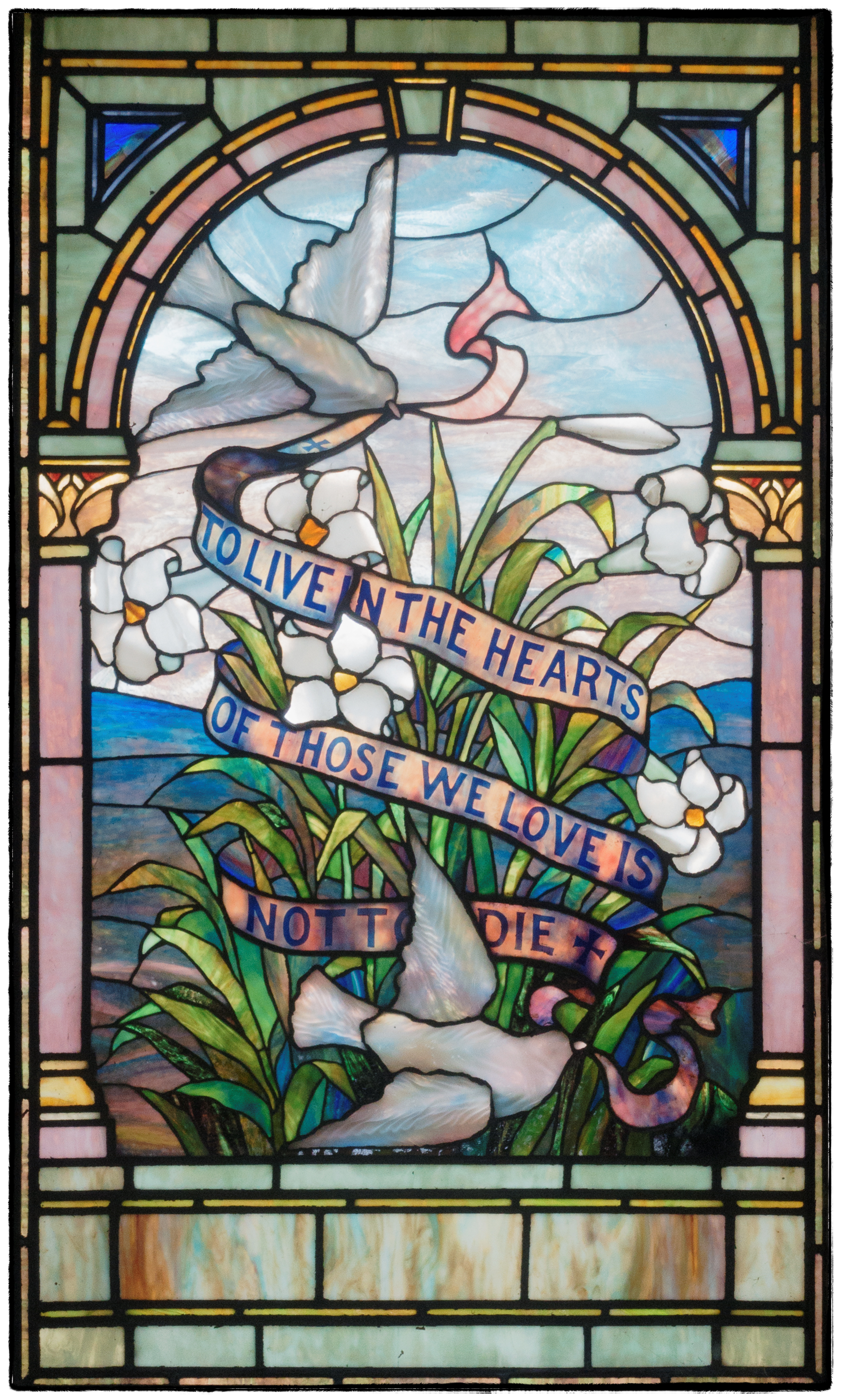
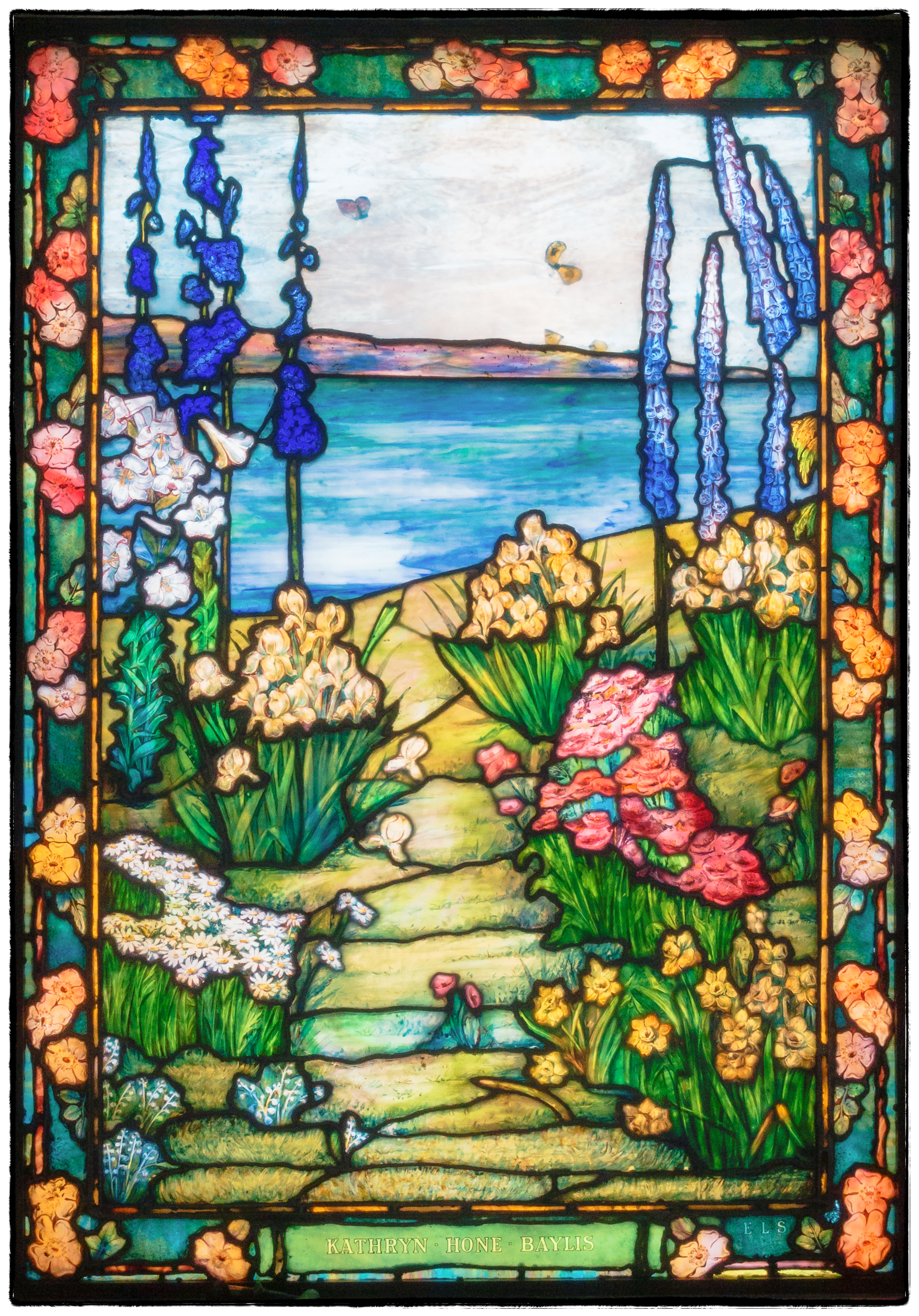
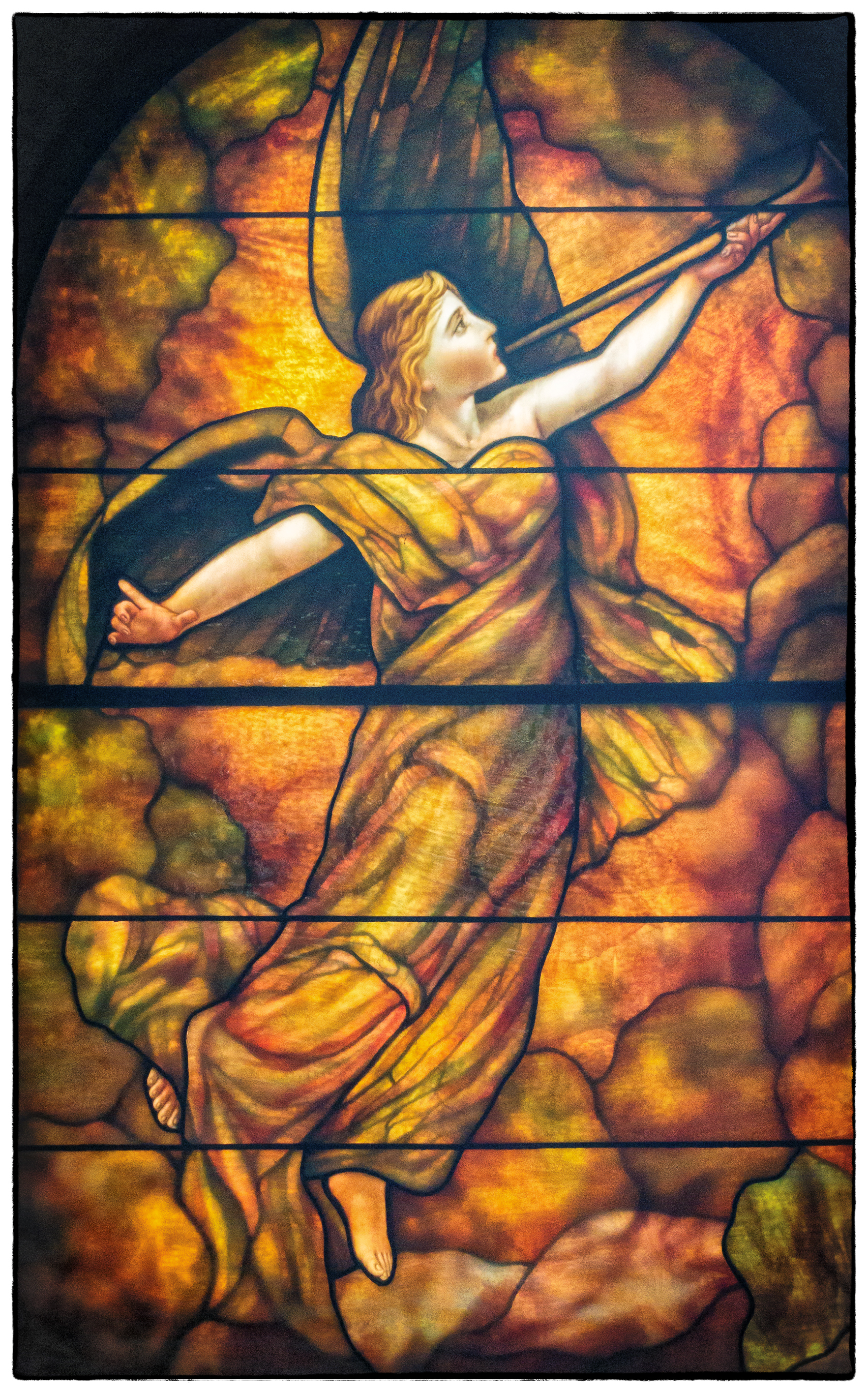
Many of the mausoleums at Woodlawn have stained glass, but regrettably much of it is only visible from the inside (e.g. when mausoleums are opened up for tours). Here are a few that could be seen through mausoleum doors. Unfortunately (with the exception of the one above, which I know is from the F.W. Woolworth Mausoleum) I can’t recall to which monuments these windows belonged (and of course I forgot to write this information down).

Woodlawn Cemetery – F. W. Woolworth Mausoleum

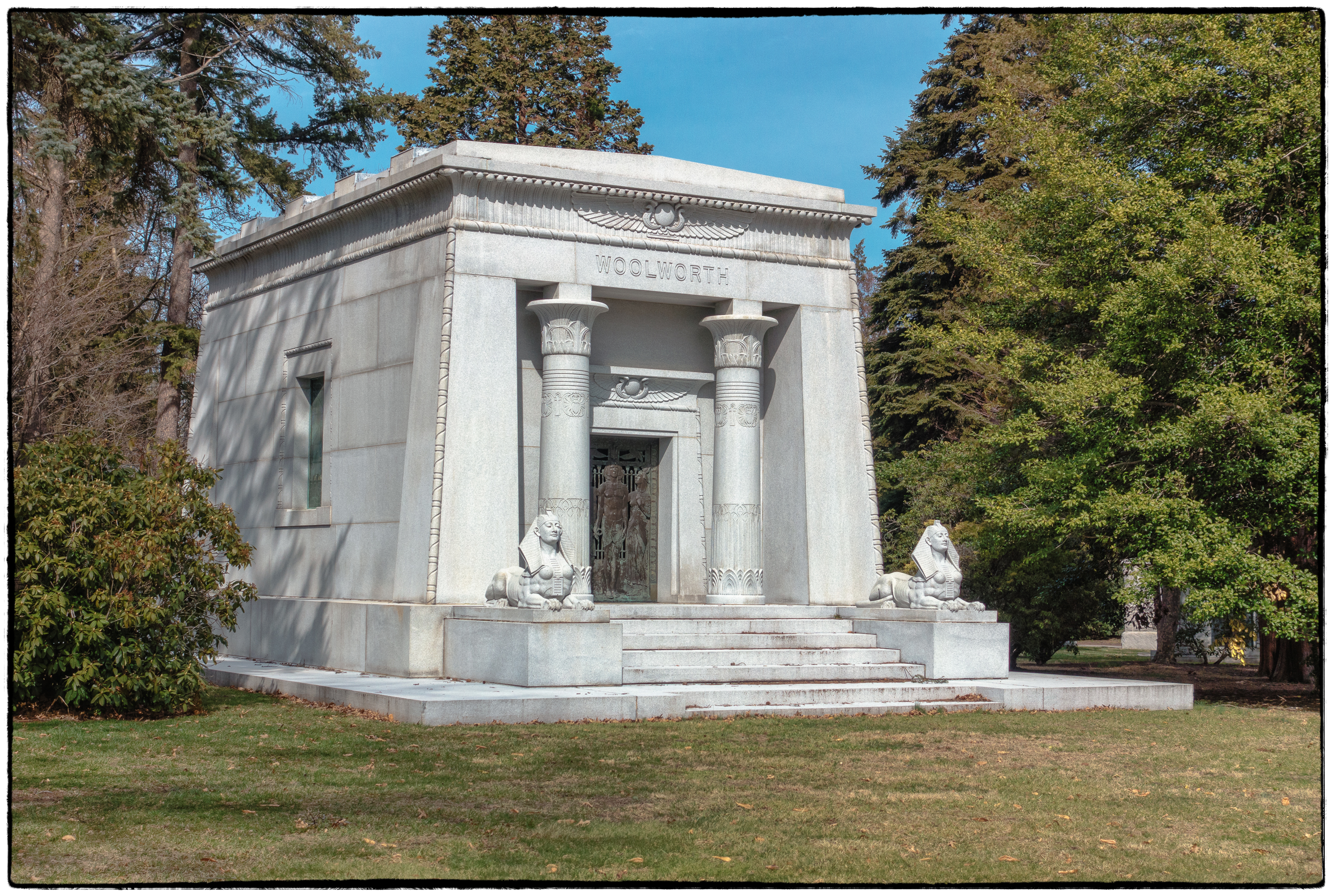
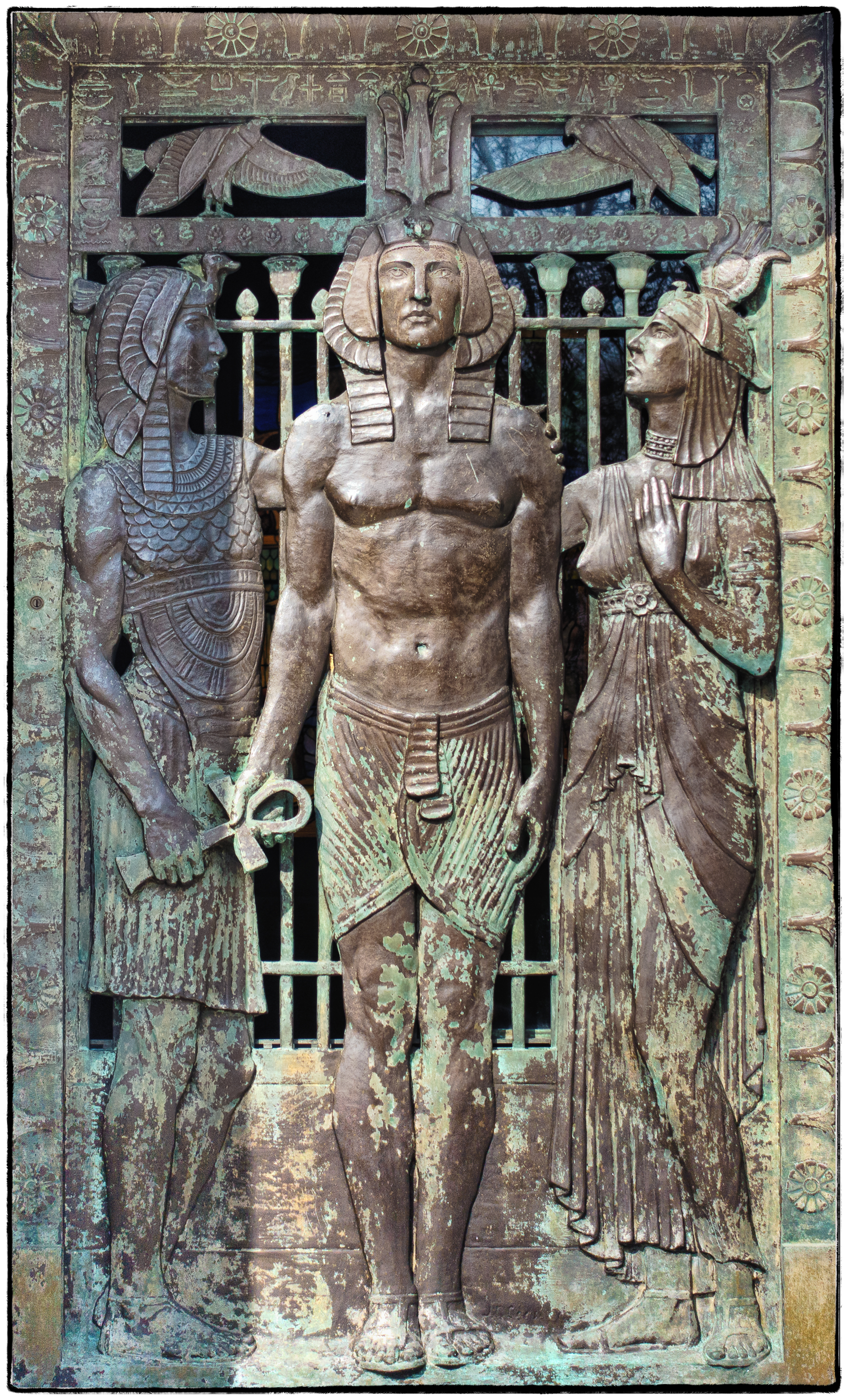
I was particularly impressed by this structure, particularly the ornate doorway. I think it’s now become my all time favorite mausoleum.

Wikipedia describes Frank W. Woolworth as follows:

Frank Winfield Woolworth (April 13, 1852 – April 8, 1919) also known as Frank W. Woolworth or F.W. Woolworth was an American entrepreneur and the founder of F. W. Woolworth Company and the operator of variety stores known as “Five-and-Dimes” (5- and 10-cent stores) or dimestores, which featured a low-priced selection of merchandise. He pioneered the now-common practices of buying merchandise directly from manufacturers and fixing the selling prices on items, rather than haggling. He was also the first to use self-service display cases, so customers could examine what they wanted to buy without the help of a sales clerk.

According to the National Register of Historic Places Registration Form for Woodlawn Cemetery:

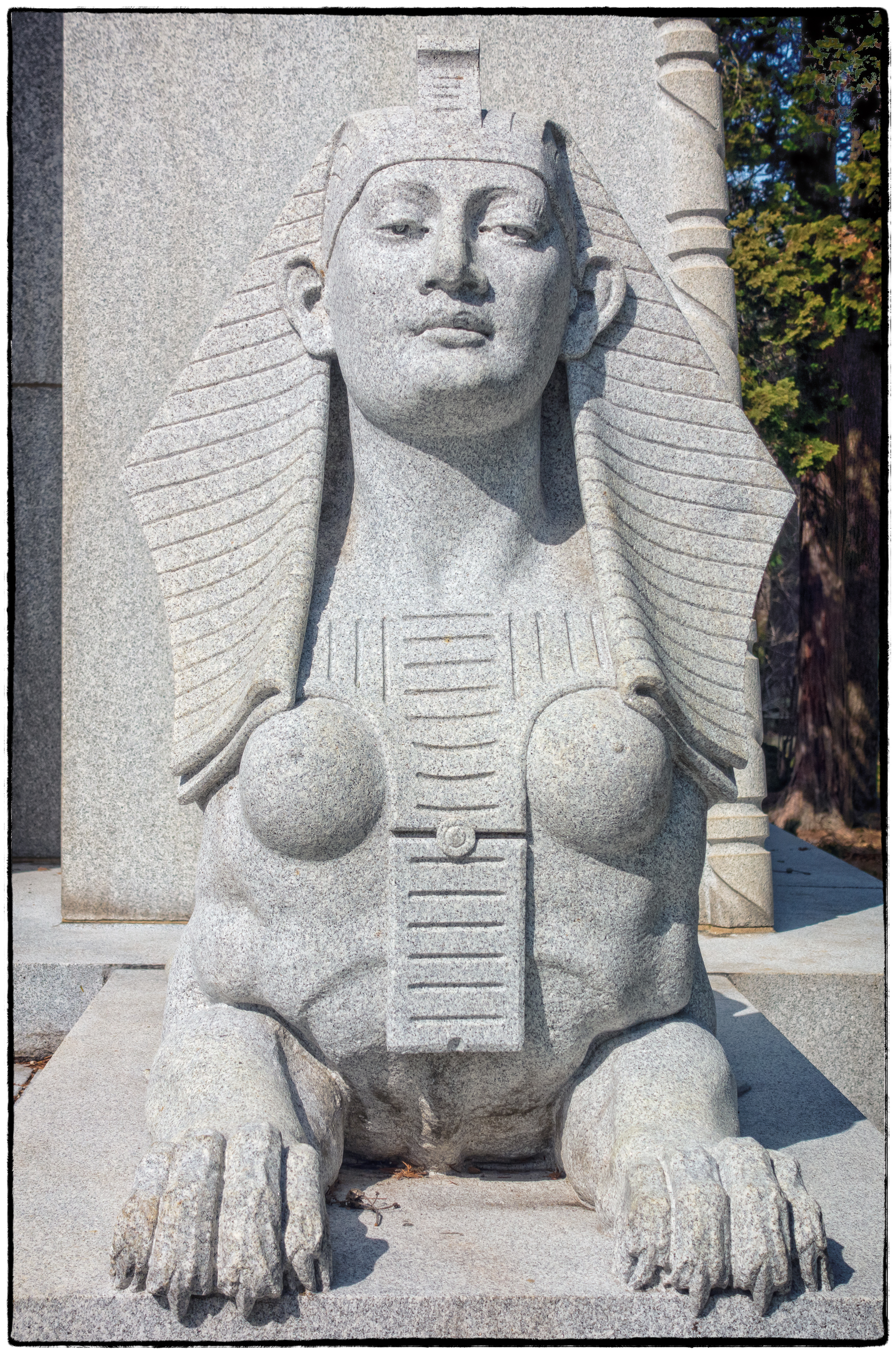
Frank W. Woolworth mausoleum … includes a bronze door designed by sculptor Julius C. Loester (1921), which was cast by the Roman Bronze Company. The Barre granite mausoleum was built by Farrington, Gould and Hoagland. The mausoleum is constructed in the exotic (Egyptian) Revival style with two sphinx sculptures flanking the entrance steps. Two columns with horizontal banding and palm capitals frame the recessed entrance. Both the entablature and the lintel above the entrance feature relief carvings of a winged solar disc, an icon that Egyptians believe offered protection to the dead. The mausoleum has a concave cornice and roll molding at its corners and where the façade meets the entablature. The interior was renovated by the family in 1941, with Italian marble and large double marble sarcophagus by Evans of Boston. The landscape design by Brinley and Holbrook, who executed plans for the New York Botanic Garden in 1920, “employed a formal scheme to accentuate the solidity and scale of the building, while successfully screening a vista spotted with many imposing mausolea.” Woolworth (1852-1919) was a businessman, merchant, and founder of F.W. Woolworth Company. Also entombed in the mausoleum is Barbara Hutton (1912-1979) known as the “Poor Little Rich Girl,” granddaughter of Woolworth and heir to his multimillion dollar estate.

Wikipedia describes Barbara Hutton as follows:

Barbara Woolworth Hutton (November 14, 1912 – May 11, 1979) was an American debutante/socialite, heiress and philanthropist. She was dubbed the “Poor Little Rich Girl,” first when she was given a lavish and expensive debutante ball in 1930, amid the Great Depression, and later due to a notoriously troubled private life.

Heiress to the retail tycoon Frank Winfield Woolworth, Hutton was one of the wealthiest women in the world. She endured a childhood marked by the early loss of her mother at age five and the neglect of her father, setting the stage for a life of difficulty forming relationships. Married and divorced seven times, she acquired grand foreign titles but was maliciously treated and often exploited by several of her husbands. While publicly she was much envied for her possessions, her beauty and her apparent life of leisure, privately she remained deeply insecure, often taking refuge in drink, drugs, and playboys.

Hutton had one child, Lance Reventlow, with her second husband, but was an indifferent and insecure parent and the subsequent divorce ended in a bitter custody battle. She later developed anorexia nervosa and perhaps therefore prevented further childbirth. Her son died in a plane crash in 1972 at the age of 36, leaving her devastated. She lived another seven years, dying of a heart attack at age 66. At her death, the formerly wealthy Hutton was on the verge of bankruptcy as a result of exploitation, as well as her compulsive generosity and spendthrift ways.

Her obituary in the Washington Post can be found in Heiress Barbara Hutton Dies at 66

Greek Style Sphinx. Apparently the Egyptian ones are always male.

Spectacular bronze doorway.

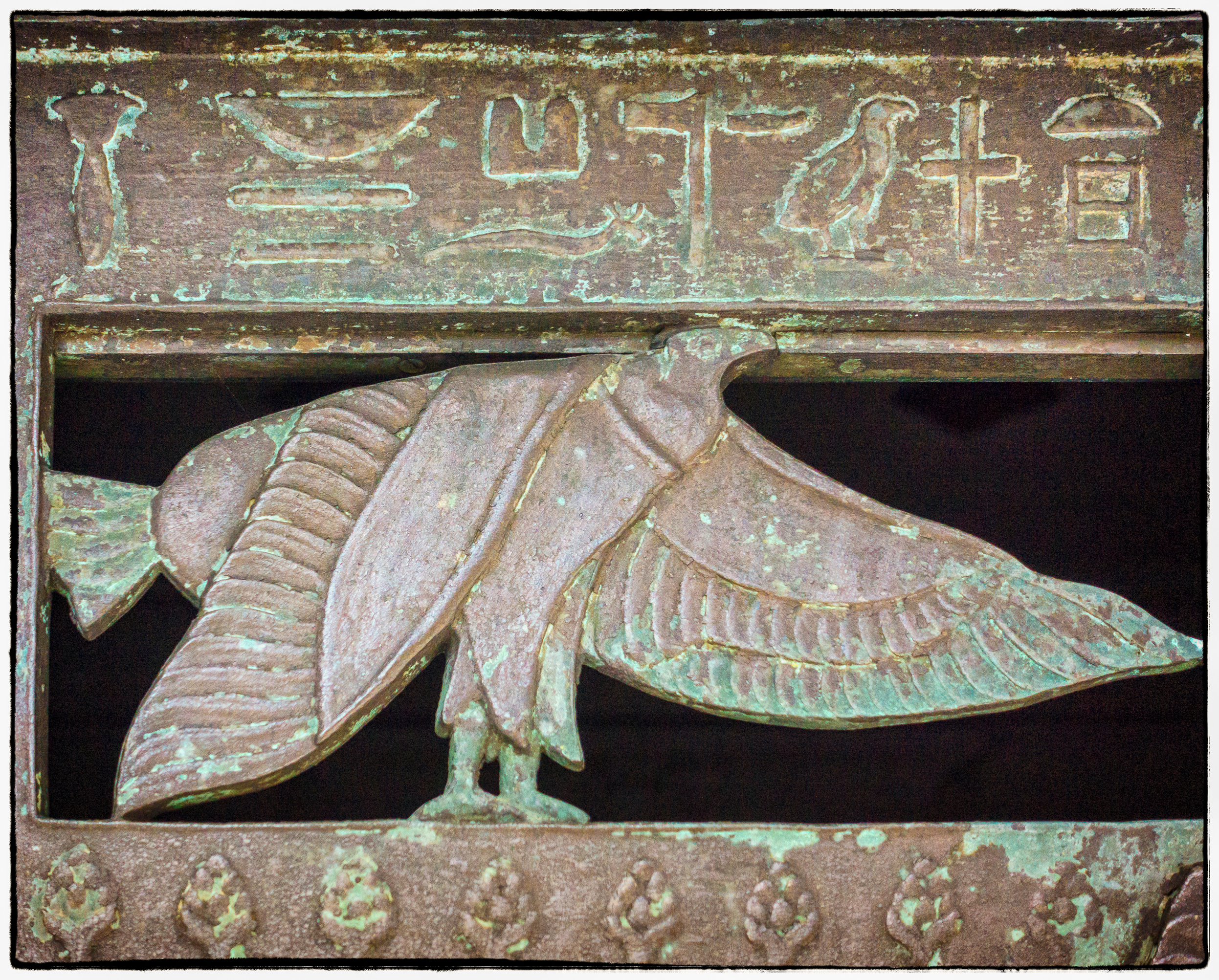
Detail of doorway. Horus?

Woodlawn Cemetery – Manger Mausoleum

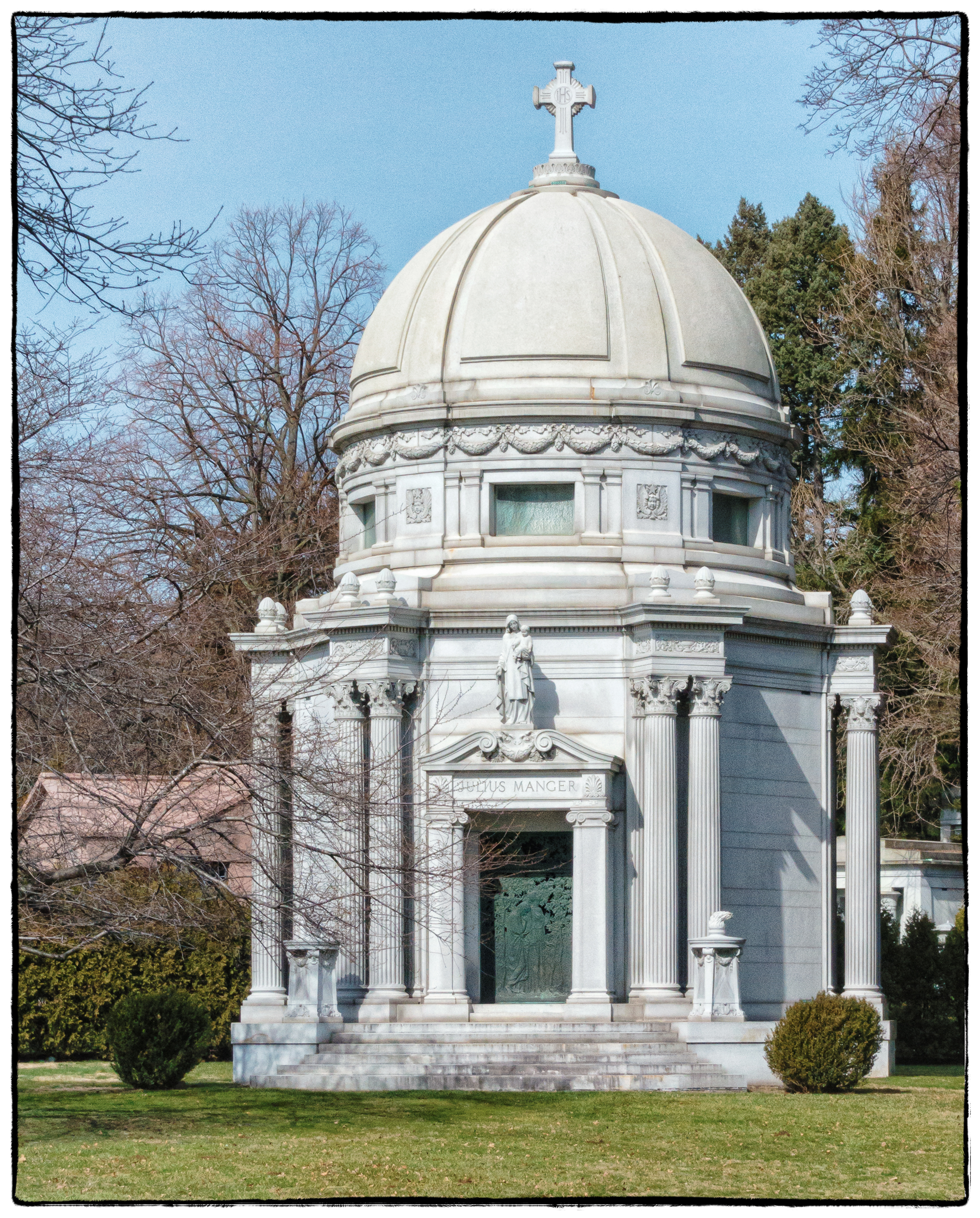
The Mausoleum of Julius Manger (1868–March 28th, 1937).

Douglas Keister on Mausoleums.com:

Julius Manger was born in Boonville, Missouri. He and his brother William became involved with building construction in Galveston and later located the hub of their activities in New York City. Their entry into the New York real estate market was the construction of more than 500 homes in the Bay Ridge section of Brooklyn. Expanding their business to larger-scale buildings, they erected the Builders Exchange Building on West 33rd Street in Manhattan. In 1907, the Mangers traded the Builders Exchange for the Plaza Hotel in Chicago, which was the beginning of their extremely successful chain of hotels. When William died in 1928, the Manger hotel properties were valued at $22,000,000, a tidy sum for the time.

Julius Manger continued buying hotels, and at the time of his death, the list included the Plaza in Chicago; the Manger Hotel in Boston; the Endicott, Martha Washington, Grand, Windsor, and Imperial Hotels in New York City; and the Annapolis Hotel, Hamilton Hotel, and Hay-Adams House in Washington, D.C.

Architect/designer Franklin Naylor built the mausoleum in 1927 for Dominico Dumbra, but it was purchased by Julius Manger in 1935. The Manger Mausoleum was one of the last hurrahs of the Golden Age of the Mausoleum, which ran from around the end of the Civil War to the Great Depression. Fittingly, it is one of the most elegantly crafted mausoleums in the United States.

Naylor was so proud of his creation that he published a pamphlet detailing its construction. The Manger Mausoleum was Naylor’s largest and most complex design in his 35 years as a memorial architect, and he called the finished mausoleum “one of the largest private mausoleums in the world and the largest in America.” His design goes under the broad heading of Beaux-Arts architecture with a nod to Renaissance Revival forms.

The design of the base of the mausoleum is a double equilateral triangle, the intersection of the two triangles forming a hexagon. These two triangles form the Star of David, also known as the Seal of Solomon, and contained within its boundaries are representations of the four elements: fire, air, water, and earth. The hexagonal base is ringed with six sets of paired Corinthian columns.

The National Register of Historic Places Registration Form for Woodlawn Cemetery provides this additional information:

The Julius Manger Mausoleum designed by Franklin L. Naylor (1927), is an opulent Classical Revival style with six sets of fluted Corinthian columns supporting the hexagonal structure, which is surmounted by a domed roof decorated with festoons and a prominent Celtic cross at its peak. The entrance is flanked by double Ionic columns on each side of the bronze door. Above the entrance, a swan’s neck pediment frames a finial consisting of a sculpture of a Madonna and Child. Inside, the mausoleum contains a stained-glass window by Tiffany Studios (1927) depicting Jesus draped in pink cloth, his hands outstretched, standing in a field with tumulus skies in rich hues of cobalt and gold.