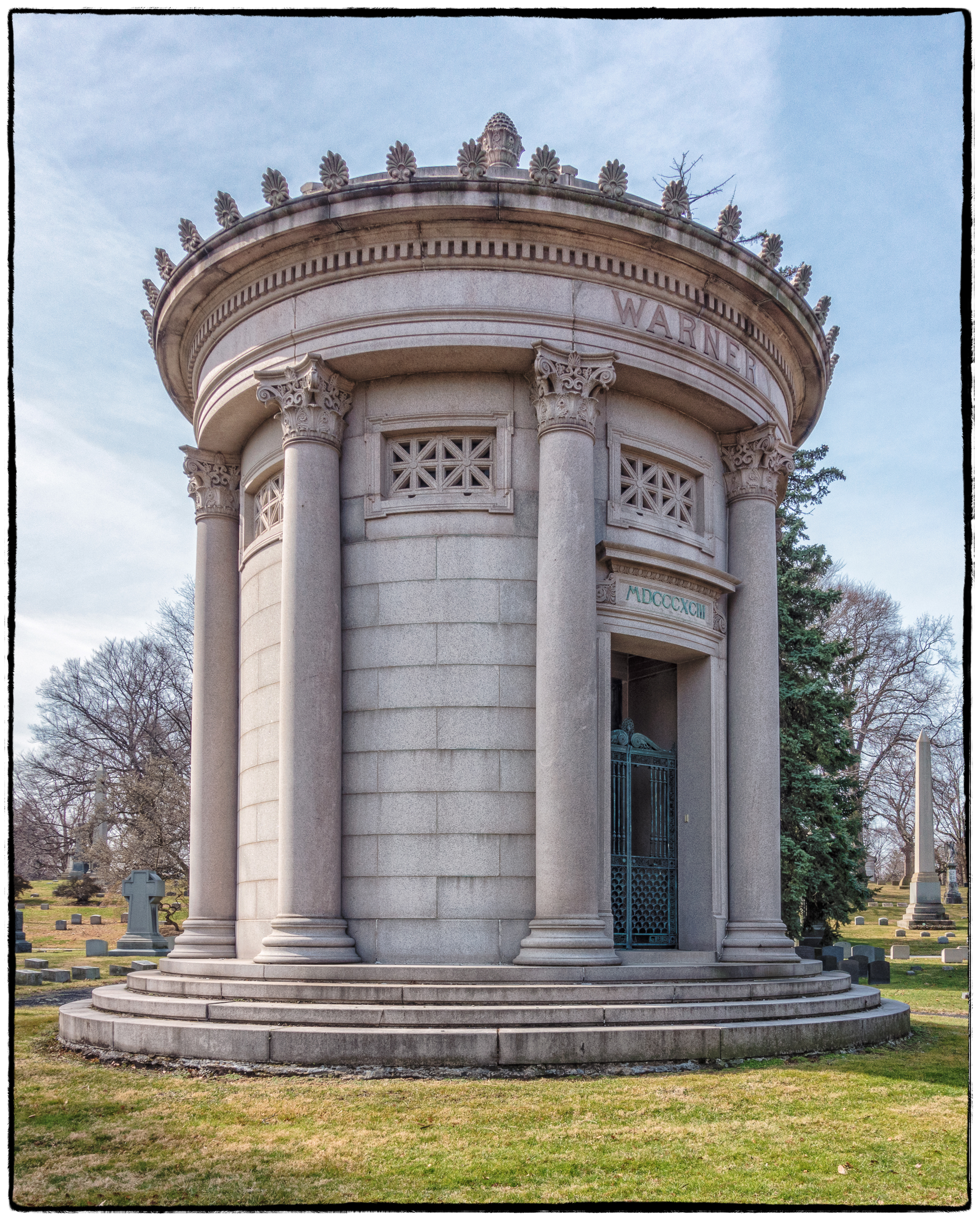
Woodlawn Cemetery – Warner Mausoleum

According to Keister:

It’s unclear how much actual doctoring Dr. Lucien C. Warner engaged in. What is clear is that along with his brother, I. DeVer Warner, he bolstered the lot of women at the turn of the century. Well, sort of. During Victorian times, fashionable women were literally tied into restrictive corsets. Besides the bodily harm that resulted from these unnatural strictures, the corsets were said to make women excited in socially unacceptable ways. Enter the Warner brothers. In the ate nineteenth century, the brothers introduced Dr. Warner’s Sanitary Corset (later changed to Dr. Warner’s Health Corset). They opened up a small shop in New Haven, Connecticut, and employed women to hawk their product door-to-door (Lucien Warner had already used the door-to-door method to sell medical books). The brothers soon found that the way to make significant money was to sell their corsets to retailers in bulk. Sales soared. What helped sell the brothers’ corsets was that they replaced the rigid materials such as whalebone used in other company’s corsets with more flexible and even elastic fibers. Women were overjoyed. The company continued to prosper and still exists today. In addition to the Warner’s brand, the company, no known as Warnaco, also owns the brands Calvin Klein, Speedo, Chaps, and Olga. Lucien Warner also owned the Warner Chemical Co. Reposing in the mausoleum alongside Lucien Warner is his wife, Keren Osborne Warner, who died in 1933.

The Warner Mausoleum was designed by architect R.H. Robertson in 1888, with additional work done by William Angus, Inc., in 1915. This substantial circular mausoleum is ringed with engaged repeating Corinthian columns. Multiple decorative acroterium circle the top of the termination of its sloped roofline, and a prominent pinecone finial tops the elegant ensemble. The bronze entry door, fabricated by Gorham Bronze in 1915 was designed by architect Cass Gilbert. The mausoleum originally contained a mosaic designed by Tiffany Studios, but it was removed in 1915. The Warner Mausoleum was featured in an 1899 issue of The Inland Architect and News Record.
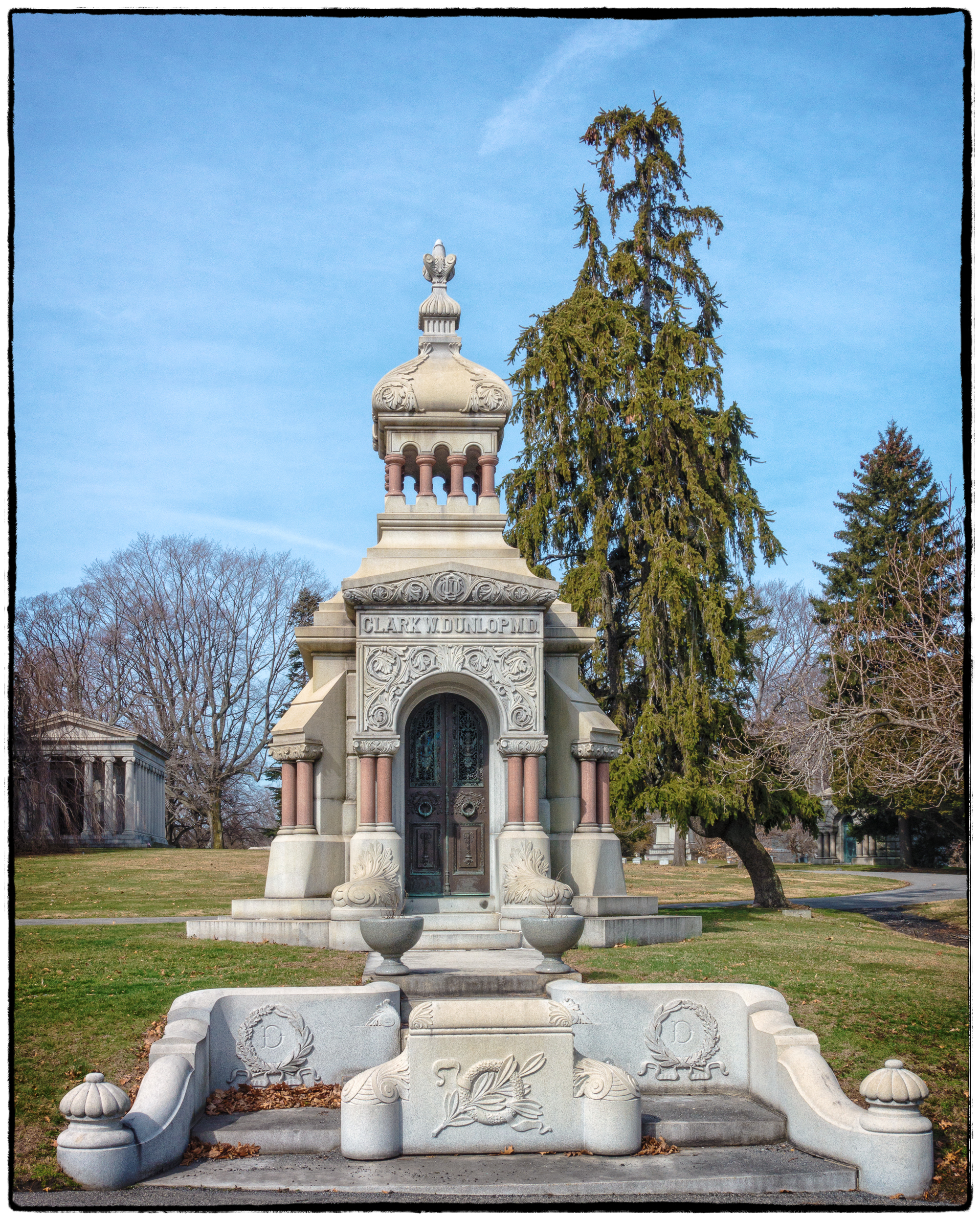
Woodlawn Cemetery – Dr. Dunlop, his parrot and magic boots

Dr. Clark Dunlop was financially successful, but died in sad circumstances. He made his fortune from a medical manual (Dr. Dunlops Family Practice), and a number of patent medicines including Dr. Dunlops King of Pain, and Dr. Dunlop’s Cascara Compound (a laxative). He made enough money to be able to build this exotic mausoleum. According to Douglas Keister on Mausoleums.com:

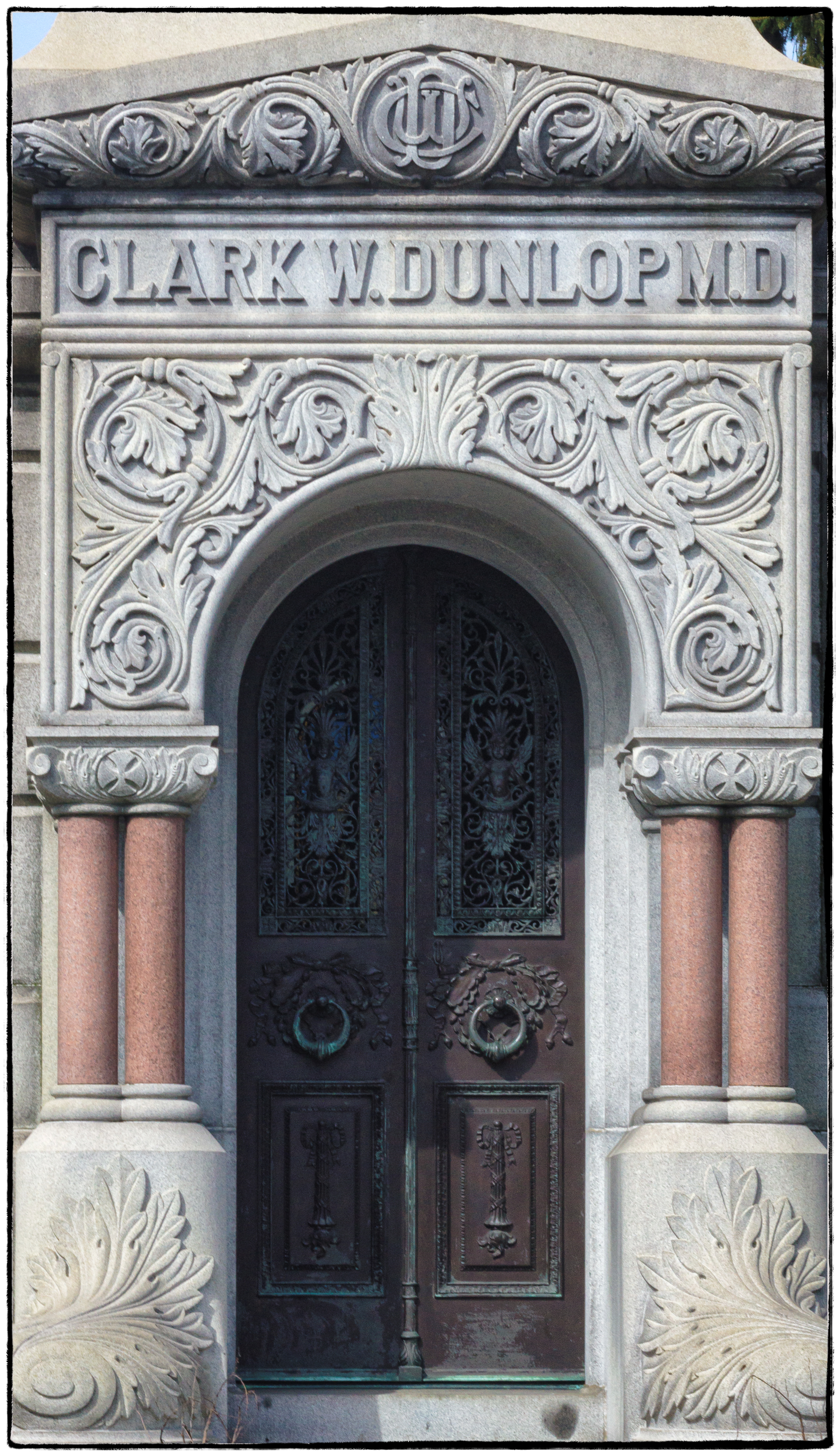
The mausoleum, which is more of a confection than a piece of architecture, was built by prominent mausoleum builders C. E. Tayntor & Company. The company quarried granite in Maine and Vermont and had offices in New York. It is difficult to put the Dunlop mausoleum into any specific architectural category. It has elements of Islamic and Byzantine and Classical Revival architecture. Then there is the curious feathery plinth flanking the steps.

The stylized feathers are most likely an homage to the Dunlops’ pet parrot (name unknown). The skeleton of the parrot reposes on a fabric bed in a glass-topped mini-casket inside a steel box that rests atop a marble shelf inside the mausoleum. Most cemeteries have rather strict regulations that prohibit pet burials, but somehow the parrot slipped under the radar. According to a tag attached to the parrot’s eternal home it expired in March, 1921 after being in the family for 30 years. It is unknown if the parrot died peacefully. Dr. Clark W. Dunlop certainly did not.

When he was declared mentally incompetent in 1907 this caused considerable strife among more distant family members (he and his wife had no children) who wanted a piece of his fortune. At the time he was being treated (unsuccessfully as it turned out) using “Magic Boots”. Again from Keister:

The late nineteenth and early twentieth century was a time of patent medicines, remedies and tortuous-looking medical contraptions. Enter shoemaker and now self-proclaimed “Professor” Matthew Hilgert who invented “magic boots”. Holgert claimed that his footwear restored balance in the body by starting from the bottom up (the feet) using special lasts to curve the arch of the foot. He also claimed he added secret chemicals to the boots that were absorbed into the body. His “magic mechanico-physiological” boots were advertised to cure all physical ailments. Hilgert claimed to have numerous satisfied customers including celebrity endorsers from baseball team owners to businessmen to Bishops. At the height of their popularity the boots reportedly sold for $1000 to $5000. Understandably most purchasers of the boots were the well-to-do. Hilgert claimed that his magic boots could cure “locomotor ataxia, paralysis, hip joint disease, sciatica, rheumatism, gout, neuritis, neuralgia, ticdoloureux, not to mention nervous prostration”.

He returned home and died not long after in 1908. His wife lived to a ripe old age (into her 90s) and the parrot apparently continued on until its death in 1921.

For some fascinating pictures of he interior of the tomb, including two of the skeletal remains of the parrot see: Society Adventures: The Entombed Parrot of Woodlawn Cemetery.

In the background you can just make out the impressive mausoleum of famous “robber baron“, Jay Gould. This too has an intriguing story associated with it. According to Keister on Mausoleums.com

Interestingly, Jay Gould’s crypt is soldered closed. Apparently the Gould family didn’t want a repeat of an incident that occurred in 1876 where the body of another millionaire, A.J. Stewart, was stolen from St. Mark’s Cemetery in Manhattan, and his remains were held for ransom. An undisclosed amount of money was paid by Mrs. Stewart for the return of what was presumed to be her husband, (embalming wasn’t an exact science in the 1870’s). Accounts of the day suggest that some of Gould’s enemies on Wall Street had the casket sealed so there was no way he could ever show up to wreak havoc again. The London Times obit summed up Gould’s life best when it declared, “All honor to the greatest money maker of any age or clime. He was less a man than a machine for churning wealth. Napoleon’s combinations were never vaster…. It will be impossible to explain one phase of civilization without a frequent mention of his name”.

Detail of facade.

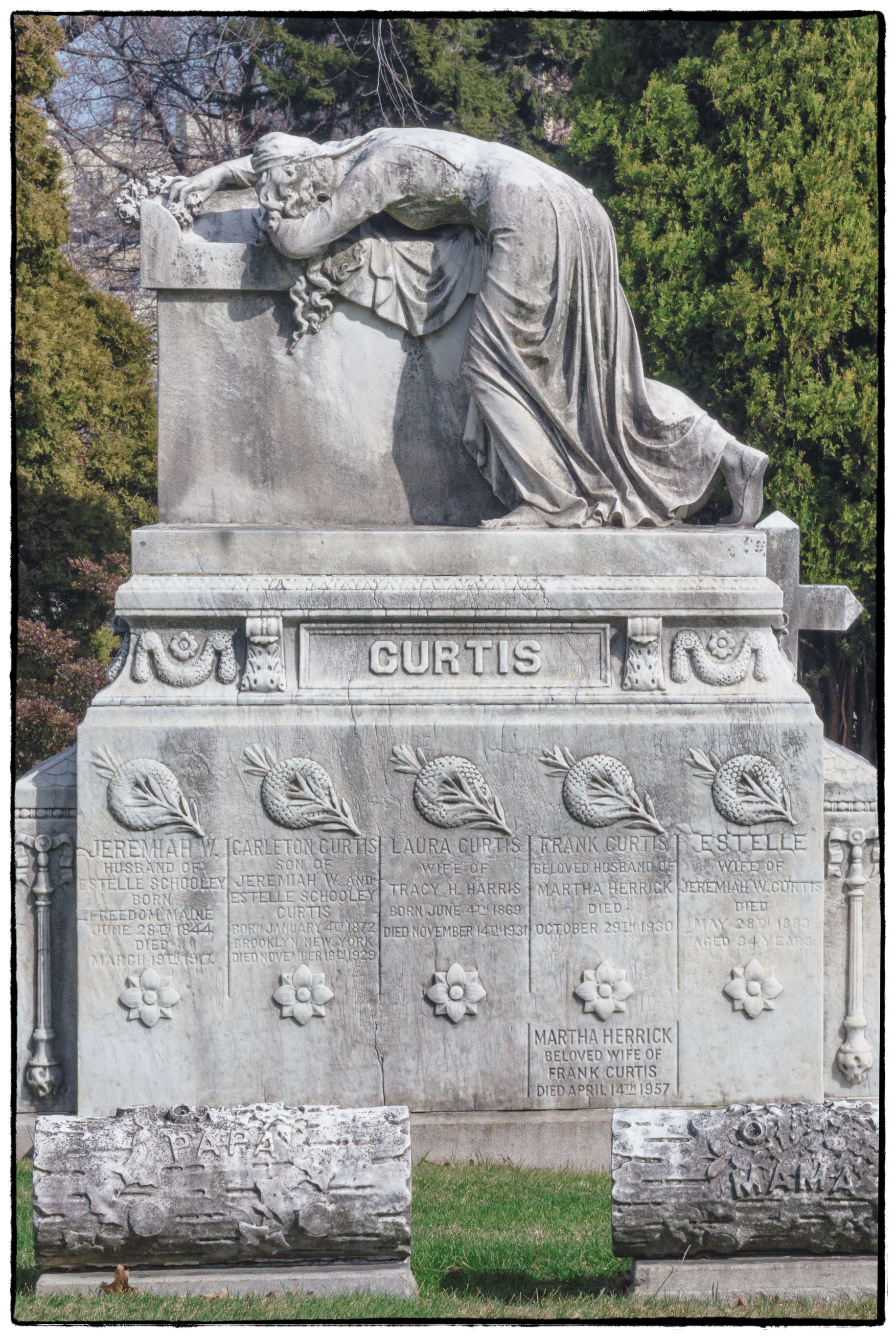
Woodlawn Cemetery – Curtis monument

I was attracted to the statue on this memorial, but had a hard time finding information on the family to whom it belonged. The name “Jeremiah W. Curtis” seemed prominent and finally in “Reports of Cases Argued and Determined in the Court of Common Pleas for the City and County of New York”. By Charles P. Daly, LL. D., First Just. of the Court, Vol II., New York, Baker, Voorhis and Co., Law Publishers, 6 Nassau Street, 1870 I found this extract:

By the Court – Van Vorst, J. Previous to the year 1844, Mrs. Charlotte N. Winslow prepared a composition for children teething, which she used with success. In 1844, she gave the recipe to her son-in-law, Jeremiah curtis, one of the plaintiffs in this action, who commenced its manufacture and sale, under the name “Mrs Winslow’s Soothing Syrup,” and with the approval of Mrs. Winslow, made that his trademark. Afterward Jeremiah Curtis associated with himself in business Benjamin A. Perkins. Curtis and Perkins, from and after the year 1845, prepared, manufactured and sold the preparation under the same name and trade mark. Before the year 1852, they used a wrapper and label generally resembling that now in use. In 1852, they invented a wrapper, which has been continued from that time to the present.

In the year 1855, Perkins retired from the co-partnership, and George Newman Curtis and Jeremiah W. Curtis, with the plaintiff Jeremiah Curtis, became the proprietors of said article, title, and name, and are the present proprietors of the recipe for the medicine, and the trad-mark.

So it seems that the Curtis family was connected to Mrs Winslow’s Soothing Syrup, whatever that was. Going further I discovered that it was quite controversial. According to an article (Mrs. Winslow’s Soothing Syrup – oooh so soothing) on Peachtree Glass (apparently the bottles it was sold in are collectible):

The formula consisted of Morphine Sulphate (an opiate analgesic related to heroin), sodium carbonate (water softener), spirits foeniculi (an alcohol that seems to be only associated with this product), and aqua ammonia (a cleaning agent). I can not even begin to imagine what this may have tasted like. Probably wouldn’t matter.

In 1911, the American Medical Association put out a publication called “Nostrums And Quackery” (pictured above) where, in a section called “Baby Killers”, it incriminated Mrs. Winslow’s Soothing Syrup. It was not withdrawn from sale in the UK until 1930.

In 1879 the English composer Edward Elgar (pictured above) wrote an early musical work, part of his Harmony Music for a wind quintet, which he titled Mrs Winslow’s soothing syrup.

In a find a grave record for George N. Curtis, Jeremiah W. Curtis is mentioned as his brother. If this is correct then Laura Curtis Bullard would have been a sister to both Jeremiah W. Curtis and George Newman Curtis.

According to Wikipedia

Laura Curtis Bullard (1831–1912) was an American writer and women’s rights activist. She founded a newspaper called The Ladies’ Visitor, and Drawing Room Companion and published two novels with women’s rights themes, the best known of which is Christine: or, Woman’s Trials and Triumphs. She was elected as a corresponding secretary for the National Woman Suffrage Association, led by Elizabeth Cady Stanton and Susan B. Anthony, at its founding meeting. She succeeded Stanton as editor of The Revolution, a women’s rights newspaper founded by Stanton and Anthony.

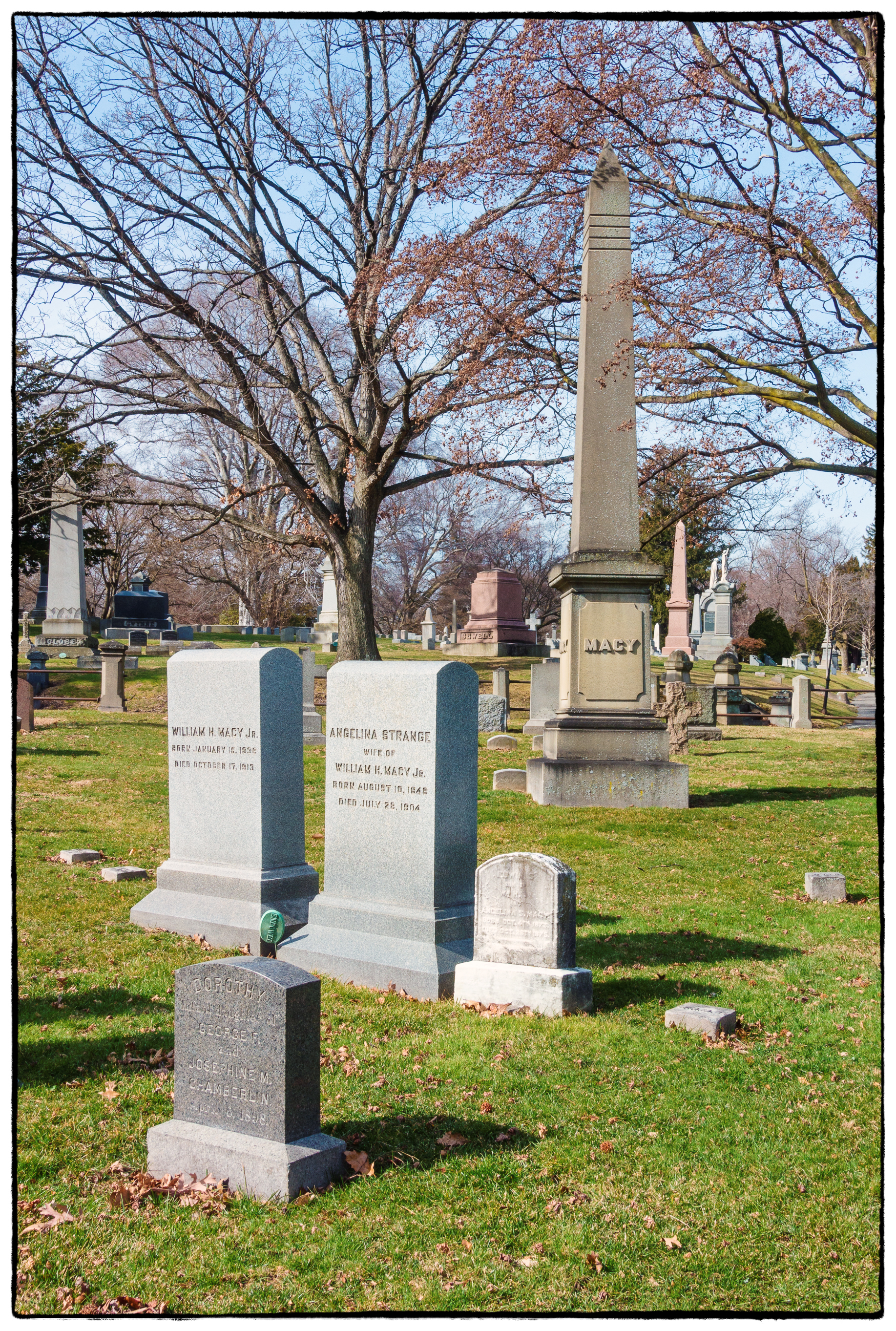
Woodlawn Cemetery – Macy Plot

I really messed this one up. When I saw the name on the obelisk and the name on it I thought: could it be that this is the final resting place of the famous department store magnate? Then I saw the name on the leftmost grave marker: “W.H. Macy”. I know that name I thought. This must be him. It isn’t much of a marker for such a well-known figure, but at least there’s an obelisk too.

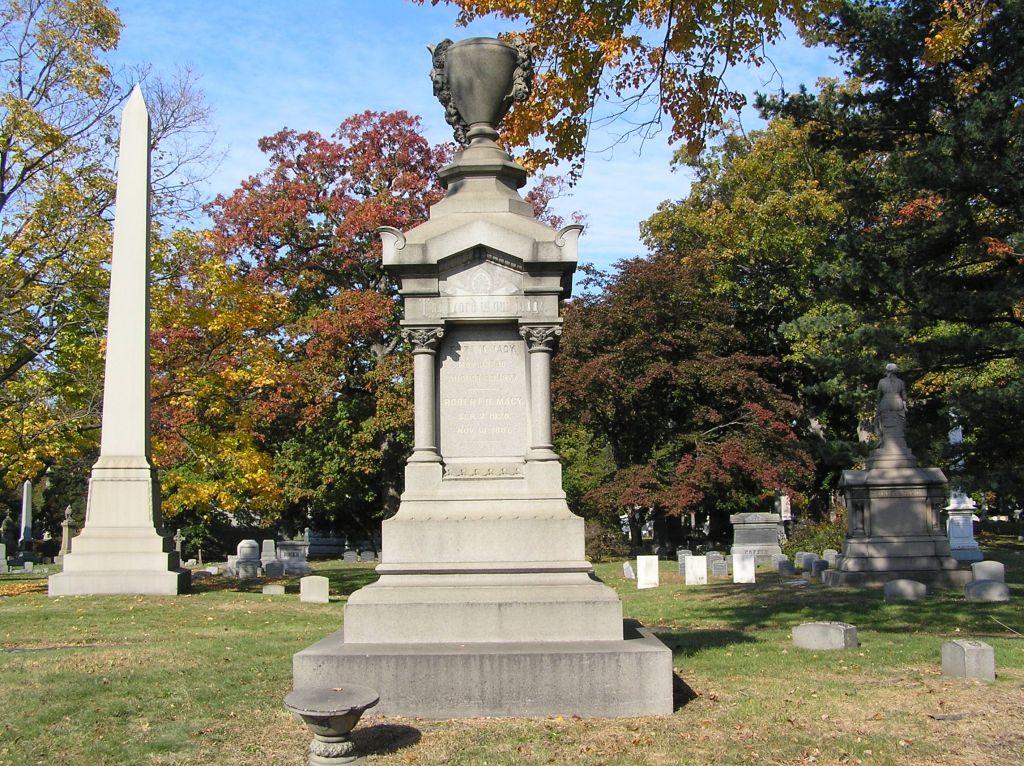
And of course there IS a famous “W.H. Macy”: William H. Macy, the actor. Unfortunately (at least for me, probably not for him) he’s still very much alive and no relation at all to the department store family. The famous department store owner was in fact Rowland Hussey (R.H.) Macy and he’s buried on a different part of the plot and with a rather more impressive monument (see below)

R.H. Macy Monument at Woodlawn Cemetery in The Bronx

R.H. Macy Monument at Woodlawn Cemetery in The Bronx

Source: R.H. Macy Monument at Woodlawn Cemetery in The Bronx by Anthony22 (CC BY-SA 3.0).

There is another famous Macy who is part of the department store family: George Nelson Macy. At the onset of the Civil Are he enlisted in the 20th Massachusetts Volunteer Infantry and was commissioned a 1st Lieutenant in command of Company I (He finished the war as a Major General). He fought in the battles of Ball’s Bluff, where he swam across the Potomac to find boats to rescue survivors. He also fought at Fredericksburg and at Gettysburg where he had a role in stopping Pickett’s Charge. A minié ball shattered his left hand and the arm had to be amputated. After he recovered he was fitted with an artificial arm and returned to action. In the fighting in the Battle of the Wilderness he was shot in both legs, but survived. His horse was shot at the Battle of Deep Bottom (Richmond) and fell on him. When the war was over he returned to Boston to become and officer of the Suffolk Savings Bank. Returning home he carried a small pistol in his vest pocket, suffered a dizzy spell and fell. The pistol went off sending a ball through his heart.

Woodlawn cemetery – Arabella Huntington memorial

I must have walked by the Collis Potter Huntington mausoleum, thinking it was just another neo-classical structure (I’m pretty much of the mind that once you’ve seen one you’ve see them all). I later discovered that it has a pretty impressive bronze door of a standing woman created by Herbert Adams in 1932.

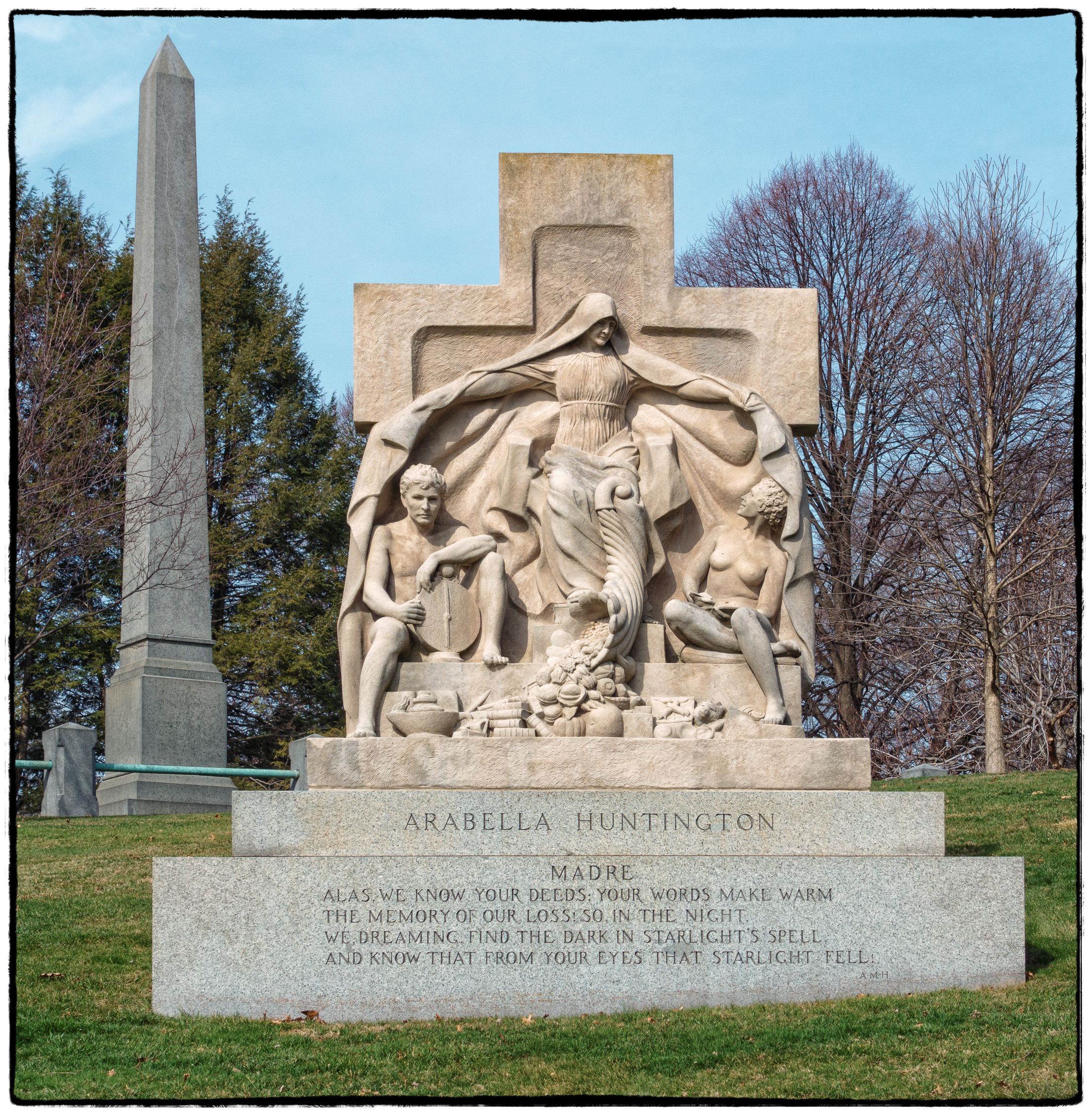
However, I didn’t miss the delightful piece above, a cenotaph (i.e. a monument erected in honour of a person or group of people whose remains are elsewhere) commemorating Arabella Huntington. According to Find a Grave, she’s actually buried in a rather impressive mausoleum in Huntington Library and Botanical Gardens, San Marino, Los Angeles County, California, USA ). According to Wikipedia:

Arabella Yarrington “Belle” Huntington (c.1851–1924) was the second wife of American railway tycoon and industrialist Collis P. Huntington, and then the second wife of Henry E. Huntington. She was once known as the richest woman in America, and as the force behind the art collection that is housed at the Huntington Library.

Arabella Huntington was the second wife of Collis P. Huntington. After his death, she married his nephew Henry E. Huntington, who was also a railway magnate and the founder of the famous Huntington Library, Art Collections and Botanical Gardens, in San Marino, California. She had a son, Archer Milton Huntington.

Compared to her famous family, information about Arabella is scarce. She was apparently born in 1850 or 1851, probably in Richmond, Virginia…However, in the 1921 passenger list for the ship Aquitania, sailing from Cherbourg to New York, Arabella identified herself as being born in Mobile, Alabama on February 9, 1851. Her first husband was a Mr. Worsham, of New York, who died shortly after they were married, leaving her with a young son, named Archer (some other sources have suggested that they were not actually married, but that she was his mistress). (It has also been suggested that Archer’s father was actually Collis Huntington, who legally adopted the boy when he was a teenager.). In 1877 she was able to purchase some property in New York, which was later sold to John D. Rockefeller. She married Collis Huntington in 1884, in San Francisco, California, and was left a widow a second time when he died in 1900. Following Collis’ death in 1900, Arabella continued to spend lavishly—on homes, furnishings, jewelry, and art. She also gave generously to the Hampton Institute, Tuskegee Institute, Harvard University.

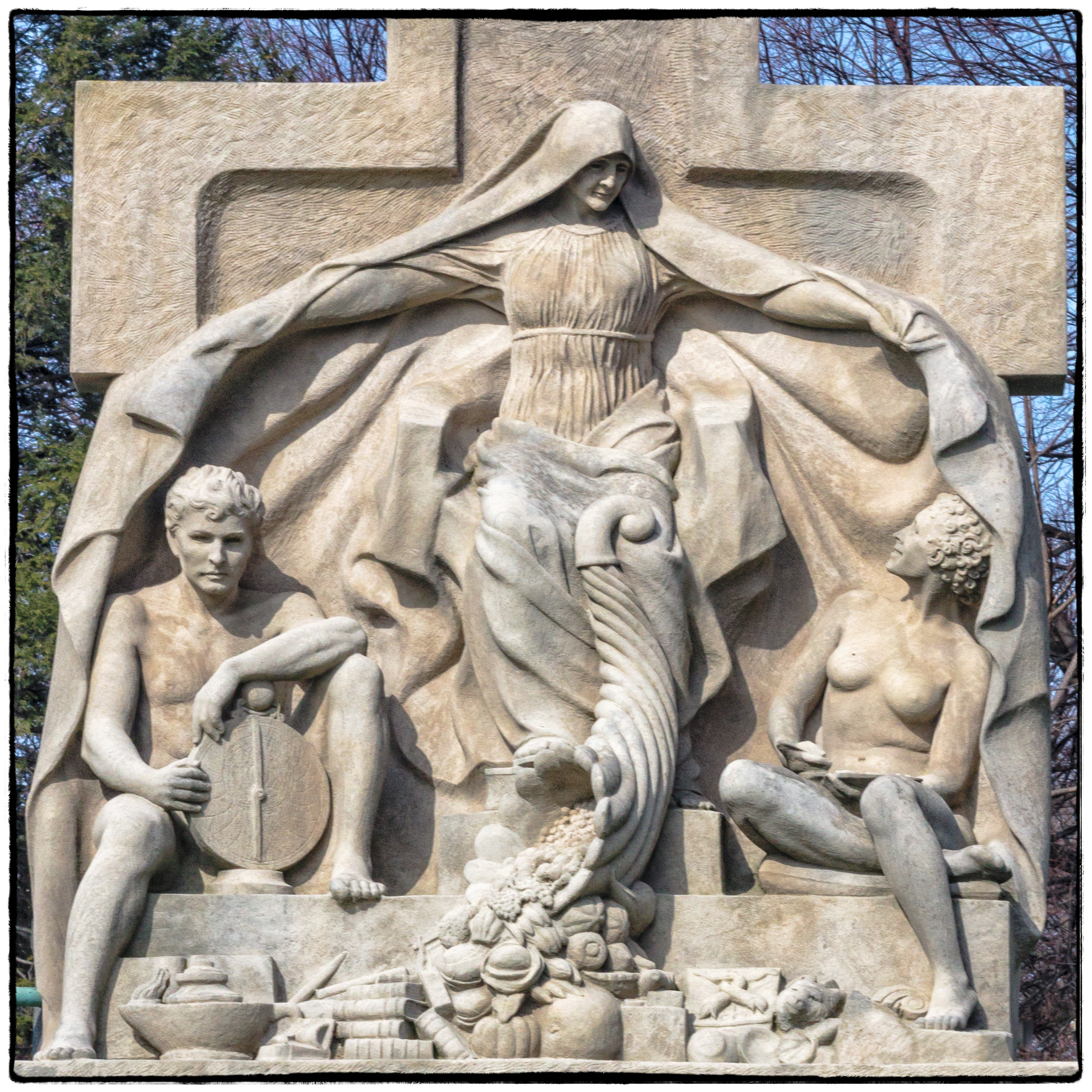
The inscription reads “Madre. Alas, we know your deeds, your words make warm the memory of our loss so, in the night we dreaming find the dark in starlight’s spell and know that from your eyes the starlight fell”.

According to the Woodlawn Conservancy website the cenotaph is:

…a work of art depicting an older woman transferring the fruits of a bountiful life to the couple protected by her outstretched arms. The monument is filled with the symbols found in a cemetery; a lamp with an eternal flame, volumes of books illustrating diving knowledge, and a dial showing the passing of time.

The sculpture is by Anna Hyatt Huntington (Arabella’s daughter-in-law), who also created one of my favorite local sculptures: that of Sybil Ludington in nearby Carmel, NY (see first picture in: In and around Carmel, NY). She is buried in the Collis Potter Huntington mausoleum.

Closer view.