A view from “The View” – Hudson River

I include this picture, not because it’s such a stunning photograph, but because of its subject. Living in the Hudson Valley I post a lot of pictures of the Hudson River, usually flowing through some idyllic rural setting. It’s easy to forget that the Hudson flows into the sea at New York City, where the view of it is quite different.

This is a view of the Hudson River, and New Jersey opposite.

Taken with a Sony RX-100 M3

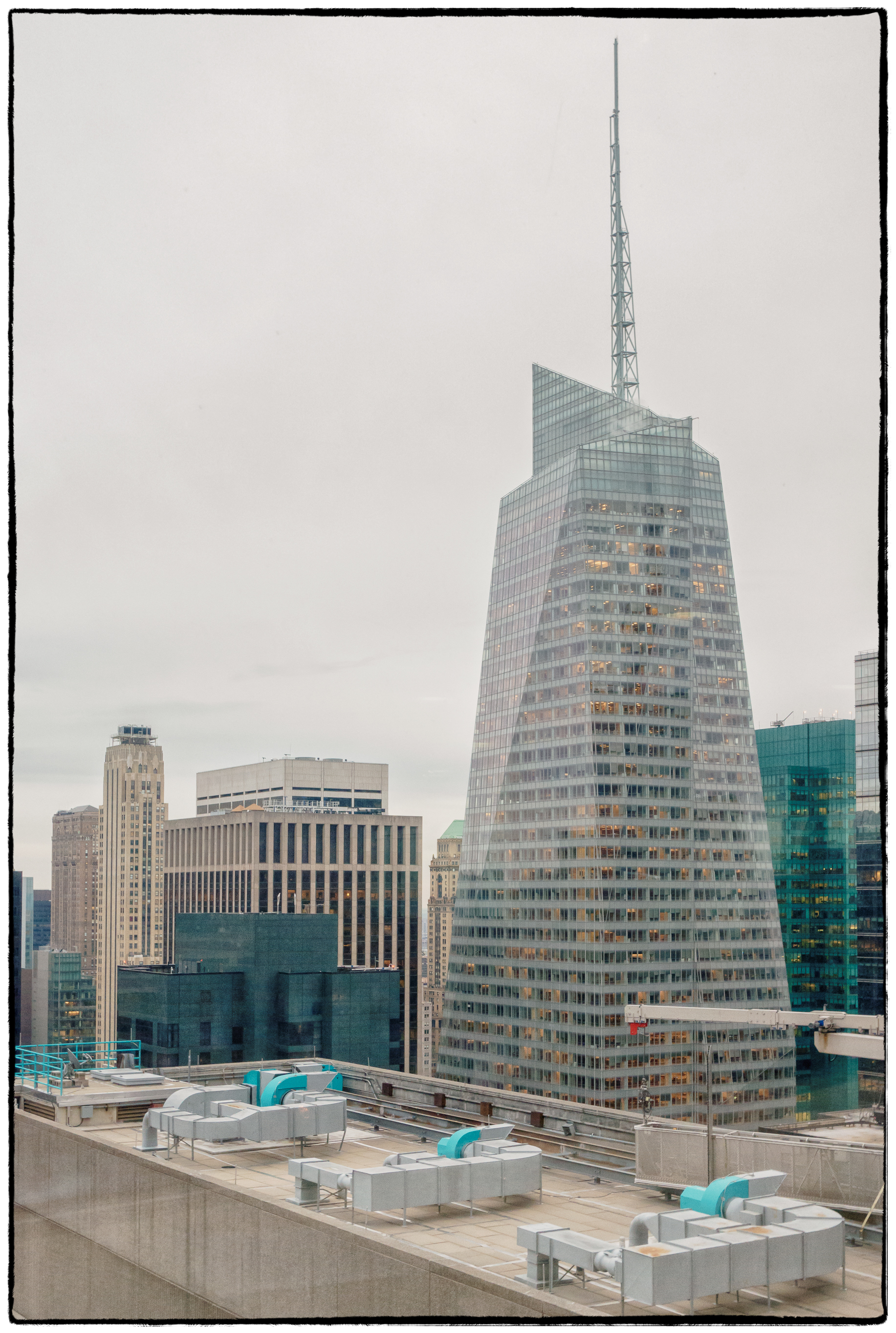
A view from “The View” – Bank of America Tower

I’ve seen this spectacular building many times from street level, and have even photographed it. Seen from up high it looks completely different – especially since the other buildings obstruct the view and you can only see the upper part.

According to the The Skscraper Center:

The Bank of America Tower at One Bryant Park was designed to set a new standard in high-performance buildings, for both the office workers who occupy the tower and for a city and country that are awakening to the modern imperative of sustainability. Drawing on concepts of biophilia—or humans’ innate need for connection to the natural environment—the vision at the occupant scale was to create the highest quality modern workplace by emphasizing daylight, fresh air, and an intrinsic connection to the outdoors. At the urban scale, the tower addresses its local environment as well as the context of midtown Manhattan, to which it adds an expressive new silhouette on an already-iconic skyline.

The building responds to the dense urban context by weaving into the existing grid at street level, yet challenging the boundaries of public and private space with a highly transparent corner entry. As it rises, the tower shears into two offset halves, increasing the verticality of its proportions as well as the surface area exposed to daylight. Mass is sliced from these two rectilinear volumes, producing angular facets that open up light and oblique views beyond the typical limits of urban geometry. The crystalline form—inspired by the legacy of the 1853 Crystal Palace, which once stood adjacent in Bryant Park, and by a quartz crystal from the client’s collection—suggests an appropriate natural analogue, both organic and urban in nature. With its crisp, folded façade, the tower changes with the sun and sky; its southeast exposure, a deep double wall, orients the building in its full height toward Bryant Park, its namesake and the most intensively-used open space in the US.

With the Bank of America as its primary tenant, occupying six trading floors and 75% of its interior, the tower signals a significant shift in corporate America and in the real estate industry, acknowledging the higher value of healthy, productive workplaces. One Bryant Park’s most lasting achievement is to merge the ethics of the green building movement with a twenty-first century aesthetic of transparency and re-connection.

Bank of America Tower is the first commercial high-rise to earn LEED Platinum certification from the US Green Building Council. The building’s advanced technologies include a clean-burning, on-site, 5.0 MW cogeneration plant, which provides approximately 65% of the building’s annual electricity requirements and lowers daytime peak demand by 30%. A thermal storage system further helps reduce peak load on the city’s over-taxed electrical grid by producing ice at night, melted during the day to provide cooling. Nearly all of the 1.2m (4ft) of annual rain and snow that fall on the site is captured and re-used as gray water to flush toilets and supply the cooling towers. These strategies, along with waterless urinals and low-flow fixtures, save approximately 7.7 million gallons of potable water per year.

Recycling was a prominent factor throughout the building’s construction, with 91% of construction and demolition waste diverted from landfill. Materials include steel made from 75% (minimum) recycled content and concrete made from cement containing 45% recycled content (blast furnace slag). To protect indoor air quality as well as natural resources, interior materials are low-VOC, sustainably harvested, manufactured locally, and/or recycled wherever possible.

The building’s exceptionally high indoor environmental quality results from hospital-grade, 95% filtered air; abundant natural daylight and 2.9m (9.5ft) ceilings; an under-floor ventilation system with individually-controlled floor diffusers; round-the-clock air quality monitoring; and views through a clear, floor-to-ceiling glass curtain wall. This high-performance curtain wall minimizes solar heat gain through low-E glass and heat-reflecting ceramic frit; it also has allowed the Bank of America Tower to reduce artificial lighting with an automated daylight dimming system, reducing lighting and cooling energy by up to 10%.

On an urban level, the project also represents the culmination of the developer’s multigenerational efforts to revitalize the Times Square area, and gives back to the city with a street-level Urban Garden Room, a mid-block pedestrian passage/performance space, and the first “green” Broadway theater, the LEED Gold Stephen Sondheim Theater.

In an era of heightened security, a central challenge of the project was balancing the complexities of program and scale with high-performance architecture and urban design. In its layered connection to the ground plane, Bank of America Tower resolves this question with a progression of public and private spaces—from Bryant Park to the Urban Garden Room to the semi-public lobby. As a total response to the urban environment, the building’s restorative connections therefore work on many levels, from green roofs and views of the park to more subtle and expressive elements. A highly integrated approach to architecture and engineering ensured a close relationship between form and function. Bridging contexts as vastly different as Times Square and Bryant Park, the project makes a highly visible statement on urban stewardship and global citizenship for the 21st century

Taken with a Sony RX-100 M3.

A view from “The View” – 1540 Broadway

According to Wikipedia:

The former Bertelsmann Building, now known as 1540 Broadway, is a 44-story, 733 foot (223 m) office tower in Times Square in Manhattan, New York City, standing at West 45th Street. The building was the North American headquarters of media conglomerate Bertelsmann from 1992 until the company vacated and sold the property, of which they occupied all office-use floors, in 2004. The building housed US satellites of central functions such as Corporate Development, Corporate Communications and the Office of the Chairman and CEO, as well as serving as worldwide headquarters for the Bertelsmann Music Group and Bertelsmann Book Group (what has later taken on the umbrella brand name Random House). Today’s office tenants include Viacom, China Central Television, Yahoo, KEMP Technologies, Adobe and Pillsbury Winthrop Shaw Pittman. The building retained the Bertelsmann name and signage facing Broadway until its eventual removal in late 2013.

Started in 1989 and finished in 1990, the tower is one of the few in Times Square to contain class A office space. Also found in the tower is Planet Hollywood, and commercial tenants MAC Cosmetics, Disney Store, and Forever 21.

In the 1990s the Bertelsmann subsidiary Random House looked to build a skyscraper across 45th Street from its parent and be connected to it via a neon-lighted bridge across 45th Street. When the deal fell through it built the Random House Tower 10 blocks uptown.

Loew’s State Theatre (1921) formerly occupied the site of the Bertelsmann Building. Before Loew’s, the Bartholdi Inn (1899), then New York’s best-known theatrical boarding house, was located there.

According to Anthony Slide’s History of Vaudeville:

The last major theatrical boarding house in New York was the Bartholdi Inn, which was opened in 1899 by Mme. Bartholdi on two upper floors of the building at 1546 Broadway, the ground floor of which was occupied by Child’s Restaurant. When Bartholdi became ill, the establishment was taken over by her daughter Polly and by 1906, it had expanded to one hundred rooms on the upper floors of three buildings at West 45th Street and Broadway. Among the Bartholdi Inn’s tenants were Pearl White, D.W. Griffith, Mack Sennett, Charlie Chaplin, Eva Tanguay, Nat Wills, and the chorus girls from the Ziegfeld Follies. It as here also the the first motion picture fraternal organization, the Screen Club, was founded on Labor Day 1912.

The establishment closed on February 1, 1920, shortly before the buildings which it occupied were demolished to make way for the new State Theatre. The inn’s furnishings were auctioned off on February 4, 1920. At its passing, Variety commented, “When the Bartholdi Inn passes into oblivion there will never be another like it. The day of the intimate theatrical boarding house in New York is gone forever, the numerous hotels in the theatrical district supplying everything the Inn could supply perhaps better – but without the spirit of comradeship”.

Taken with a Sony RX-100 M3.

A view from “The View” – One Worldwide Plaza

Up next is One Worldwide Plaza. According to Wikipedia:

One Worldwide Plaza is the largest tower of a three-building, mixed-use commercial and residential complex completed in 1989, in the New York City borough of Manhattan, known collectively as Worldwide Plaza. One Worldwide Plaza is a commercial office tower on Eighth Avenue. Two Worldwide Plaza is a residential condominium tower west of the center of the block, and Three Worldwide Plaza is a low-rise condominium residential building with street level stores on Ninth Avenue, to the west of the towers. Skidmore, Owings & Merrill was the designer for the office complex, and the residential complex was designed by Frank Williams. The complex, whose component skyscrapers are among the list of tallest buildings in New York City, occupies an entire city block, bounded by Eighth Avenue, Ninth Avenue, 49th Street, and 50th Street. Located on the west side of Eighth Avenue, One Worldwide Plaza is built on the site of New York City’s third Madison Square Garden.

Skidmore, Owings and Merrill have designed many well known buildings including the Burj Khalifa, currently the tallest building in the world. Frank Williams also designed the ‘W Hotel – Times Square‘, which was the subject of the previous post.

Taken with a Sony RX-100 M3.

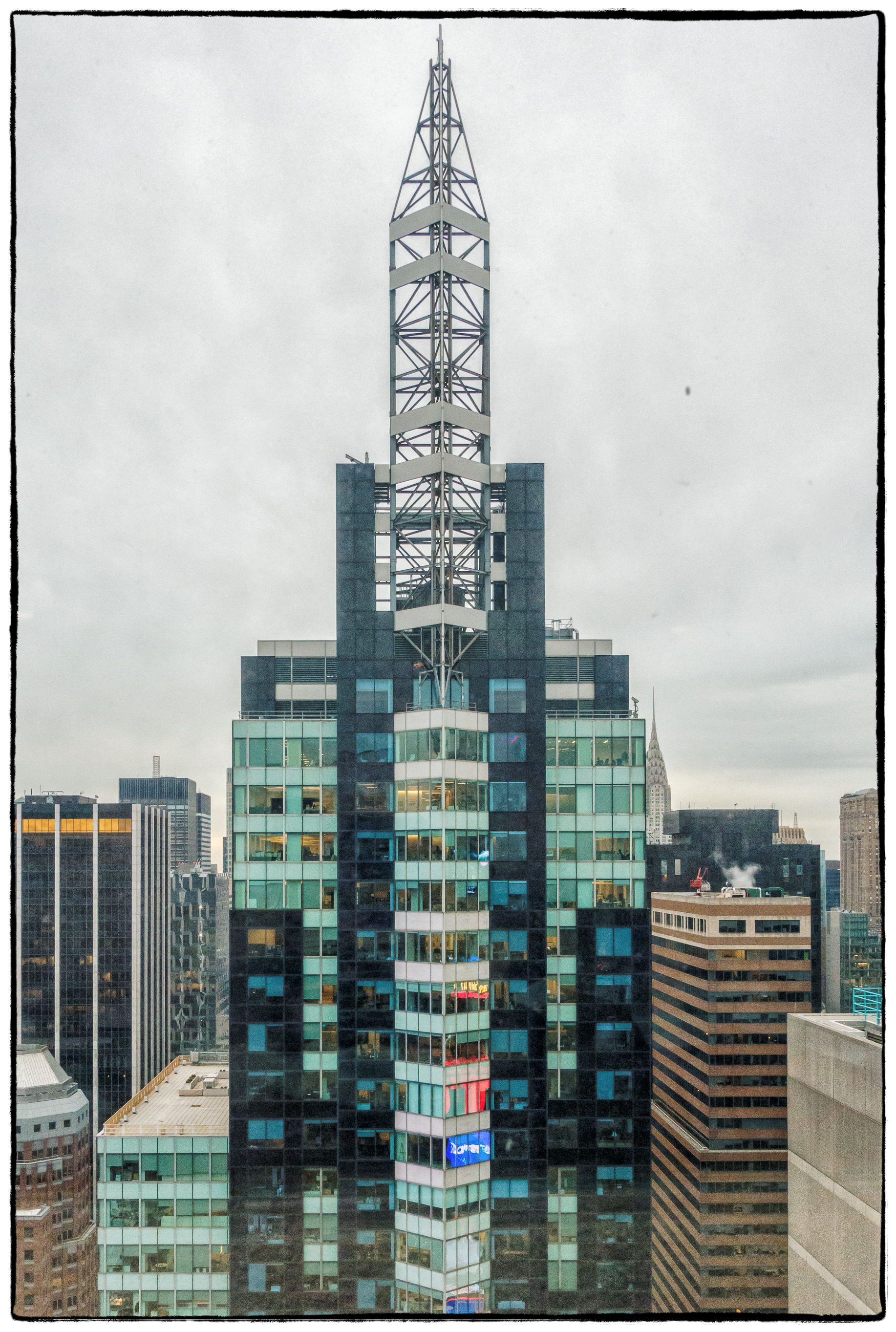
A view from “The View” – W Hotel – Times Square

In an earlier post (See: Book of Mormon) I mentioned that we went into New York City to celebrate my wife’s birthday, and that we had eaten at “The View” restaurant perched on top of the Marriott Marquis Hotel. The restaurant revolves slowly (it takes it about one hour to complete a full revolution) and as it does you get views of the surrounding skyscapers – from a perspective quite different from that you get a street level.

This is the “W Hotel – Times Square“, recognizable from the huge letter “W” on top of it.

According to Wikipedia:

W Hotels was launched in 1998 with the W New York, a conversion of the old Doral Inn hotel at 541 Lexington Avenue in Manhattan. The first few W hotels were mainly conversions of existing hotels already within the Starwood group. The W expanded its number of flagship properties quickly in the United States over the next decade and is now focusing its expansion efforts abroad for the most part.

W opened its first hotel in Europe in Istanbul in May 2008. The hotel, located in the renovated Akaretler Row Houses, a group of historic structures built in the 1870s to house the employees of the Dolmabahçe Palace, blends the traditional Ottoman design of the row houses with the contemporary feel of the luxury hotel chain. The W Barcelona hotel was W’s first in Western Europe and opened in October 2009. It features a futuristic design by architect Ricardo Bofill in the shape of a sail and, standing 26 stories tall, it can be seen from all over the city. At the moment, the W Doha Hotel and Residences is the only W property in the Middle East and North Africa, though there are several properties currently in development for the United Arab Emirates and India. W’s most notable properties under-development includes the 62 storey W MUMBAI also known as Namaste Tower.

For example, the lobbies of all the hotels are known as the “Living Room.” W Hotels attempt to include the letter W wherever possible – the swimming pool is known as “Wet”, the concierge is known as “Whatever Whenever”, the laundry bag is known as “Wash” and so on. Many of the W properties are accompanied by their well regarded “Bliss” spas.

Taken with a Sony RX-100 M3