A visit to Dia Beacon – Artists I don’t care for, or don’t understand – Robert Smithson

I first visited Dia in April 2014. When I came across these installations/displays I initially thought that they were unfinished i.e. that someone was in the process of building an installation. My tastes in art have evolved a lot since then but I still have problems understanding why a pile of broken glass, a pile of sand, a pile of cement and a couple of mirrors are important art. Clearly I still have a way to go. Having said that I do rather like some of his large scale exterior works such as Spiral Jetty and Broken Circle/Spiral Hill.

Wikipedia describes Robert Smithson as follows:

Robert Smithson (January 2, 1938 – July 20, 1973) was an American artist known for sculpture and land art who often used drawing and photography in relation to the spatial arts. His work has been internationally exhibited in galleries and museums and is held in public collections. He was one of the founders of the land art movement whose best known work is the Spiral Jetty (1970).

For (lots) more information see here.

Taken with a Sony A7IV and Samyang 45mm f1.8

A visit to Dia Beacon – Artists I don’t care for, or don’t understand – On Kawara

Above museum visitors studying the work of On Kawara. Clearly I have to more studying to do too. I just don’t get it, but then I still struggle with conceptual art of all kinds. However, I seem to come across his work everywhere so apparently lots of people, gallery owners, museum owners, critics etc. must feel that it’s important. I must be missing something.

The Dia Beacon website describes him as follows:

On Kawara was deeply concerned with the ways humans experience and record time. Kawara began his Today Series of paintings on January 4, 1966, and continued to work on them until his death in mid-2014. Adhering to a rigorous set of rules that he established, Kawara required that each painting be completed on the date depicted on its surface and in the language and grammar of the country in which it was completed. In addition to these formal conventions, the Today Series paintings are stored in handmade cardboard boxes along with a clipping from the local newspaper. Occasionally these boxes are exhibited, and particularly in earlier works, phrases or text from the clippings would form part of the title as well. Combining the individual with the universal, the Today Series is both a deeply personal journey (asserting that I was here on this day), but also the story of humanity and struggles experienced on a much larger scale—as captured through the lens of daily newspaper reportage.

The Today Series was presented at Dia Center for the Arts from January 1 through December 31, 1993; each calendar month saw a different rotation of Date Paintings, chosen exclusively from those made in New York City—a thousand works in total. Kawara’s One Million Years was also presented for the first time as an audio piece in that exhibition. Alternating between two voices, a female reader for even years and a male reader for odd years, One Million Years is an oral reading from Kawara’s twenty four-volume publication by the same title. Both artworks reflect the influences of the micro and macro in Kawara’s work, and how an individual lifespan forms a part of human history.

Taken with a Sony A7IV and Samyang 45mm f1.8

A visit to Dia Beacon – Other artists I liked – Dan Flavin

According to The Guggenheim:

Daniel Flavin was born in Jamaica, New York, in 1933. He studied for the priesthood for a brief period of time before enlisting in the United States Air Force. During military service in 1954–55, Flavin studied art through the University of Maryland Extension Program in Korea. Upon his return to New York in 1956, he briefly attended the Hans Hofmann School of Fine Arts and studied art history at the New School for Social Research. In 1959, he took drawing and painting classes at Columbia University; that year, he began to make assemblages and collages in addition to paintings that pointed to his early interest in Abstract Expressionism. In 1961, he presented his first solo show of collages and watercolors at the Judson Gallery in New York. In the summer of 1961, while working as a guard at the American Museum of Natural History in New York, Flavin started to make sketches for sculptures that incorporated electric lights. Later that year, he translated his sketches into assemblages he called “icons,” which juxtaposed lights onto monochromatic canvases. By 1963, he removed the canvas altogether and began to work with his signature fluorescent tubes; and by 1968, he had developed his sculptures into room-size environments of light. That year, Flavin filled an entire gallery with ultraviolet light at Documenta 4 in Kassel (1968).

In the 1970s and 80s, Flavin began to create more complex figurations of fluorescent tubes, notably his “barred corridors” and corner installations. His work increasingly concentrated on the relationship between his sculptures and the spaces they inhabited. In the 1990s, as institutions began to offer larger galleries to Flavin, the scale of his light installations became more and more grandiose. In 1992, he filled the Solomon R. Guggenheim Museum with multicolored light, taking full advantage of the openness of the Frank Lloyd Wright design. In 1996, he introduced electric green and blue lights into the staircases of the warehouse then occupied by the Dia Art Foundation. Additional sites for his architectural “interventions” include the Hamburger Bahnhof in Berlin, Chianti Foundation in Marfa, Texas, and the church of Santa Maria Annunziata in Chiesa Rossa in Milan, all in 1996.

Major retrospectives of Flavin’s work have been organized by the National Gallery of Canada in Ottawa (1969), St. Louis Art Museum (1973), Kunsthalle Basel (1975), and Museum of Contemporary Art in Los Angeles (1989). He also executed many commissions for public work, including the lighting of several tracks at Grand Central Station in New York in 1976. Flavin died on November 29, 1996, in Riverhead, New York. Both the Deutsche Guggenheim in Berlin in 1999 and the Dia Foundation for the Arts in 2004 mounted major posthumous retrospectives of the artist’s work.

For more information see here on the Dia Beacon website.

Taken with a Sony A7IV and Samyang 45mm f1.8

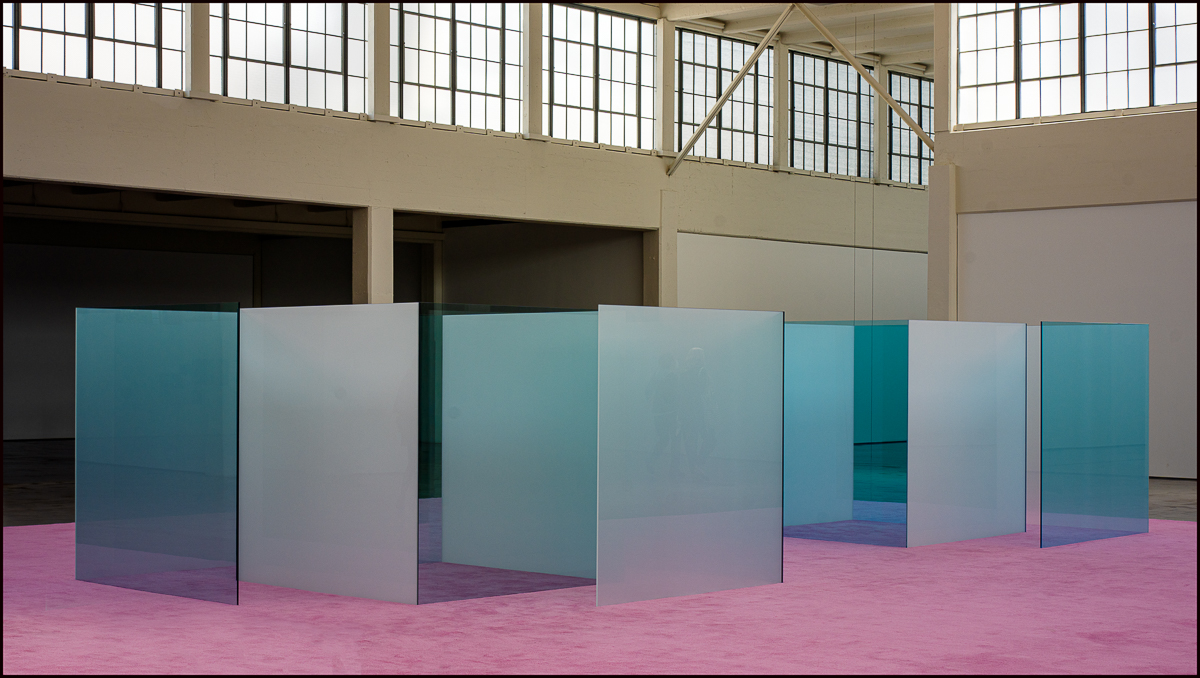
A visit to Dia Beacon – Other artists I liked – Larry Bell

According to The Guggenheim:

Larry Bell was born in Chicago in 1939 and grew up Southern California. Bell attended the Chouinard Art Institute in Los Angeles from 1957 to 1959, where he created abstract oil paintings dominated by gestural brushstrokes influenced by Abstract Expressionism. At Chouinard he met Robert Irwin, an influential arbiter of Perceptualism, who profoundly affected how Bell conceptualized vision. From 1960 to 1962, Bell created a series of shaped canvases with the corners lopped off, onto which he painted simple polygonal forms that mimed the form of the canvas. By 1962 Bell had integrated both mirrored and transparent glass into his painting in several collage constructions; the different types of reflective glass created spatial complexity, conflating the world of the viewer with that of the object. Bell soon transitioned to sculpture with shallow boxes of glass onto which he painted geometric shapes. In 1963, Bell developed his signature glass cubes, the earliest versions of which were covered with opaque designs of stripes, checkers and, most commonly, ellipses. Several of the ellipse-covered cubes were included in Bell’s solo exhibition at the Pace Gallery in New York in 1965, which sold out on its first day. Bell moved to New York soon after this successful exhibition, but stayed for only a year before returning to Southern California. The artist abandoned the geometric surface designs and created his famous elegant vacuum coated glass cubes with chrome frames from 1964 to 1968. In these new works, often included in major exhibitions on Minimalism, Bell explored the properties of glass by offering subtle gradations of transparency, reflectivity, and color. These faint variations, achieved by specialized machinery Bell obtained for his studio, supply seemingly simple forms with complex inquiries into the nature of perception. In 1968 Bell began to abandon the chrome frame and create larger cubes in which the effects of the planes of glass interact only with one another. This development led to Bell’s glass panels, which stood eight feet tall, operated at an almost architectural scale, and could be arranged in countless configurations in the gallery space. In 1973 Bell moved to Taos, New Mexico, where he established a studio and created the huge fifty-six-panel adjustable glass structure The Iceberg and It’s Shadow (1974). In the late 1970s Bell initiated his Vapor Drawings and Mirage Paintings, which extended the artist’s investigations into perception, but this time on a flat plane. Since the late 1970s, Bell has engaged with such diverse practices as furniture design and bronze sculptures, as well as large-scale glass sculptures and installations like Moving Ways (1981–82), The Wind Wedge (1982), and Made for Arlosen (1992).

Solo exhibitions of Bell’s work have been organized by the Pasadena Art Museum (1972), Oakland Museum of Art (1973), Fort Worth Art Museum (1975 and 1977), Washington University in St. Louis (1976), Detroit Institute of Arts (1982), Museum of Contemporary Art in Los Angeles (1986), Denver Museum of Art (1995), and Alberquerque Museum (1997). His work was also included in major group exhibitions such as The Responsive Eye at the Museum of Modern Art in New York (1965), Primary Structures at the Jewish Museum in New York (1966), Guggenheim International (1967), Documenta 4 (1968), and Venice Biennale (1976). In 1970 Bell received a Guggenheim Fellowship. The artist lives and works in Taos, New Mexico, and Venice, California.

For more information see here on the Dia Beacon website.

Taken with a Sony A7IV and Samyang 45mm f1.8