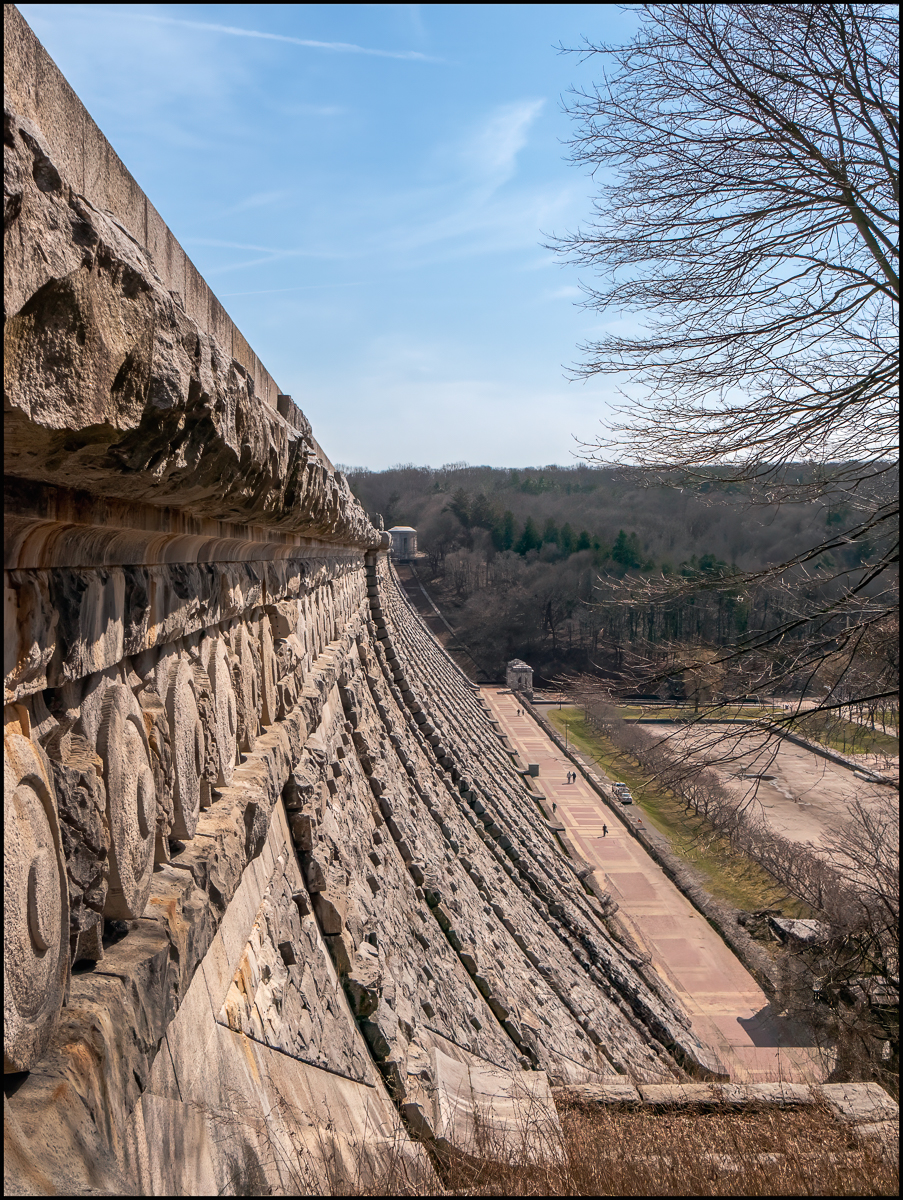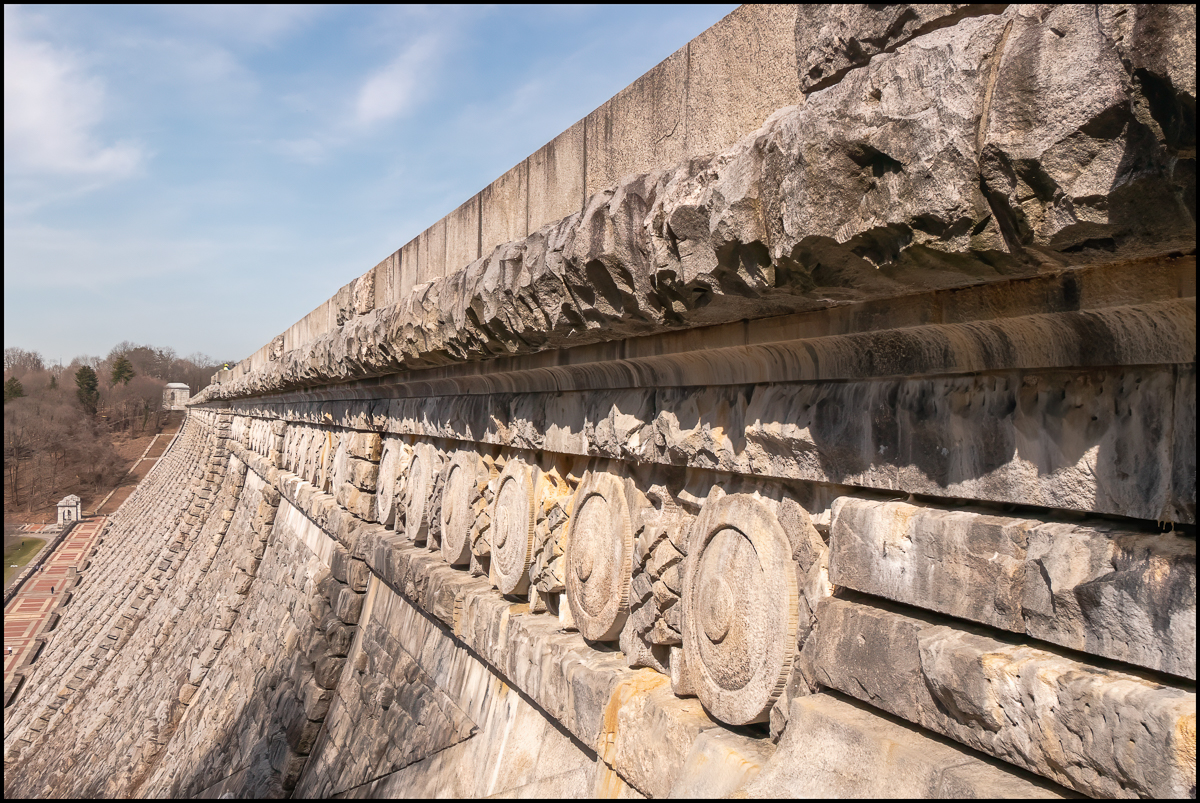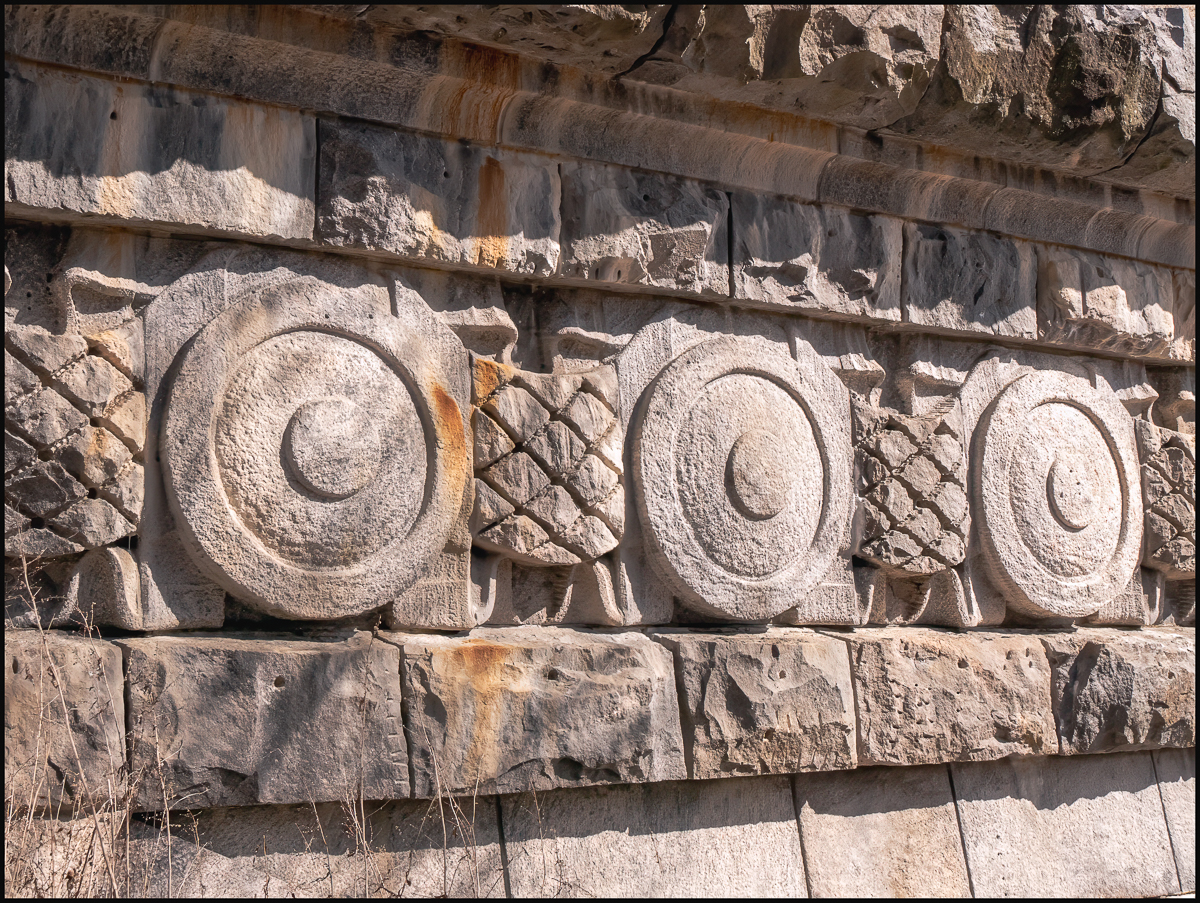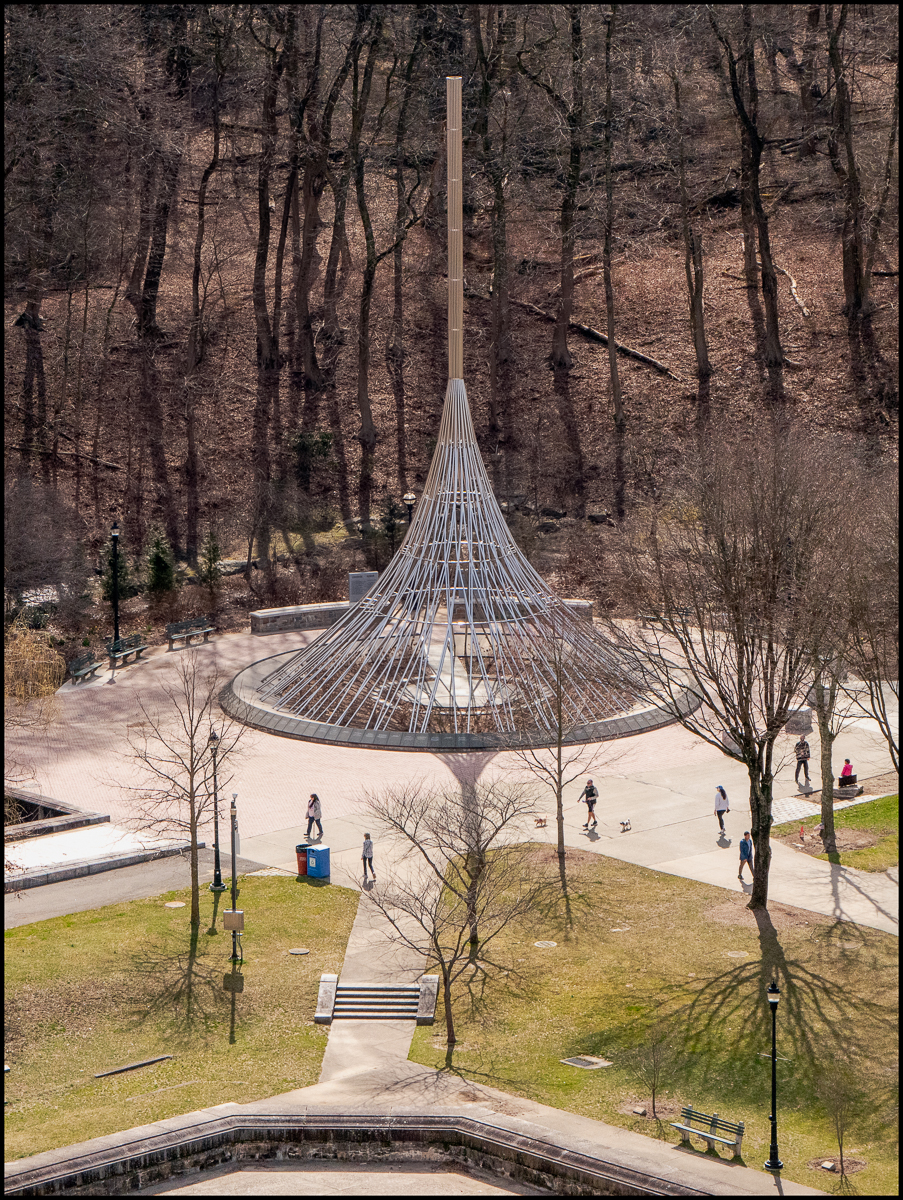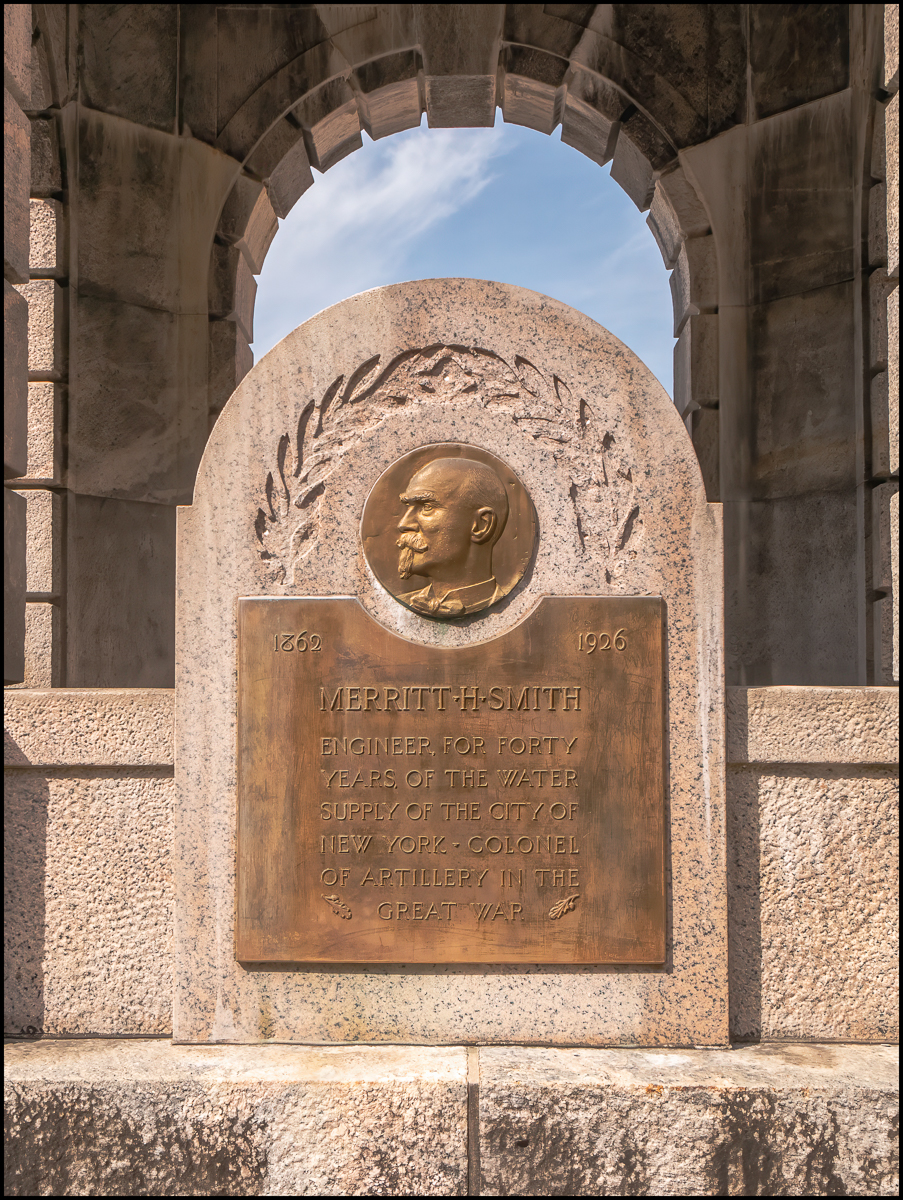
The person being honored is Merritt Smith and the inscription reads: 1892-1926. Merritt H. Smith. Engineer for Forty years of the Water Supply of the City of New York. Colonel of Artillery in the Great War.
To get a sense of the number of people involved in this project see the extract below from The World’s Greatest Aqueduct. Water from the Catskill Mountains to the City of New York, by Alfred Doughlas Flinn, Harper’s Monthly, 1909 (reference to Merritt Smith in bold):
Goethe once wrote, “Dem Menschen ist ein Mensch noch immer lieber als ein Engel.” (To mankind men are always dearer than angels). And so perchance the reader may be possessed of sufficient human interest to inquire by what marshaling of men’s brains and brawn these great works are to be wrought. By appointment of Mayor George B. McClellan, under special legislation, John A. Bensel, a civil engineer, Charles N. Chadwick, a business man, and Charles A. Shaw, formerly president of the Hanover Fire Insurance Company, constitute the Board of Water Supply of the City of New York. They were chosen from lists of three names presented respectively by the Chamber of Commerce, the Manufacturers’ Association of New York, and the Board of Fire Underwriters. Mr. Bensel is president of the board, and succeeded Mr. J. Edward Simmons, who resigned in January, 1908, and is now president of the Chamber of Commerce.
Two bureaus comprise the board’s forces. In the Administration Bureau are the secretary, auditor, chief clerk, and purchasing agent, adjuster of claims, and chief of aqueduct patrolmen, each having a necessary corps of assistants, totaling for the bureau about 125 persons. Consulting Engineer John R. Freeman is the engineer adviser of the commissioners. At the head of the Engineering Bureau is Chief Engineer J. Waldo Smith. On his staff of consultants are Professor William H. Burr, Mr. Frederic P. Stearns, Allen Hazen, George W. Fuller, and a few other engineers and scientists of national and international reputation. Mr. Charles L. Harrison is Deputy Chief Engineer. Because of the geographical extent and the magnitude of the works, the Engineering Bureau has been organized in four departments: the Headquarters Department, with Alfred D. Flinn, Department Engineer, has charge of preparing designs and specifications for the dams, aqueducts, and other structures; executive and civil-service matters, inspection of manufactured materials for construction, and preparation of real estate maps and documents for all the departments, and in addition surveys and construction within the city limits. The Reservoir Department, with Carleton E. Davis at its head, is charged with all surveys and construction on the watersheds. Its chief work at present is the Ashokan reservoir, with its great dams and the headworks of the Catskill aqueduct. From the headworks to the divide of the Croton watershed sixty miles of Catskill aqueduct is under the care of the Northern Aqueduct Department, Robert Ridgway, Department Engineer, to whom falls the Hudson River crossing and the great siphons under the Rondout, Wallkill, and Moodna valleys. The remainder of Catskill aqueduct, with Kensico and Hill View reservoirs and the filters, falls to the Southern Aqueduct Department, with Merritt H. Smith as Department Engineer. The departments are divided into three or more divisions, which in turn are subdivided into several sections. Including engineers, inspectors, stenographers, clerks, laborers, and other assistants, the Engineering Bureau contains nearly 1000 persons.
Taken with a Panasonic Lumix GX85 and Lumix G Vario 14-140 f3.5-5.6