
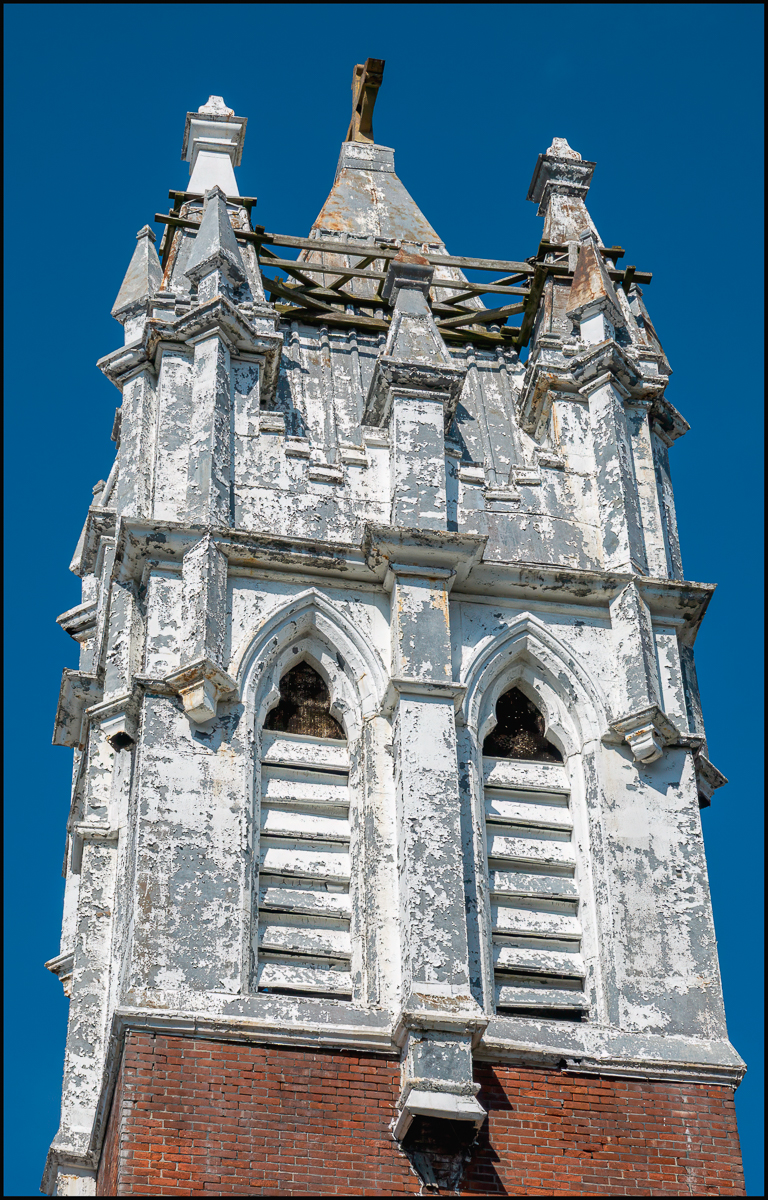
It seems that the church administration has the same idea (see image below)
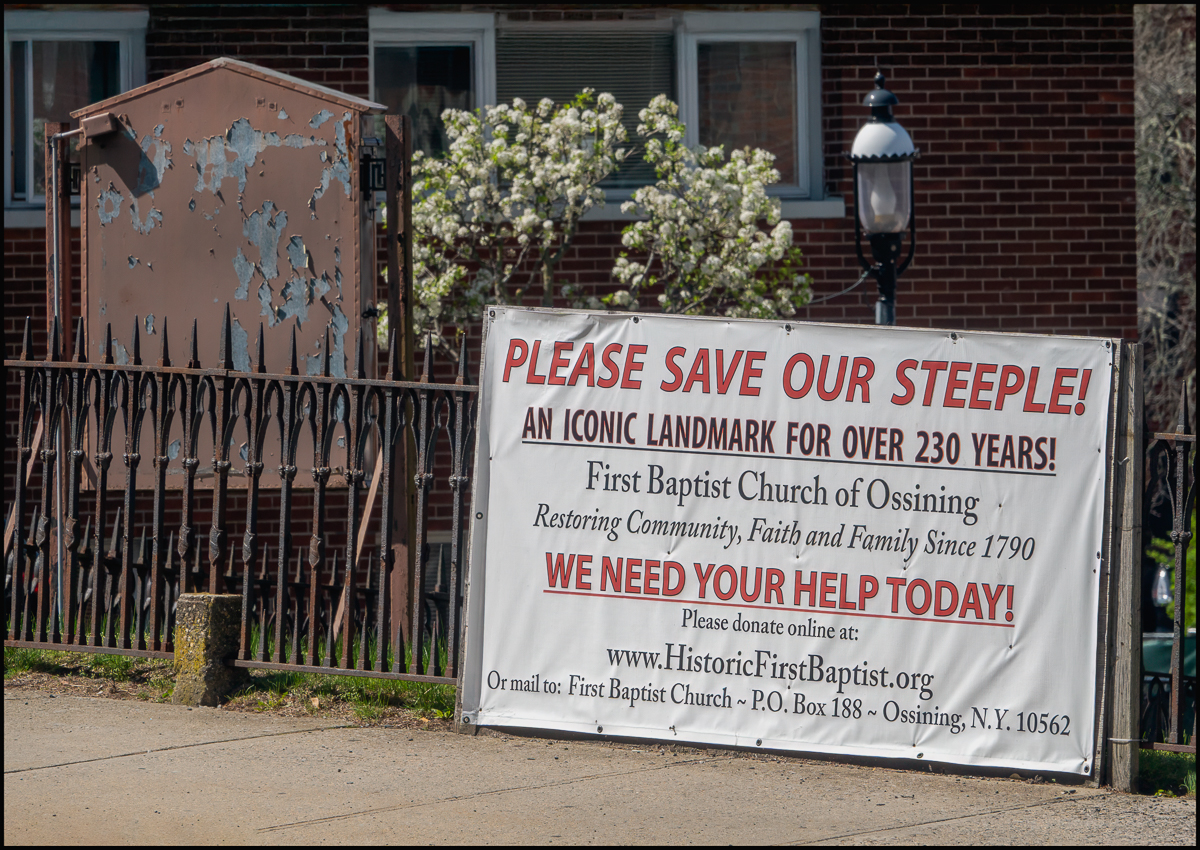
As indicated in the sign, this is the First Baptist Church of Ossining:
High Victorian Gothic architecture, which evolved from the older Gothic Revival style, differs from that style in its use of contrasting polychromatic bands on the exterior wall surfaces and more elaborate decorative elements. This style was usually reserved for public buildings such as schools or churches. As it is related to the Gothic Revival style, structures in this style also contain such elements as steeply pitched rooflines, elaborate ornamentation, and a predominantly vertical orientation.
The First Baptist Church consists of two sections: a rectangular main section and a smaller, perpendicular northern section. The main section’s 100-foot-tall spire, which is surrounded by 16 pinnacles, was added in 1894. Older photographs show that the building originally had an
ornamental roof cresting that was subsequently removed at an unknown date. The structure is capped with a gray slate gable roof with four gabled dormers. Each contains a large, pointed arch window and elaborate decorative exterior woodwork around the gables. The pointed arch-shaped double front doors at the main entryway facing Church Street are surrounded with polychrome brick trim and a decorative fanlight above the door. Eight stained glass windows located around the perimeter of the structure illustrate scenes from the Bible. The church is constructed with brick and limestone.Significance: Architectural and Cultural
The First Baptist Church was added to the National Register of Historic Places in 1973 as architecturally significant for its status as the best example of High Victorian Gothic architecture in the Village. Other examples include the First Presbyterian Church (see entry) and the First Baptist Church (see entry). The nomination took place prior to the 1989 designation of the Downtown Ossining Historic District in which the Church is located and listed as a contributing structure. The Church is also culturally significant for its association with its founder, Captain Elijah Hunter (1749-1815), a Sing Sing-based landowner and businessman who later served as the first Supervisor for the Town of Mount Pleasant prior to the formal incorporation of Sing Sing Village in 1813; the Sing Sing Baptist Congregation, founded in 1786; and for its overall role in the cultural life of the Village since its construction in 1874.
The First Baptist Church, completed in 1874, is actually the second structure to occupy the site at 1 Church St; the first was constructed in the early 19th Century to house the Sing Sing Baptist Congregation. This congregation was founded in April of 1786 by Captain Elijah Hunter, a Revolutionary War spy who was the founder of the hamlet Hunter’s Landing, an early waterfront settlement located near the current-day train station which grew to later become part of Sing Sing Village. Hunter chose a triangular-shaped site at the center of the Village near the convergence of the Albany Post Road (known today as Highland Avenue or Route 9), Croton Avenue, and Main Street in order to maximize its visibility and emphasize its central importance to Ossining’s religious life. The original First Baptist Church was a place where blacks and whites would worship side by side in a setting that permitted a degree of equality that did not exist elsewhere, a tradition that continued with the construction of the current structure. The original church building was demolished once the size of the congregation grew too large, and the present structure was built on the same site. The church was designed by J. Walsh, a Brooklyn-based architect, and was built for a cost of $75,000 in 1874 dollars.
Documented Sources of Information:
1. First Baptist Church “Historic First Baptist Church: History.” http://historicfirstbaptist.org/history.html (accessed April 17th, 2009).
2. Nomination Application for National Register of Historic Places, “First Baptist Church”, 1973, Ossining Historical Society Archives.
3. Ossining Historical Society, “Images of America: Ossining Remembered”, (Charleston, SC: 1999), 98.
4. Scharf, Thomas, J. “History of Westchester County, NY”, (Philadelphia, PA: 1886), 338.
5. Williams, Gray. “Picturing Our Past: National Register Sites in Westchester County”, Westchester County Historical Society, (Canada: 2003), 274-275.
Village of Ossining Significant Sites and Structures Guide, page 192.
Taken with a Sony RX10 IV