
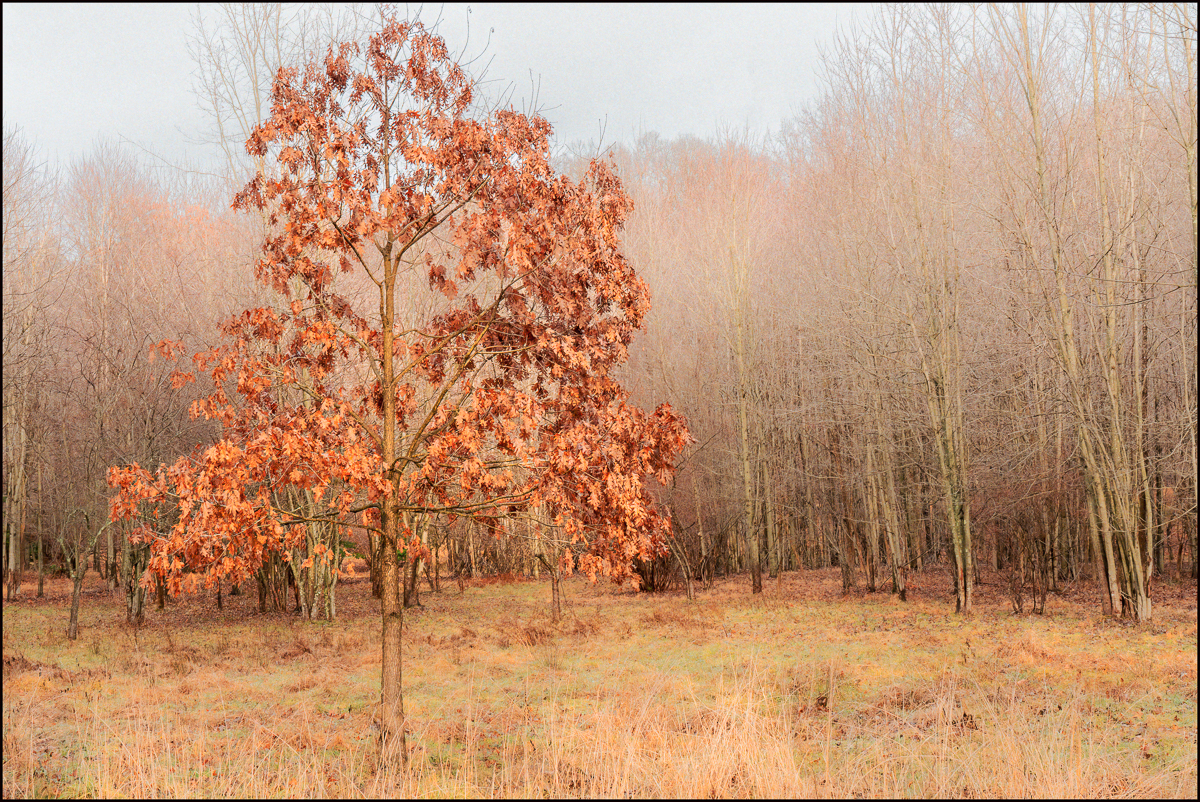
I learned a new word today: “marcescence”. During my walks I’d noticed a number of these trees and had wondered why they retained their leaves after all the others had lost theirs. Apparently scientists have studied this phenomenon and refer to it as “marcescence.” Why do the trees do this?
According to the University of Illinois:
“Several theories have emerged on the advantages of foliage marcescence. Winter foliage may deter browsing by herbivorous fauna by making it more difficult to consume stems, lending an advantage to a young understory tree that would otherwise be a prime target. As the tree gets taller, growing above the browsing height, there is less advantage, which may be why some trees lose their ability to retain winter leaves in maturity.
Another theory explores how marcescence can help deciduous trees compete with their evergreen counterparts in nutrient-poor environments. In these situations, where we know evergreens tend to dominate, it is advantageous for a deciduous tree to hold its leaves over winter and release them in spring. The leaves add some needed organic matter to soils in spring — think of it as compost.
During this time of high nutrient demand for spring leaf out, the tree self-fertilizes the soil beneath. There is also evidence that suggests photo degradation of leaves held over winter begins to break them down, or pre-composts them a bit.”
Taken with a Sony A7IV and Sony FE 28-75 f3.5-5.6 OSS.