
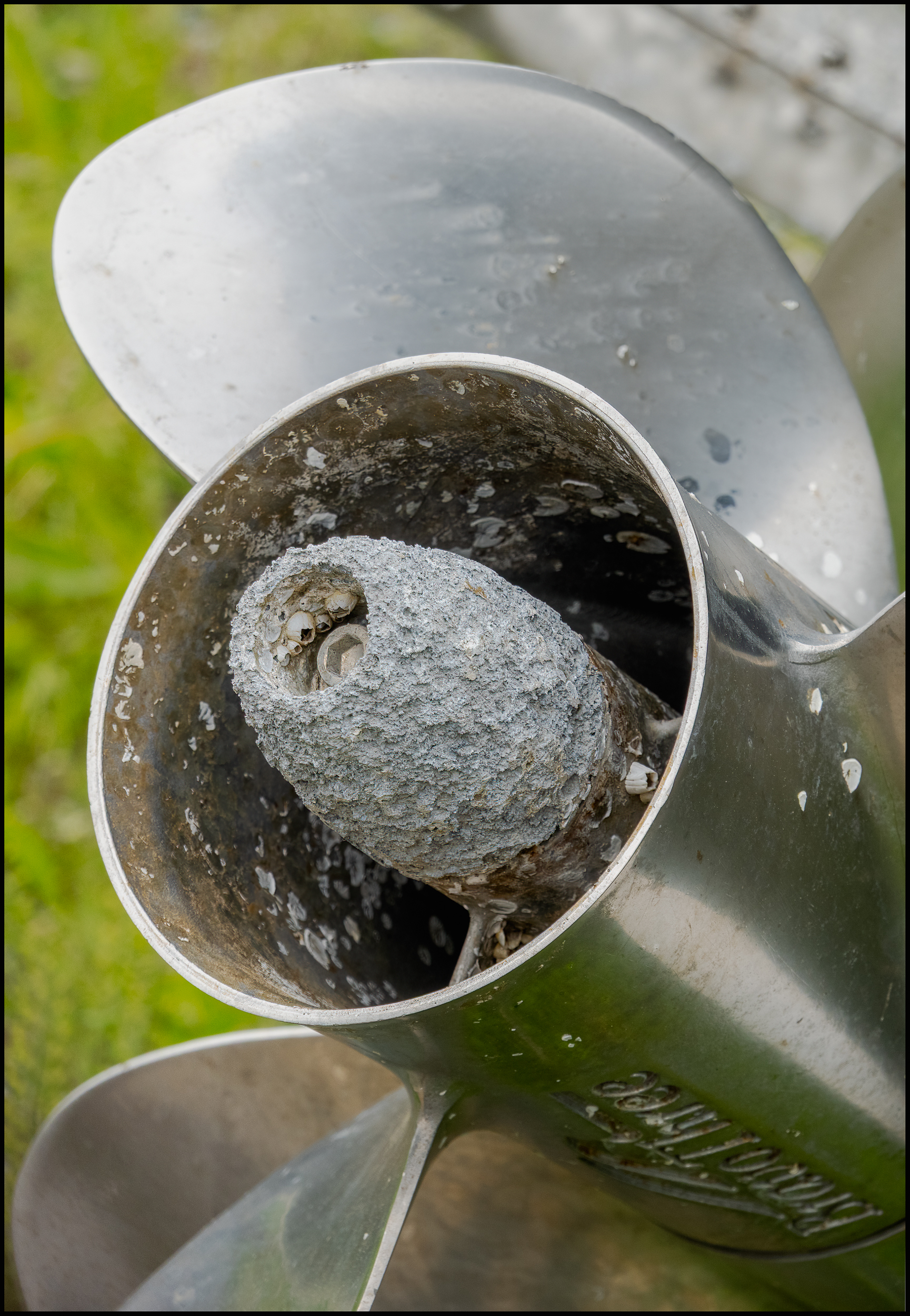
Taken through a fence at Westerly Marina. I liked the contrast between the smooth metal and rough textures on the propellor boss. Although I didn’t notice them when I took the picture also liked what I assume to be barnacles. According to Wikipedia:
Barnacles are arthropods of the subclass Cirripedia in the subphylum Crustacea. They are related to crabs and lobsters, with similar nauplius larvae. Barnacles are exclusively marine invertebrates, many species live in shallow and tidal waters. Some 2,100 species have been described.The word “barnacle” is attested in the early 13th century as Middle English “bernekke” or “bernake”, close to Old French “bernaque” and medieval Latin bernacae or berneka, denoting the barnacle goose. Because the full life cycles of both barnacles and geese were unknown at the time, (geese spend their breeding seasons in the Arctic) a folktale emerged that geese hatched from barnacles. It was not applied strictly to the arthropod until the 1580s. The ultimate meaning of the word is unknown.
The name Cirripedia comes from the Latin words cirritus “curly” from cirrus “curl” and pedis from pes “foot”. The two words together mean “curly-footed”, alluding to the curved legs used in filter-feeding. Most barnacles are encrusters, attaching themselves to a hard substrate such as a rock, the shell of a mollusc, or a ship; or to an animal such as a whale (whale barnacles). The most common form, acorn barnacles, are sessile, growing their shells directly onto the substrate, whereas goose barnacles attach themselves by means of a stalk.
Taken with a Sony RX100 VII