Don’t know what came over me again

In an earlier post I mentioned that I’d acquired a Nikon D80, mostly because I wanted to see what it was like to use a Nikon Digital camera. Well – I’ve done it again.

It all started when came across posts like the following:

Kirk Tuck was also waxing lyrical about the benefits of older cameras, although in his case he was referring to Nikon Cameras (See:Just kicking back and enjoying the D700 and a little handful of cheap lenses.)

I’d always fancied having a full frame camera, but the recent generation models just cost more than I wanted to pay. I even took a look at the Nikon D700 and the Canon 5D Mark II (notice that the photographic community now seems to refer to the original 5D as the “Canon 5D Classic) – still too expensive.

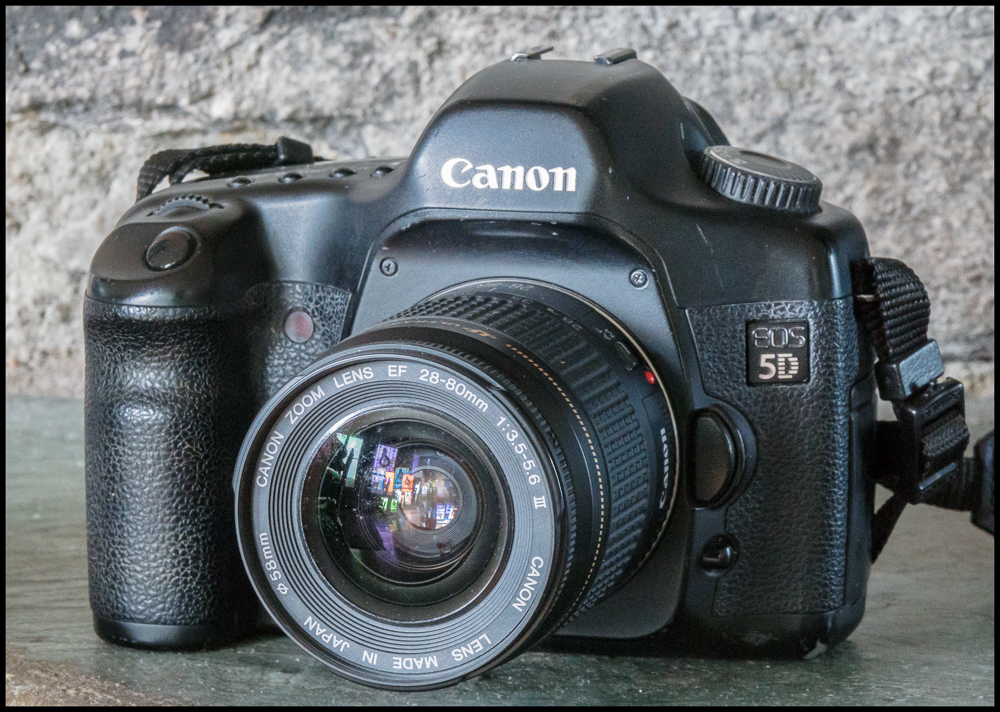
So back to the original 5D. I managed to find one at a price that I could tolerate and decided to get it. I had a few Canon EF lenses from film cameras I had acquired earlier and figured that I could use them to see whether or not I liked the camera.

I won’t write a review here. There are lots of them on the web, including the four above. To me the conclusion of the first review above says it all:

Ultimately, it’s my view that if you’re looking for a cheap entrance into the world of full frame DSLRs, you can’t beat the Canon 5D Classic in terms of image quality, lens selection, and catching an outright bargain. The mixture of the beautiful sensor and the film-camera-feel makes it a compelling camera to use. It’s served me rather well over the last couple of years, and I intend to use it until it’s dying day; I really feel as it’s in a class of it’s own. Less really is more, the Canon 5D Classic is a perfect example of this!

I couldn’t agree more. Yes, it has a lower resolution sensor. Yes, its autofocus is primitive. Yes, the lcd is appalling. In many ways it’s rather primitive compared to current generation cameras.

But, and it’s a very big but, there’s something rather wonderful about this camera. Most of the reviews I read point out that it has a very ‘filmic’ feel. I’ll go a bit farther and say that to me this camera has come the closest of any digital camera I’ve tried to giving a film photography feel. The files it produces have a very film like look and the whole shooting experience it more like shooting a film camera than a digital.

I love it! (Although it should said that I don’t do action photography so I don’t need super-sophisticated autofocus (in fact I have trouble understanding all of the autofocus options on my Sony A77II). Nor do I make very large prints. I don’t “chimp” very much. So most of the disadvantages of this camera don’t affect me all that much.

For some pictures taken with this camera see:

A view from Spur Beach.
The last of the fall colors.
Autumn light over the lake.
The last of this year’s rose blooms
Glynwood – Overview
Glynwood – Around the main house
Glynwood – An interesting looking building
Glynwood – Old Farm Buildings
Glynwood – Residences?
Glynwood – Red Barn
Glynwood – Across a meadow
Glynwood – The boat house
Glynwood – A Waterfall
Glynwood – Fall colors
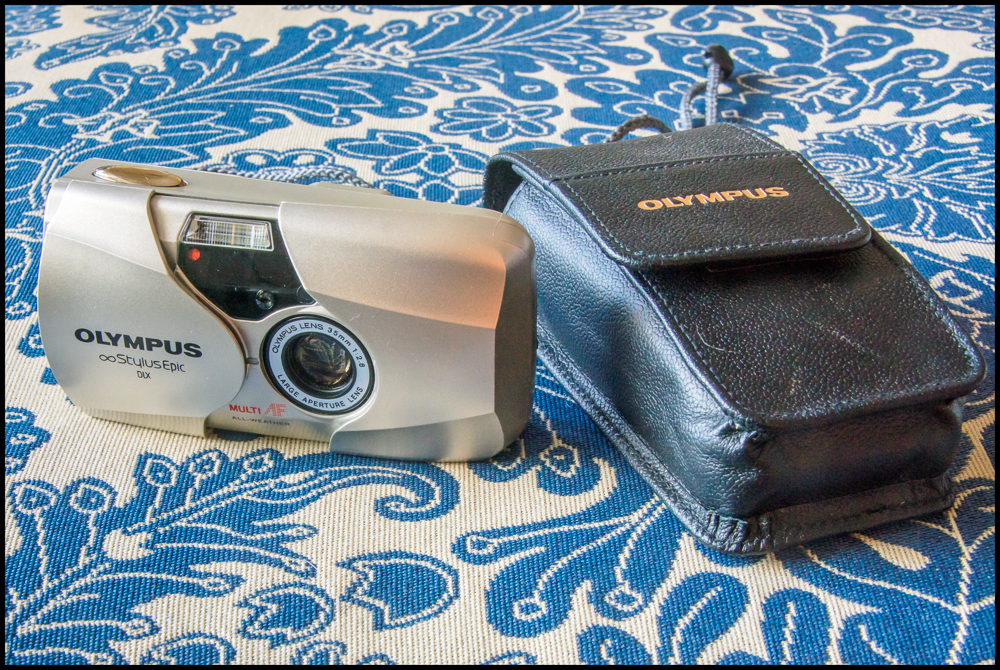
Film Camera 2018/3 – Olympus Infinity Stylus Epic (Mju II) DLX

The other day my wife wanted to go to a nearby Goodwill store to look for some pots. While we were there I took a look around. At first I didn’t see anything of interest – just one broken 1980s vintage point and shoot. Then at the back of a bin I noticed a case, possibly empty, possibly not. I took it out and had a look and, lo and behold, an Olympus Infinity Stylus Epic DLX!

Now I already have two of these (see: Finally found something at the thrift store; and Back to film: Olympus Stylus Epic where I’ve already described the main features of this camera)

Since I already have two why get another one? First the cameras that I have, while functioning well, leave a lot to be desired cosmetically. This one also appears to function perfectly (hopefully it won’t be plagued with the light leaks that tend to affect the Infinity Stylus line), but also is in near mint condition. Second it’s hard to ignore a camera that costs $5.99 (actually less. When my wife paid she got them down to $3.00) and sells at the moment on ebay for around $200.

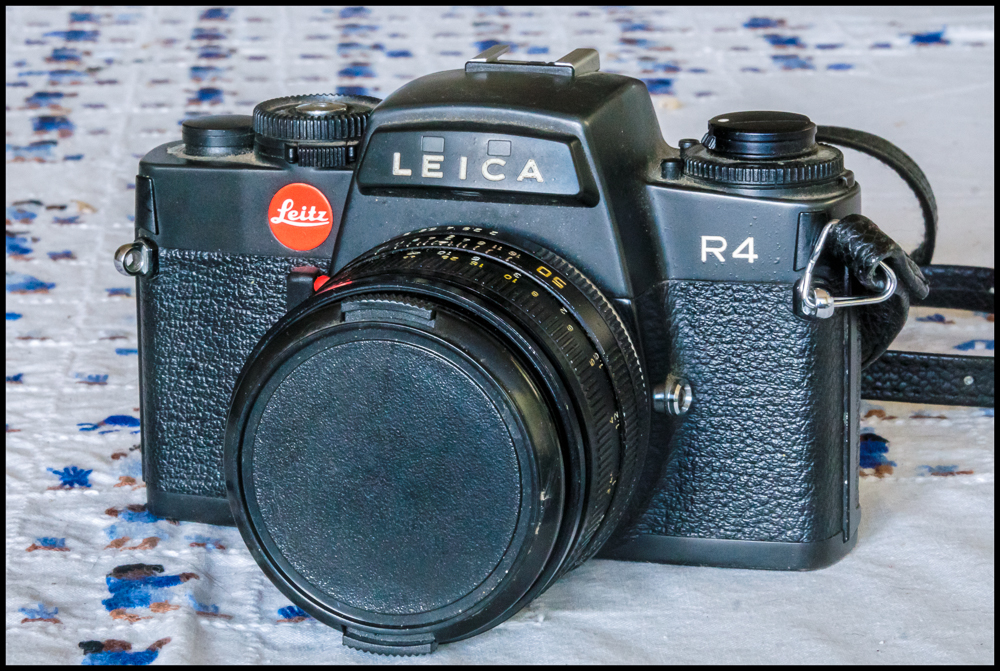
Considering a Leica R4

For some reason I got it into my head that I’d like a Leitz 50mm F2 Summicron R. Possibly to use with a Leica body, or possibly to use with an adapter on my Sony NEX 5n. I’d read (and heard) so much about this lens that I fancied trying it. I quickly realized that the rangefinder versions cost much more than I was willing to pay, but that the SLR R-mount lenses were much less costly and that some of the SLR bodies (e.g. the R4) were not that expensive either. Was a Leica R4 with 50mm f2 Summicron R the way to go?

This was as far as I had gotten, however, when a new friend (knowing my interest in old cameras) showed me some of his. One of them was an R4 with 50mm f2 Summicron (or at least it think it was. The lens faceplate was missing, but it certainly looked like the pictures Id seen).

He kindly let me borrow it for a while to try it out. I was thinking I’d do the following:

1. Just generally try it out without film to see how I liked the handling.
2. Put a roll of film through it.
3. Get an adapter so I could try out the lens on my Nex.

I had the sense that he needed the camera back fairly soon so I quickly ruled out option 3 and I started with option 1. I quickly came to the conclusion that I didn’t like the camera all that much. Admittedly it’s solid and very well made (as you’d expect from a Leica), but it’s also very heavy. I also found the controls to be “fiddly”. Trying to use the camera in my preferred aperture priority mode also turned out to be awkward, largely because the lens was double cam (i.e. designed for the SL series of SLRs) and would only support aperture priority in stopped-down mode: a fairly tortured procedure involving pulling in the depth of field preview level while at the same time half pressing the shutter release and turning the aperture ring.

I’d also read that some early versions of the R4 (of which this was one) had bad electronics that might or might not have been fixed.

Doing more research on the internet I also discovered that the R4 was not particularly liked (for some of the reasons I’ve outlined above).

I returned the camera with my thanks. I’d certainly learned a lot.

Where do I go from here. I’m thinking that I might proceed as follows: 1) as finances allow get my hands on a Summicron R and an adapter to allow its use on Sony E-mount cameras; 2) Still later consider acquiring an R-mount body, possibly a SL2, which seems to get good reviews.

Film Camera 2018/3 – Nikon N6006

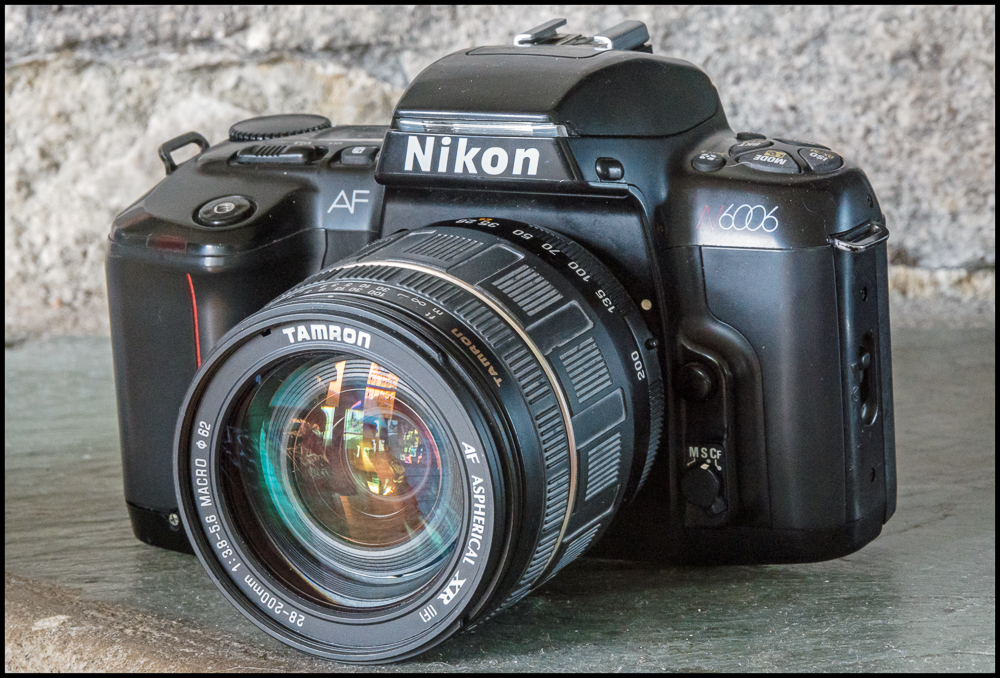
I didn’t particularly want this Nikon body. I was more interested in the lens. But the price of the body plus lens was so attractive that I decided to go for it.

The Nikon N6006 (also known as the F-601 outside of the US) was launched in 1990. The Nikon F4 was at the pinnacle of the Nikon product line. Below it was the ‘prosumer’ Nikon N8008. Then came the N6006 aimed at advanced amateurs. Finally came the N4004 targeted at the beginner end of the market.

The N4004 was the first, coming out in 1987, and started to take on the modern camera “look”: electronic film advance; thicker grip and the newly introduced command dial to allow multiple functions without dedicated dials.

Then in 1988 came the Nikon N8008 with its four-button cluster on the left side and the command dial on the right. PASM shooting modes were introduced. This layout has not changed much since.

Enter the Nikon N8008, in 1988, with the new “push-button” interface and the new “matrix“ metering, which measured five segments and then averaged them to give the correct exposure.

In 1990 the N6006 was introduced featuring the same controls, and also including a built in flash, burst mode (2 frames/second rather than the N8008‘s 3.3), a slower shutter speed (1/2000 rather than the N8008‘s 1/8000). It was sold as a less sophisticated alternative to the N8008 but in fact had improved matrix metering and a predictive autofocus system that could track moving subects.

It continued to be produced from 1990-1994.

For more information see the appropriate section on the Malaysian Internet Resources site.

I don’t know what came over me

While I fairly frequently purchase old film cameras, I can’t remember ever buying an old digital camera. So why did I buy this one?

Recently I’ve come across a few articles on the internet talking about how cameras have become too complicated – with resolution and functionality that we don’t really need, and that it might be worth taking a look at older cameras to see what they can do. For example: Digital classic: Robin reviews the original Canon 5D in 2018; Why do I still have warm, fuzzy feelings about the old Nikon D700? I guess it’s because the photos I shot with it eight years ago still stand up today. Can’t say that about some other cameras I’ve bought….; Is 4MP Enough In 2018? (Three Part Series – Part 1; Part 2; Part 3.) etc.

So I decided to try to find an older digital camera to see what the experience would be like. The Nikon D700 (example one above) and the Canon 5D Mark I (example two above) were a bit more than I wanted to pay for what after all was pretty much a whim. The cameras in the three part series were all a bit too “low end” for me.

A secondary factor was that my use of digital cameras has been so far limited to Canon compact digital cameras; Panasonic compact digital cameras; and most particularly Minolta/Sony DSLRs. Apart from briefly trying out my son-in-law’s camera I’ve never tried Nikon digital cameras.

In the end I settled on this camera, which met my basic criteria:

  • A Nikon DSLR so that I could get familiar with the Nikon digital experience – even if a rather dated one.
  • A resolution appropriate for my normal use i.e. posting to this blog, social media sites, and occasional prints up to 8×10 inches.
  • Outrageously inexpensive (I already had the 35-80mm lens, which I’d used on some of my film Nikons).

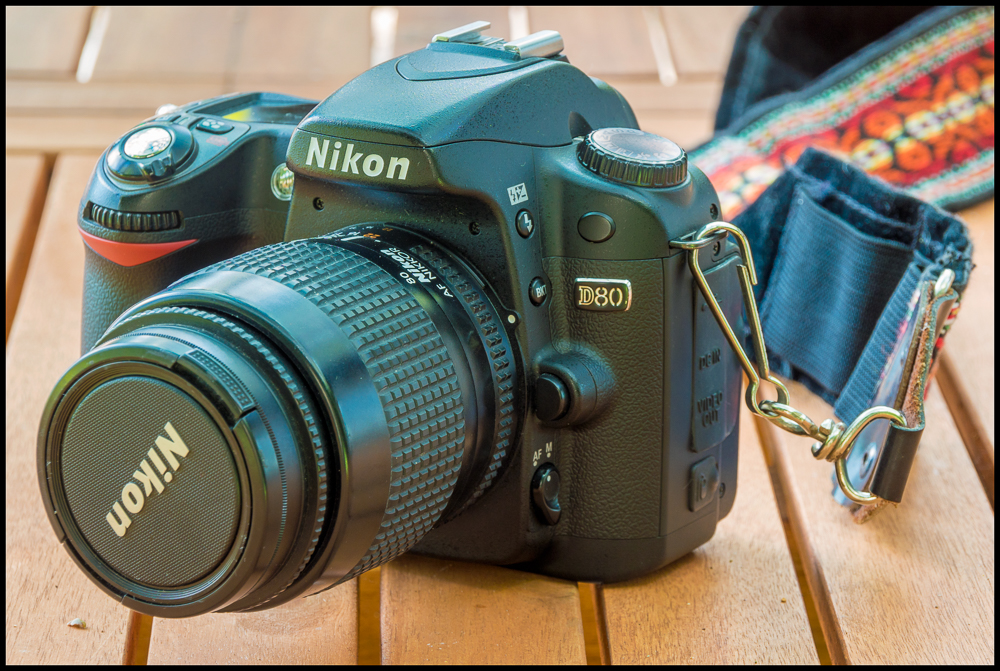
It’s a Nikon D80, which co-incidentally is the same model as the one my son-in-law has.

It came out in August 2006 and according to Nikon it has the following key features:

  • 10.2 effective megapixel Nikon DX Format CCD image sensor
  • High-speed continuous shooting: 3 frames per second (fps) in bursts of up to 100 consecutive JPEG (FINE M-size or smaller) or 6 RAW (NEF) images
  • Advanced high-precision, high-performance imaging processing engine with color-independent pre-conditioning
  • 3D-Color Matrix Metering II with 420-pixel RGB sensor delivers consistent and dependable automatic exposure for ideal results in most lighting conditions
  • Refined 11-area AF system with new Auto-area AF mode and center sensor that can be switched to wide-frame operation for broader coverage
  • ISO AUTO mode automatically adjusts sensitivity between ISO 100 to 1600, maximizing available light to help achieve optimal exposure
  • Seven automated Digital Vari-Programs (Auto, Portrait, Landscape, Close Up, Sports, Night Landscape and Night Portrait) optimize white balance, sharpening, tone, color, saturation and hue to match the scene.
    User-selectable choice of Normal, Softer, Vivid, More vivid, Portrait, Custom and Black-and-white image optimization options
  • Near-instant response with 0.18 sec. power-up and approx. 80-millisecond shutter release time lag promotes fast handling
  • Top shutter speed of 1/4,000 second and flash sync speeds up to 1/200 second
  • Fast image transfer via USB 2.0 Hi-Speed interface and SD memory card
  • Creative in-camera effects and editing functions consolidated under the new Retouch menu, including D-Lighting, Red-eye correction, Trim, Image Overlay, Monochrome settings (Black-and-white, Sepia, Cyanotype) and Filter Effects (Skylight, Warm filter, Color balance)
  • Multiple Exposure shooting option automatically produces an effect that resembles multiple exposure techniques used with film
  • Large 2.5-inch LCD monitor with ultra-wide 170-degree viewing angle for clear image preview and easy access to settings and information, including RGB Histograms
  • Selectable Slideshow function (Standard or Pictmotion)
  • SD memory card storage, SDHC compatible
  • Lightweight, compact body
  • High-energy EN-EL3e rechargeable lithium-ion battery delivers the power to shoot up to 2,700 pictures on a single charge and provides detailed battery status information. (Battery life figure determined by in-house test parameters)
  • Built-in Flash with i-TTL flash control and full support for Nikon’s Creative Lighting System
  • The D80 supports more than 43 AF NIKKOR lenses in addition to the growing family of DX NIKKOR lenses
  • Includes Nikon’s PictureProject software for easy control over image adjustment and management
  • Support for Nikon’s new Capture NX software, which provides easier access to powerful and visually intuitive enhancement tools that help tap the full potential of NEF images

While I’ve taken a few pictures with it already I don’t think I’ve used it enough to be able to say much at the present time so I’ll save my thoughts for a future post.