Woodlawn Cemetery – Bache Mausoleum

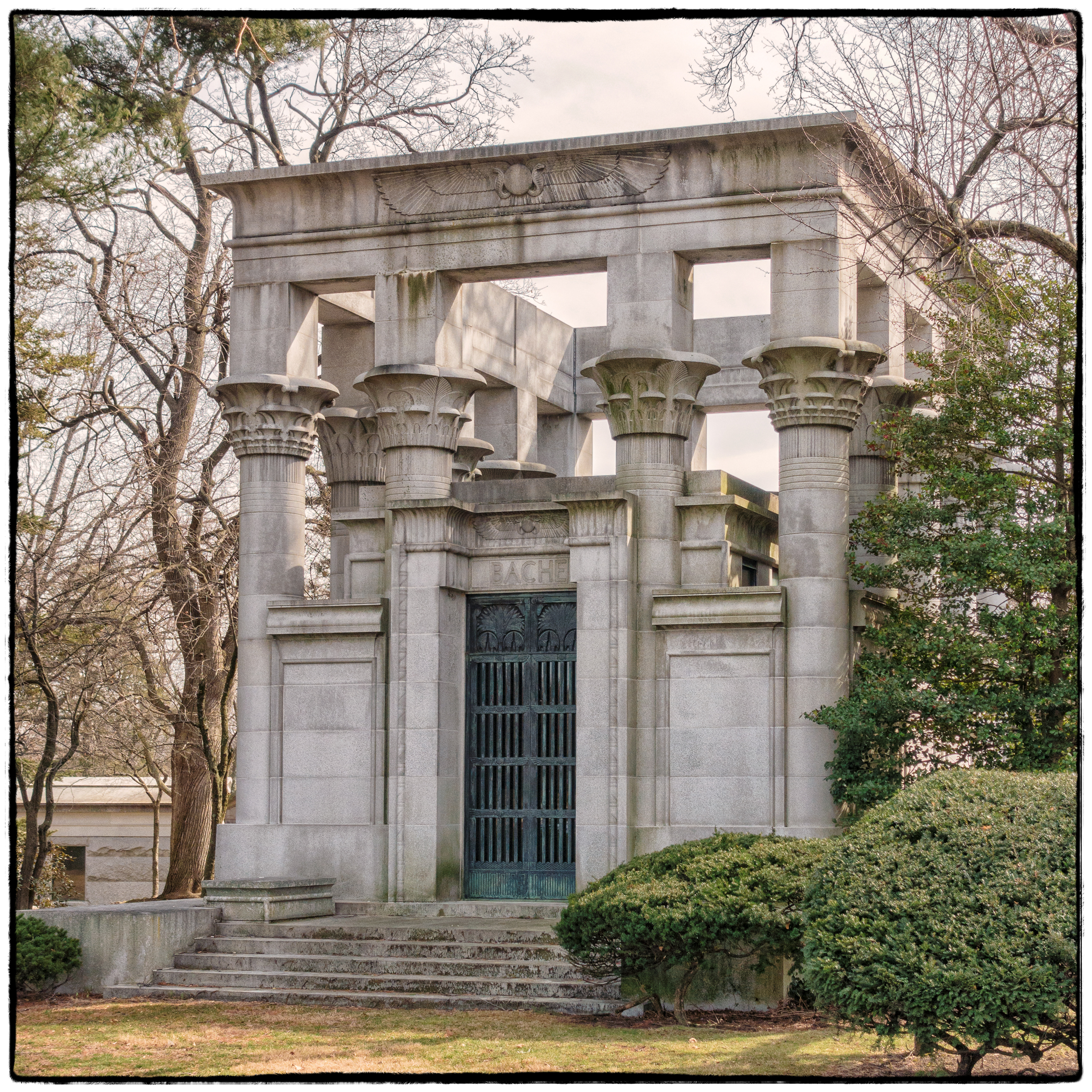
After the nearby Belmont Mausoleum we turn to another replica (of Trajan’s Kiosk), but this time not full scale: the Jules Bache (November 9, 1861 – March 24, 1944) mausoleum.

Again as explained by Douglas Keister in Mausoleums.com.

German born Jules Semon Bache rests among the many robber barons, financiers, and millionaires he lived with. Bache made his living as a banker and stockbroker In 1886 he became a minority partner in the stockbrokerage firm of Leopold Cahn & Co., then, when he took over full control of the company in 1892, renamed it J. S. Bache & Co. Through crafty investing and financial acumen he became enormously wealthy. And, to his credit he gave away much of his fortune to support the arts and charitable causes. He was a long time collector and patron of the arts and donated a number of Raphaels Rembrandts, Titians and others to the Detroit Institute of the Arts and the Metropolitan Museum of Art. In 1981 Bache & Co. was acquired by Prudential Financial, Inc. for $385 million, and is now known as Prudential Bache.

His tomb reflects his interest in the arts. He chose as his mausoleum, a replica of the elegant Kiosk of Trajan or “pharaoh’s bed” at the temple of Isis on the island of Philae on the Nile River. Bache’s Kiosk of Trajan was designed by Davis, McGrath & Kiessling in 1916 and fabricated of Barre granite by Farrington Gould & Hoagland The hallmarks of the Bache mausoleum are the 14 massive columns which are capped with abstractions of lotus blossoms (signifying the unfolding creative universe) and the open roof design. A winged solar disk which is associated with divinity and royalty is carved above the lintel. The winged sun is also symbolic of the soul. When placed above doors it served as a reminder to visitors of the eternal nature of their soul. The landscaped lot was designed by Charles Wellford Leavitt in 1918. Leavitt’s original design was quite Spartan and meant to reflect the aridity of the Egyptian climate. The Bache mausoleum and its grounds were featured in a 1917 article in Architectural Review magazine on mausoleum architecture, and in a 1921 article titled “Planting the Mausoleum Plot” in Park and Cemetery, magazine. It also appeared in the “Portfolio of Current Architecture” in the May 1920 issue of Architectural Record, and on covers of Park and Cemetery magazine in April, May, June and July 1932.

Woodlawn Cemetery – Belmont Mausoleum

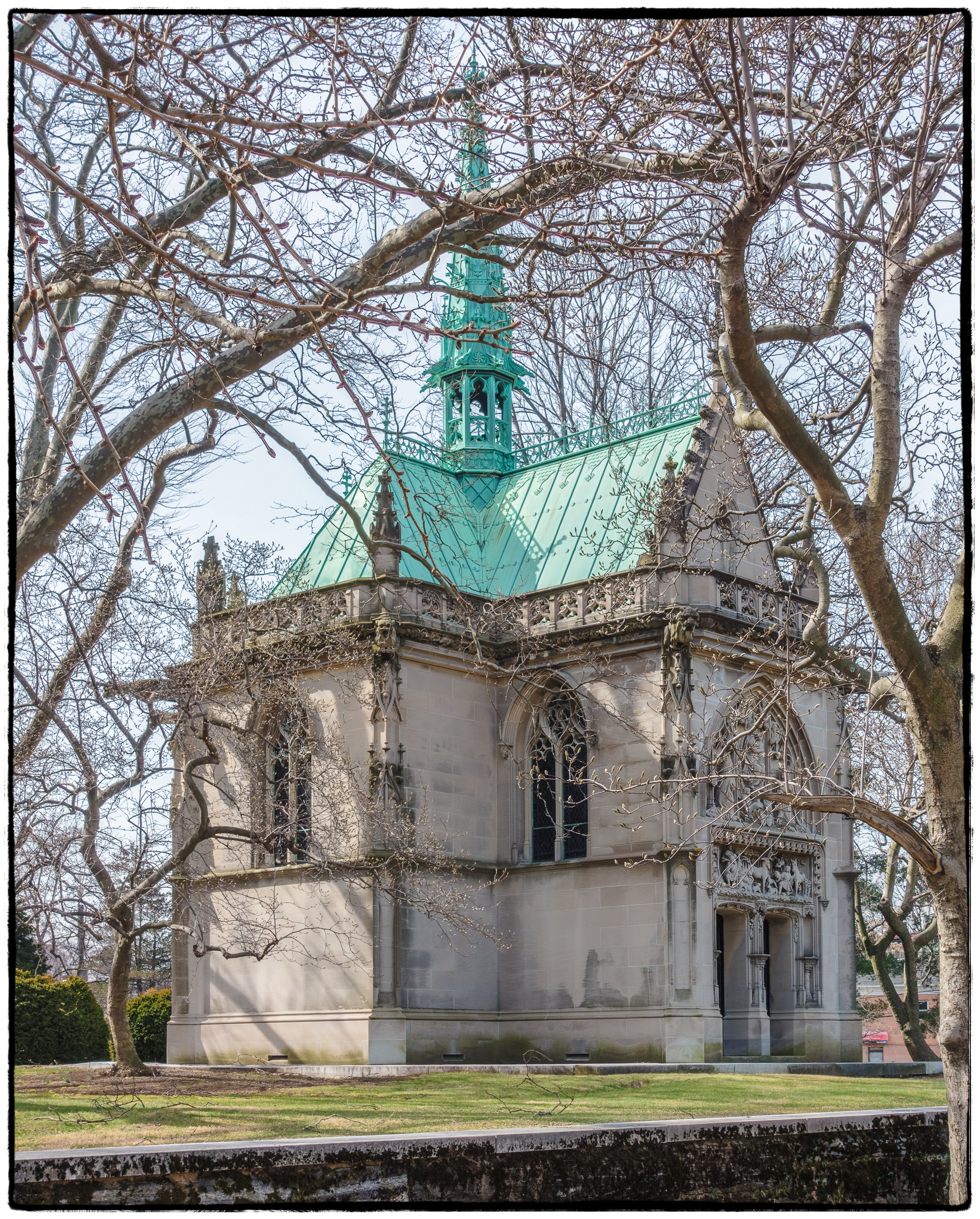
And now we come to the Chapel of Saint-Hubert in the Queens section of Chateau Amboise in France’s Loire Valley. Designed by Leonardo Da Vinci early in the 16th Century, it’s in the late gothic ‘flamboyant‘ style.

According to Atlas Obscura:

Da Vinci’s wish was to be buried in the church of St. Florentin in Amboise, which took place on August 12, 1519. However the church was demolished during the French Revolution in the late 18th century (and later by Napoleon I). The alleged bones of Da Vinci were discovered in 1863 and moved to the Chapel of Saint-Hubert in the gardens of the Château d’Amboise. Today, the tomb can be visited on the left side of the tiny chapel, where two epitaphs (in French and Italian) hang on the wall describing his birth, death, and how he came to rest in the Chapel of Saint-Hubert.

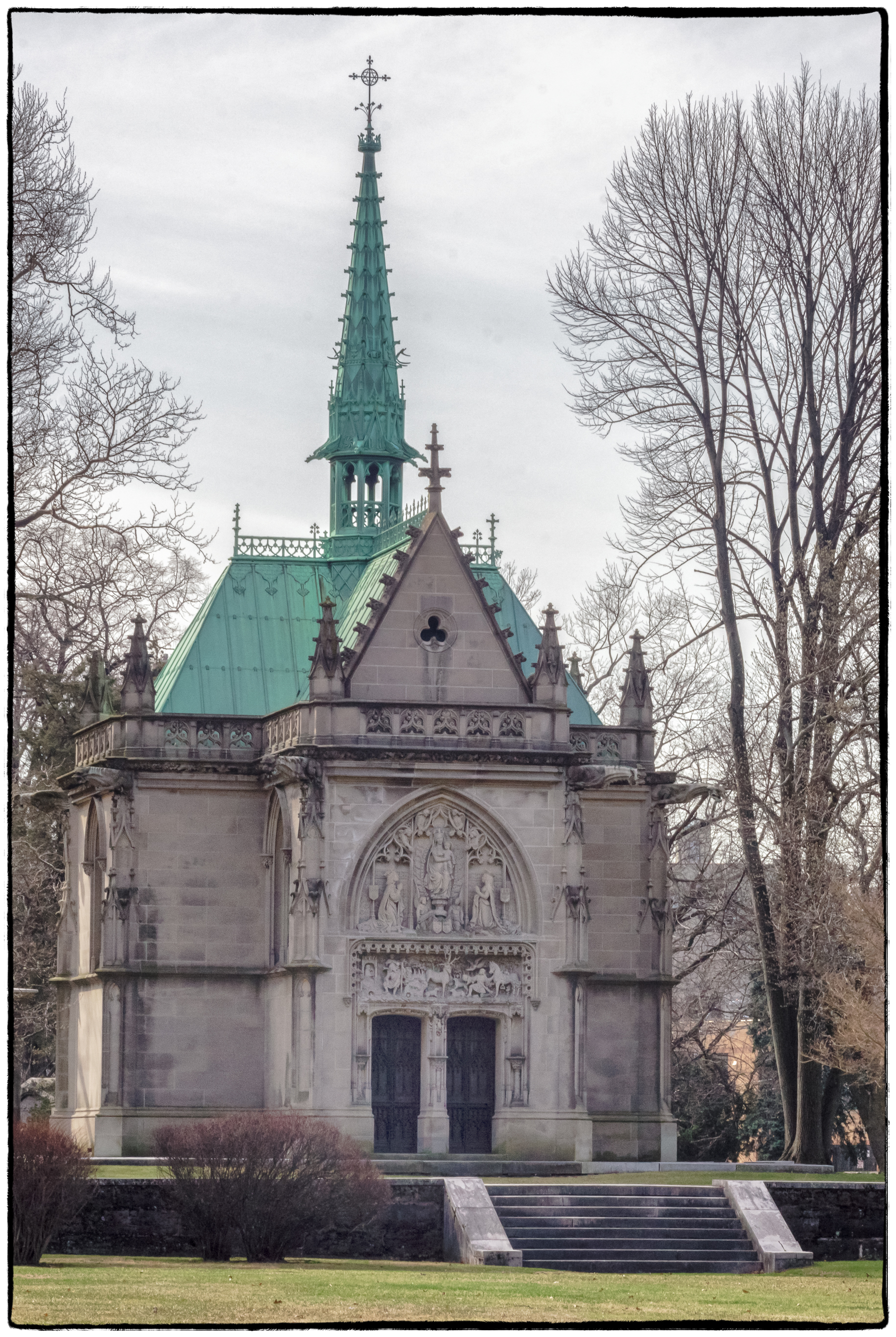
No, hang on a minute! Although I’ve been to Amboise and the Chapel of Saint-Hubert, this isn’t it! But it is a pretty much exact duplicate serving as the mausoleum for Oliver Belmont (November 12, 1858 – June 10, 1908) and Alva Vanderbilt Belmont (January 17, 1853 – January 26, 1933) in Woodlawn Cemetery.

According to Douglas Keister on Mausoleums.com:

The Belmont version was designed by the architecture firm of Hunt & Hunt (1908) and fabricated in limestone by Barr Thaw & Frazer.

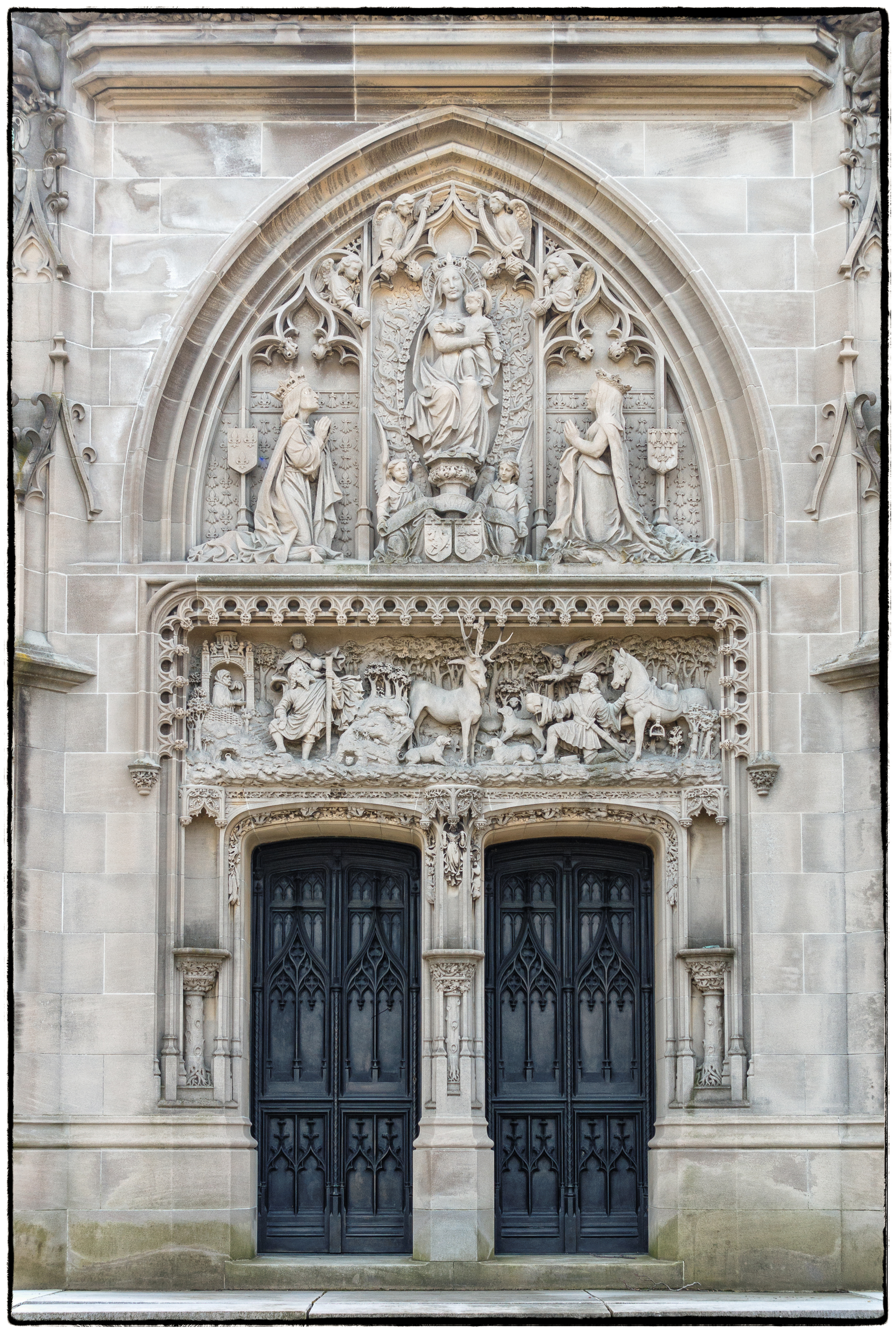
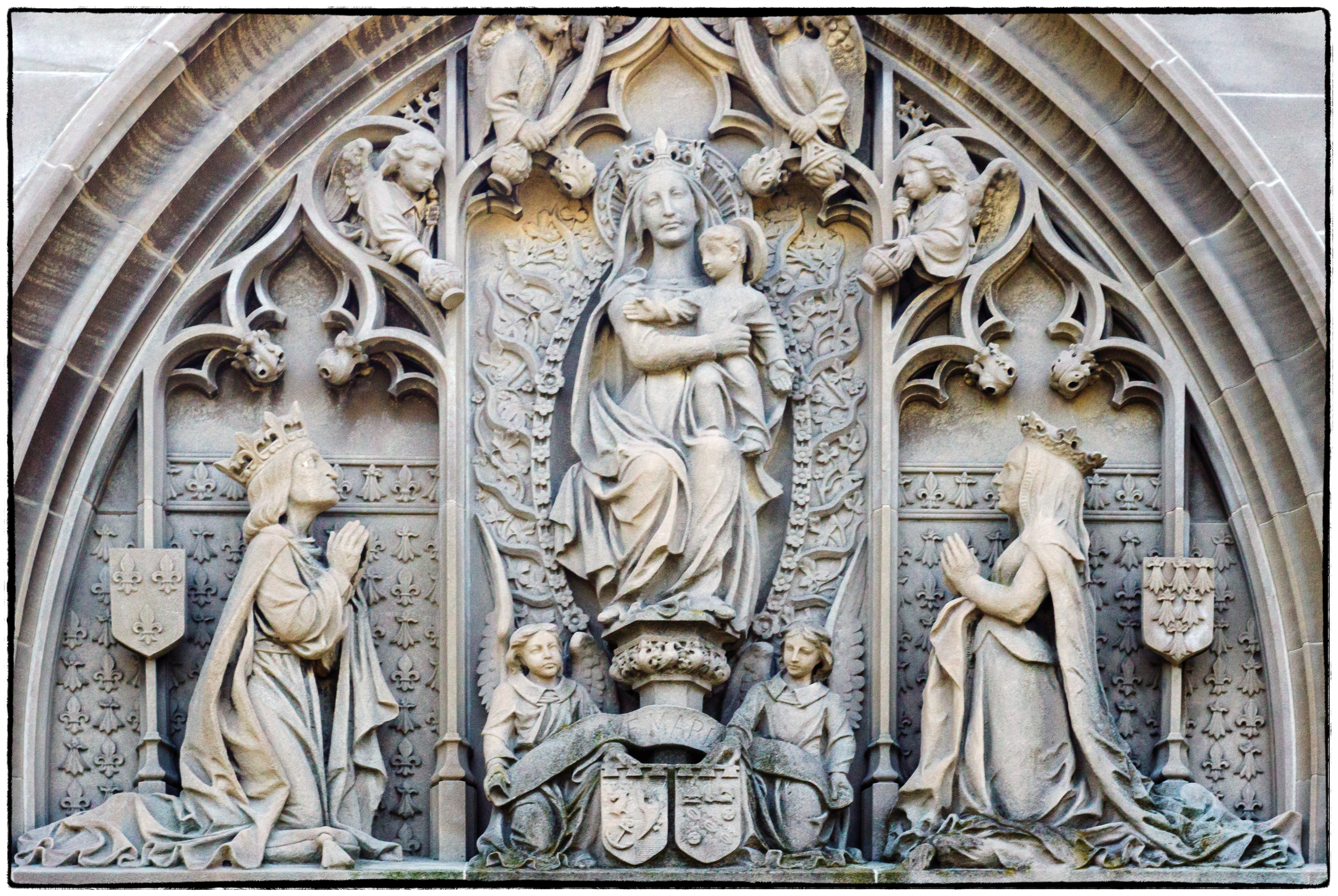
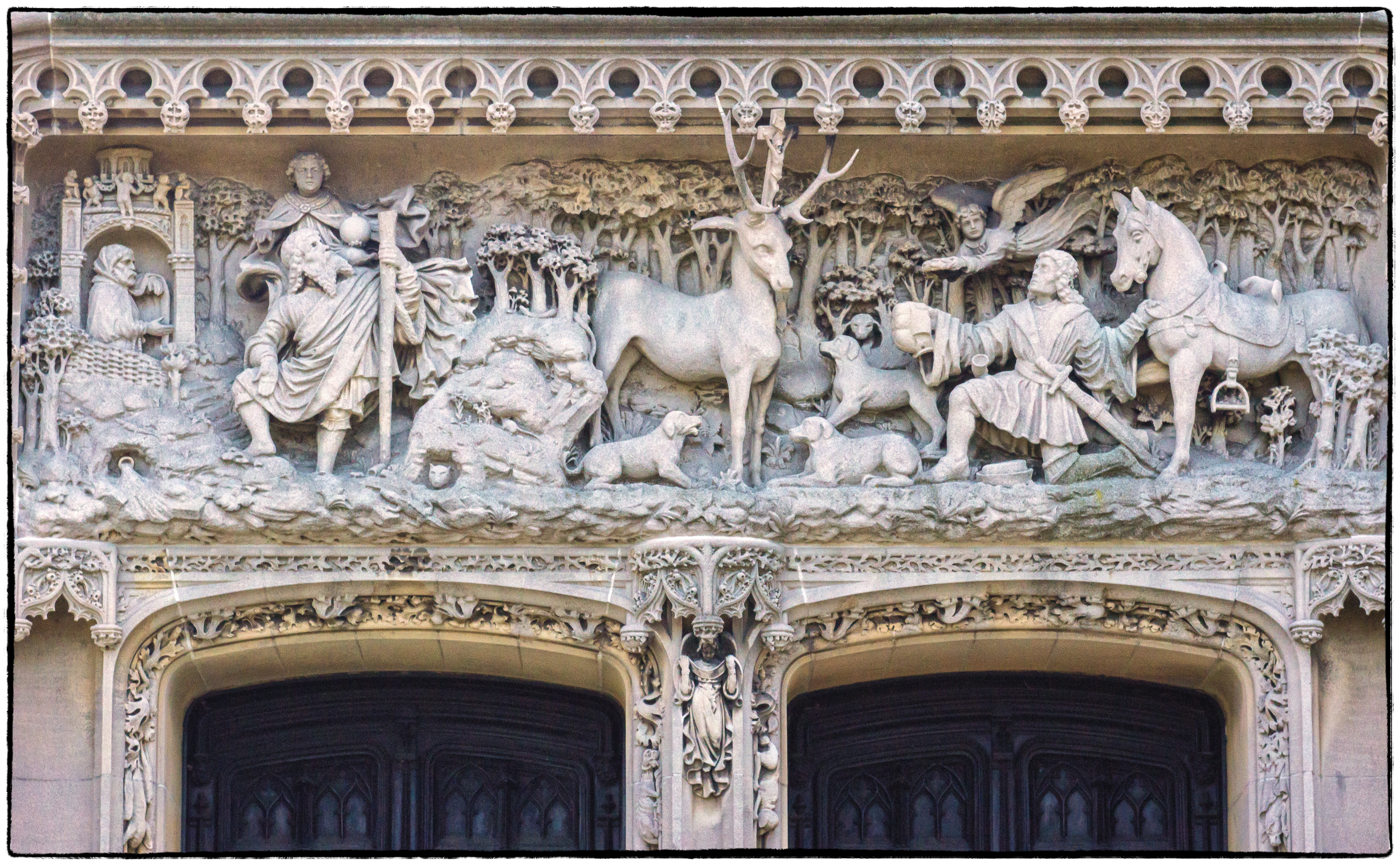
Architect R.H. Hunt, in designing the relief panels above the entry of the Belmont mausoleum made very few changes from the originals on the Chapel of St. Hubert in Amboise, France. The central figure in the lintel is a stag with what looks like a crucifix growing from its head. The crucifix is actually supposed to be wedged in its antlers and represents the stag that caused St. Hubert to convert to Christianity. Also occupying the panel are St. Hubert, patron saint of the hunt, St. Christopher, St. Anthony, dogs, angels, cherubs, and various woodland creatures. The tympanum’s central figure is the Madonna and Child flanked by the kneeling figures of Charles VIII of France and his Queen, Anne of Brittany.

Oliver Hazard Perry Belmont who rests beneath the protruding gargoyles of his mausoleum was hardly a religious man. O.H.P. Belmont’s great love was horses. He was the founder of the Belmont Raceway. He was also a financier and a U.S. representative in Congress from New York. After O.H.P. died, following an attack of appendicitis, his wife Alva Vanderbilt Belmont (she was previously married to William Vanderbilt), used large sums of her fortune to support the growing suffragette movement. Alva lived a long life, and, after her death in Paris in 1933, her remains were interred in the Belmont mausoleum. Interred along with Alva is the suffragette banner she carried, inscribed with the words, “failure is impossible”. The banner hangs inside the mausoleum. As early as 1917, Alva Belmont opened the mausoleum to the public and today it is frequently opened for tours given by the Friends of Woodlawn Cemetery.

R.H. Hunt and his father Richard Morris Hunt were partners in an architectural firm that specialized in designing residences for the rich and famous. Richard Morris Hunt designed residences for Alva when she was a Vanderbilt and R.H. Hunt designed this mausoleum for her when she was a Belmont. She may have switched husbands but she knew a good architectural firm when she found one.

The second and last pictures were taken with a Sony RX100M3 and the remainder with a Sony NEX 5N and Leitz 90mm f4 Elmar.

Entrance

Tympanum detail

Tympanum detail

Three quarter view

Woodlawn Cemetery – Franz Otto Matthiessen Mausoleum

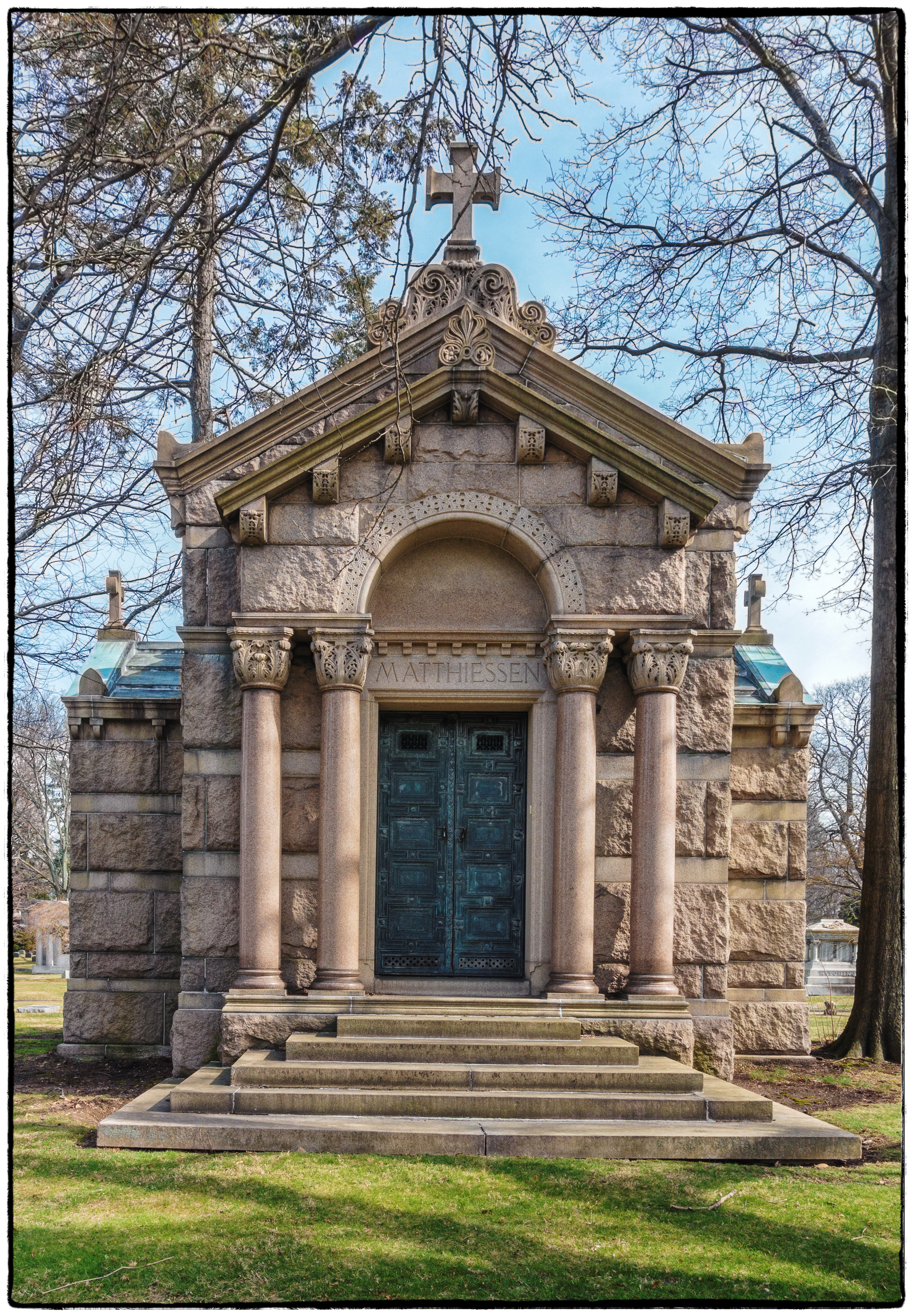
I just loved the way this one looked: the color of the stone; the diminishing size of the steps; the four columns, which do not seem to belong to any of the classical orders (maybe Egyptian?) and whose capitals are each carved differently; the bronze door; the cross above the open pediment with the ornate carvings beneath it. Lovely.

The National Register of Historic Places Registration Form (itself a fascinating, illustrated document covering a number of lesser known monuments about which information is not readily available elsewhere) for Woodlawn Cemetery contains this entry:

Franz O. Matthiessen mausoleum (structure) in Lake Plot, Section 61 has a series of windows by Tiffany Studios (1890). Designed by Heins and La Farge, the mausoleum is constructed of roughhewn red granite. Franz Mathiessen made his fortune in tobacco sales and distribution.

According to Wikipedia:

Heins & LaFarge was a New York-based architectural firm composed of the Philadelphia-born architect George Lewis Heins (1860–1907) and Christopher Grant LaFarge (1862–1938), the eldest son of the artist John La Farge. They were responsible for the original Romanesque-Byzantine east end and crossing of the Cathedral of St. John the Divine, New York, and for the original Astor Court buildings of the Bronx Zoo, which formed a complete ensemble reflecting the aesthetic of the City Beautiful movement. Heins & LaFarge provided the architecture and details for the Interborough Rapid Transit Company, the first subway system of New York.

As for Mr. Franz Otto Matthiessen. According to: Sugar House. American Sugar Refining Company. Sugar House Lofts at Liberty Cove, 174 Washington Street on New Jersey City Past and Present.

The largest of Jersey City’s sugar refineries was established by German immigrants Franz Otto Matthiessen (1833-1901) and William Alfred Weichers (1835-1888). Matthiessen had learned the basics of sugar refining as an apprentice in Hamburg, Germany. In 1858 he immigrated to America where he worked in several refineries in New York and Boston before opening his own establishment in Jersey City. He and Weichers founded the New Jersey Sugar Refining Company which soon became known as the Matthiessen & Weichers’ Sugar Refining Company.

Danish-born architect Detlef Lienau (1818-1887) designed the first refinery for the new company that was constructed in 1863 on the southern bank of the Morris Canal between Washington and Warren Streets. The firm was quick to implement technological innovations in sugar refining such as centrifugal processing. By 1875, Matthiessen & Weichers’ sugar refineries expanded north of the Morris Canal, and the company built a new seven-story office and warehouse on the site of the old Jersey Glass Works factory at the southwest corner of Washington and Essex Streets. The old American Pottery Company buildings on Warren Street between Essex and Morris Streets survived a little longer but these were finally demolished in 1892 for sugar house expansion.

Faced with recurring oversupplies of sugar and an overall decline in its price, owners of some of the larger refineries made various attempts to reduce competition within the sugar industry and revive profitability. By 1891, under the leadership of the Havemeyer family of Brooklyn, NY, several major sugar refining plants, including Jersey City’s own Matthiessen & Weichers Co., were consolidated under a single corporate ownership called the American Sugar Refining Company. The incorporation papers were filed in New Jersey to avoid New York State’s stricter regulations, which had earlier thwarted the Brooklyn-based Havemeyers. Matthiessen relinquished direct control of his Jersey City refineries, but maintained considerable influence as a Director and Treasurer of the new organization. Often referred to as the “Sugar Trust,” the industry remained a frequent target of anti-monopoly government lawsuits from its inception through the 1920’s.

An art collector and enthusiast, Matthiessen officially retired from the American Sugar Refining Company in January 1900 to pursue travel in Europe. However, he died not long afterwards and is buried in Woodlawn Cemetery in The Bronx, NY. At the time of his death, his estate was valued at approximately 15 million dollars.

His ‘Find a Grave‘ entry includes a scan (source not identified) of an obituary dated Paris, March 9, which contains the following poignant paragraphs:

Few men possessed a stronger physique than Mr. Matthiessen, and one of his closest friends said yesterday that he was sure Mr. Matthiessen’s death was precipitated by a broken heart. While in Italy in 1889, with her father nd mother, Mr. Matthiessen’s only daughter, Helen, then just twenty years old, died. She was a very beautiful woman, and was engaged to be married to an Italian Count.

The shock was a terrible one for the father and mother. Mr. Matthiessen brought the body home and kept it in his residence at Irvington-on-Hudson for several months, refusing to have it interred. He closed up his house at 580 Fifth Avenue and retired from all social life. He had been in deep mourning ever since. Mrs. Matthiesen was so stricken by the grief that her nervous system was undermined, and she is now an invalid.

Not surprisingly Helen Matthiessen is also interred in the mausoleum.

Woodlawn Cemetery – Our Bell

Although it’s not one of the famous mausoleums, or the final resting place of someone famous I found myself strangely drawn to this small monument.

The extract below (from a post entitled Our Bell by Neil J Murphy on Talking Pictures) pretty much sums up my own views.

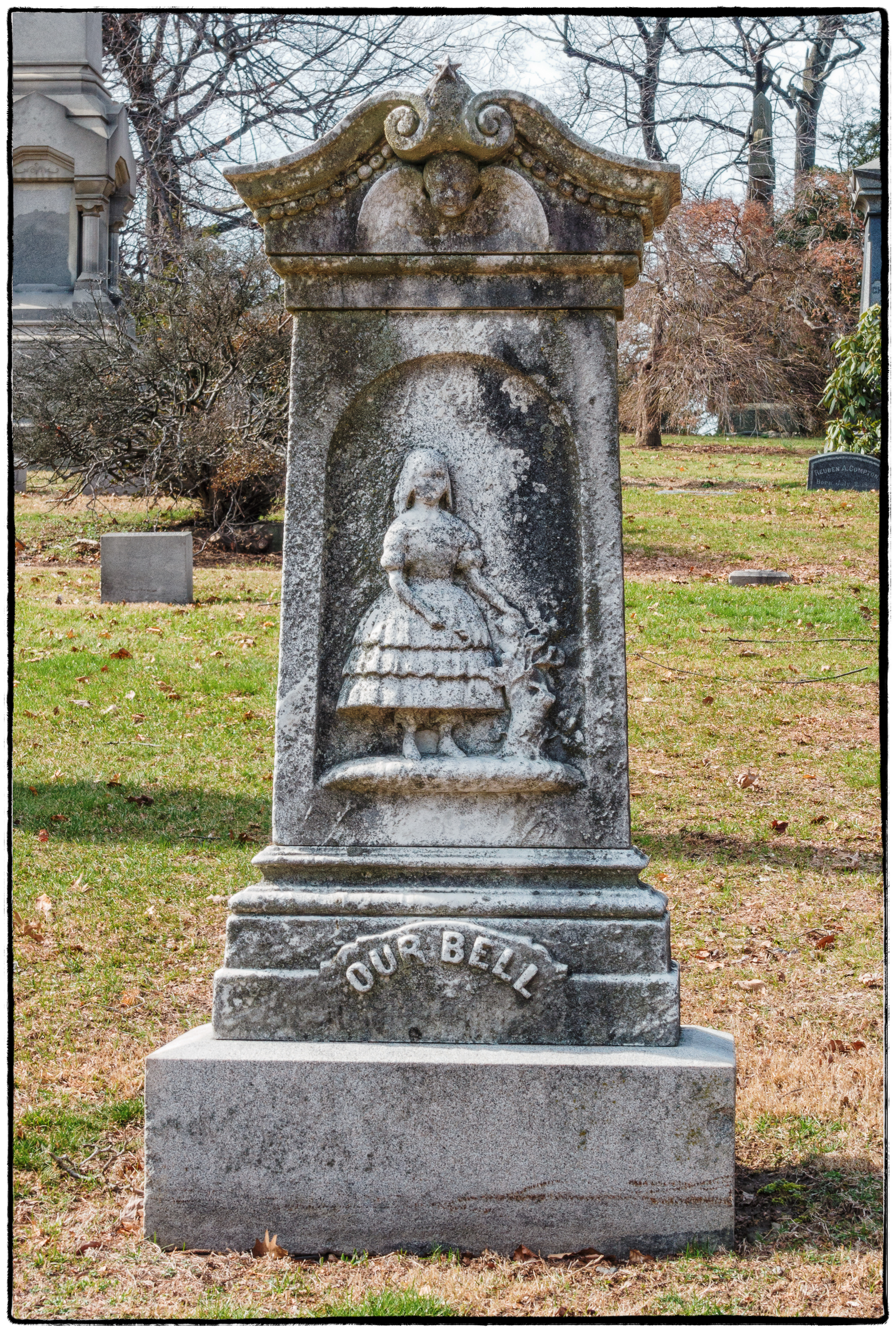
I think the creepiest memorials in any cemetery, without fail, are the ones for children. Take for example, ‘Our Bell’ (which I first mistook for ‘Our Bill’, given the angle of the sunlight on the eroded relief) in the Lake section of New York’s Woodlawn Cemetery.

Her stone stands alone, with no obvious connection to the surrounding plots. There are no dates, no family name, just the carving of an Alice-in-Wonderland figure of a little girl standing under an arch, her right hand resting on the top of her hoop skirt, her features worn away by time and weather. She looks as if she could have stepped out of a Seurat painting; you can almost see the parasol in her left hand, just the other side of the stone.

Really though, I think she looks for whoever left her here.

The only thing I’d disagree with is the use of the word ‘creepy’. I don’t find child graves any more creepy than any other graves. They just make me feel very sad: that a life was cut short before it really had a chance to get going. Usually when I’m in a cemetery I’m focused more on the architecture, statuary, flora, peace, tranquility etc. than I am on thoughts of death. Child graves are an exception. You can’t see one without thinking about mortality.

As the author of the extract above indicates, this monument seems to be all by itself, not connected to anything around it. And it’s anonymous, with no indication of who “Our Bell” was. This sense of isolation and ‘disconnectedness’ is only emphasized by the erosion of the stone, particularly of the face. This to me only adds to the sense of sadness (even loneliness) that I feel when I come across one of these graves.

Another child grave that had a big impact on me can be seen in Sad Photo.

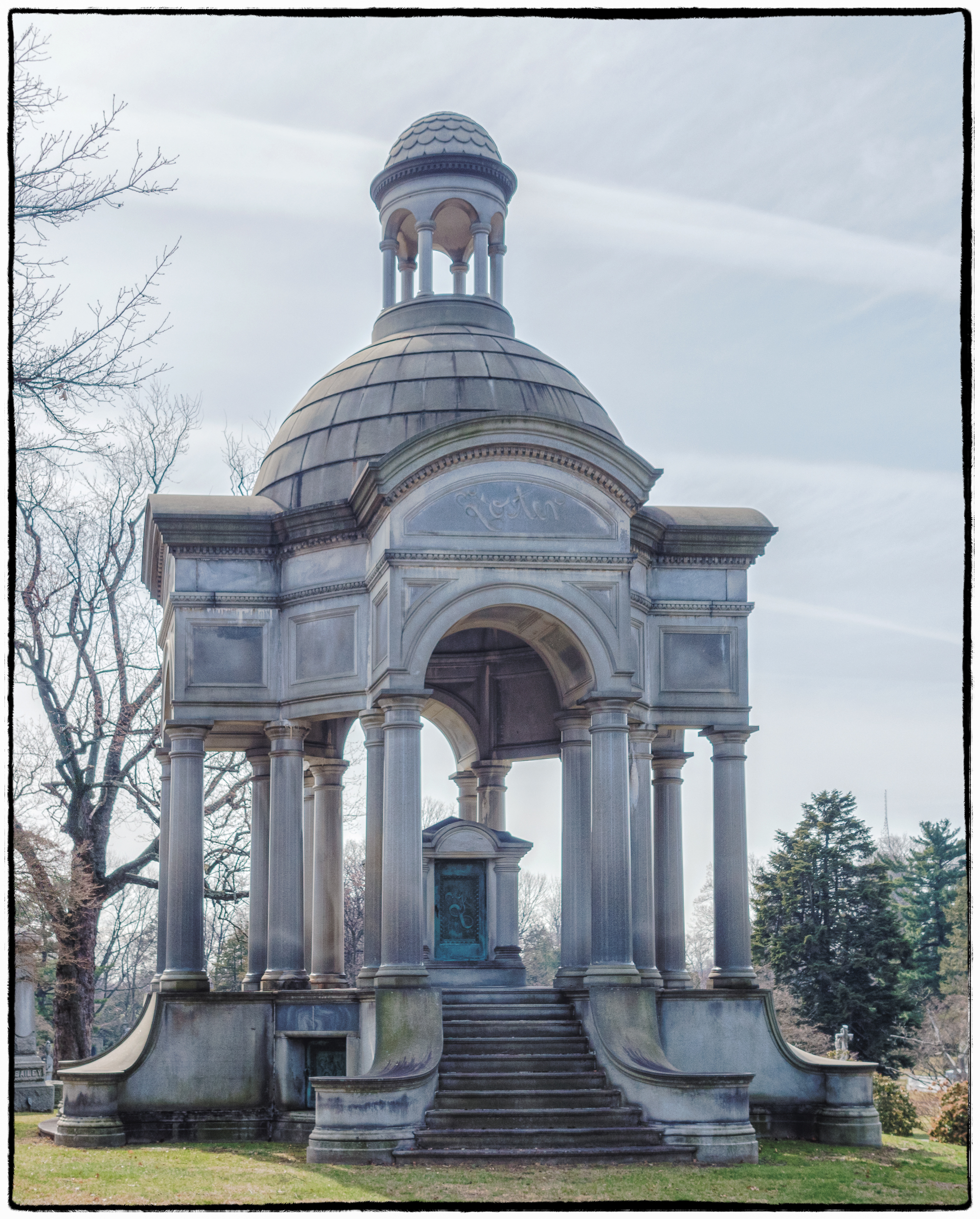
Woodlawn Cemetery – William F. Foster Tomb

According to Keister:

William F. Foster made his rather large fortune by manufacturing a rather small product: fasteners. He also made kid gloves. His final resting place was the subject of a lot of media attention when it was constructed in 1895. The canopied granite structure, which has a cruciform footprint, was designed by architect John Wooley, who had offices at 111 Fifth Avenue. Wooley’s design broke the mausoleum mold since it did not have walls and a door. Despite using massive blocks of granite, the tomb has a much lighter feel, thanks to its open air construction. The base of the tomb is a single 42 x 24 foot 40 ton slab of granite, which was one of the largest ever quarried in Westerly, Rhode Island, an early center for granite quarrying in the United States. Under the slab are catacombs, which have space for eight permanent residents. Centermost on the massive slab is a double sarcophagus containing the mortal remains of William F. Foster. Sixteen Tuscan columns frame the stone ensemble. In all over 1,100 tons of granite were used in the construction of the 52-foot-high tomb.

The structure takes the form of a canopy tomb rather than a mausoleum, although its sheer size puts it in a classification usually reserved for mausoleums. In the simplest sense, canopy tombs are tent-like structures that shelter a sarcophagus. These structures, usually composed of columns or pillars supporting a dome, are open-air affairs, and unlike mausoleums, they have no doors restricting entry. Copies may be seen in a variety of ancient architecture. They didn’t become part of the European and American architectural repertory until the eighteenth century, when architects began using them for garden pavilions. The decorative potential of these canopied pavilions and kiosks were soon exploited by designers of funerary monuments. The are often seen hovering of a grave or small monument, or sheltering a sarcophagus. The Foster Tomb is among the largest canopy tombs in the world.

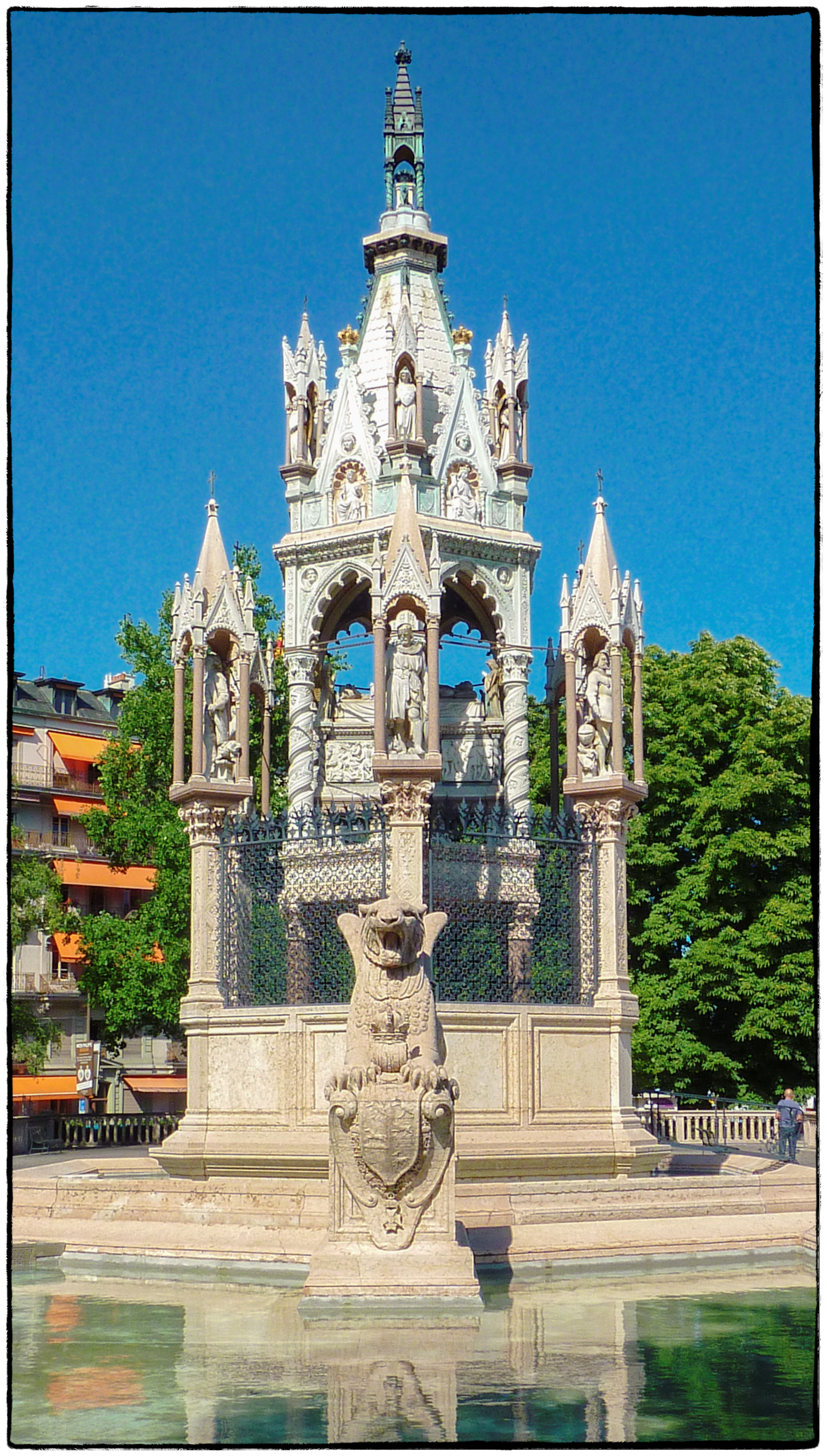
When I saw this tomb I recalled from my days living in Geneva another similar, although more gothic in style, canopy tomb: The Brunswick Monument (see below) – itself a copy of the Scaliger Tombs in Verona, Italy. This tomb was built in 1879 for Charles II, Duke of Brunswick (1804 – 1873). It stands right next to Lake Geneva near to the Mont Blanc bridge (Pont de Mont Blanc). The story that is told in Geneva is that he left his fortune to the City of Geneva on the condition that he be entombed facing the lake. The story went on to say (and I don’t know if this part can be verified) that the the fortune turned out to be less than anticipated so they placed him facing away from the lake rather than towards it. See: Lake Geneva 2004 – View from my hotel room for the kind of view that the Duke would have wanted. The monument is right next to the hotel I stayed in).