Pictures at an exhibition – Multiply, Identify, Her

According to the Center’s website:

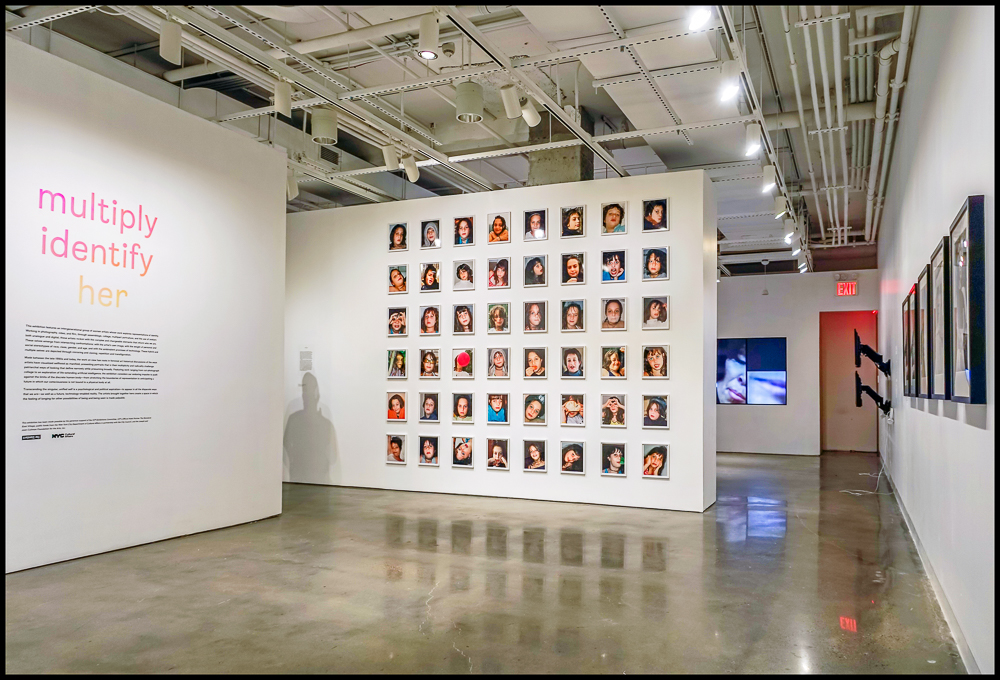
This exhibition features an intergenerational group of women artists whose work explores representations of identity. Working in photography, video, and film, through assemblage, collage, multipart portraiture, and the use of avatars both analogue and digital, these artists reckon with the complex and changeable elements that inform who we are. These selves emerge from intersecting confrontations: with the artist’s own image, with the weight of personal and social stereotypes of race, class, gender, and age, and with the ambivalent promises of technology. These hybrid and multiple selves are depicted through mirroring and cloning, repetition and transfiguration.

Made between the late 1990s and today, the work on view has roots in feminist art historical discussions of the ways artists have visualized selfhood as manifold, presenting portraits that in their multiplicity and radicality challenge patriarchal ways of looking that define narrowly while presuming broadly. Featuring work ranging from cut-photograph collage to an exploration of life-extending artificial intelligence, the exhibition considers our enduring impulse to push against the limits of the discrete human body—from stretching the boundaries of representation to anticipating a future in which our consciousness is not bound to a physical body at all.

Transcending the singular, unified self is a psychological and political aspiration—to appear in all the disparate ways that we are—as well as a future, technology-enabled reality. The artists brought together here create a space in which the feeling of longing for other possibilities of being and being seen is made palpable.

– Marina Chao, Curator

The exhibition features the work of Mickalene Thomas; Geta Brătescu; Wangechi Mutu; Lorna Simpson and Barbara Hammer.

I’m afraid this exhibition didn’t really appeal to me – maybe just a bit to avant-garde for my tastes (for example a series of photographs seemed to portray a nude figure with internal organs overlaid and titled “What You Are Not Supposed to Look At”. So I didn’t spend a lot of time there. Maybe I should have? Maybe I would have understood more?

Taken with a Sony RX-100 M3.

Pictures at an exhibition – Pittsburgh 1950, Elliott Erwitt

The second exhibit I visited was “Pittsburgh 1950” and the work of Elliott Erwitt. According to the Center’s website:

In 1950 Elliott Erwitt, then just twenty-two years old, set out to capture Pittsburgh’s transformation from an industrial city into a modern metropolis. Commissioned by Roy Stryker, the mastermind behind the large-scale documentary photography projects launched by the US government during the Great Depression, Erwitt shot hundreds of frames. His images recorded the city’s communities against the backdrop of urban change, highlighting his quiet observations with the playful wit that has defined his style for over five decades. After only four months, Erwitt was drafted into the army and sent to Germany, leaving his negatives behind in Stryker’s Pittsburgh Photographic Library. The negatives remained at the Pennsylvania Department of the Carnegie Library of Pittsburgh for decades. This exhibition, organized by Assistant Curator Claartje van Dijk in association with the photographer, will present these images in the United States for the first time.

This exhibition is right next to “The Decisive Moment” – so close in fact that I didn’t immediately realize that I was no longer seeing works by Cartier-Bresson. I’m something of a fan of Erwitt too (particularly for the humor he brings to his work), but seeing it right next to Cartier-Bresson I couldn’t help be feel it was a step down. I did try to bear in mind, however, that this is very early Erwitt (he was only 22 at the time where Cartier-Bresson was 44 when “The Decisive Moment” was published) and I’m such a fan of Cartier-Bresson that, to me, almost anything would suffer by comparison.

The exhibition runs until September 2, 2018.

For more on the story behind these pictures see the video below: “What Were You Thinking?” with Legendary Magnum Photographer Elliott Erwitt

Taken with a Sony RX-100 M3.

Pictures at an exhibition – The Decisive Moment, Henri Cartier-Bresson

We went into New York City the other day and while my wife was shopping I went down to the International Center of Photography. The exhibitions used to shown in their location in midtown west, which was quite convenient when I was still working. I hadn’t been to this new location before, but it turned out to be only a short train ride from Grand Central Terminal.

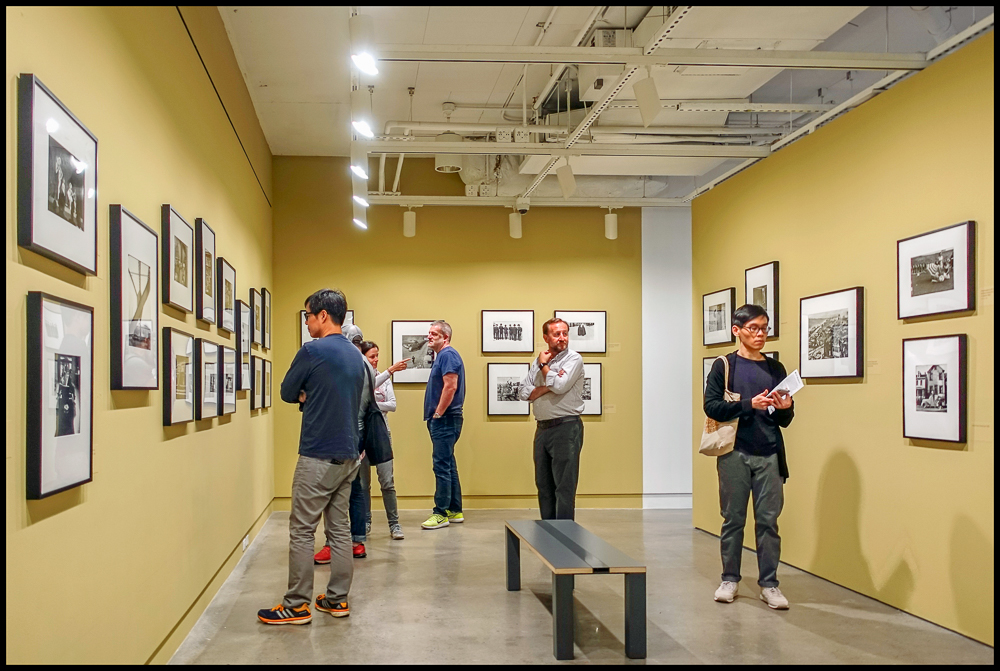
Four exhibitions were being held. The picture above shows Henri Cartier-Bresson: The Decisive Moment. According to the Center’s website:

Henri Cartier-Bresson: The Decisive Moment examines Cartier-Bresson’s influential publication, widely considered to be one of the most important photobooks of the twentieth century. Pioneering for its emphasis on the photograph itself as a unique narrative form, The Decisive Moment was described by Robert Capa as “a Bible for photographers.” Originally titled Images à la Sauvette (“images on the run”) in the French, the book was published in English with a new title, The Decisive Moment, which unintentionally imposed the motto which would define Cartier-Bresson’s work. The exhibition details how the decisions made by the collaborators in this major project—including Cartier-Bresson, French art publisher Tériade, American publisher Simon & Schuster, and Henri Matisse, who designed the book’s cover—have shaped our understanding of Cartier-Bresson’s photographs. Through vintage gelatin silver prints, first-edition publications, periodicals, and correspondence, Henri Cartier-Bresson: The Decisive Moment brings new insights to this iconic work.

I’m a big fan of Cartier-Bresson and it was inspiring to see some of his work “in the flesh” (i.e. not on the internet or in books) as it were. I’ve always been in awe of his ability to blend form and content in the split second it took him to see and take the photograph.

The exhibition runs until September 2, 2018. It’s well worth seeing.

Taken with a Sony RX-100 M3.

A Year in Photography: Magnum Archive

I recently picked a copy of this book. Amazon.com describes it as follows:

Now available again in a stunning new format, this generously illustrated book for lovers of photography includes 365 images from the greatest photojournalists of today and yesterday. Founded by Henri Cartier-Bresson, Magnum Photos is the iconic international photographic cooperative whose members have captured the major historical events of their times, as well as private and intimate moments. A year’s worth of these images is offered in this visually stunning book that features full page reproductions organized to reflect what CartierBresson himself declared a “community of thought, a shared human quality, a curiosity about what is going on in the world, a respect for what is going on and a desire to transcribe it visually.” Nearly 70 photographers are represented with five to six images each, and the current Magnum members have selected the photographs that they consider to best represent their own output. Running more than 700 pages, this book includes images that make history both individual and universal.

It’s a small (about 7 inches by 7 inches), thick book so of course the images inside are also quite small. There’s little in the way of explanatory text. No introductory essay. No text other than brief captions (usually just the name of the photographer and the place/date where the photograph was taken) accompanying the photographs. Just a short (four paragraphs) blurb from Jonas Bendiksen, President of Magnum Photos (2010) and an even shorter (two paragraphs) piece from Marie-Christine Biebuyck, Magnum Photos.

There were a few images that I was familiar with, but the vast majority I’d not seen before. I find it a great book to keep handy so that I can pick it up from to time just to browse through the beautiful photographs.

A photographically interesting couple of hours in Pleasantville, NY

A few days before Christmas my wife was going to lunch with a friend in Pleasantville, NY. I needed to get out of the house so I decided to go along with her. I knew that there was a small bookstore in Pleasantville and I thought that I would “check it out” and then grab a bite to eat.

I set off walking in the direction of the bookstore when I spotted this photo store: Photoworks. I’d noticed it before, but it always seemed to be closed when I went by. Assuming that it was largely devoted to photofinishing, scanning etc. I was about to walk by when, looking through the window, I noticed a glass case inside – full of vintage cameras. I went in and asked the women if the cameras were for sale or just for display. She called her husband, George who emerged from the back somewhere and we had a long conversation about vintage cameras. Inside the case were two Nikon Fs (see above). I’d wanted one of these for a while, the price was right and the prospect of actually having a human being I could bring the camera back to in case of problems was appealing. I told him I would consult with my wife and return later.

I continued on to the bookstore: The Village Bookstore, a very pleasant establishment, small but well stocked and with a nice atmosphere. Among the shelves I came across (and purchased) this recently published biography of Robert Frank: American Witness. The Art and Life of Robert Frank.

Time to start looking for somewhere to eat. Then I spotted this building. On the front it said “The Gordon Parks Foundation“, so I went inside to take a look. I didn’t even realize that such an institution existed in Pleasantville. Inside they had a small selection of books by/on Gordon Parks but the bulk of the space was taken up by an exhibition: Element: Gordon Parks and Kendric Lamar. According to the Foundation’s website:

The Gordon Parks Foundation announced the opening of ELEMENT – a new exhibition on view at the Foundation’s exhibition space from December 1—February 10 showcasing Gordon Parks photographs that inspired rapper Kendrick Lamar’s music video ELEMENT from his album, DAMN. Lamar, known for using powerful images in his music videos, directly references and revives a number of Parks’ images that explore the lives of Black Americans, including the 1963 photo Boy With Junebug, Untitled, the 1956 photo from Parks’ “Segregation Stories” series, Ethel Sharrieff, a 1963 photo from his “The White Man’s Day Is Almost Over” photo essay about Black Muslims, as well as photos form Parks’ 1948 “Harlem Gang Leader” series.

“Gordon Parks’ work is continuing to have a great impact on young people – and particularly on artists like Kendrick who, use the power of imagery to examine issues related to social justice and race in our country,” said Peter W. Kunhardt, Jr., Executive Director of The Gordon Parks Foundation. “With ELEMENT the music video, Kendrick has helped to call attention to one of the most important artists of our time.”

Long-time friend and supporter of The Gordon Parks Foundation, Kasseem Dean (aka, Swizz Beatz) noted, “I’m so inspired that my friend Kendrick Lamar chose the iconic imagery of the legendary Gordon Parks in his video for ELEMENT. It’s a prime example of how contemporary change makers – artists, musicians, filmmakers, designers – can borrow from the greats of the past who were also working towards social change.”

At the foundation of ELEMENT. are Parks’ photo essays exploring issues related to poverty and social justice which established him as one of the most significant story tellers of American society. “Harlem Gang Leader,” the photo essay published in LIFE magazine, is credited with introducing Parks to America. The photos explored the world of Leonard “Red” Jackson, the leader of a gang in Harlem. Soon after, Parks was offered a position as staff photographer for the magazine, making him the first, and for a long time the only, African American photographer at the magazine. Also published in LIFE, Parks documented the daily life of an extended African American family living under Jim Crow segregation in the rural South entitled “The Restraints: Open and Hidden.”

The Guardian has also published an interesting article on this exhibition: The story behind Kendrick Lamar’s Gordon Parks exhibition

After that I decided that I didn’t have enough time to eat before meeting my wife so I adjourned to a nearby bar
Foley’s Club Lounge for a couple of beers.

According to Mount Pleasant by George Waterbury, Claudine Waterbury, Bert Ruiz:

Harry Foley was a Pleasantville High School Basketball legend. He was also a Niagara University Hall of Fame and Westchester County Hall of Fame athlete. He bought Gorman’s Club Lounge on Bedford Road in 1950 and maintained the establishment until the 1970s. Foley’s Club Lounge has been a traditional watering hole for generations of Pace University students for nearly a half century.

When my wife finished her lunch we met up and I asked her if she’d like to buy me a Christmas present. She said yes so it was off back to the photo store to pick up the Nikon F with Photomic Ftn finder.

All in all a photographically speaking an interesting day, if rather unexpected.