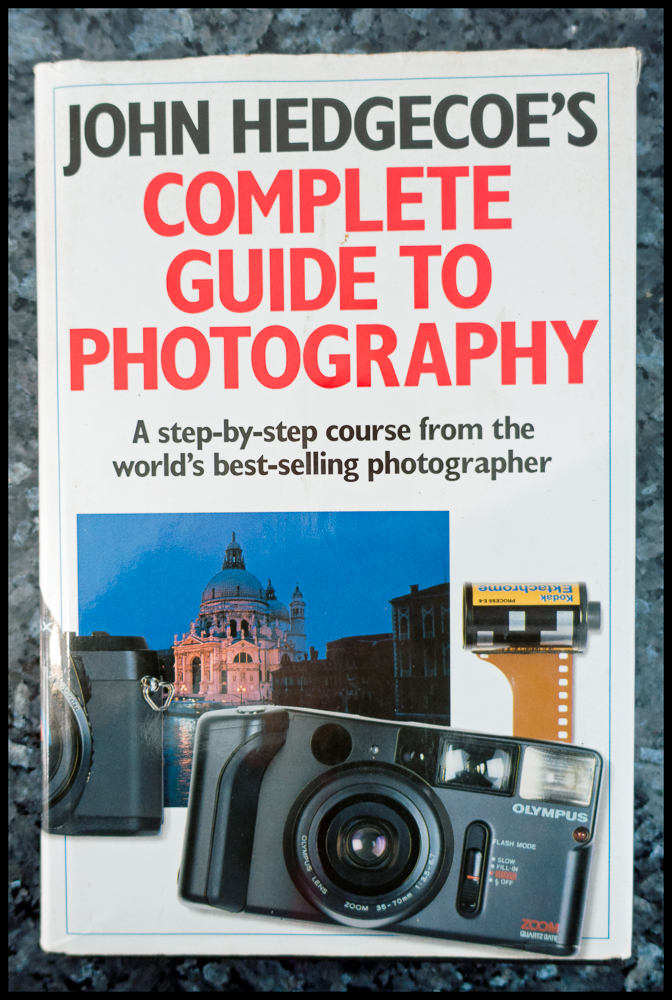
John Hedgecoe’s Complete Guide to Photography

I was going through some boxes when I came across this book. I loved the sub-title: “A step-by-step course from the world’s best-selling photographer”. ‘Best-Selling’ in terms of what I wondered. Presumably in terms of photography ‘how to’ books.

I’m not trying to demean this book. Quite the contrary. I remember loving it at the time. It was first published in 1990 and consists of three main sections.

The first covers basics: How the camera works; Choosing a camera; Camera automation; Choosing and using lenses; Choosing the Aperture; Choosing the Shutter Speed; Colour Film; Black and White Film; Camera Flash; Colour through the day.

The third and final section is called “Broadening your Scope” and covers such topics as Choosing the Right Equipment; Using Camera Filters; The Home Studio; The Home Darkroom; Photographic Montage; Mounting and Presentation; and Fault Finding.

There’s also a glossary, but the ‘meat’ of the book is contained in the second section entitled ‘The Projects’ where the author presents a series of 71 projects covering such areas as The Essential Elements (e.g. shape, form, texture, pattern, colour, tone, perspective etc.); People; Places; Still Life; The Natural World; and Action. It was these projects that interested me most when I bought the book. I tend to be all over the place and these projects gave some much needed structure. Another thing I liked was that each project was lavishly illustrated with related photographs.

The funny thing is that I remember loaning this book to a neighbor that I later lost touch with. It always annoyed me that he had not returned it and from time to time I’d “curse” him under my breath. It seems it was wrong though. Since I have the book I guess he must have returned it. My apologies Artie wherever you are.

A photographically interesting couple of hours in Pleasantville, NY

A few days before Christmas my wife was going to lunch with a friend in Pleasantville, NY. I needed to get out of the house so I decided to go along with her. I knew that there was a small bookstore in Pleasantville and I thought that I would “check it out” and then grab a bite to eat.

I set off walking in the direction of the bookstore when I spotted this photo store: Photoworks. I’d noticed it before, but it always seemed to be closed when I went by. Assuming that it was largely devoted to photofinishing, scanning etc. I was about to walk by when, looking through the window, I noticed a glass case inside – full of vintage cameras. I went in and asked the women if the cameras were for sale or just for display. She called her husband, George who emerged from the back somewhere and we had a long conversation about vintage cameras. Inside the case were two Nikon Fs (see above). I’d wanted one of these for a while, the price was right and the prospect of actually having a human being I could bring the camera back to in case of problems was appealing. I told him I would consult with my wife and return later.
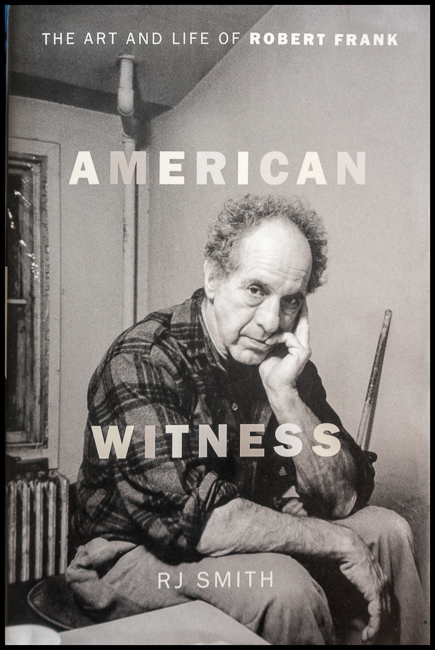
I continued on to the bookstore: The Village Bookstore, a very pleasant establishment, small but well stocked and with a nice atmosphere. Among the shelves I came across (and purchased) this recently published biography of Robert Frank: American Witness. The Art and Life of Robert Frank.

Time to start looking for somewhere to eat. Then I spotted this building. On the front it said “The Gordon Parks Foundation“, so I went inside to take a look. I didn’t even realize that such an institution existed in Pleasantville. Inside they had a small selection of books by/on Gordon Parks but the bulk of the space was taken up by an exhibition: Element: Gordon Parks and Kendric Lamar. According to the Foundation’s website:

The Gordon Parks Foundation announced the opening of ELEMENT – a new exhibition on view at the Foundation’s exhibition space from December 1—February 10 showcasing Gordon Parks photographs that inspired rapper Kendrick Lamar’s music video ELEMENT from his album, DAMN. Lamar, known for using powerful images in his music videos, directly references and revives a number of Parks’ images that explore the lives of Black Americans, including the 1963 photo Boy With Junebug, Untitled, the 1956 photo from Parks’ “Segregation Stories” series, Ethel Sharrieff, a 1963 photo from his “The White Man’s Day Is Almost Over” photo essay about Black Muslims, as well as photos form Parks’ 1948 “Harlem Gang Leader” series.

“Gordon Parks’ work is continuing to have a great impact on young people – and particularly on artists like Kendrick who, use the power of imagery to examine issues related to social justice and race in our country,” said Peter W. Kunhardt, Jr., Executive Director of The Gordon Parks Foundation. “With ELEMENT the music video, Kendrick has helped to call attention to one of the most important artists of our time.”

Long-time friend and supporter of The Gordon Parks Foundation, Kasseem Dean (aka, Swizz Beatz) noted, “I’m so inspired that my friend Kendrick Lamar chose the iconic imagery of the legendary Gordon Parks in his video for ELEMENT. It’s a prime example of how contemporary change makers – artists, musicians, filmmakers, designers – can borrow from the greats of the past who were also working towards social change.”

At the foundation of ELEMENT. are Parks’ photo essays exploring issues related to poverty and social justice which established him as one of the most significant story tellers of American society. “Harlem Gang Leader,” the photo essay published in LIFE magazine, is credited with introducing Parks to America. The photos explored the world of Leonard “Red” Jackson, the leader of a gang in Harlem. Soon after, Parks was offered a position as staff photographer for the magazine, making him the first, and for a long time the only, African American photographer at the magazine. Also published in LIFE, Parks documented the daily life of an extended African American family living under Jim Crow segregation in the rural South entitled “The Restraints: Open and Hidden.”

The Guardian has also published an interesting article on this exhibition: The story behind Kendrick Lamar’s Gordon Parks exhibition

After that I decided that I didn’t have enough time to eat before meeting my wife so I adjourned to a nearby bar
Foley’s Club Lounge for a couple of beers.

According to Mount Pleasant by George Waterbury, Claudine Waterbury, Bert Ruiz:

Harry Foley was a Pleasantville High School Basketball legend. He was also a Niagara University Hall of Fame and Westchester County Hall of Fame athlete. He bought Gorman’s Club Lounge on Bedford Road in 1950 and maintained the establishment until the 1970s. Foley’s Club Lounge has been a traditional watering hole for generations of Pace University students for nearly a half century.

When my wife finished her lunch we met up and I asked her if she’d like to buy me a Christmas present. She said yes so it was off back to the photo store to pick up the Nikon F with Photomic Ftn finder.

All in all a photographically speaking an interesting day, if rather unexpected.

Revisiting Ansel Adams

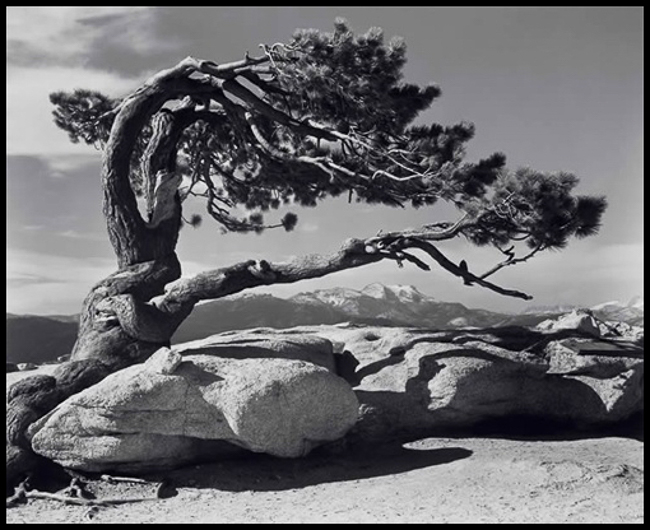
Jeffrey Pine.  Source: Ansel Adams Galleries

Jeffrey Pine, Sentinel Dome. Source: Ansel Adams Galleries

I got the idea for this post from a video that I came across on the internet. I was well worth seeing so I thought I would post a link to it. However, as I started to do so it occurred to me that I might have posted about this video before. I checked and indeed I had (see Ansel Adams: A Documentary Film 2002).

So instead this post revisits my love/hate relationship with Ansel Adams. Actually ‘hate’ is the wrong word. Even when I’m ‘down’ on Adams I don’t ‘hate’ his work. It’s just that once upon a time I thought he was THE great photographer. This was in the late 1970s-early 1980s. My wife had recently bought me my first serious camera (a Minolta Hi-Matic 7sII) and I was new to photography. At that time Adams was (and continues to be) immensely poplar. A print of “Moonrise, Hernandez, New Mexico” sold at auction in 1981, for a then record price for a photograph – $71,500 (doesn’t seem much now when Rhein II by Andreas Gursky is fetching in excess of $4 million!). This was the kind of photographer I wanted to be. I wanted to make (Adams himself preferred the verb to ‘make’ a photograph rather than to ‘take’ one) landscape photographs like these.

Over the years I learned more about photography and famous photographers and discovered that even though to this day I continue to photograph landscapes, my passion for landscape photography pales in comparison to Adam’s. Other genres started to interest me. Other photographers began to interest me and I started to turn away from Ansel Adams. I began to think of him as more of a superb technician than a great creative photographer.

Then in the late 1990s-late 2000s I almost entirely lost interest in photography, ‘making’ pictures only when required to document travel and family events. Starting around 2010 my interest was re-kindled and since then I’ve been taking pictures, collecting cameras and reading about famous photographers like there’s no tomorrow.

So where do I stand on Adams now. My collection of photography books includes Examples: The Making of 40 Photographs (a great book). I’d also read Looking at Ansel Adams: The Photographs and the Man and I have a copy of Ansel Adams: 400 Photographs. In preparation for this post I read his autobiography: Ansel Adams: An Autobiography.

I also did quick and totally unscientific test. I looked at all of the photographs in “Ansel Adams: 400 Photographs” one evening. The next day I repeated this exercise noting down those that if felt, from a quick perusal, had moved me. Only 24 had.

Of course there’s much more to Ansel Adams than just his photographs. He was an accomplished pianist (headed for a career as a concert pianist before photography became his passion). Judging from his autobiography he was no slouch at writing either. He was a tireless advocate for the environment, a founder member of the West Coast circle of photographers Group f64 that also included (among others) Edward Weston and Imogen Cunningham, a founder of ‘Aperture‘ magazine. He was also an educator and a prolific writer. Adams, along with Alfred Stieglitz, probably had the most impact on the evolution of photography in the United States.

His best photographs are superb! However, I feel that the totality of his work falls behind other great American photographers like Paul Strand and Edward Weston. Neither of these photographers had the same overall impact on photography as a whole though.

Regrettably the tree in the picture above has now gone. According to the Ansel Adams Gallery:

Though Adams’ photograph made the Jeffrey Pine famous, it was long an icon for photographers visiting Yosemite ; Carleton Watkins photographed it in 1867. the easy hike to reach Sentinel Dome from the Glacier Point road, the tree became a popular destination; over the years, thousands of visitors carved their initials into it. Despite the efforts of park rangers who carried buckets of water to it, the tree perished in the drought of 1976-77 and fell in August 2003.

Online portal at George Eastman House

According to a November 6, 2016 Shutterbug article:

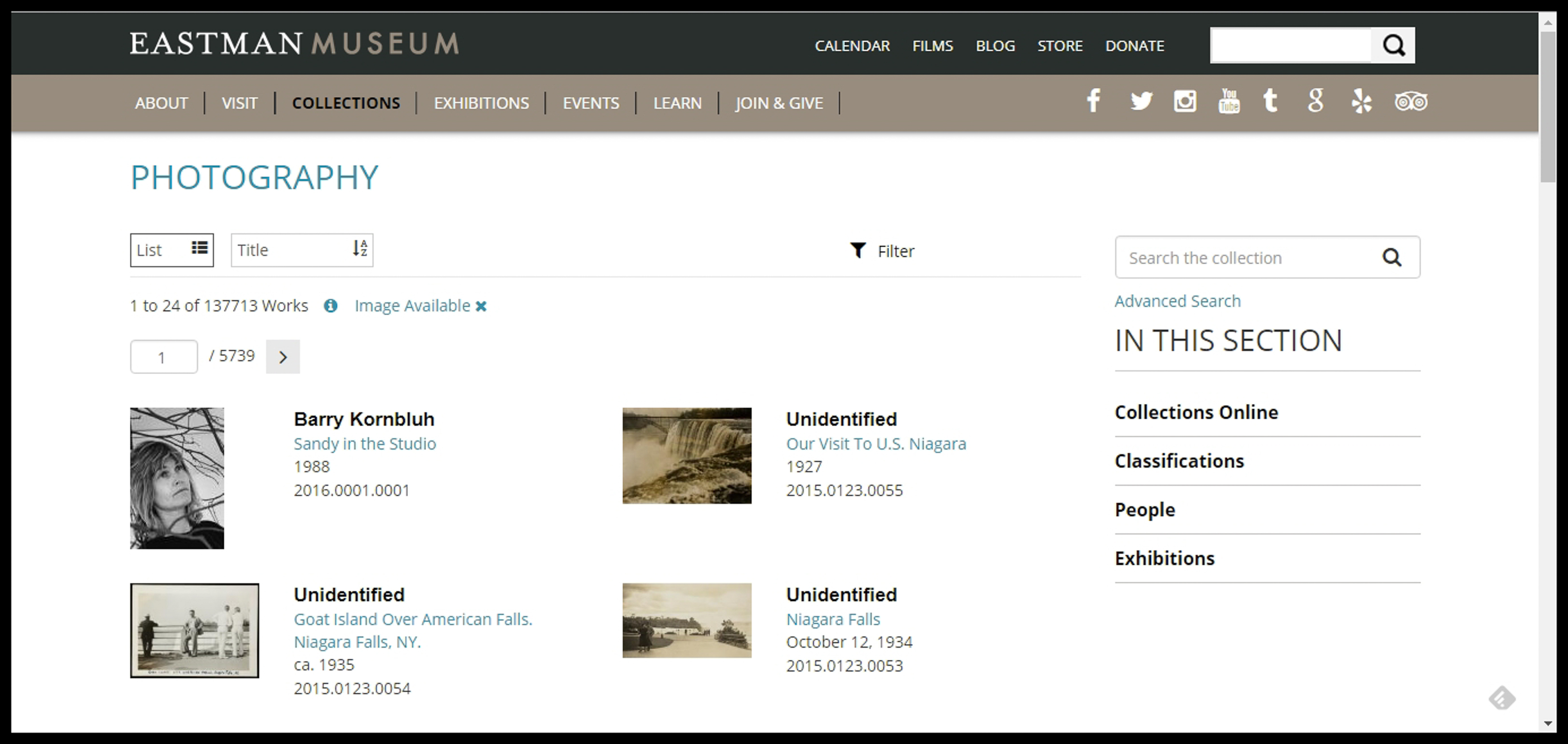
The famous George Eastman Museum has created a new, public portal where you can view over 250,000 images and other objects from their vast collections. The database is searchable by artist, collection, classification and date, and includes a wealth of photography, cinema, and technology related to imaging.

The 250,000 objects currently on the site are but a mere fraction of the museum’s collections of several million objects, but additional holdings are being added to the portal weekly.

It’s certainly an impressive undertaking. I briefly browsed through it and there’s a lot to see. Unfortunately they seem have started off with the image metadata, to which they are gradually adding images. I imagine it’s faster to add the metadata than it is to scan all the images. So the end result is that many of the entries indicate that the image is “not available”. For example I searched for Ansel Adams and got 18 pages of results. On the first page there were 24 entries. 18 of them indicated that the image was not available. I’m sure that over time these gaps will be filled.

It’s potentially a great resource.

Robert Capa – The Definitive Collection

Almost a year ago (Novemeber 14, 2016 to be precise) I came across Robert Capa’s Grave in a nearby cemetery (See: Amawalk Hill Cemetery – The Big Surprise). Capa was, of course, a photographic “great”, possibly the best known of all war photographers. I was familiar with some of his work (e.g. the Normandy pictures, an example of which appears above; Falling Soldier etc.), but beyond that didn’t know much other than that he was killed in Vietnam in 1954 after stepping on a land mine.

So I decided to find out more, and after looking around for a bit came across this book, which I promptly ordered. It arrived and seems to have been promptly moved downstairs (I suspect tidied away at the request of my wife when we had visitors). So “out of sight, out of mind” I forgot that I had it until the other day when some reference to Capa made me think of it. I pulled it out and read through it.

The book is the brainchild of Cornell Capa (himself a renowned photographer and founder of the International Center of Photography and Richard Whelan – interestingly they are both buried next to Robert Capa in Amawalk Hill Cemetery).

Robert Capa grave site in Amalwalk Hill Cemetery. From left to right: David Richard Whelan (biographer); Edith Capa (wife of Cornell Capa); Cornell Capa; Julia Friedman Capa (mother of Robert and Cornell); Robert Capa).

In a section entitled “About the Photographs” Cornell Capa says the following:

Between 1990 and 1992, Richard Whelan and I rexamined all of Robert Capa’s contact sheets. From the approximately 70,000 negative frames that my brother exposed during his lifetime, we chose 937 images to constitute an in-depth – though certainly not exhaustive – survey of his finest work over the entire course of his career, from 1932 to 1954. The images are arranged here by photographic story and in chronological order, tracing the trajectory of his life. Nearly half of the 937 images have never been widely published or exhibited. Our principal goal was to identify images whose emotions and graphic impact measures up to, or at least comes close to, the impact of Capa’s classic photographs. In a very few cases, however, we included less powerful photographs in order to give coherence to a group of pictures that work together as a story, but which would not necessarily hold up as individual images.

Whelan provides an interesting, illustrated 11 page introduction and the rest of the book is devoted to the photographs, each with a usually short, quite dry caption. I much preferred the longer, more descriptive captions in Karsh. A Biography in Images. The photographs are, for the most part, wonderful, but there are so many that it’s all a bit overwhelming. This has had a few negative consequences: many of the photographs are quite small; and the book is rather large and heavy. As I usually read while sitting in a chair or on the sofa I found it quite difficult to hold comfortably. It’s more suited to reading on a stand on a table. I also found the typeface used to be hard to read. It’s a typewriter style font, and at times, when a lighter text is used, it tends to blend into the background.

I’d also take exception to Cornell Capa when he says “In a very few cases, however, we included less powerful photographs…”. I’d say that quite a few “less powerful photographs” have been included. Of course I’d have been proud to have produced any of them, but a lot of the photographs are not close to his best (just goes to show that even the greatest photographers don’t always produce winners).

I’m sure that there are books on Capa out there that include fewer photographs and consequently are more focused and easier to hold and to read. For potential readers who just want to know a bit more about Capa, I’d recommend one of those (maybe even his own memoir Slightly Out of Focus – although this seems to focus on the WWII period and so might leave out some of the wonderful Spanish Civil War pictures.). Since this volume is mostly about Capa’s pictures it might also be worth reading a biography, such as the one written by Richard Whelan: Robert Capa: A Biography.

Despite the issues noted above, I very much enjoyed this book. I feel sure that I’ll return to it from time to time to look again and again at the photographs, each time getting new insights and a better understanding.