The Audience Will Come

The Audience Will Come from Doc League on Vimeo.

I just came across this documentary about Tod Papageorge. I’d heard the name before, and had seen some of his photographs, but I didn’t really know much about him. I really enjoyed the video (it’s largely him speaking to an unseen/unheard interviewer).

A couple of scenes caught my attention:

About 17 minutes in he tells a charming story about his encounter with a dapper man, who turns out to be French, in Central Park. He attempts to strike up a conversation and through a little trickery eventually manages to do so. Towards the end of the conversation he says (in French) to the man: “Because of you I’m a photographer”. It was Henri Cartier-Bresson who Papageorge clearly admires saying “But Cartier-Bresson was one of the supreme beings. A totally realized human being. He was beyond most people in his capabilities. So that’s the level he was operating at I believe.”

Papageorge says this right at the end of the documentary:

None of my pictures are in any sense about the viewer. I never think about the viewer. I don’t care about the viewer. I’m really only interested in myself exploring the process of making what I consider to be a challenging, complex or simply interesting photograph. There’s never an audience – never an audience, which may be why, one reason why my career was in the shadows for a couple of decades. Because I never had that concern. I know you don’t believe me, but its true. The audience will come.

Well said Mr. Papageorge!
The 50 most influential photographers of the past 10 years?

Source: The 50 Most Influential Photographers of the Past 10 Years.

Without a doubt, photography has helped to shape our experience. It captures our joys, desires, accomplishments just as it does our problems, fears and failures. This list aims to mention many of the photographers affecting the way we see the world we live in—from the isolated forests of a far off land, to fashion models, to your kitchen sink. 

via The 50 Most Influential Photographers of the Past 10 Years | Complex UK.

Interesting list. I’d heard of only 10 or 11 of them – mostly amongst those in the top 20. This shows just how woeful my knowledge of contemporary photography is. I’ll have to do some more research, reading etc. My opinion on this list? I started to write something about my take on contemporary photography, but then realized that this contradicted my earlier comment saying I was not familiar with many of the photographers. I’d better keep my mouth shut until I have a better understanding than I do at the moment.

As final parting shot let me quote Maris at the Analog Photography Users Group (APUG) whose view echoes my own preliminary thoughts (although I’m not sure that I’d go along with the use use of the word ‘indictment’):

I’d suggest the list is an indictment of modern critical and curatorial thought that confuses photographs of great things (installation, tableaux, performance, assemblage, …) with great photographs of things.

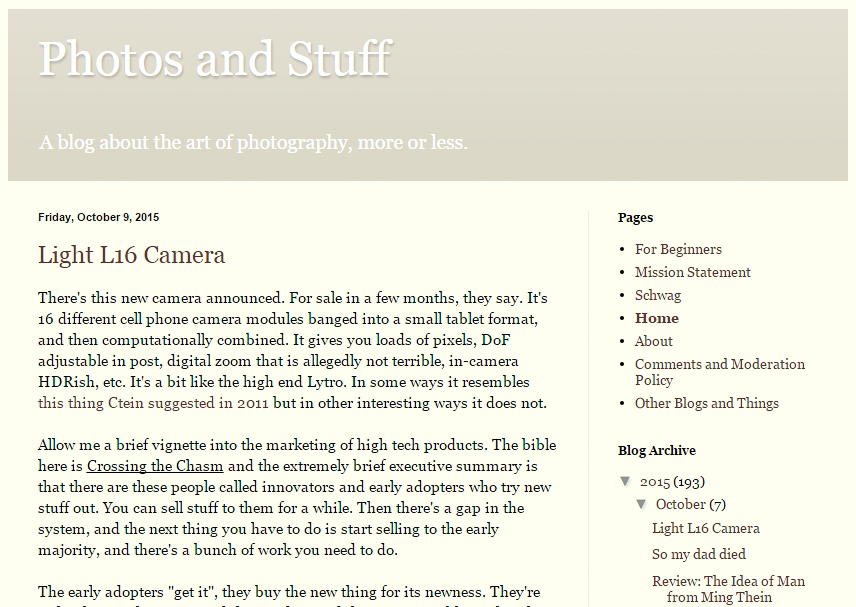
Photos and Stuff

I came across this blog from Kirk Tuck’s wonderful site: The Visual Science Lab.

This blog’s ‘About’ page says the following:

I’m a cranky old bastard who has been taking crappy pictures for 20 years or so. I’m full of opinions and ideas about photography, but not terribly good at putting them into practice. So it goes.

This blog is a place for me to put those ideas and opinions, so that I don’t have to keep them bottled up inside, nor try to explain them off the cuff and on the fly.

via Photos and Stuff: About.

There’s much to like in this blog. The author seems to be very knowledgeable in a number of areas. He writes well and is often quite amusing. As he suggests in his ‘About’ section he’s “full of opinions and ideas about photography” and he’s certainly not afraid to voice them. He’s also quite prolific so there’s no want of things to read. As I only came across his blog yesterday I spent a large part of the day reading it and I thoroughly enjoyed it. I also learned a great deal.

For a photography blog I was surprised to find so little actual photography. The blog is virtually devoid of photographs. Maybe he likes to keep his opinion pieces separate from his photographs. If so then I had great difficulty finding them on the internet. Again maybe he prefers print rather than internet.

Although I like the blog there’s something about it that makes me a bit uneasy. First he really seems to have it in for Ming Thein. Don’t get me wrong these attacks are not directed at Ming himself, as much as they are about what he represents: a certain type of photography pundit that appears to thrive on the internet. He’s even somewhat complementary (very rarely) to some of Ming’s work. I understand, and largely agree, with what he’s saying but after a while harping on this issue becomes too much. The first couple were fun, but after a while I started to thing “Oh no! Not another piece on Ming Thein”. As Internet attacks go though his anti-Ming diatribes are quite mild. Maybe I’m over-reacting. After all I’m British and as someone once said the British and excruciatingly polite to their enemies and insult their friends.

As mentioned above the author is very good at opinion pieces. However, it would be wise not to forget that these are just that:opinions – not gospel. I have a friend who is somewhat similar. He can formulate opinions extremely quickly, perhaps faster then anyone else I know. He too is also very articulate and expresses his opinions quite forcefully. He comes across as if he has all the answers. Unfortunately, knowing him as I do I also know that often his quickly formed opinions are based on quite scanty knowledge. There’s nothing wrong with this and I admire him greatly for the way he’s able to do it. It’s very much a case of ‘buyer beware’. It’s up to those receiving the opinions to validate their worth. The reader must not uncritically take on the views of the author just because they sound convincing.

There’s an interesting section For Beginners.

I heartily recommend this blog. Go take a look!

A Guide to Contemporary Indian Photography

Mother and Elsa: from Life is Elsewhere by Sohrab Hura

I’ve always wondered about what new photography is happening in India but never really knew quite how dynamic Indian photography is until I asked Sohrab Hura (Magnum member and author of the truly fantastic Life is Elsewhere) about it. Sohrab is helping to run the Delhi Photo-Festival – which takes place at the beginning of November and doubles up with Photo Kathmandu if you’re thinking of an India/Nepal Photo-Festival double-header. 

via Colin Pantall's blog: A Guide to Contemporary Indian Photography.

Interesting overview of photography in India (and to a lesser extent other parts of South Asia). I especially liked the links to the work of various Indian photographers. This will make it much easier for me to pursue this topic further – although as Mr. Hura points out: “Many of the photographers in India don’t have websites so you’ll need to dig a bit to see their works and I’m sure I’ve missed out on quite a few other names as well.”

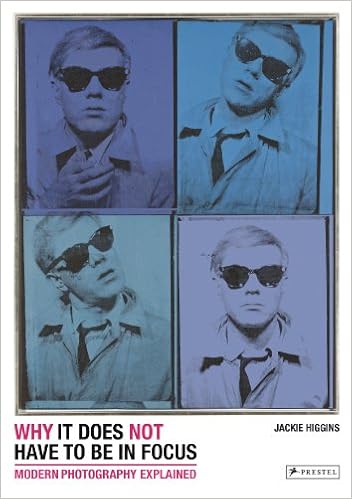
Why It Does Not Have to be In Focus: Modern Photography Explained

Why it does not have to be in focus. Source: Amazon.com

I suppose this book’s subtitle should really be “Modern art using a camera as a tool”. I’m strangely fascinated by this book. I bought it some time ago and I find that I often pick it up and browse throught it. If you’re looking for a book on photographic technique then this book isn’t for you. It doesn’t talk about ISO, shutter speeds, f-stops, rule of thirds or any of the other things commonly found it photography “how to” books. Instead about 100 images are organized according to the following categories: portraits/smile; document/snap; still lifes/frieze; narrative/action; landscapes/look; and abstracts/dissolve. Each picture is from a different photographer and for each one the author: “Describes the artist’s approach, process and technique; Locates the image in its historic and artistic context;…provides additional incremental information; and lists examples of similar images by the same photographer. Quotations (both attributed and unattributed) are also scattered throughout the book.

To give a flavor of what the book’s about I’ll provide a few examples of the photographs provided:

Second Beauty Composite by Nancy Burson, 1982. A single face which is actually a composite of five famous female movie stars: Jane Fonda; Jacqueline Bisset, Diane Keaton, Brook Shields and Meryl Streep. As the book says “This face belongs to non one; it has never existed”.

Untitled [Cowboy] by Richard Price, 1989. Re-photographed ‘Marlborough Man’ photograph blown up to gallery size. Has become known as “appropriation art”. This was the first photograph to sell for more than $1 million.

Poll by John Demand, 2001. Looks like a real office, but is actually an elaborately constructed set made of card, which is then photographed subsequently destroyed.

Strip by Jemima Stehli, 1999. A series of pictures of a woman (the photographer I think) with her back to the camera. She takes off her clothing in front of a man (a different man in each picture) who sits on a chair holding a remote shutter release and who presumably decides when to take the picture.

99 Cent by Andreas Gursky, 1999. A huge 81 1/2 by 132 1/4 inch picture of the shelves in .99 store.

Damage/Drown/Canal, 168 hours, June 2003 by Catherine Yass, 2005. According to the book “Yass photographed the canal on her large-format(4×5 inch) camera. Returning to where she exposed the image, she tied a large print to the edge of the canal and floated it in water for one week”.

I think I like this book so much because it encourages you to break rules and explore boundaries – something which I find very hard to do, and probably the reason why my photographs are so conventional. It would never have occurred to me to even try to do any of these things. I guess I keep hoping that if I go back to the book often enough something will rub off. It hasn’t so far, but who knows…

This book certainly won’t teach you photographic technique, but it will hopefully give you lots of ideas.