Flash. The making of Weegee the Famous

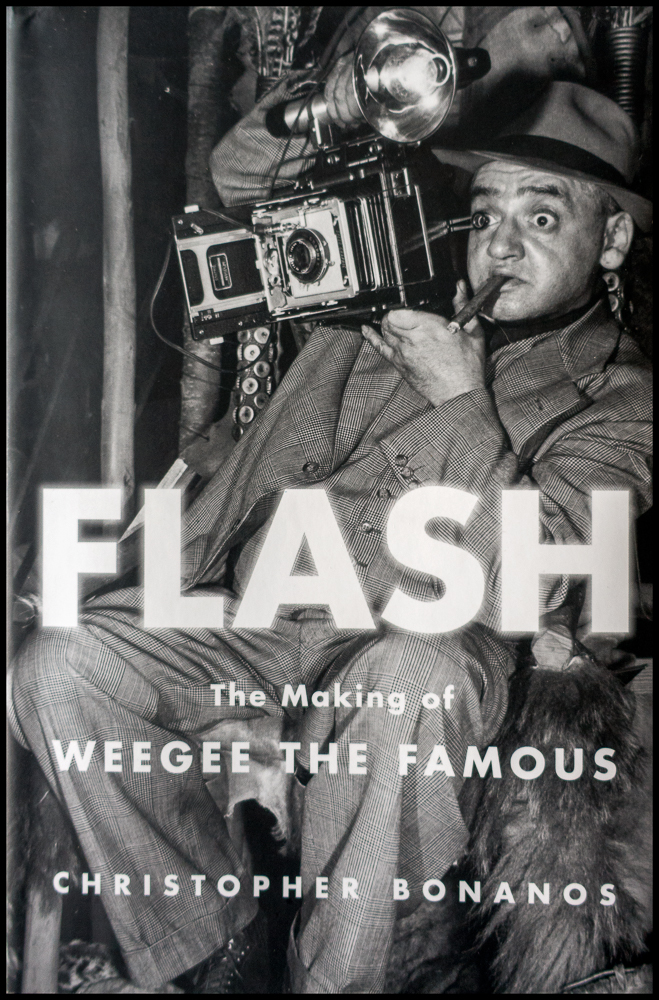
When I think of a press photographer from the 1930s/1940s a particular image comes to mind: Huge press camera with equally massive flash; fedora; rumpled coat; possibly a cigar. This particular image was largely created by Usher Fellig – later Arthur Fellig and eventually Weegee.

According to Wikipedia:

Weegee was the pseudonym of Arthur (Usher) Fellig (June 12, 1899 – December 26, 1968), a photographer and photojournalist, known for his stark black and white street photography. Weegee worked in Manhattan, New York City’s Lower East Side, as a press photographer during the 1930s and 1940s, and he developed his signature style by following the city’s emergency services and documenting their activity. Much of his work depicted unflinchingly realistic scenes of urban life, crime, injury and death. Weegee published photographic books and also worked in cinema, initially making his own short films and later collaborating with film directors such as Jack Donohue and Stanley Kubrick.

.

Weegee was certainly a fascinating, if somewhat eccentric character. He was a ruthless self-promoter (hence ‘Weegee the Famous’) who wasn’t afraid to stage a scene if it suited him. For example one of his most famous photographs, The Critic was certainly a setup.

His story is also rather sad. He seemed to badly want to transcend the type of street photography for which he was renowned, but was never able to do so. Towards the end of his life he ended up playing roles in ‘nudie cutie’ exploitation films.

It’s a fascinating story and well worth reading. Should Weegee be included in the pantheon of great photographers? Some of his photographs are certainly remarkable, but I’m not sure that I can really answer this question at the moment.

Flash. The Making of Weegee the Famous. By Christopher Bonanos.

Why photographs work

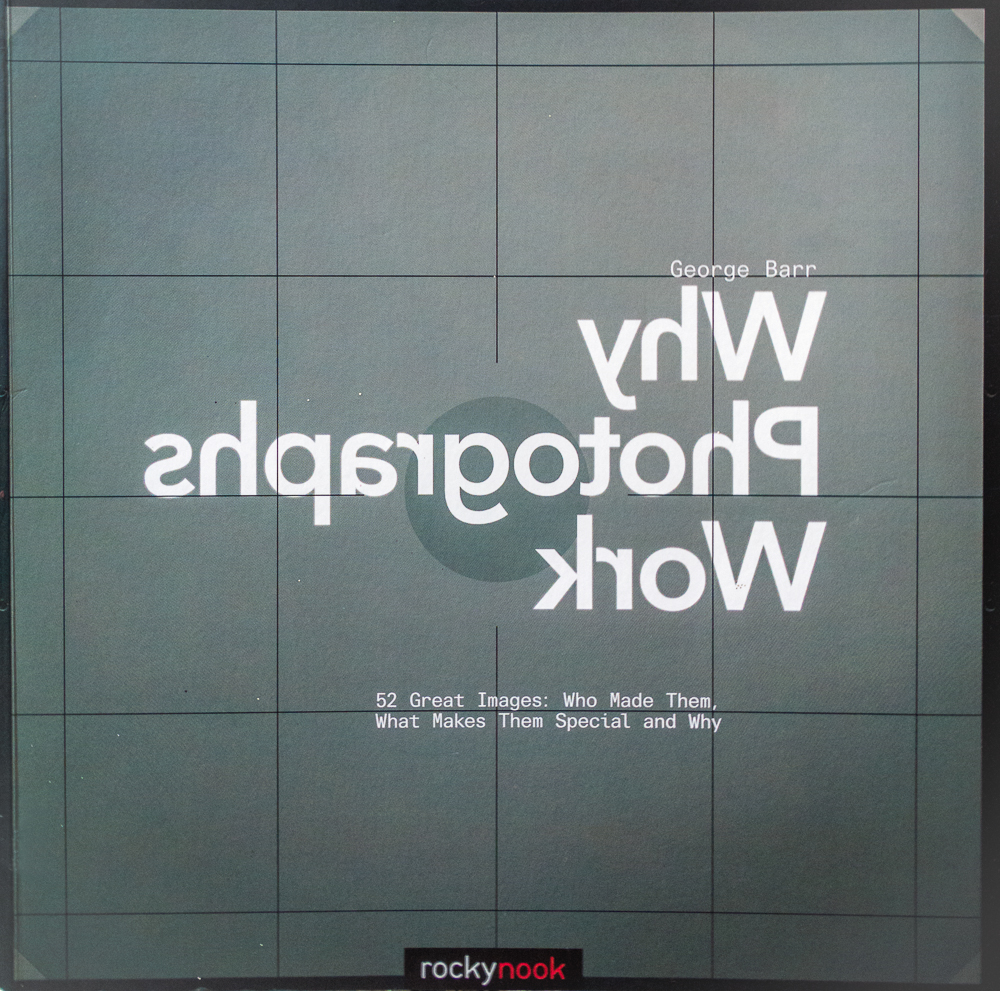
Why Photographs Work by George Barr.

A summary on the rear cover reads:

Every photographer, from weekend enthusiast to professional, can learn by studying the “greats.” In Why Photographs Work, author/photographer George Barr analyzes 52 striking images by some of the world’s top photographers. Accompanying Barr’s analysis of each image is an explanation by the photographer describing the circumstances of making the image, including not only the how, but also the why. Also included is each photographer’s biography, a reference to his or her websites and publications, and brief technical descriptions of the equipment used in making each image.

We guidance from Barr, we learn to decipher that certain intangible “something” that makes an image go beyond the ordinary. As we gain an understanding of and appreciation for the elements that make an image truly great, we are bound to improve our own images as well.

I haven’t come across this particular format before and I rather like it. At times I found the author’s contributions to be a little “arty”, but still interesting. I particularly like the photographers’ viewpoint. It’s great to hear the rationale behind the photograph.

I just (re) discovered Aaron Siskind.

I’m not entirely sure how I came across Aaron Siskind, but I think it’s probably through his good friend and fellow photographer Harry Callahan I looked around and found some of Siskind’s work on the Internet. I’d heard his name, but wasn’t familiar with his work. Or so I thought. As I looked through the pictures I realized that I must have, at some point, come across his work. Why? Well, because as I look at my own photographs I can see Siskind’s influence everywhere. Not that I have consciously tried to emulate his work. Rather I think that I must have seen some of his pictures at some point and unconsciously absorbed elements into my own.

Since I felt a close connection I decided that I needed to go beyond the small images on the internet and bought this book: “Aaron Siskind. Another Photographic Reality“. There’s a useful review of the book on Photo-eye Blog so I won’t duplicate here. Suffice it to say that I really love this book.

For a useful selection of Siskind’s work see his page at the International Center of Photography.

Happy Birthday Henri

Today marks the 110th Anniversary of one of the greatest of all photographers (and a personal favorite of mine): Henri Cartier-Bresson.

It also gives me the opportunity to highlight a publication I picked up a couple of months ago at the International Center of Photography: Henri Cartier-Bresson. Interviews and Conversations 1951-1998. It contains 12 interviews with the Master. As the foreword says:

Henri Cartier-Bresson often defined himself as a visual person. “I watch, watch, watch. I understand things through my eyes.” he wrote in 1963. Throughout his life, his preferred language was the image. He did take a lot of notes during his reporting and kept a constant correspondence with his family, but in the end he wrote little about his own photographic practice…it is in fact in his interviews that Cartier-Bresson’s liveliest thinking can be found. It is the one place where the photographer has indeed not been sparing with his words.

Most of these talks have not been reissued since their publication and are therefore difficult to find. They reveal a fascinating and passionate Cartier-Bresson, who talks about his photography, comments on the state of the world, and reflects on his path. Spread over nearly half a century, his word make it possible to perceive the evolution of the photographer’s thinking: he backs down from his comments, changes his mind, sometimes contradicts himself. The image that the interviews give of Cartier-Bresson is not frozen in legend, but on the contrary, alive and kicking.

Joel Meyerowitz: Where I find myself. A lifetime retrospective

I just got my hands on a copy of this marvelous book. I won’t go into detail because there are many excellent reviews available online including:

It”s a large and heavy book that I found I either had to place on a table, or even better on a book stand. I found the quality of the reproductions to be excellent. I believe that Mr. Meyerowitz was heavily involved in the production of the book and the selection of images.

The choice of starting with the most recent work first and then working backwards (rather than the more usual starting with the oldest and working forward) was interesting, but after going through the book I found that I wanted to start at the end (i.e. with the oldest work) and read backwards towards the beginning. I found that this helped my understand how his work had evolved over time.

An evolved it certainly has. I find this one of the most impressive things about Mr. Meyerowitz: the way he has frequently re-invented himself. Many photographers find their niche and then stick with it for the rest of their careers. Not Mr. Meyerowitz. He started off in black and white and then became an early advocate of color. He began as a street photographer, but then moved into other genres including landscapes, portraits, still life. He started out using a 35mm camera, but later espoused large format. His reasoning for these changes is nicely explained in the book.

I was particularly impressed with his most recent work: a series of still life photographs. I’ve always liked still lifes, but have taken surprisingly few. The book has inspired me to try to do more.

There’s also an interesting Interview with Joel Meyerowitz: Where I find myself on Lenscratch.

A great book. I thoroughly enjoyed it!