Taschen 20th Century Photography

I like these small, but thick Taschen books. They’re quite easy to carry around and I find that if I leave a copy on a nearby table I often pick it up when I have a moment or two to spare – just to browse. They’re also quite inexpensive (about $20 in this case).

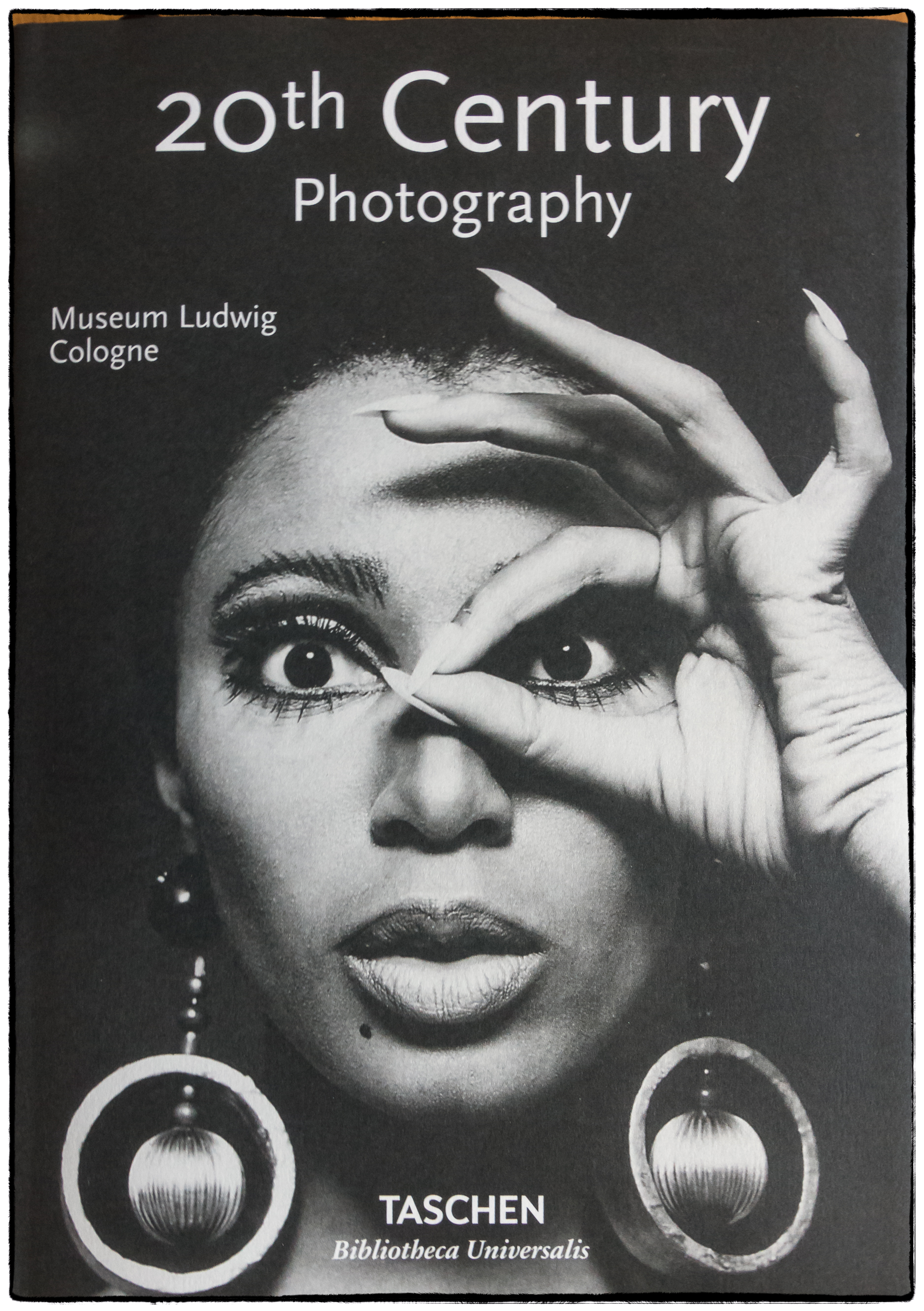
This one is entitled 20th Century Photography and contains over 850 photgraphs from a large number of photographers (each photographer has his/her own short textual summary). Of course the pictures are necessarily quite small so you can’t see them in their full glory, but that’s fine for this type of overview.

One thing I missed when I bought the book was that this is 20th Century Photography as represented by the L. Fritz Huber Collection of Cologne’s Museum Ludwig. I have a few other ‘History of Photgraphy’ type books and they tend to be dominated by the usual suspects (e.g. Bresson, Frank, Stand, Adams, Weston etc.) mostly either American photographers or photographers who have worked in the US (with a few of the more famous non-American photographers sprinkled in). This books seems to have a more European orientation. Yes, many of the usual suspects are still there, but quite a few are missing – presumably because the Museum Ludwig does not have them in its collection. Some notable absentees are: Nan Golding, Diane Arbus, William Eggleston, Lee Friedlander, Gary Winogrand, Robert Frank, Cindy Sherman, Imogen Cunningham and Minor White. These are just a few that I noticed. There are certainly more.

The lack of these famous photographers is offset by the large number of photographers I’d never heard of: e.g. Hugo Smölz (interesting architectural photography); Friedrich Seidenstücker (a chronicler Berlin Life); Jean Le Gac (narrative art) and many, many more too numerous to mention.

I’m glad I bought it.

The photograph above is from the books’s cover and is Charlotte March, Donyale Luna with Earrings for Tween magazine, 1966 Gruber Collection.

Rediscovering Roger and Frances

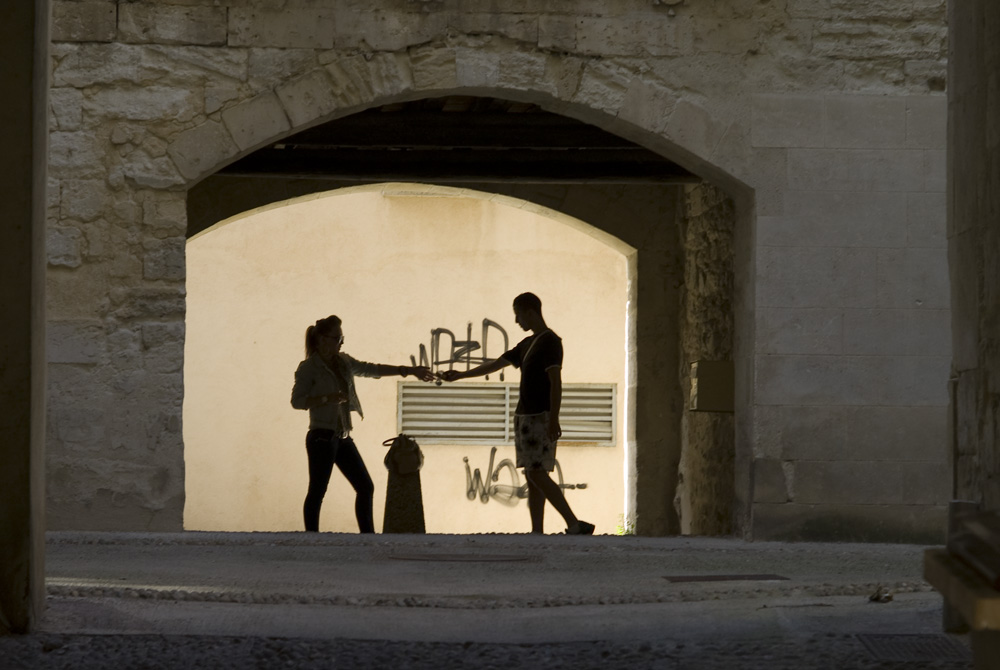
Couple, Arles. Source: Photographs from the Home Page

Whenever I get interested in a subject I tend to read a lot about it. I started collecting cameras a few years ago and my first move was to start browsing web sites; reading articles and buying books about camera collecting. My first interest was rangefinder cameras and one of the first books I got was “Rangefinder: Equipment, History, Techniques” by Roger Hicks and Frances Schultz. Subsequently I discovered the Roger was a regular contributor to one of the online fora I frequent (Rangefinderforum.com) and eventually I came across Roger and Frances’ own site, which I used to read regularly. And then somehow I stopped…

I realize now that I have become so dependent on my RSS feeds that if a site doesn’t have one (and I’ve never been able to find one on Roger’s site) I lose track of it.

I was with great pleasure then that I recently re-discovered Roger and Frances’ site – now with an all new look. I was a bit like reconnecting with an old friend.

I think I like the site so much because Roger and myself have a few things in common: we’re both British; we’ve both lived in France (he still lives there while I’ve moved to the USA); and from what he says we’re almost exact contemporaries. I love his thoughtful style of writing, always with that typically English touch of humour (in his honour I’ll spell both “humour” and “honour” the English rather than American way). Here’s a short extract from one of his articles. It pretty much sums up my own thoughts about why I take photographs.

…If you pursue the argument, I will say that because photography is an art (I regard with contempt anyone who still pretends it isn’t), then if I am a photographer, I am necessarily an artist. I do not however see any need to press the point, or to shout in your ear.

For me, though, ‘fine art’ comes down to something very simple. It is not something that artists do. Rather, it is an essential part of what they are. They do it because they can’t really imagine doing anything else. It’s not a hobby, a fad, a passing interest. Source: Fine Art Photography

Source: Rogerandfrances.eu Home Page

Unfortunately somewhere along the line the old site seems to have gotten lost. The new site has plenty of links to it, but whenever I follow one I get an otherwise blank screen with the cryptic message: “Could not determine user from environment”. I suppose it will get sorted out eventually. In the meantime there’s plenty to read and enjoy on the new site.

Now I just have to remember to keep looking for new articles.

A few photography related Christmas presents

My family finds it difficult to decide what to get me for Christmas. I like CDs; books; photography related items. In the past that have bought me CDs and books that I already have and photography related stuff that I didn’t really want. So now I make an Amazon.com wishlist every year. This too can have its problems. Some items have been on the list for years and nobody buys them. Another case in point: I’ve been reading a four book series on the Overland Campaign of the US Civil War. I’ve read the first volume and started the second one. I got the fourth one as a Christmas present, but I’m missing the third one. I guess I’ll have to buy it myself. Generally, however,this scheme works well.

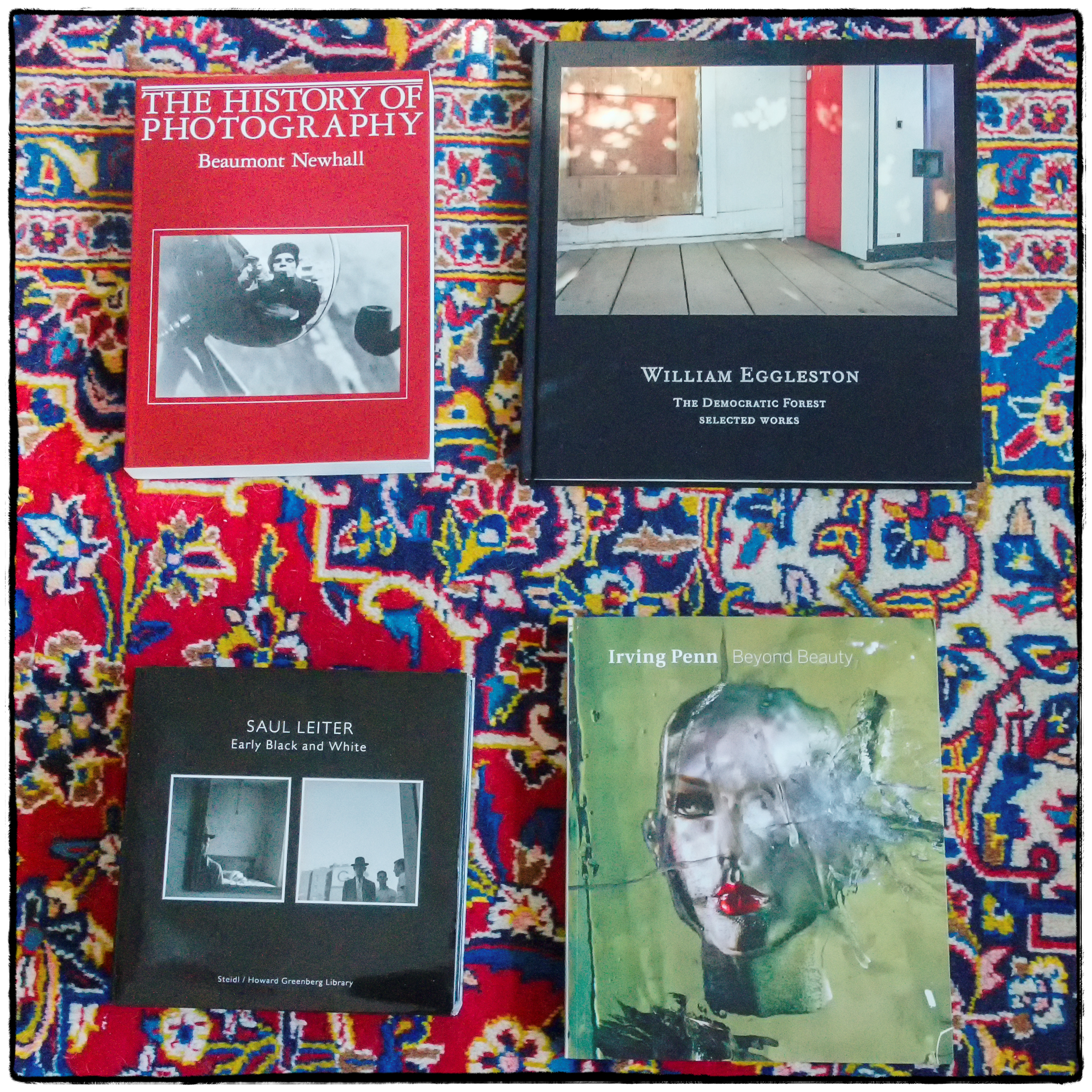
This year I got four photography related books. In case you can’t read the titles they are:

The History of Photography: From 1839 to the Present. Beaumont Newhall.

The Democratic Forest. Selected Works. William Eggleston.

Early Black and White. Saul Leiter.

Beyond Beauty. Irving Penn.

More to follow when I’ve had a chance to spend more time with them.

Time. 100 photographs. The most influential images of all time.

I went grocery shopping the other day and as I was standing in line at the checkout I noticed this publication. I’d read that Time was about to publish such a volume, but had then forgotten about it. It seemed like it might make an interesting read so into my cart it went.

I’m glad I got it. The subtitle is “The Stories Behind the Pictures” and I certainly found the introduction and the short textual “stories”, which accompany each picture to be of interest.

Anyone who compiles a ‘best of…’ list is looking for trouble. You can’t please everyone so there will always be complaints. Time has set itself a particularly difficult task in that it has tried to identify the ‘most influential’. They do spend some time in the introduction explaining what criteria they used and how they applied these criteria, but trying to determine influences is always hard. I couldn’t help but feel in some cases that the pictures didn’t so much ‘influence’ as much as they did just reflect an already existing trend.

In my opinion this publication also reflects a couple of biases: 1) a concentration on US photography; and 2) a preference for photojournalism/reportage. Considering the history of ‘Time’ I suppose this should be no surprise.

Of course I have my own thoughts as to what should have been included, and what not. For example – the daguerreotype was certainly very influential in the early days of photography, but ultimately turned out to be a dead end as it produced a positive image, which could not be reproduced. I could argue that Willam Henry Fox Talbot’s calotype process (and other processes which produced negatives e.g. collodion etc.) was ultimately much more influential as it formed the basis for photography for the next 150 years or so. Likewise you could make the case that, although Carleton Watkins came first and influenced the establishment of the Yosemite National Park, Ansel Adams was ultimately more influential both in terms of the environmental movement and the development of photography. But these are mere subjective quibbles that inevitably come up whenever anyone attempts a list of this kind.

Generally I liked this publication a lot and I’m glad I bought it.

Photographs from the edge

I recently bought a copy of Photographs from the edge. A master photographer’s insights on capturing an extraordinary world by Art Wolfe (with Rob Sheppard).

The photographs are mostly along the lines of: animals in exotic locations; people in exotic locations; exotic locations all by themselves. In total there are about 130 color pictures (two pictures on the inside of the front and back covers are in black and white) spanning a period from the 1980s to the present. They’re striking pictures and well worth studying. However, they’re not really my cup of tea. While I can recognize the skill and ability required to produce such pictures they don’t move me all that much.

So why did I buy the book? Each picture is accompanied by technical information on the camera and lens used; settings chosen; and where appropriate the type of film used. In addition as Rob Sheppard says in his preface:

For each of Art’s photographs, we have included a section on the nature of the photograph, a short piece inspired by the subject matter of the image. To do each image justice, I often learned something new, especially about cultures and out-of-the-way places.

As a photographer, I enjoy learning how other photographers handle their way of seeing. Exploring another person’s approach to this art and craft can even illuminate your own pieces by way of both contrast and empathy with the work.

It’s this background to each picture, when read in conjunction with the pictures themselves, that I find appealing.

As an example I include below the full text relating to the picture on the book’s cover (see above).

October 2008
Huangshan
Anhui Province, China
Canon EOS-1Ds Mark III, EF70-200mm F2.8 lens +1.4x, f/14 for 1/13 sec., ISO 100

I first visited Huangshan, or the Yellow Mountains of China, in 1984. I had been in the first Western expedition to Tibet and the slopes of Mount Everest. On our return, several of us stopped in eastern China to visit Huangshan. This is a sacred place for the Chinese people. In contrast to the grayness and the ice of Mount Everest, it is like being inside a giant sumi brush painting.

I had studied the sumi brush masters of both Japan and China during my college years in art history, and I remembered the imaginative landscapes of those artists. I long thought that they imagined those scenes, maybe from trips to the opium den! When I traveled to Huangshan, I discovered they were much more literal paintings than I had thought. There were indeed landscapes of vertical granite faces, contorted pine trees, and swirling mists.

Since that first visit, I have returned to the area on three distinct trips. Each time I renewed my fondness for this landscape and photographed new formations of the land. What I love about these shots is the scale. Pinnacles of rock rise out of the swirling mists, while tiny pine trees cling to the windswept slopes. The mist and the landscape formations provide a balance of positive and negative space, of light and dark areas.

The nature of the photos

Huangshan has long been a popular location for artists because of its spectacular mountains and cliffs. The pine trees growing on the rocks are endemic (exclusively native) to the area and so have gained the name “Huangshan pine”.

Photo Tip

Fog and changing weather can provide unique views of any landscape. Don’t be afraid of the clouds. Just avoid using large areas of blank clouds in your composition.