New deal photography

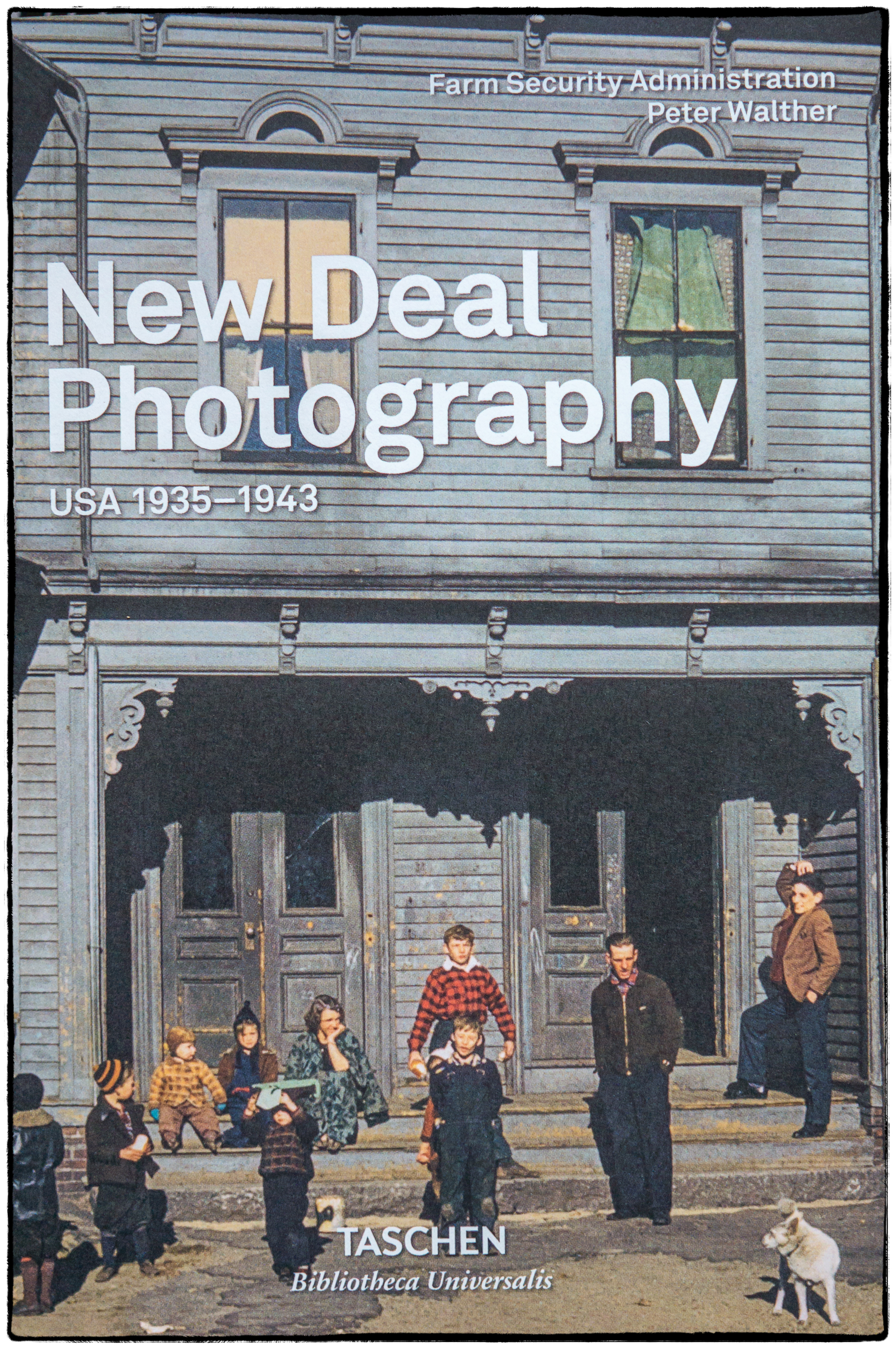
Not long ago I posted about some depression era kodachromes (Lovely Depression era Kodachromes). I recently came across, and acquired, a copy of a Taschen book (New Deal Photography. USA 1935-1943), which contains many more. It also has even more black and white photographs from the same era – more than 400 in all. An introduction describes the work of the Farm Security Administration and each section of the book covers a single geographical area: the Northeast; the Midwest; the West; The South. An appendix provides capsule summaries of the photographers: Esther Bubley; John Collier; Paul Carter; John Collier Jr.; Marjory Collins; Jack Delano; Walker Evans; Charles Fenno Jacobs; Theodor Jung; Dorothea Lange; Russell Lee; Carl Mydans; Alfred T. Palmer; Gordon Parks; Louise Rosskam; Edwin Rosskam; Arthur Rothstein; Ben Shahn; Roy Emerson Stryker; John Vachon; Marion Post Wolcott;

The text is “peppered” with comments/quotations from the photographers. Here’s an example I particularly liked:

There was one farmer, well he was alright, you could take his photograph all over the place, out in the field, and we’d been inside their house and then around almost all day. Russ had walked away down the field taking pictures of something else and I was talking to the man, and he said “What does he do?” And I said, “He takes pictures”. And he man said “You know, you’d think think a great big man like that, he’d get out and get himself a job”. Jean Lee (wife of Russell Lee).

There’s also a fairly long comment by Dorothea Lange describing how she came to take the famous “Migrant Mother” photograph.

Of course the photographs are rather small compared to the originals, but it’s a great overview of the work of the FSA. Well worth the <$20 I paid for it.

For those interested in the history of photography

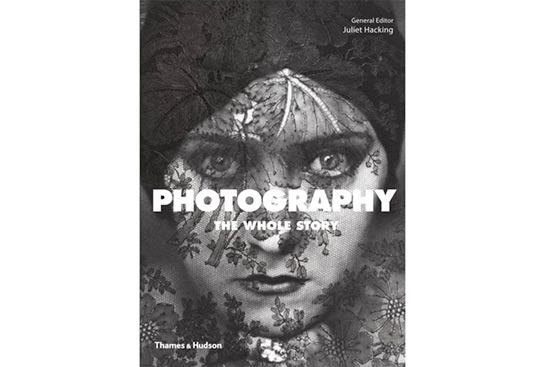
For those interested in the history of photography I can heartily recommend Photography – The Whole Story; general editor: Juliet Hacking; foreword by David Campany; 30+ contributors; 576 pages; Prestel; 2012. The Conscientious website reviewed it and I agree whole-heartedly with the points made in the review:

Much to my delight (“delight” isn’t a word I use very often) I recently discovered Photography – The Whole Story. Edited by Juliet Hacking, the book was produced featuring over 30 contributors (art historians, curators, writers). In a nutshell, a specialist for any given period or subject matter writes about just that. On top of that, the book is organized simply around time frames, with subject matters/topics then covering those. That might just be the simplest way to do it. The writing in the book is compelling and a joy to read, avoiding tedious jargon where possible, while never being superficial or simplifying.

On top of all of this, the book presents quite a few individual photographs in detail. These sections are what makes this book stand out. The general background of the photograph is explained. The artist is – briefly – introduced. What is more, four to six sections/parts of the photograph are discussed in more detail: Technical details, historical details, poses, compositions, whatever might be of relevance. Of course, learning about photography has to involve learning how to look at photographs, and Photography – The Whole Story does a wonderful job doing just that for dozens and dozens of historical photographs, some well known, many others not.

The book thus teaches the history of photography not as a large number of facts and names, which, let’s face it, are hard to remember. Instead, it uses a large number of photographs created over the course of that history, tying those photographs to what matters. Learning the history of photography has to mean seeing and understanding a lot of photographs, both how they operate as photographs and how they’re tied to the underlying history. Photography – The Whole Story superbly does just that. Given its focus, writing and design, I think it will have a large appeal for a general audience, people interested in the history of photography. For anyone seriously interested in photography, the book is a must have, must read. Highly recommended.

A bit of an obsession with Diane Arbus

Identical Twins, Roselle, New Jersey, 1967. © Estate of Diane Arbus

I seem to have developed a bit of an obsession with Diane Arbus of late. I think it started when I read about the exhibition: Diane Arbus. In the beginning at the Met Breuer. Of course I’d seen some of her more famous pictures (the twins; the boy with the hand grenade; etc.) but I didn’t really know much about her. I felt like reading something about photography so I browsed around on Amazon.com and came up with this: Diane Arbus: Portrait of a Photographer and bought the Kindle version. I don’t usually buy electronic versions of photography books because I like to see the photographs in their full glory. However, the reviews of this book indicated that there were no Arbus photographs in it because the author hadn’t been able to obtain rights to use them. So I figured I wasn’t losing much by getting the e-book. It was an interesting (and long – coming in at over 700 pages) read, but I missed not having the photographs.

So I thought I’d get a book with Arbus photographs and bought: Diane Arbus: An Aperture Monograph: Fortieth-Anniversary Edition . This book is virtually the opposite to the Lubow book in that it’s almost all photographs and virtually no text. What little text there is is mostly in the form of Arbus’s words taken from interviews and recorded lessons. She apparently didn’t like to teach (doing it mostly for the money it brought in) and doesn’t seem to have been particularly good at it. It’s more a series of disjointed thoughts than anything else. The pictures are impressive though.

Finally I found a number of articles on the internet, the most interesting of which was: Freak Show by Susan Sontag. Where Lubow is largely postitive towards Arbus’s work Sontag is much more negative saying at one point:

The ambiguity of Diane Arbus’s work is that she seems to have enrolled in one of art photography’s most visible enterprises—concentrating on victims, the unfortunate, the dispossessed—but without the compassionate purpose that such a project is expected to serve.

.

After all of this what do I think about Arbus? Her reputation certainly doesn’t come from her photographic technique. The exposure isn’t always right. Composition seems to be off. Her fans are effusive about her ability to bring out the “inner person”. In “Looking at Photographs” John Szarkowski says of her:

With rare exceptions, Arbus made photographs only of people. The force of these portraits may be a measure of the degree to which the subject and the photographer agreed to risk trust and acceptance of each other. She was interested in them for what they were most specifically: not representatives of philosophical postitions or life styles of physiological types, but as unique mysteries. Her subjects surely perceived this, and revealed themselves without reserve, confident that they were not being used as conscripts to serve an exterior issue. They were also doubtless interested in her. At times it may have been unclear which was the mariner and which the wedding guest.

While this may be true for many of the “freak” pictures I don’t believe this is the case with many of her pictures of “normal” people. As described in the Lubow book she often used techniques (making people wait; making them hold poses for very long periods of time; making the sessions excessively long etc.) designed to frustrate and annoy. The famous picture of the boy with the hand grenade may serve as an example. The contact sheet containing this picture is available on the internet. It contains 12 photographs, 11 of which show the boy. In ten of these he looks like a perfectly normal child. Arbus chose to use the twelfth picture where he looks like a psychopath. Did she capture his inner personality (Lubow interviewed the child for his book and he certainly doesn’t seem to have become a psychopath) or did she “cherry pick” a picture where he finally showed his frustration for a fleeting second?

So I’m not entirely sure where I stand regarding Diane Arbus. While I have some concerns and doubts I still find myself fascinated by her work and I’m not entirely sure why. Maybe it will become clearer over time?

I will probably make a trip into the city to see the above exhibition though.

A small gripe

We took three of our grandchildren to the movies today. I didn’t especially want to see the movie (Pete’s Dragon) so I went off to Barnes and Noble to wait until they’d finished. While there I started reading “Within the Frame: The Journey of Photographic Vision” by David Duchemin. I’m a fan of Mr. Duchemin’s and I have a few of his books. I like the way he focuses on vision rather than on technique. However, in reading his introduction I came across this paragraph:

This is a book about the passionate photography of people, places, and cultures. It’s a book about chasing your vision and telling your stories as clearly and passionately as possible with compelling photography. It’s a book for everyone who’s wanted to shoot images of the places and people they love, whether or not they ever go around the world to do it.

Mr.Duchemin lives in Victoria, British Columbia and he does include a few (very few) pictures from there (particularly Vancouver) but most of them are from further afield: India; Kenya; Italy; Nepal; Ethiopia; Tunisia; Vietnam; Cuba; Thailand; Egypt; Ecuador. Apparently Mr. Duchemin likes to shoot: “places and people” he loves in exotic locales. Pity. Most people to not get travel to the extent that he does and it would have been nice to see a fe pictures of places that that did not require going “AROUND THE WORLD TO DO IT”. I would have enjoyed seeing some pictures along the lines of: “I took this one walking back from the pub”. Or “I was sitting in my backyard when…”. Possibly such mundane locales do not appeal to Mr. Duchemin.

As usual though I did enjoy the remainder of the book – or at least those portions I had time to read.

Hold Still by Sally Mann

I really enjoyed this book. Sally Mann is, of course, best known for her wonderful photography, but this book confirms that she’s also an excellent writer (the book was after all a finalist for the National Book Award).

The book is subtitled: “A memoir with photographs” and it certainly contains a number of photographs: some by Ms. Mann herself and many from a treasure trove of family photographs found in boxes in her attic. It is these photographs that were the inspiration for the book.

A Los Angeles Times review entitled “Sally Mann’s memoir ‘Hold Still’ as lyrical as her photos” describes it as follows:

Photographer Sally Mann has built her career capturing the intimate details of the bodies, landscapes and objects that surround her. Her subjects have included her young children depicted as wild things (“Immediate Family”), landscapes of her beloved Virginia (“Deep South”) and vivid, raw images of her own body and that of her husband’s (“Proud Flesh”). Her excellent memoir, “Hold Still,” a careful, detailed literary and visual portrait of the photographer’s early influences and experiences, begins with Mann opening what she calls “ancestral boxes” filled with old photographs. She notes that rummaging through old photos, deciding which to keep and which to trash, is a delicate and emotional enterprise fraught with the misguided belief that visual representations of ourselves offer clues to who we are.

I’d love to be able to write something like this, but I see a couple of obstacles. First, I don’t have the boxes of photographs and other memorabilia that she has. I have next to no photographs of my parents and grandparents and very few of myself as a child. While I have a lot of family photographs they mostly date from the late 1970s onwards. Second, I can’t write to save my life. So it’s not looking good for “Howard Dale. A memoir with photographs”.