Magnum Contact Sheets

Magnum Contact Sheets

Magnum Contact Sheets: Kristen Lubben: Amazon.com: Books.

This is an amazing book – possibly the best photography book I have. It’s huge and heavy: over 500 pages and contains more than 120 contact sheets from some seventy Magnum photographers. Besides the contact sheet (often with annotations) itself each sheet has a short description by the photographer on the background to the photo and often why one was selected rather than others taken at the same time. In all some 250 color and 200 black and white photos are provided.

It’s fascinating to see the selected photo in the context of the others around it. Not all of them are that spectacular – even the great photographers produced some mediocre photographs alongside the masterpieces. It also made me realize that it would be almost impossible to duplicate this now. I now process photos digitally – even those made with film cameras. So there are no contact sheets. The contact sheets showed both keepers and discards. In my Lightroom catalogue I only have keepers. The others have all been deleted. If other photographers do the same as I do there will never be an opportunity to compare as this great book allows us to do.

Capturing the Light

Capturing the Light

I’ve just finished reading “Capturing the Light”. It recounts the early history of photography through the stories of two great photographic pioneers: Luis Jacques Mande Daguerre and William Henry Fox Talbot.

Daguerre was an accomplished painter and a great showman. He initially made his name as the creator of dioramas but as that business started to wane he looked for another source of income. Not really a scientist Daguerre through experimentation, strategic partnerships (e.g. with Nicephore Niepce who is credited with producing the first photograph) managed to come up with the process which bears his name: Daguerreotype and started a photographic explosion which continues to this day.

Talbot was the complete opposite to Daguerre. Coming from the British landed gentry he was independently wealth and had the time to indulge his scientific pursuits, of which photography was one of many. He came up with his own process before Daguerre but in characteristic style did not rush to publication so Daguerre got there first. Showing his typical modesty he named his process Calotype rather than Talbottype . Most significantly the Calotype was based on prints made from negatives where the Daguerreotype was a direct positive on a metal plate. Large numbers of additional prints could be made from the Calotype negative whereas each Daguerrotype was unique and additional copies could not easily be produced. So although Daguerre got there first Fox Talbot’s process became the basis for all photography up to the digital era.

I very much enjoyed this book. It combines two of my main interests: history and photography.

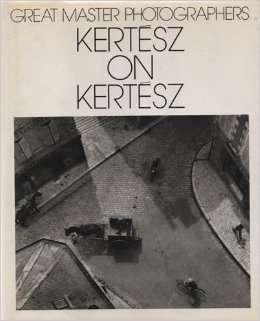
Kertesz on Kertesz

Kertesz on Kertesz

I bought this book and I really liked it. After a short introduction by Peter Adam it’s divided into three sections, each one a phase in Kertesz’s life/career: Hungary, Paris, New York It contains over 100 of Kertesz’s images, fascinating in of themselves. Many of them are accompanied by very short comments by Kertesz himself.

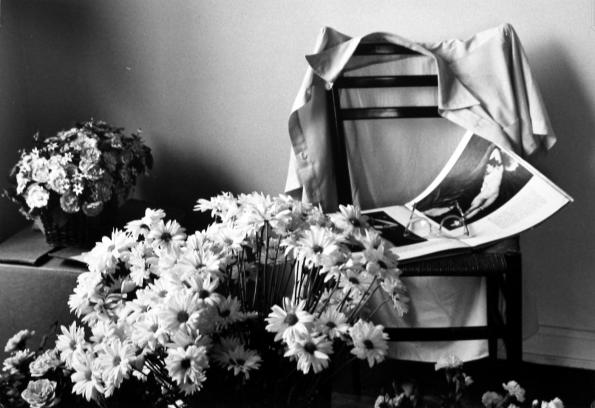
Still Life, New York City, 1976


For example, the above photograph entitled “Still Life, New York City, 1976” was taken late in Kertesz’s life (he died in 1985 aged 91).

The caption reads: “This is a photograph of the apartment taken while my wife was in the hospital. I wanted the apartment to be painted for here when she came back, but she never came back”.

The only thing I didn’t like about the book was that there wasn’t more of it.  I got through it quite quickly and wanted to read more.  This isn’t a criticism as much as it is a comment on the quality and readability of the the book.

Got some photography books for Christmas

It seems that my family finds it difficult to decide what to get me for Christmas. For many years now I have made an Amazon.com wish list, which they then choose from. Typically it contains books, CDs, DVDs, the occasional electronic gadget; maybe something to assist with my cooking.

This year I got, among other things, a number of photography-related books, specifically:

Why People Photograph by Robert Adams

Aperture Magazine Anthology – The Minor White Years 1952-1976. Edited by Peter C. Bunnell.

A History of the Photgraphic Lens by Rudolf Kingslake.

The Photographer’s Eye by John Szarkowski.

Annie Leibovitz at Work by Annie Leibovitz.

I haven’t had a chance to read them yet, but even just browsing through them they seem very interesting.

The Adams book is a collection of essays on selected topics e.g. colleagues, humor, collections, writing, teaching, money, dogs followed by sketches of a number of famous photographers including Edward Weston, Paul Strand, Laura Gilpin, Judith Joy Ross, Susan Meiselas, Michael Schmidt, Ansel Adams, Dorothea Lange and Eugene Atget.  The collection closes with three chapters on ‘working conditions’.

The Aperture anthology is quite a thick book.  The preface says: “It is not a comprehensive reprint of the issues, but rather a highly selective anthology of texts that were published in the magazine.  While a selection of photographs has been chosen from those illustrating the original articles, and several spreads from two image-drive issues consisting mainly of images are reproduced to give a sense of sequence, the focus here is on words….The goal is to give the reader a sense of ‘Aperture’ and the range of subjects that White and his colleagues addressed during his editorship, and to reflect on the development of serious art photography during the period 1952-1976”

The Kingslake volume.  Absolutely fascinating.  Couldn’t understand a word.  Actually that’s not true.  I could understand quite a bit, but there’s still a lot that’s beyond me at the moment.  I’ll keep plugging away at it until I can understand more.

The Photographer’s Eye.  Divided into an introductory essay and five sections (The thing itself; The Detail; The Frame; Time; and Vantage Point.  Each section begins with a couple of paragraphs of text followed by a series of photographs.   Very easy to ready and the photos are lovely.

They Leibovitz book will appeal to anyone interested in how a real life photographer actually works.  The fact the Leibovitz’s takes pictures of some of the world’s most famous celebrities gives this a sort of ‘voyeuristic’ appeal.