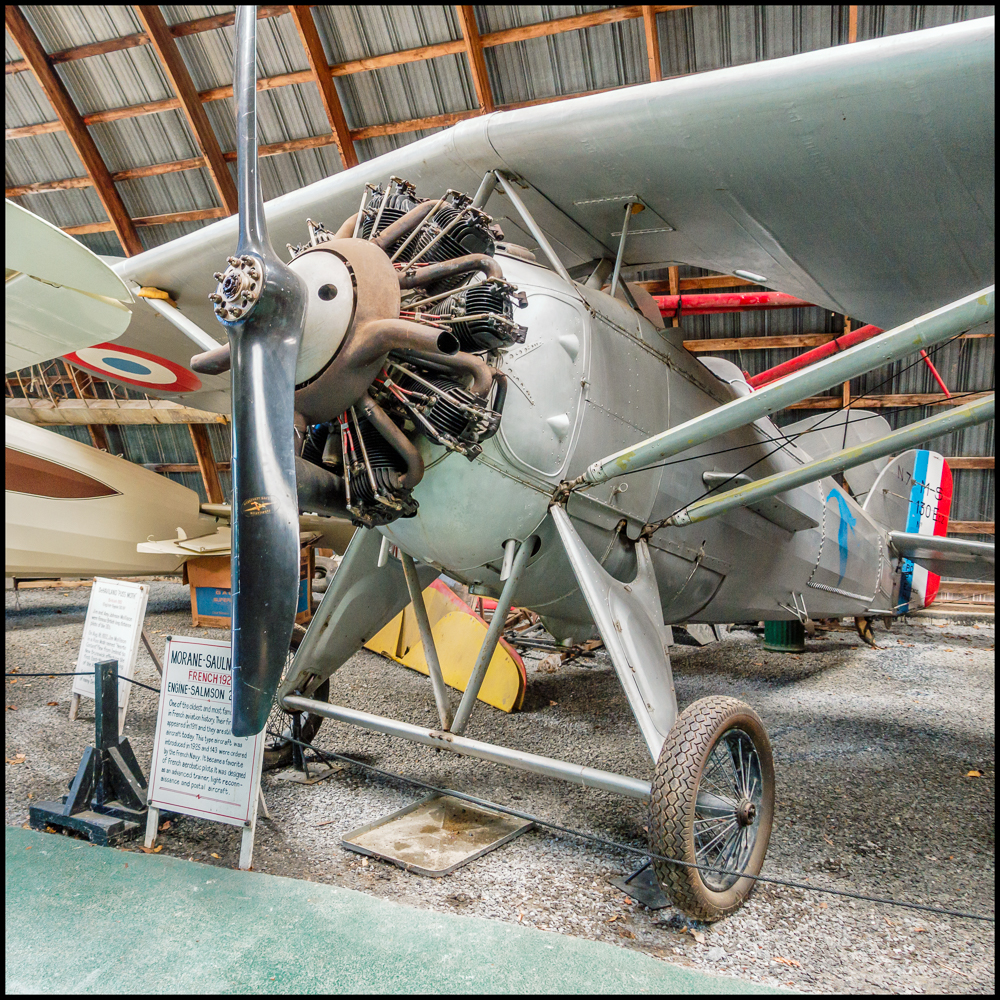
Old Rhinebeck Aerodrome – Golden Age Hangar. Morane-Saulnier MS.130

According to the Military History Encyclopedia on the Web:

The Morane-Saulnier M.S.130 was a parasol wing trainer that saw most use with the French navy. It was developed from the M.S.53, itself an improved version of the M.S.50. The M.S.50 was similar to the M.S.35, a training aircraft originally developed in 1915. This first aircraft had a straight parasol wing. The M.S.50 had a straight wing with an improved aerodynamic profile and round tips. The M.S.53 of 1924 had a sweptback parasol wing, described by Morane-Saulnier as being ‘autostable’. It was followed in 1925 by the M.S.129, which had a more powerful 180hp Hispano-Suiza engine.

The M.S. 130 appeared in 1926. It had a sweptback ‘autostable’ parasol wing, a carefully contoured fuselage (built around a rectangular frame that was faired out to produce the curved shape), and a yet more powerful engine, using an uncowled 230hp Salmson 9Ab radial. The M.S.50. M.S.53 and M.S.129 had sold in small numbers, but the M.S.130 was rather more successful. A total of 145 aircraft were built, with most going to the French navy, where they were used at naval air training centres from 1927 until 1935. The French military aviation service ordered a small batch, fifteen were sold to Brazil, two to Belgium, and the type also sold to China, Guatemala and Turkey.

A number of variants were produced, mostly by fitting an alternative engine to the basic design (see list below and separate articles). The second M.S.130 was given a modified undercarriage in 1929 (as later used on the M.S.230) and entered in the 1929 Coupe Michelin air race. Two further M.S.130s were later converted to the M.S.230 standard.

Taken with a Sony RX100 M3.

Old Rhinebeck Aerodrome – Golden Age Hangar. 1930 Austin 7

According to Wikipedia:

The Austin 7 is an economy car that was produced from 1922 until 1939 in the United Kingdom by Austin. It was nicknamed the “Baby Austin” and was at that time one of the most popular cars produced for the British market and sold well abroad. Its effect on the British market was similar to that of the Model T Ford in the US, replacing most other British economy cars and cyclecars of the early 1920s. It was also licensed and copied by companies all over the world. The very first BMW car, the BMW Dixi, was a licensed Austin 7, as were the original American Austins. In France they were made and sold as Rosengarts. In Japan, Nissan also used the 7 design as the basis for their first cars, although not under licence. This eventually led to a 1952 agreement for Nissan to build and sell Austins in Japan under the Austin name.

Many Austin 7s were rebuilt as “specials” after the Second World War, including the first race car built by Bruce McLaren, and the first Lotus, the Mark I.

Such was the power of the Austin 7 name that the company re-used it for early versions of the A30 in 1951 and Mini in 1959

Taken with a Sony RX-100 M3.

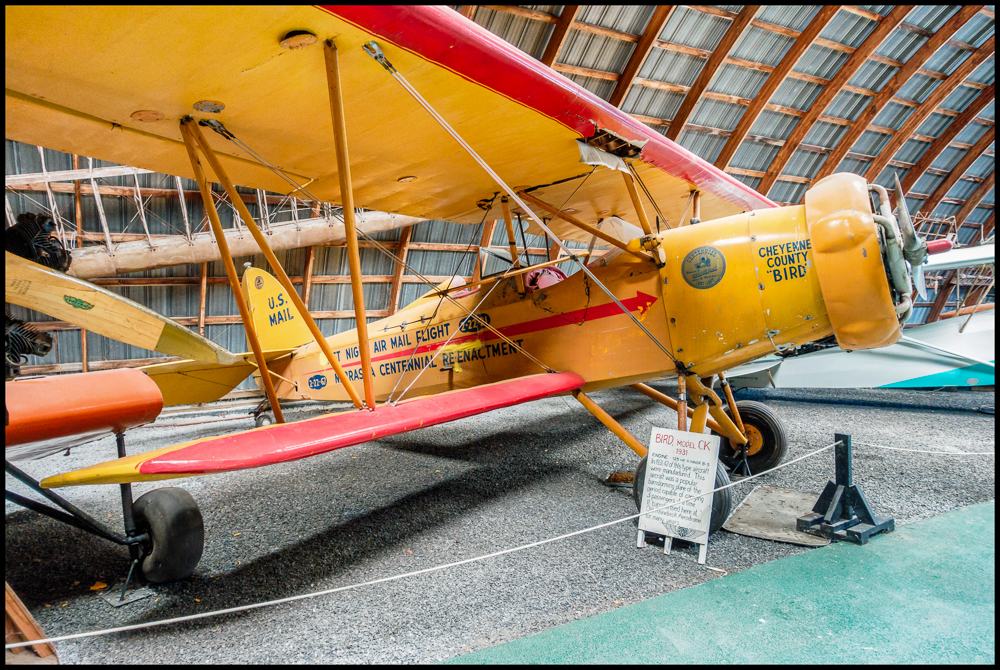
Old Rhinebeck Aerodrome – Golden Age Hangar. 1931 Bird CK.

According to the Golden Age Air Museum:

Built in 1931 in Brooklyn, New York by the Bird Aircraft Corporation (formerly Brunner- Winkle). The CK series was the third generation Bird biplane. Previous models were powered with the 90 horsepower Curtiss OX-5 and the 100 horsepower Kinner K5 radial engine. This airplane was designed and built for the barnstorming or ride business. It has room for three passengers and the pilot. A small fold out jumpseat in the front cockpit provided room for the third passenger. The Bird was very unique in the fact that the upper wing was twice the area of the lower wing. It also was unique in comparison to its competitors that it carried the same or even a greater load on half of the available horsepower.

Taken with a Sony RX100 M3.

Old Rhinebeck Aerodrome – WWI Hangar. Sopwith Camel (Replica)

According to Wikipedia:

The Sopwith Camel was a British First World War single-seat biplane fighter aircraft introduced on the Western Front in 1917. It was developed by the Sopwith Aviation Company as a successor to the earlier Sopwith Pup and became one of the most iconic fighter aircraft of the First World War.

The Camel was powered by a single rotary engine and was armed with twin synchronized machine guns. Though proving difficult to handle, it provided for a high level of manoeuvrability to an experienced pilot, an attribute which was highly valued in the type’s principal use as a fighter aircraft. In total, Camel pilots have been credited with the shooting down of 1,294 enemy aircraft, more than any other Allied fighter of the conflict. Towards the end of the Great War, the type had also seen use as a ground-attack aircraft, partially due to it having become increasingly outclassed as the capabilities of fighter aircraft on both sides were rapidly advancing at that time.

The main variant of the Camel was designated as the F.1; several dedicated variants were built for a variety of roles, including the 2F.1 Ship’s Camel, which was used for operating from the flight decks of aircraft carriers, the Comic night fighter variant, and the T.F.1, a dedicated ‘trench fighter’ that had been armoured for the purpose of conducting ground attacks upon heavily defended enemy lines. The Camel also saw use as a two-seat trainer aircraft. In January 1920, the last aircraft of the type were withdrawn from RAF service.

Taken with a Sony RX-100 M3.