New England Air Museum – Grumman E-1B (WF-2) ‘Tracer’

According to the Museum’s website (which also provides technical specifications):

THIS AIRCRAFT IS ON LOAN FROM THE NATIONAL NAVAL AVIATION MUSEUM, PENSACOLA, FLORIDA

Yes, this plane actually could fly! The “Tracer” was the first purpose built airborne early warning aircraft used by the U.S. Navy and could operate from an aircraft carrier. It was originally designated a “WF-2” which led to the affectionate nickname “Willie Fudd.” In 1962, military aircraft designations were changed and the Tracer became the E-1B. The piggyback 20′ X 30′ umbrella houses long-range search radar to detect targets beyond the line-of-sight of surface vessels.

The plane’s first flight was in late 1956 and was introduced into service in 1958. It was retired in 1977 and was replaced by the more modern Grumman E-2 “Hawkeye.”

A rare aircraft now, the Tracer represents one of the Grumman special purpose aircaft family that also included the C-1 “Trader,” C-2 “Greyhound,” E-2 “Hawkeye,” OV-1 “Mohawk,” and S-1 “Tracker.” The Museum’s aircraft was the last one to leave Navy service, and was one of 88 manufactured.

Taken with a Sony RX-100 M3.

New England Air Museum – Douglas A-3B ‘Skywarrior’

According to the Museum’s website (which also provides technical specifications):

THIS AIRCRAFT IS ON LOAN FROM THE NATIONAL NAVAL AVIATION MUSEUM, PENSACOLA, FLORIDA

The “Skywarrior” was designed as a strategic bomber to operate from an aircraft carrier. The test version, XA3D-1, first flew in October, 1952 and in March, 1956, the A3D-1 entered service with the U.S. Navy. One year later, the main production variant, the A3D-2 (later to be re-designated as A-3B) was delivered. For many years, it was the largest and heaviest carrier-based aircraft earning it the unofficial nickname, “The Whale.”

The A-3 was initially used as a bomber, but the aircraft proved to be very adaptable and its roles evolved to include photographic and electronic reconnaissance, electronic warfare, air refueling tanker, high speed transport and trainer. It proved very valuable in the Vietnam War as the EKA-3B in providing intelligence and jamming of enemy radar systems and communications networks, and as the KA-3B for in-flight refueling of attack aircraft. The Skywarrior was retired from service in 1991 as one of the longest serving carrier-based aircraft in history.

While the Navy was the primary user of the aircraft, a derivative, the B-66 “Destroyer,” also served with the U.S. Air Force as a tactical bomber, electronic warfare and reconnaissance aircraft until the early 1970’s.

This plane was flown to the Museum from the Patuxent River Naval Air Station, MD, by Navy Commander Joel H. Graham.

Taken with a Sony RX-100 M3.

New England Air Museum – Grumman HU-16E ‘Albatross’

According to the Museum’s website (which also provides technical specifications):

THIS AIRCRAFT IS ON LOAN FROM THE NATIONAL NAVAL AVIATION MUSEUM, PENSACOLA, FLORIDA

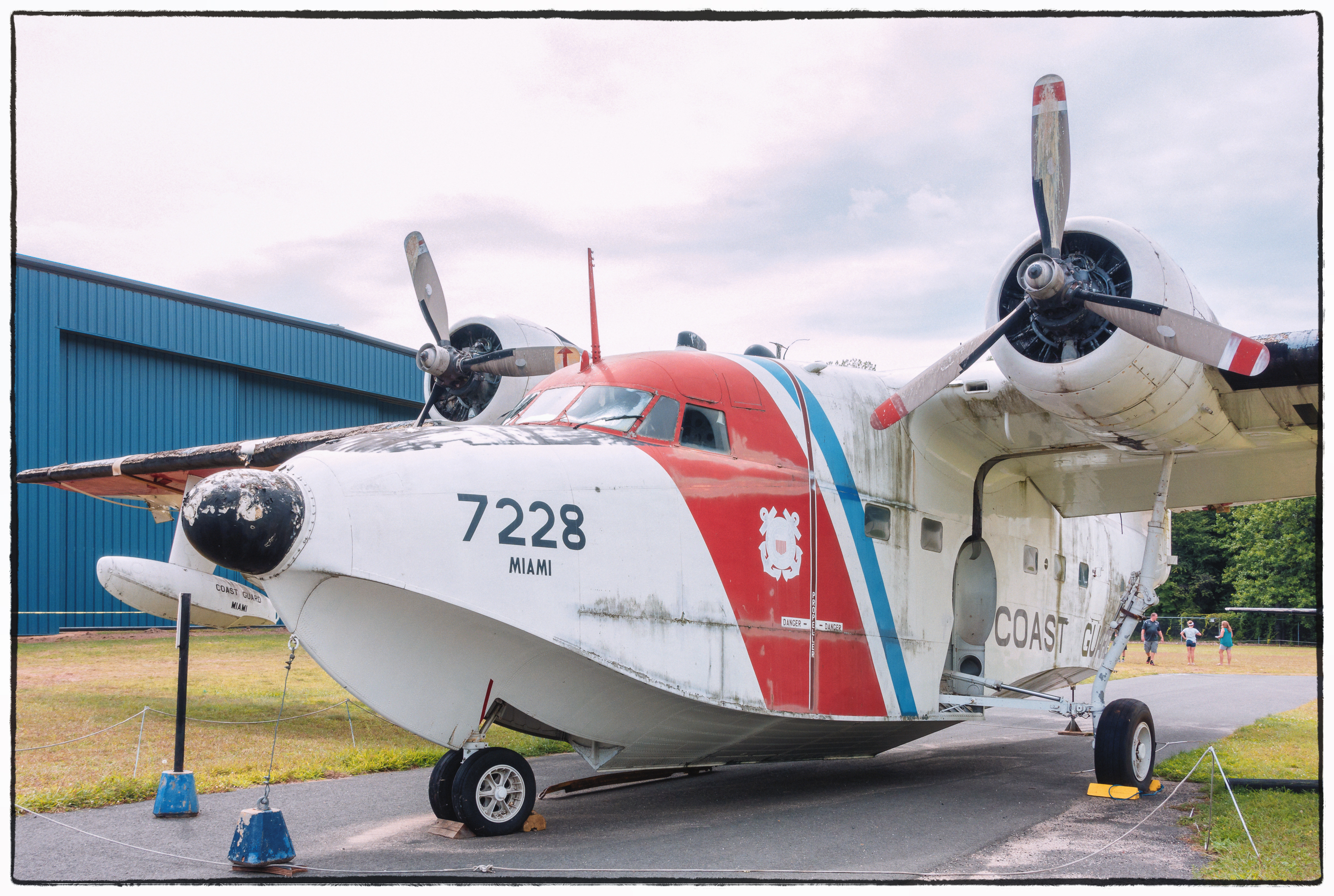
Grumman designed the “Albatross” to meet a U.S. Navy requirement for an amphibious utility aircraft that could also operate with skis from snow and ice. The Albatross has been likened to a “bird of good omen.” It has also been called “The Goat” because of its stubborn, slow response to controls and was known as “Old Dependable” due to its ruggedness.

It has been a primary search and rescue craft for the U.S. Navy, Coast Guard, and Air Force. The Albatross was active in the Korean Conflict and rescued nearly 1,000 United Nations personnel including hazardous rescues behind enemy lines. It later saw action in the Vietnam War.

Grumman HU-16E AlbatrossIntroduced into service in 1949, the craft had a long operatonal history with the final USAF flight taking place in 1973, the final Navy flight in 1976 and final Coast Guard flight in 1983. Ted Lattrell, who flew this actual plane in the 1970’s graciuosly supplied the picture at the left of the final flight of HU-16s stationed in Miami which included #7228.

This plane, was originally with the U.S. Air Force designated SA-16B and was transferred to the U.S. Coast Guard originally designated UF-1G and in 1962 was redesignated HU-16E. It was used for twenty years for air-sea rescue in the South Pacific and later along the Atlantic Coast.

Taken with a Sony RX-100 M3.

New England Air Museum – Douglas F4D-1 (later F-6) ‘Skyray’

According to the Museum’s website (which also provides technical specifications):

THIS AIRCRAFT IS ON LOAN FROM THE NATIONAL NAVAL AVIATION MUSEUM, PENSACOLA, FLORIDA

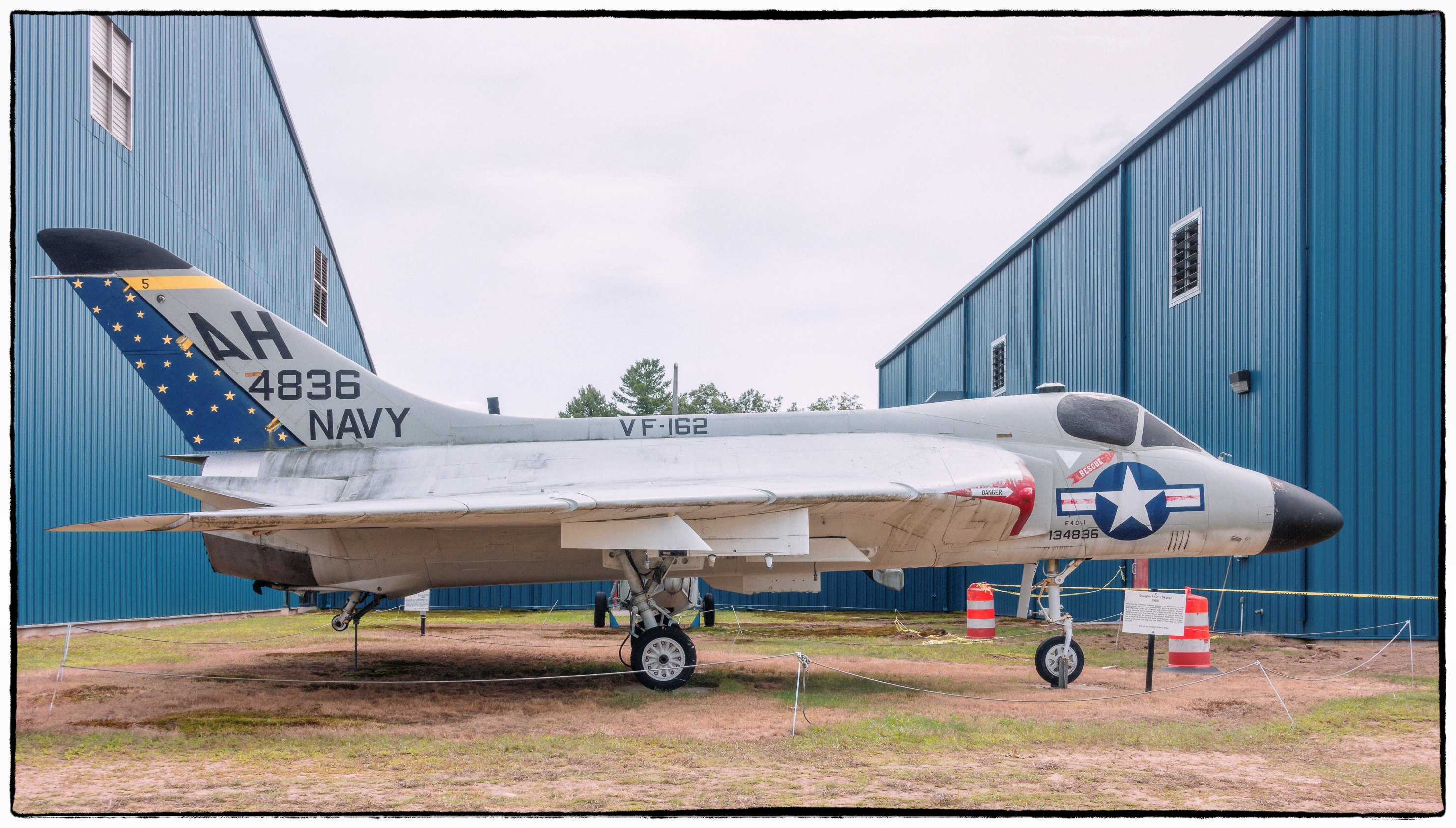
After World War II, it was believed that there was an emerging threat of high-flying incoming jet bombers. To counter this, the U.S. Navy commissioned Douglas for a design study and mock-up for a carrier based, short range interceptor capable of a high rate of climb. Famed aircraft designer, Ed Heinemann, proposed a tailless aircraft with a distinctive “bat wing” based on the concepts of the German aerodynamicist Dr. Alexander Lippisch who was an advocate of the delta wing configuration. The first prototype first flew in January, 1951, and production models of the ”Skyray” were delivered to the Navy in 1956.

In 1953, one of the prototypes captured the world speed record (753 mph) and rate-of-climb record (49,221’ in 2.6 minutes), the first carrier-based design to do so.

The Skyray never saw combat and was also flown by the U.S. Marines, the Naval Air Reserve and Marine Air Reserve until 1964. It was also the only Navy fighter assigned to NORAD (North American Defense Command).

Taken with a Sony RX-100 M3.

New England Air Museum – Lockheed TV-2 (T-33) ‘Shooting Star’

According to the Museum’s website (which also provides technical specifications):

THIS AIRCRAFT IS ON LOAN FROM THE NATIONAL NAVAL AVIATION MUSEUM, PENSACOLA, FLORIDA

With the advent of the jet fighter in the late 1940’s new demands were put on pilots and there was a need for a jet trainer aircraft. The solution was to extend by about three feet the fuselage of the U.S. Air Force’s first operational jet fighter, the P-80/F-80, to allow for a second cockpit with dual controls. The first flight of this new trainer, designated T-33 for the Air Force and TV-2 for the Navy, took place in March, 1948.

The “Shooting Star” proved to be a very capable trainer and was built until 1959 with over 6,500 produced. It took on additional roles as well in reconnaissance, drone directors and target towing. Due to the Cold War, their use was not limited to the U.S. and they also went into the inventories of many U.S. allies.

While the TV-2 was used by the Navy in land-based training, Lockheed subsequently developed the T2V/T-1A “SeaStar” for aircraft carrier training. The design also became the basis for Lockheed’s F-94 “Starfire” which was the Air force’s first jet powered all-weather interceptor.

Taken with a Sony RX-100 M3.