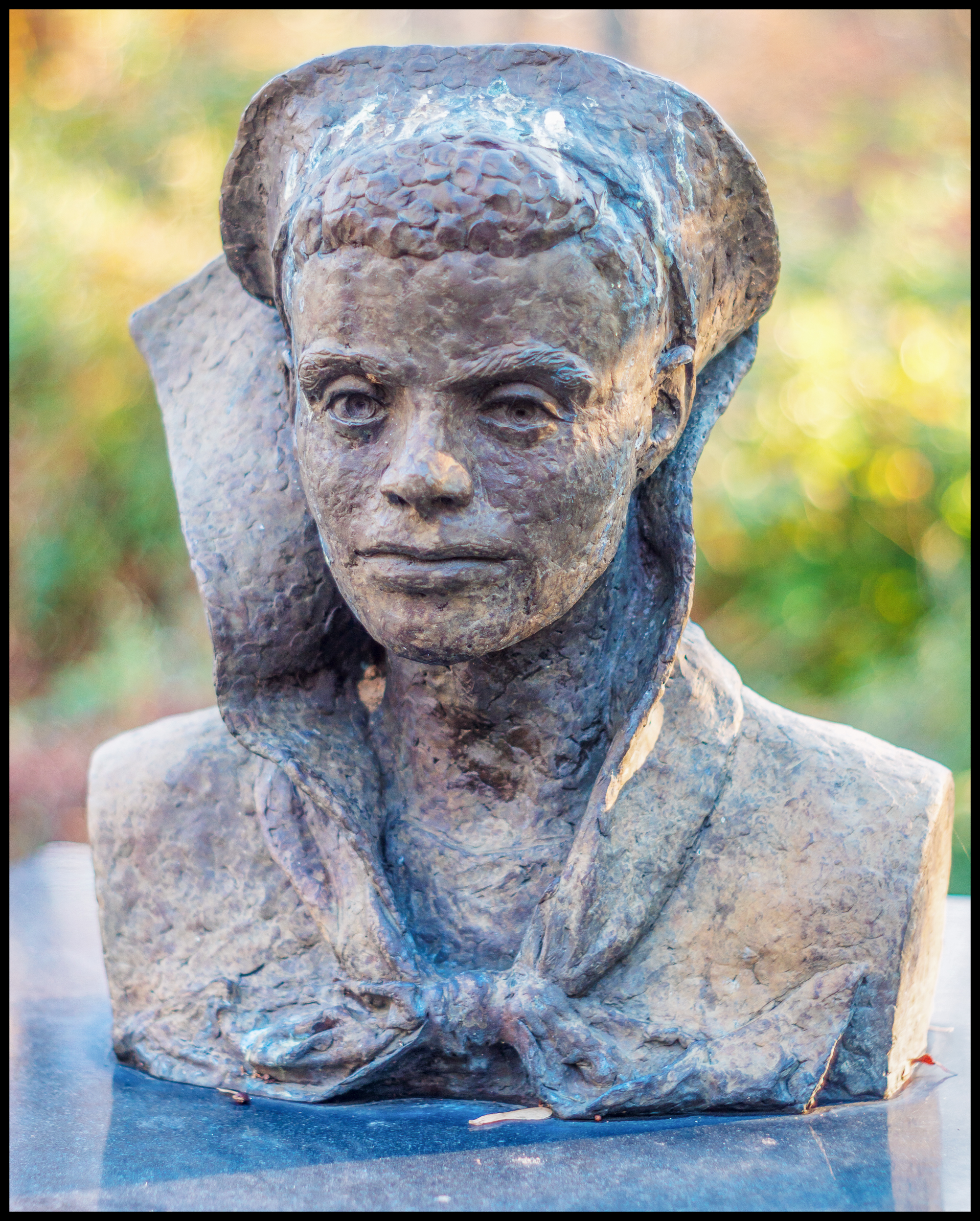
Lasdon Park and Arboretum – Trail of Honor, Female Nurses Monument

According to lasdontrailofhonor.com:

The last bust on the trail is dedicated to the hundreds of women who have dutifully attended our nation’s wounded soldiers for over 200 years. Without the aid and services of these brave women, many more lives would have been lost to infection, disease, and unattended injuries. The bust stands as a testament to their continued service and dedication to our troops at large.

There’s also a monument (not shown here) to eight nurses killed in Vietnam:

As you follow the path leading to the Vietnam Veterans memorial, this humble monument will present itself. This piece of black granite commemorates the sacrifice of the eight nurses who were killed during their service in Vietnam. The monument is placed next to the Vietnam Veteran’s Memorial, showing the significance of their sacrifice during the war to the servicemen they treated. Even though none were from Westchester County, the significance of their story has earned them a place on this beautiful trail.

Lasdon Park and Arboretum – Trail of Honor, Desert Storm Bust

According to lasdontrailofhonor.com:

This next bust features a tank trooper dedicated to those who served in Desert Storm, also known as the Persian Gulf War and the shortest conflict in American history, lasting only 100 hours of combat time. In August 1990 Kuwait was invaded by Iraqi troops, an action that was immediately met with economic sanctions by the U.N. Six months later the United States decided to respond to the Iraqi presence in Kuwait with military force, launching Operation Desert Storm, which was made up of troops from the United States, The United Kingdom, Egypt and Saudi Arabia. The coalition first launched a bombing run, and then followed with a ground assault to expel the Iraqi troops from Kuwait. Once the Iraqi troops had been pushed back, a cease-fire was called, after only 100 hours of combat involved during the campaign.

Lasdon Park and Arboretum – Trail of Honor, Vietnam War Bust

According to lasdontrailofhonor.com:

The Vietnam War was fought from 1959 to 1975, during a time of major social revolution and chaos on the home front. The war was another attempt to prevent Russia’s influence from spreading into Asia. North Vietnam was attempting to claim South Vietnam, similar to what happened in Korea, and Americans felt that the war would be a swift victory.
However, the North Vietnamese used guerilla warfare to strike at American troops patrolling through their native jungles. After years of fighting on the war front and rallies and protests on the home front, President Nixon pulled out U.S. troops in 1975. The monument shows a machine gunner in a worn uniform, reflecting the exhaustion of the servicemen who fought in Vietnam.

Lasdon Park and Arboretum – Trail of Honor, Korean War Bust

According to lasdontrailofhonor.com:

Next in line on the trail is The Korean War bust. The monument is of a man wrapped in a standard issue blanket, reflecting the cold temperatures that most soldiers experienced while fighting in Korea. This conflict was fought to diffuse a Communist spread into Asia. After World War II, Russia became the next major threat with their attempt at spreading their influence into Asia. When peace was declared after World War II, Korea was split in half, with the Socialists in North Korea attempting to invade South Korea. The United Nations intervened, defending the infamous 38th Parallel from the North Koreans, who were backed by the communist forces of China and Russia. The UN used both swift infantry raids and bombing runs in order to force back the North Koreans from the demilitarized zone, but in 1953 a stalemate was declared. UN forces still occupy the 38th parallel to this day.

Lasdon Park and Arboretum – Trail of Honor, World War II Busts

According to lasdontrailofhonor.com:

Continuing on the trail you come to the World War II busts standing side by side. The two busts, one of whom is an infantryman and the other being a seaman, both visualize the struggle and hardship that all generations faced while fighting against the rising Nazi threat. In 1939 the allied powers, with the exception of the United States, declared war on a vicious Nazi Germany, whose borders had violently made their way into Poland and Austria. Japan, who had allied themselves with Germany along with Italy, soon attacked Pearl Harbor, provoking the United States to defend itself and come to the aid of the Allied forces. The war raged on both in Europe and in the Pacific, lasting a total of six years before ending in 1945 with the death of Nazi Germany’s dictator, Adolf Hitler, and finally with the bombing of Japan through use of the first nuclear weapons.