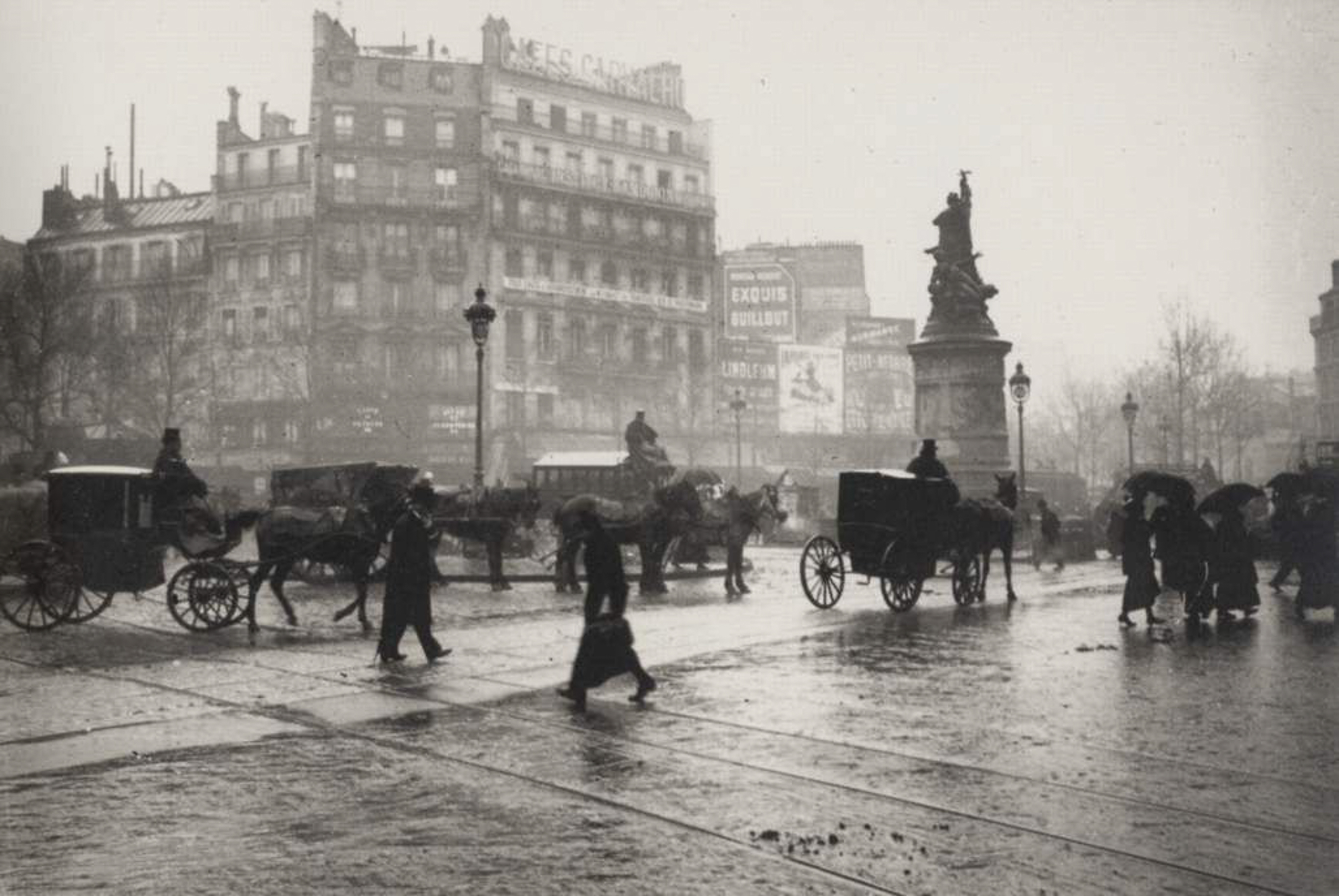
An interesting two part interview with Henri Cartier-Bresson:
The journalist and filmmaker Sheila Turner-Seed interviewed Henri Cartier-Bresson in his Paris studio in 1971 for a film-strip series on photographers that she produced for Scholastic. After her death in 1979 at the age of 42, that interview, along with interviews that Ms. Turner-Seed had conducted with Bruce Davidson, Cornell Capa, Lisette Model, W. Eugene Smith, Don McCullin and others, sat like a time capsule in the archives of the International Center of Photography in New York.
via Henri Cartier-Bresson: Living and Looking – NYTimes.com.
The second part of that interview, transcribed from tape by Sheila Turner-Seed, continues where we left off yesterday. It has been lightly edited. A DVD of the Cartier-Bresson interview, with his photos, is available from the International Center of Photography’s online bookstore.
via Henri Cartier-Bresson: ‘There Are No Maybes’ – NYTimes.com.
Thames & Hudson’s Photofile series. I have a couple of these and can recommend them:
Thames & Hudson’s Photofile series – a sort of Reader’s Digest of coffee table books – offers well-produced paperbacks containing approximately 60 decent reproductions. Rather than review one at a time, I’ll review the series, as most are worthwhile, and the concept of these affordable and small packages is fantastic.
Quality photo books generally are priced too high for students (or anyone on a budget) to purchase with abandon. Additionally, they can be cumbersome and better suited to adorn a coffee table than to actually thumb through. Thus the Photofile series addresses an important gap in the marketplace. These portable and reasonably priced ‘mini-monographs’, allow readers to enjoy well-reproduced photos without breaking the back or the bank. They are to large art books what a high quality point and shoot is to the professional DSLR. Let’s go through some of their strong points….
via The Photofile Series published by Thames & Hudson: Digital Photography Review.
Ever wanted to make your own camera. Now’s your chance with the Lomography Konstruktor (from Petapixel).
You may have seen built-it-yourself 35mm pinhole cameras before, but have you ever seen a DIY SLR? Lomography today announced the Konstruktor, a camera it calls “the world’s first 35mm do-it-yourself” SLR camera. If you loved building model airplanes as a kid, this is one camera kit you’re going to love.
via Lomography Konstruktor is the World’s First Build-It-Yourself 35mm SLR.
Now you too can make blurry, over-saturated, grainy, cross-processed, light polluted pictures with your very own home built camera. Sounds like I hate lomo cameras :-). Actually I don’t – even if I find them typically overpriced. I do like some of the pictures they produce and I admire the way they seem to have introduced an entire new generation to film photography. For $35 I might pick up one myself.
I loved this parable: “Losing your marbles” from Kirk Tuck at the Visual Science Lab.
“One day, as if by magic, a young boy in a very poor village, found a small, perfectly round object only half an inch across that seemed to glow with the most beautiful blue light. He carefully put the round object in his pocket and went home to show his parents. The parents were delighted because, living in a village made of beige mud they’d never seen anything so beautiful. ‘If you can find more of these we could sell them and become rich.’ Said the boy’s father. So the boy decided to go out into the world and find out the secret of the small, perfectly round, beautiful orbs. He put the one he’d found into his pocket, packed a few sandwiches and headed off to search the world for more………
Follow the link for more via Losing your marbles. | The Visual Science Lab / Kirk Tuck.
It seems that Kodak is not quite dead yet.
The first fruits of Kodak’s partnership with JK Imaging are starting to emerge. Chinese camera site DCFever has published some photographs of the Kodak S1, a new Micro Four Thirds camera that was announced at the beginning of the year.
via New Photos of the Kodak S1 Micro Four Thirds Mirrorless Camera.
The camera never lies. We all know that this has never been true and it’s particularly not true in the Photoshop era. Is this good or bad? My view is that it depends. If the picture purports to present reality (e.g. a news photo) then it should not be manipulated. If not (e.g. if the picture is more artistic in nature) then anything goes. Whatever makes a good image.
We are bombarded with images from television, computer screens, newspapers, and magazines. There are advertisements, illustrations for news stories, snapshots from social media, and on and on. From time to time there are news stories expressing outrage about manipulated photographs in advertisements and, heaven forbid, enhanced photos in news stories. There are rants about “fake” photographs, and prestigious publications such as the New York Times proclaim their purity. In the nytco web site1 we find, “Images in our pages that purport to depict reality must be genuine in every way.”
Does this make any sense? Is there such a thing as a fake painting, a fake magazine article, a fake television show? I think there are fakes, but to me these are things that are meant to deceive, in other words, things that are not what they claim to be. The problem with photographs is the out-of-date notion that photographs represent reality and have an implied label of nonfiction.
via ethics-fake.
This article also pointed me towards an interesting site, which, among other things, provides numerous examples of actual photomanipulation.
.Ethics in Photo Editing.