
At the Bronx Zoo – Birds – Crested partridge

The crested partridge (Rollulus rouloul) also known as the crested wood partridge, roul-roul, red-crowned wood partridge, green wood quail or green wood partridge is a gamebird in the pheasant family Phasianidae of the order Galliformes, gallinaceous birds. It is the only member of the genus Rollulus.

This small partridge is a resident breeder in lowland rainforests in south Burma, south Thailand, Malaysia, Sumatra and Borneo. Its nest is a ground scrape lined with leaves, which is concealed under a heap of leaf litter. Five or six white eggs are incubated for 18 days.

Unusually for a galliform species, the young are fed bill-to-bill by both parents instead of pecking from the ground, and although precocial, they roost in the nest while small.

The crested partridge is a rotund short-tailed bird, 25 cm (9.8 in) in length, with the male marginally larger than the female. Both sexes have a scarlet patch of bare skin around the eye and red legs without a spur or hind toe.

The male is metallic green above with glossy dark blue underparts and a brownish wing panel. The head is adorned with a tall red crest, a white forehead spot and black frontal bristles. The female has pea-green body plumage apart from the brown wing coverts. She has a slate-grey head with the bristles but no spot or crest. The bill is all-dark. Young birds are duller versions of the adult of the same sex. The song is a mournful whistled si-ul.

The crested partridge is usually seen singly or in pairs as it uses its feet to probe the forest floor for fruit, seeds and invertebrates. When disturbed, it prefers to run but if necessary it flies a short distance on its rounded wings.

There is some concern about the effect of habitat destruction on this bird, especially with regard to logging. However, it seems to be somewhat more adaptable than other southeast Asian pheasants. As of 2021, the crested wood partridge is evaluated as Vulnerable on the IUCN Red List of Threatened Species. It is listed on Appendix III of CITES. (Wikipedia)

Taken with a Sony A7IV and Sigma 150-600mm f/5-6.3 DG DN OS Sports Lens

At the Bronx Zoo – Birds – Red-throated parrotfinch

The red-throated parrotfinch (Erythrura psittacea) is a species of estrildid finch found in New Caledonia. It has an estimated global extent of occurrence of 20,000 to 50,000 km2.

It is found in both subtropical or tropical moist lowland forest and shrubland habitats. The IUCN has classified the species as being of least concern.

The red-throated parrotfinch was formally described in 1789 by the German naturalist Johann Friedrich Gmelin in his revised and expanded edition of Carl Linnaeus’s Systema Naturae. He placed it with the finches in the genus Fringilla and coined the binomial name Fringilla psittacea. The specific epithet is Modern Latin for “parrot-like”. Gmelin based his account on the “parrot finch” that had been described and illustrated in 1783 by the English ornithologist John Latham in his multi-volume work A General Synopsis of Birds. Latham’s had access to a specimen that had been shot by the German naturalist Johann Reinhold Forster in New Caledonia. Forster had accompanied James Cook on his second voyage to the Pacific Ocean. The red-throated parrotfinch is now one of 12 parrotfinches placed in the genus Erythrura that was introduced in 1837 by the English naturalist William John Swainson. The species is monotypic: no subspecies are recognised. (Wikipedia)

Taken with a Sony A7IV and Sigma 150-600mm f/5-6.3 DG DN OS Sports Lens
At the Bronx Zoo – Birds – Grey Winged Trumpeter

The grey-winged trumpeter is a chicken-like bird with a long neck and legs and a hump-backed profile. It is 45 to 52 centimeters (18 to 20 in) long. Two males weighed 0.82 and 1.02 kg (1.8 and 2.2 lb) and six females weighed between 0.79 and 1.06 kg (1.7 and 2.3 lb). The sexes are similar in appearance. Their stout, slightly decurved, bill is yellowish green and their legs and feet greenish olive. Their plumage is mostly black. The nominate subspecies has green or violet iridescence on the lower neck. Its inner wings and rump are ashy gray and the middle of the back is ochre to chestnut. Subspecies P. c. napensis has bronzy or purple iridescence, lighter gray wings and rump, and a more ferruginous back. P. c. ochroptera has entirely ochraceous wings, rump, and middle back. (Wikipedia)

Taken with a Sony A7IV and Sigma 150-600mm f/5-6.3 DG DN OS Sports Lens
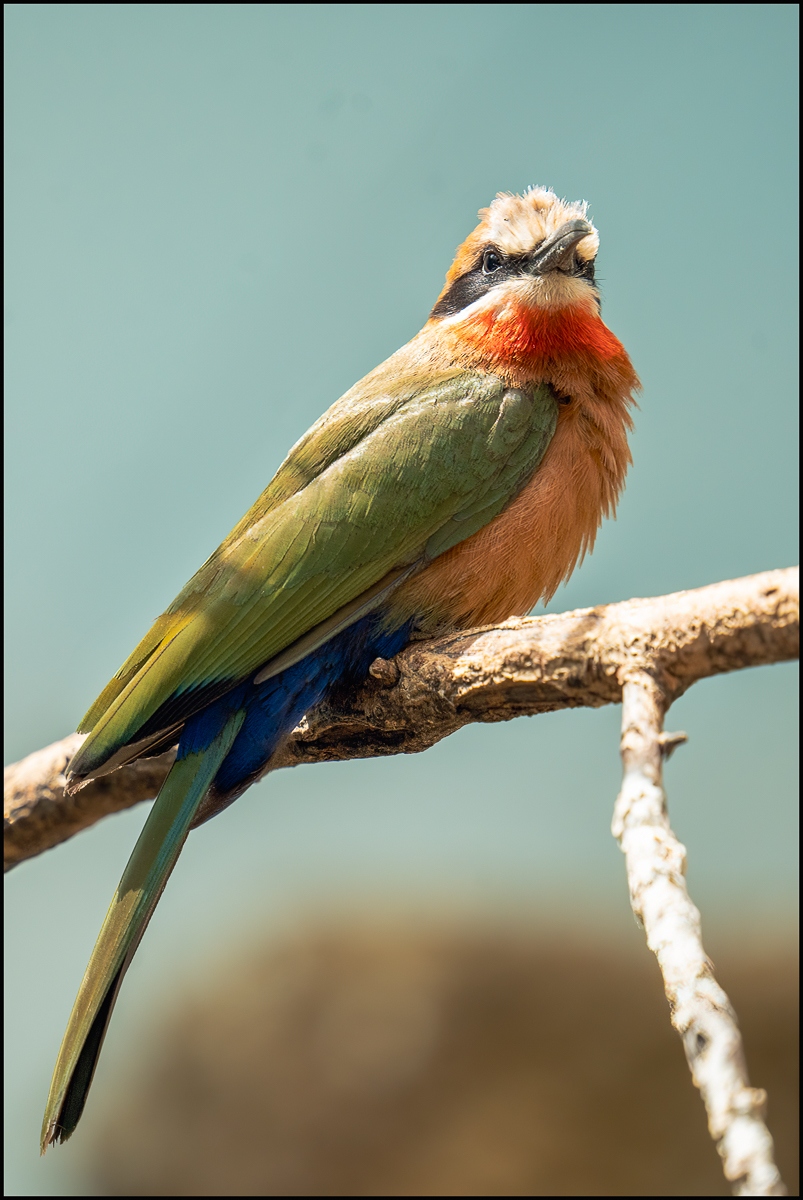
At the Bronx Zoo – Birds – White FRONTED bee eater

The white-fronted bee-eater (Merops bullockoides) is a species of bee-eater widely distributed in sub-equatorial Africa. The species has a distinctive white forehead, a square tail, and a bright red patch on its throat. It nests in small colonies, digging holes in cliffs or earthen banks, and can usually be seen in low trees, waiting to hunt passing insects by making quick hawking flights or gliding down before hovering briefly to catch the prey. This species, like other bee-eaters, is a richly coloured, slender bird, but with a distinctive black mask, white forehead, square tail and a bright red throat. The size is 23 cm (9 in.). The upperparts are green, with cinnamon underparts. The call is a deep squeak. (Wikipedia)

Taken with a Sony A7IV and Sigma 150-600mm f/5-6.3 DG DN OS Sports Lens

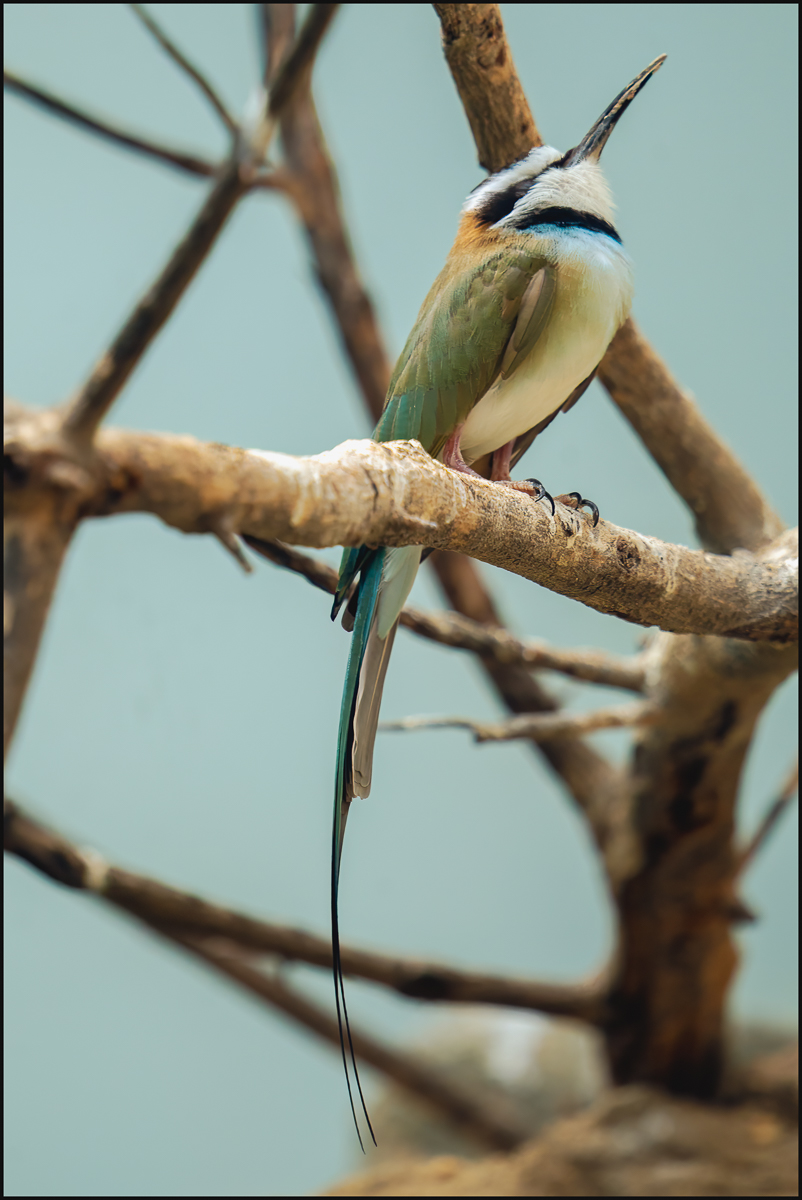
At the Bronx Zoo – Birds – White-THROATED bee eater

Finally found some birds that aren’t either Mallards or Canada geese, but I had to go to the zoo to do it. When I started to write these posts I had no idea what the birds were called. However, it turned out that it was pretty easy to find them on the internet.

This one is a White-throated bee eater: (Merops albicollis), a near passerine bird in the bee-eater family, Meropidae. It breeds in semi-desert along the southern edge of the Sahara, Africa. The white-throated bee-eater is migratory, wintering in a completely different habitat in the equatorial rain forests of Africa from southern Senegal to Uganda. Description: This species, like other bee-eaters, is a richly coloured, slender bird. It is predominantly green, but its face and throat are white with a black crown, eye stripe, and neckband. The underparts are pale green shading to blue on the breast. The eye is red and the beak is black. The white-throated bee-eater can reach a length of 19–21 cm, excluding the two very elongated central tail feathers, which can exceed an additional length of 12 cm. They weigh between 20 and 28 grams. Sexes are alike, except that the male has longer tail feathers. The call is similar to European bee-eater.
(Wikipedia)

Taken with a Sony A7IV and Sigma 150-600mm f/5-6.3 DG DN OS Sports Lens