
Seen as we returned to Kingston after a great boat ride on Rondout Creek and the Hudson River.
Taken with a Sony A7IV and Rokinon/Samyang AF 24-70 f2.8 FE
Photographs and thoughts on photography and camera collecting

Seen as we returned to Kingston after a great boat ride on Rondout Creek and the Hudson River.
Taken with a Sony A7IV and Rokinon/Samyang AF 24-70 f2.8 FE

“If you’re a true-born Kingstonian, you probably remember the days when our Mariner’s Harbor building was home to the Daily Freeman.
Back in the day, lower Broadway was the hub of our great city. Rondout Savings Bank was nearby. So was B & F Market, the post office, the Orpheum Theater, the shoe-shine shop, the five-and-dime store and Rookie’s Tavern on the Strand.
Those were the days when newspaper people were portrayed in the movies as heroes—the Cary Grants and the Clark Gables of a bygone era.
The Freeman occupied our historic building that dates back even further to 1851 when Jewish businessman Israel Sampson built it as the Sampson Opera House. A couple of fires—one in 1874 and another in 1885—destroyed much of the buildings original features. Some, like the cast-iron pillars at the ground level of our three-storied building remain in tact. It became the official home to the Daily Freeman in 1911, some 20 years after Jay Klock bought it in 1891.
Today when you visit our restaurant, you’ll come in through a corner door. Above it hangs a sculpted swordfish. Back in the day, the double doors leading into the Freeman were on the lower Broadway side.
Edward Palladino, a former city editor at the Freeman and 31 year veteran of the paper, shared with us, “All three stories of the building were used at the newspaper.” The editorial department occupied the second floor. It was the place where Palladino and the other news people settled down each morning to hunt the day’s stories. Back then, the Freeman was an afternoon paper. The presses would start their run at around 2 pm, and former Freeman staffer Bob Haines recalls what it was like. “Once the presses got going, the whole building would shake,” says Haines who worked as a Freeman photographer from 1967 till 2007. “I would come in each morning to pick up my assignments for the day, and I’d drop my pictures by at night.” Haines said he often put his finished work in a dumb waiter that would carry items up to the editorial floor. “We used to throw in all kinds of stuff like half-eaten baloney sandwiches, and once, someone put a cat in there. It was a real fun place to work,” Haines shared.
“It was a great atmosphere,” Palladino agreed. “The newspaper business to me is one of the most fascinating businesses in the world because everyday there’s something new.”
When Joan Saehloff was hired in 1950, the Freeman was still owned by the Klock family. After Saehloff put in her time as an “office girl,” she worked her way up to Society Page editor. “The downtown Freeman was just like what you’d see in the old movies. It was a busy place, and you could smell the paste pots and the ink,” says Saehloff, who at age 18 was in charge of the newspaper delivery boys. “You could see the big printing presses through the window.” Now those windows overlook the Rondout Creek.” (Mariners Harbor Website).
“Only the old-timers like us would remember. Overtime I go there, there’s a lot of nostalgia,” said Palladino.
We’re proud of our history here in Kingston!


Taken with a Sony A7IV and Rokinon/Samyang AF 24-70 f2.8 FE

“If this yacht could talk, it would probably be able to tell some amazing tales.
On Monday afternoon, a luxury yacht designed to look like a pirate ship docked in Kingston, NY. If the 156-foot vessel looks familiar, it’s because the famous boat has been photographed countless times by the paparazzi.
The ship was purchased by Johnny Depp back in 2007 and named Vajoliroja. At the time, Depp was dating Vanessa Paradis. The name was created by combining both of their names with the names of their children, Lily-Rose and Jack.
After purchasing the yacht, Depp hired famed interior designer LM Pagano to renovate it. According to Insider, Pagano draped the interior of the ship in velvet and other luxurious fabrics in an effort to make it feel like “the Orient Express on the ocean.”
After Depp parted ways with Paradis and started dating Amber Heard in 2017 he renamed the vessel Amphitrite. The boat even played a part in their infamous trial. Heard claimed that the actor assaulted her on the yacht by hitting her against a wall. She accused Depp of drinking too much because he was angry he had to sell the boat. Depp denied the accusation, but he did wind up selling the yacht to another huge celebrity in 2015.
The Amphitrite was purchased seven years ago by famed novelist J.K. Rowling for a reported $27 million. The Harry Potter author may have actually scored a great deal on the yacht which includes a Jacuzzi, helicopter pad and a small swimming pool. The interior of the boat hides five luxury cabins. Insider says three of the cabins are furnished with double beds, and the other two children’s rooms have twin beds. All of the bedrooms have their own private bathroom.
There was lots of buzz when the ship, now called Arriva, showed up on the Hudson River in 2020. Locals were heading to the river in hopes of catching a glimpse of Rowling, but that may have been a waste of time. It appears the boat was sold by the author and is now owned by a wealthy businessman.” (Yacht Once Owned by Johnny Depp Spotted in Kingston, We Peek Inside which also includes a number of interior shots)
I’ve also read that the Arriva is usually docked on the Long Island Sound, but that the present owner brings it up the Hudson River once a year so he can enjoy the fall foliage.
Taken with a Sony A7IV and Rokinon/Samyang AF 24-70 f2.8 FE
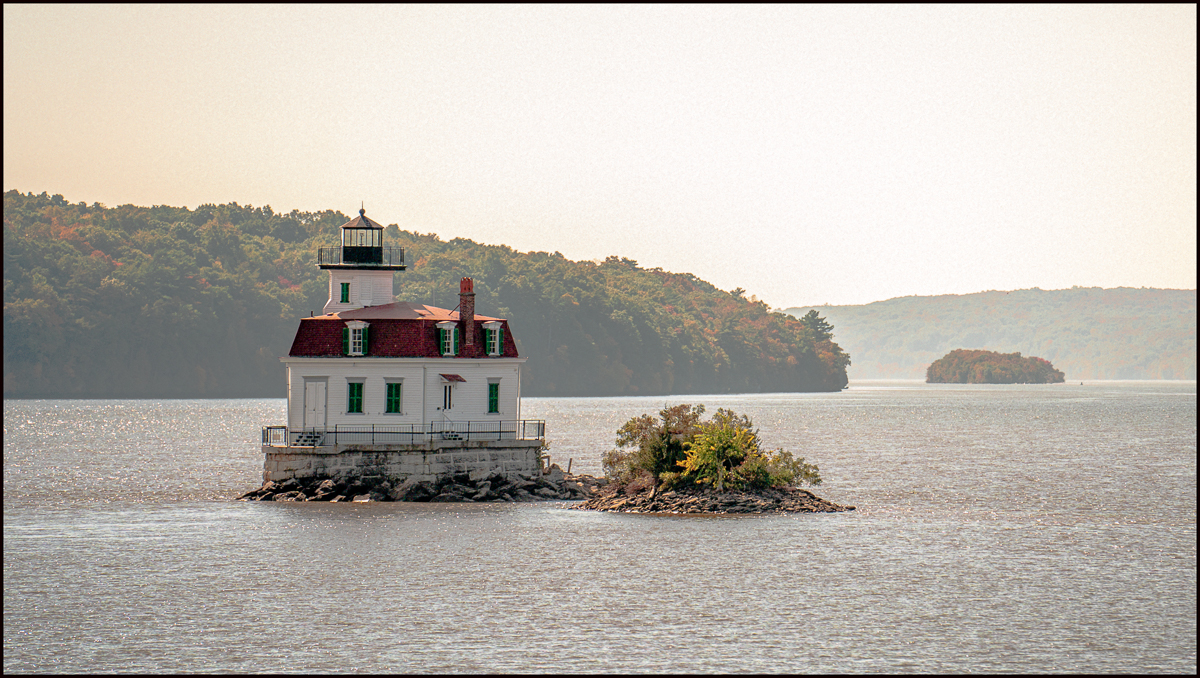
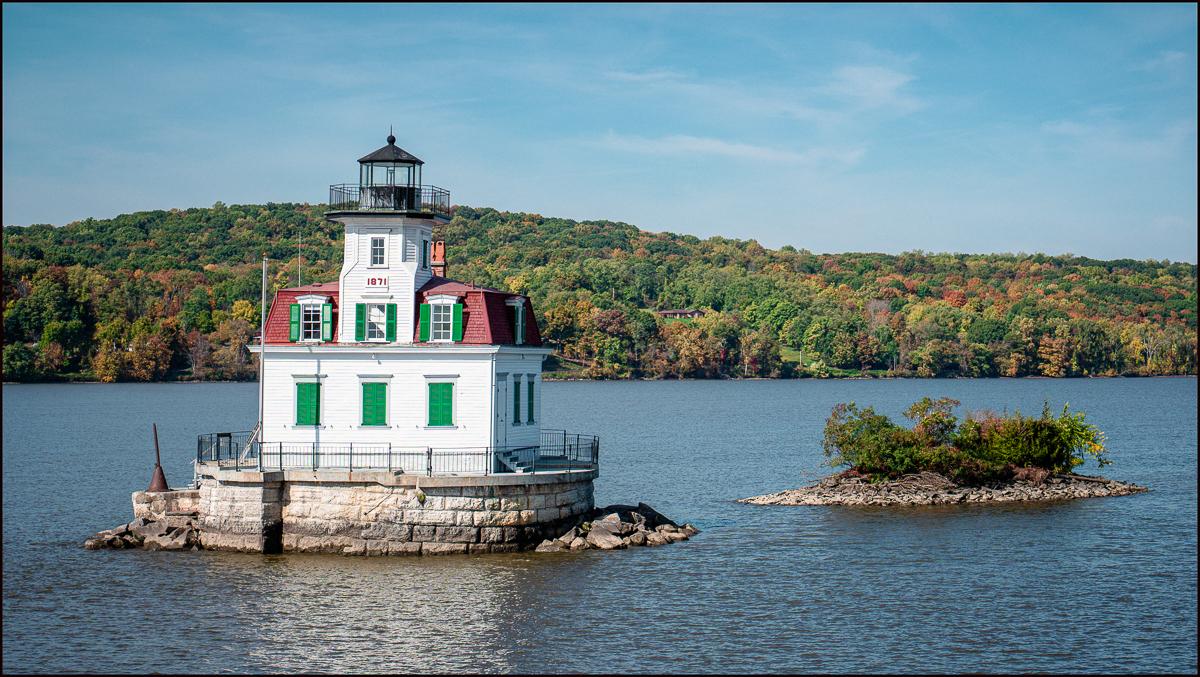
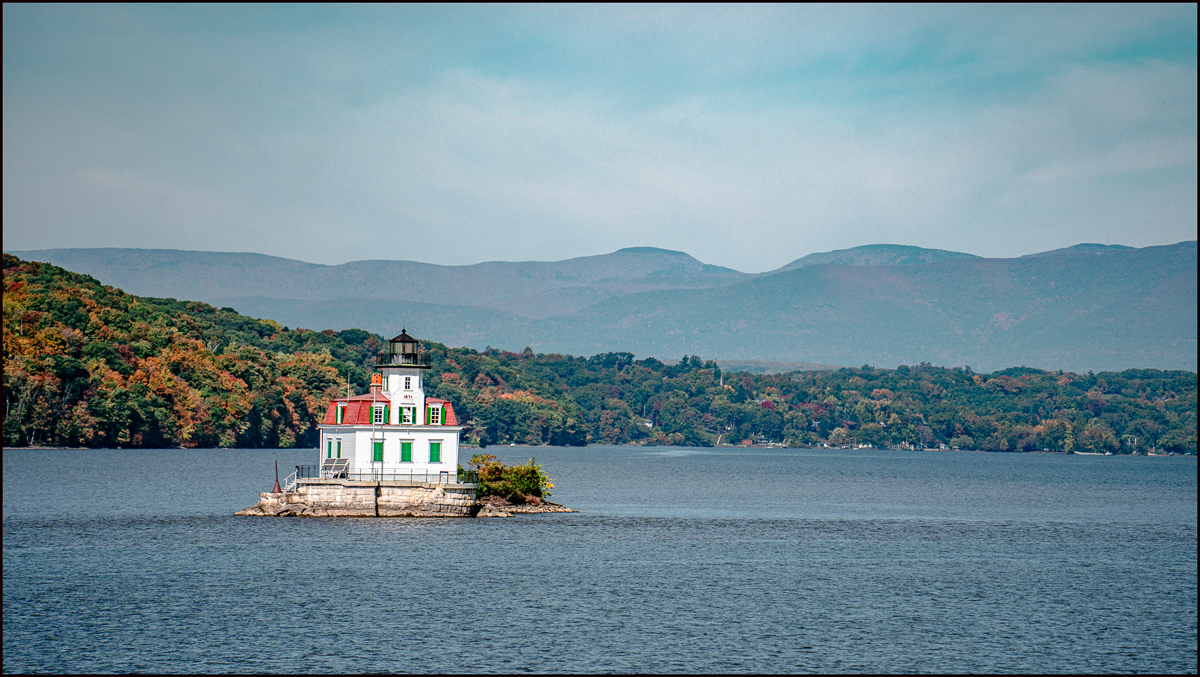
Consequently, on July 15, 1870 Congress authorized $25,000 to build a new lighthouse 100 feet southeast of the old site (coordinates 41°52’6.2”N 73°56’29.8”W, NOAA Chart 12347). Construction, entailing 250 40-foot-long piles driven into the river bed, topped by twelve-inch-square timbers and a round 49-foot in diameter cut granite pier supporting a French Second Empire Style, wood-framed white clapboard exterior with red mansard roof, was completed in 1871. Designed by Vermont architect Albert Dow, the square keeper’s residence contained seven rooms with a kitchen, sitting room, and equipment room on the first floor and three bedrooms and a bathroom on the second floor. A 53-foot high octagonal tower crowned the lighthouse and was originally fitted with a fifth order Fresnel light, flashing white every 2.5 seconds over a 270° arc with a range of 12 nautical miles, beginning on August 26, 1872. An automatic fog bell was added in 1891, but has subsequently been removed. Similar lighthouses are located at Rose Island Light (Newport Harbor), Sabin Point (Providence River), Pomham Rocks Providence River), and Colchester Reef (originally on Lake Champlain now at Shelburne Museum)
Accessible only by boat, life for a keeper and his family could be very lonely and on occasion even dangerous. Polishing the Fresnel lens and brass reflectors were daily tasks. The keeper also maintained a daily log of weather, significant events, and names and classes of ships passing on the river. In winter, when the river froze, keepers often took part time jobs on shore like ice cutting in the winter months. Manny Resendes was the last civilian light keeper before the Coast Guard took over operations in 1939. The last Coast Guard keepers were there until 1965. David Bennett, was actually stalked (unsuccessfully) over the ice in January of 1961 by a pack of ravenous wild dogs. In 1965 the lighthouse was officially closed, when an automated navigation aid was established on an adjacent metal tower. Eventually the Coast Guard planned to demolish the deteriorating lighthouse, until the Hudson River Valley Commission intervened with an eye towards preservation. Boards were placed over the windows and painted to look like curtains, including a black cat in an eastern window. On May 29, 1979 the Esopus Meadows Lighthouse achieved recognition by the US National Register of Historic Places.
In 1990 the Save Esopus Lighthouse Commission (SELC), under the direction of Arline Fitzpatrick (niece of Manny Resendes) and a number of dedicated volunteers leased the lighthouse from the United States Coast Guard to begin restoration. Having sustained major damage from vandals, flood tides, ice, and an occasional barge collision had eventually tilted the lighthouse on the deep (east) side of its granite foundation by 18 inches. The interior was cleaned, the exterior was repainted and the windows and roof were replaced. In 1997 SELC was reorganized under the leadership of Pat Ralston to continue these efforts. (It is safe to say that without the efforts of Pat, Esopus Meadows would not be standing today. She was instrumental in fighting for the right to carry on the restoration efforts when the General Services Administration wanted to pull the lease. She battled state and local naysayers who thought a woman couldn’t do it. She proved them wrong.) Large I-beams resting on hydraulic jacks were finally installed beneath the lighthouse in 2000, successfully leveling the building. A meticulous renovation has successively been completed, including recapping and repointing the stone pier, replastering the interior and repainting the interior and exterior, adding indoor trim work, refinishing interior doors, replacing missing shutters, rebuilding and restoring the staircase with polyurethane, installing indoor plumbing in the bathroom, adding period furniture, restoring the tower with a copper floor, and rewiring the lighthouse, installation of an alarm system and generator, battery bank, solar panel, and a new working light. In May, 2010, a floating dock was installed to facilitate the landing of larger tour vessels at the lighthouse.
These many accomplishments were accorded significant public recognition, when in September of 2002 ownership was formally acquire as part of a pilot program of the National Historic Lighthouse Preservation Act of 2000 and on May 31, 2003 the Coast Guard reactivated the light. The Esopus Meadows Lighthouse was recognized as a museum under the New York State Regents in July of 2001 and in September 2002 the lighthouse stewardship was authoritatively granted by the General Services Administration to the newly chartered Esopus Meadows Lighthouse.” (Hudson River Lighthouses)
Taken with a Sony A7IV and Tamron Di III VXD A056SF 70-180mm f2.8.
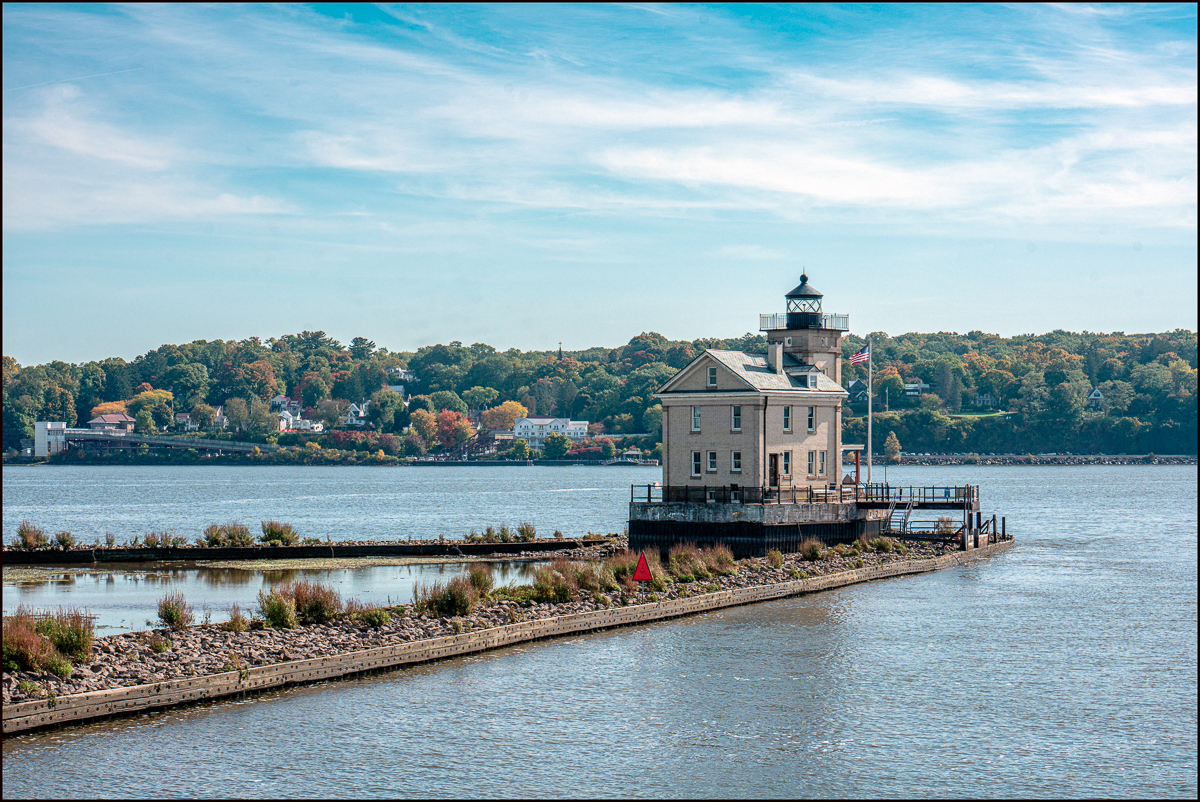
“Built in 1837 by James McEntee, the first Rondout Lighthouse was a direct response to increased traffic on Rondout Creek due to the opening of the Delaware & Hudson Canal in 1828. Built by Maurice and William Wurts to bring coal from eastern Pennsylvania to the Hudson Valley and New York City, the canal terminates at Rondout Creek in Kingston. After it opened, thousands of coal sloops and later towed barges joined the already laden sloops and barges full of bluestone, bricks, cement, and natural ice bound from Kingston to New York City and beyond. The 1837 lighthouse was a two story building made of wood and built near the center of Rondout Creek. Although the exact location of the first Rondout lighthouse is unknown, its wooden structure eventually became unstable, and a new lighthouse was needed.
In 1867 a new Rondout Lighthouse constructed of sturdy bluestone on an enormous stone base was completed on the south side of Rondout Creek off the shores of Sleightsburgh/Port Ewen. This three story stone structure had family living quarters wrapped around a central light tower. Sturdy, comfortable, and very Victorian, just one family lived in this lighthouse for its duration – lighthouse keeper Catherine Murdock (widow of lighthouse keeper George Murdock) and her sons and daughters. Her son James became assistant keeper in 1880 when the addition of breakwater jetties at the mouth of Rondout Creek meant that Rondout light now had three jetty lights in addition to the tower light to maintain. Catherine retired in 1907 after 50 years of service.
James was the first light keeper when the new lighthouse was built on the north side of the creek in 1915. The third Rondout lighthouse was built due to complaints from river boatmen about the difficulty of seeing the new entrance to the creek formed by the jetties. The little lanterns that James maintained on the dikes were insufficient, and the bluestone lighthouse too far back to see, so the new one was built from 1913 to 1915. The youngest lighthouse on the Hudson River, the Rondout Lighthouse was built on time and under budget.
For many years the two lighthouses coexisted – the Old Rondout Lighthouse (bluestone) stood boarded up and slowly deteriorating. Finally, in 1954, the roof caved in completely and the order came down to demolish it. Due to its location out on the water, it was dynamited.
In 1948 the brick Rondout Lighthouse was electrified and fully automated in 1954, although the Coast Guard employed a civilian watcher who lived in Port Ewen to ensure the light came on every night. When the last keeper moved out, the lighthouse was boarded up and largely abandoned. In the 1980s, when the Coast Guard was divesting of properties, the City of Kingston and the Hudson River Maritime Museum took ownership of the lighthouse.” (Hudson River Lighthouses).
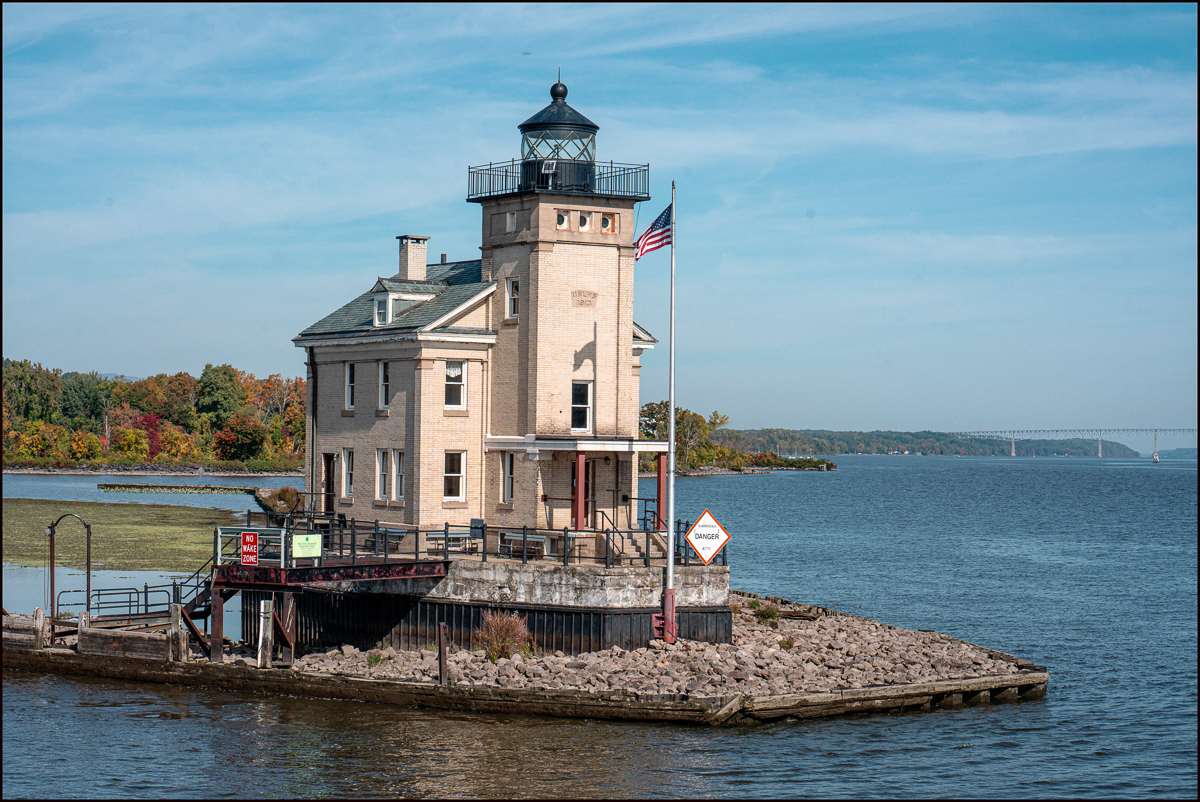
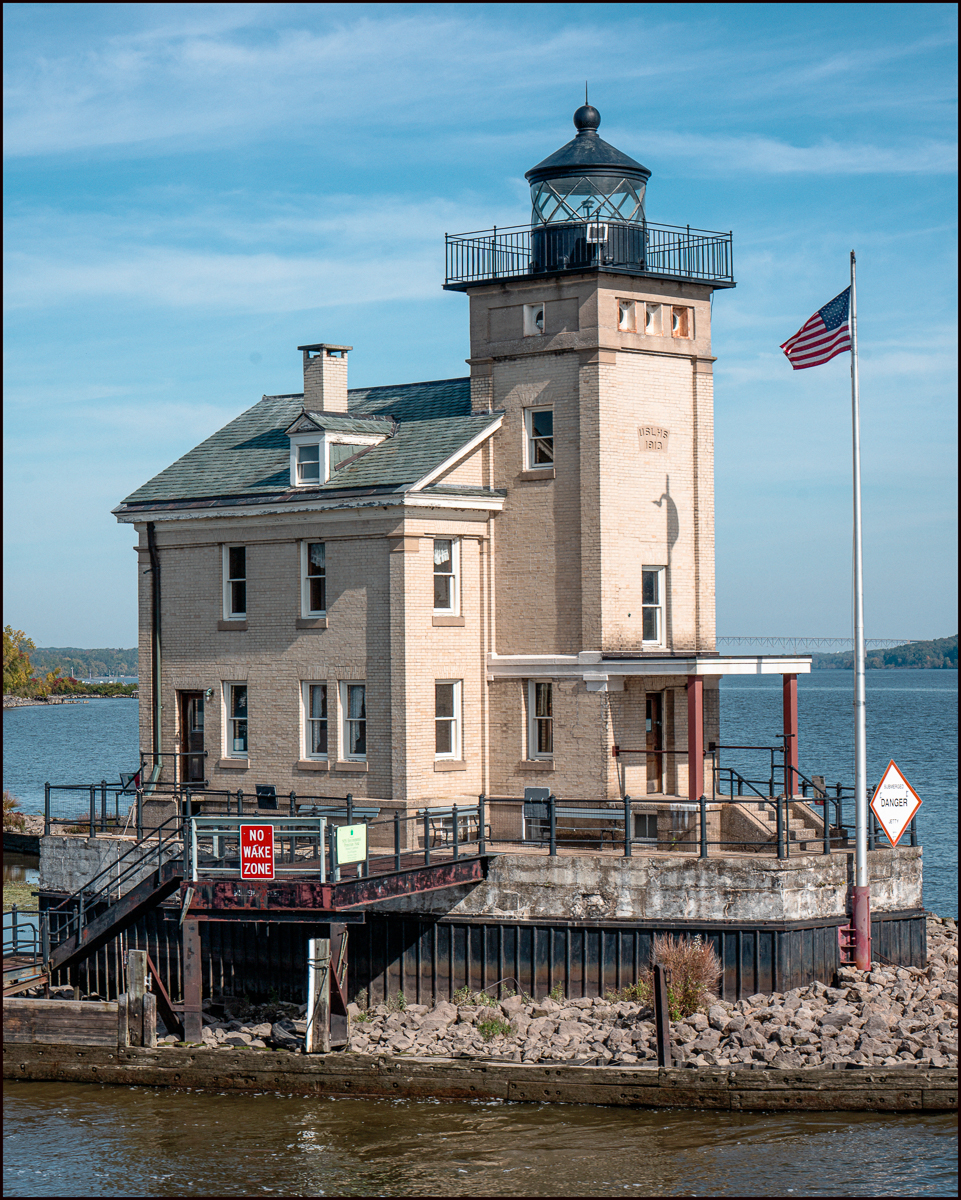
Taken with a Sony A7IV and Tamron Di III VXD A056SF 70-180mm f2.8.