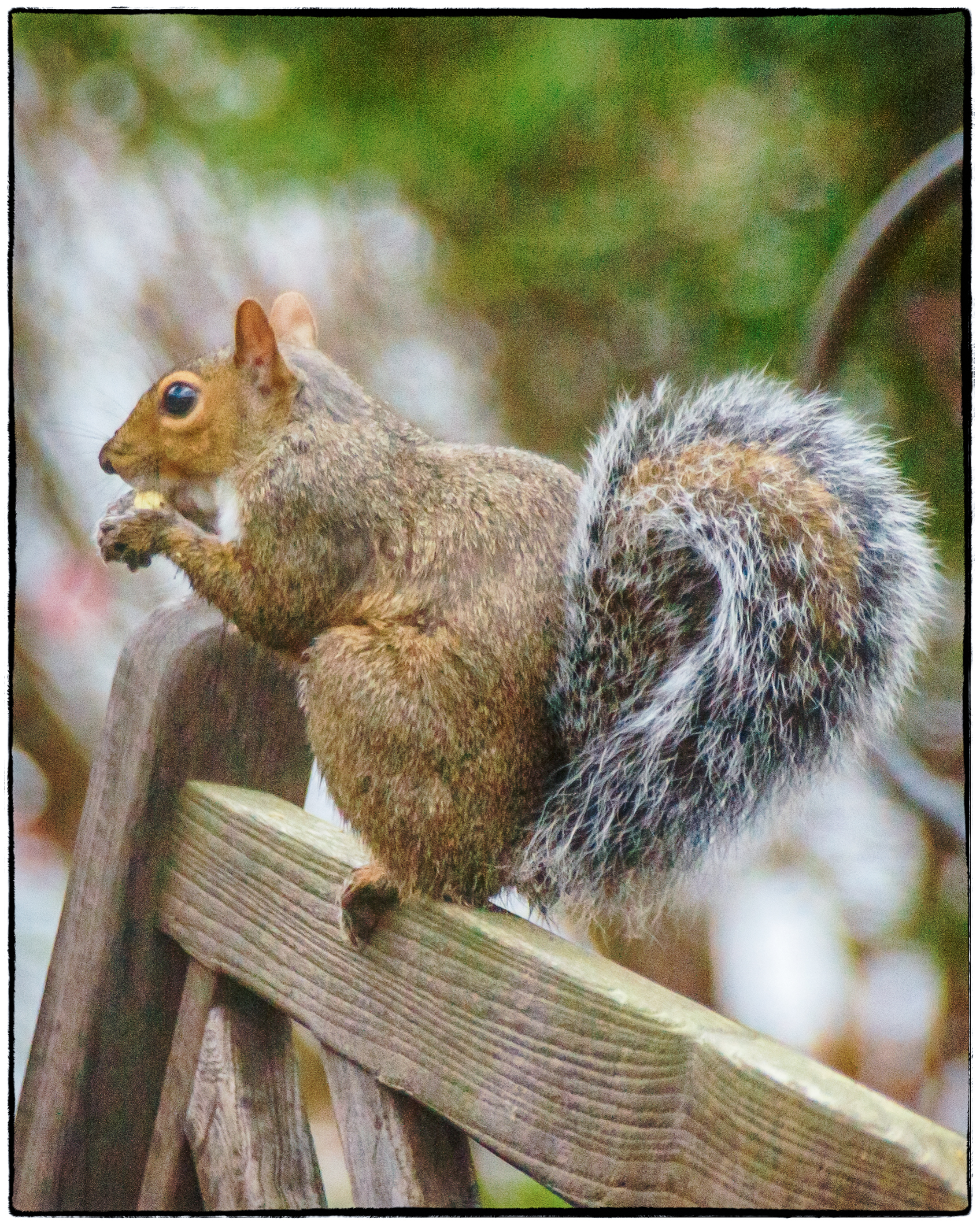
We have lots of acorns this year: it seems to having been “raining” them for months. There are hundreds, maybe even thousands, of them scattered around in piles in our garden. Needless to say this attracts chipmunks and squirrels. I caught this one munching away on our patio yesterday morning. I’m not usually quick enough to get them, but on this occasion I had a suitable camera/lens right next to me on the table. I had to take the picture through our living room window, which caused some problem with the focus. Also I suspect that the glass degraded the picture a bit. And as I was rushing there’s probably some camera shake too. Still at least I got something this time.
Poet’s Walk Park, Dutchess County, NY
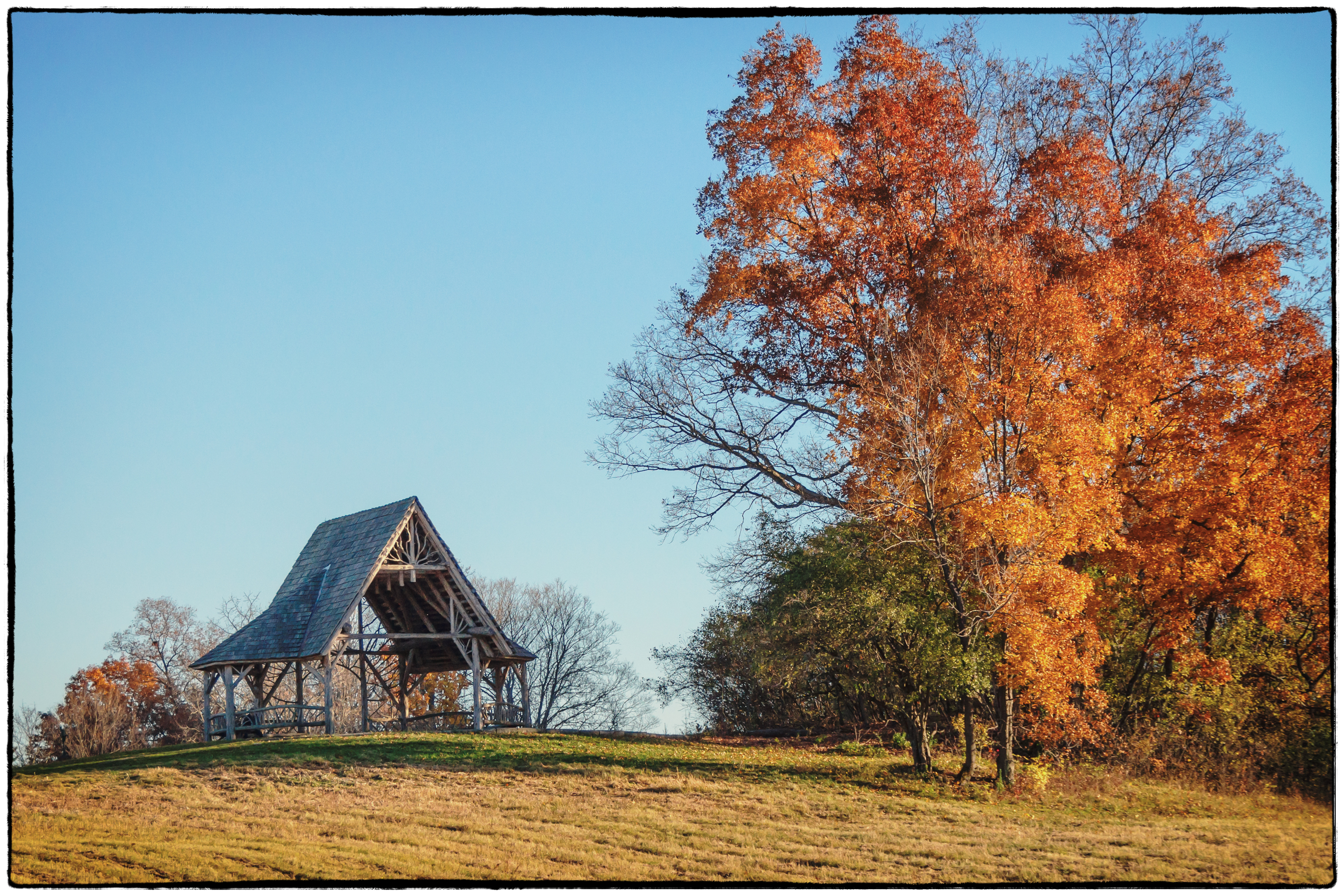
Overlook and tree.
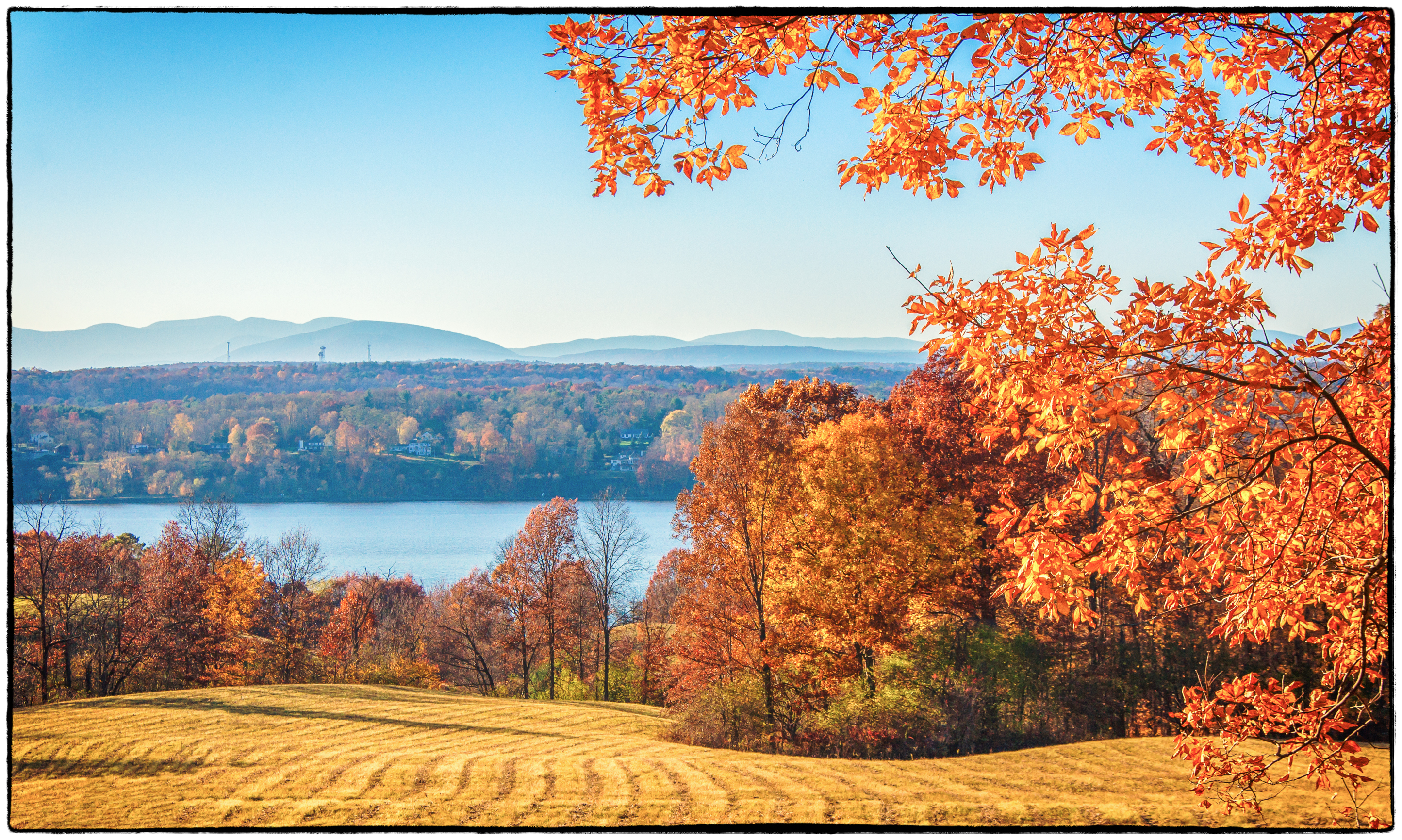
It was a gorgeous warm, sunny fall day with not a cloud in sight so we decided to venture north and take the dog for a walk at Poets’ Walk Park near Red Hook in Dutchess County, NY. I hadn’t been there before and found it most enjoyable – full of rolling meadows, interesting wooden structures and spectacular views out over the Hudson to the Catskill Mountains. There are only about two miles of trails divided into two parts. The first part takes you through meadows to The Overlook, a large rustic wooden structure. The second part is a bit more rugged, descending down through woods to the river and then ascending back again to near The Overlook. All told we walked for about two hours, a bit more than my wife (who isn’t much for walking in the woods) would have liked. We went towards the end of the day and the light was great.
View from the Overlook – Hudson River and the Catskill Mountains.
An information board near the entrance describes the park as follows:
The forests around Poets’ Walk were first cleared almost 300 years ago for farms. But the landscape we see today began to take shape in 1849, when owners Franklin H. Delano and Laura Astor replaced the old farms with a landscape garden. Designer Hans Jacob Ehlers laid out a series of grassy clearings linked by winding paths culminating in a dramatic view of the river and distant Catskill Mountains.
They named the estate Steen Valetje – Little Stony Falls – in honor of the region’s Dutch heritage. But this was no traditional garden. Old-fashioned gardens had straight pathways lined with neatly trimmed hedges and flower beds. Steen Valetje’s meadows were designed to enhance the nataural contours of the land – to look as if they had not been designed.
Once coveted for its rich agricultural land, by the mid-19th century the Hudson Valley attracted poets and painters for its beauty. Two famous writers particularly loved walking here. In honor of Washington Irving and Fitz-Greene Halleck, in 1996 Scenic Hudson renamed the estate Poets’ Walk Park.
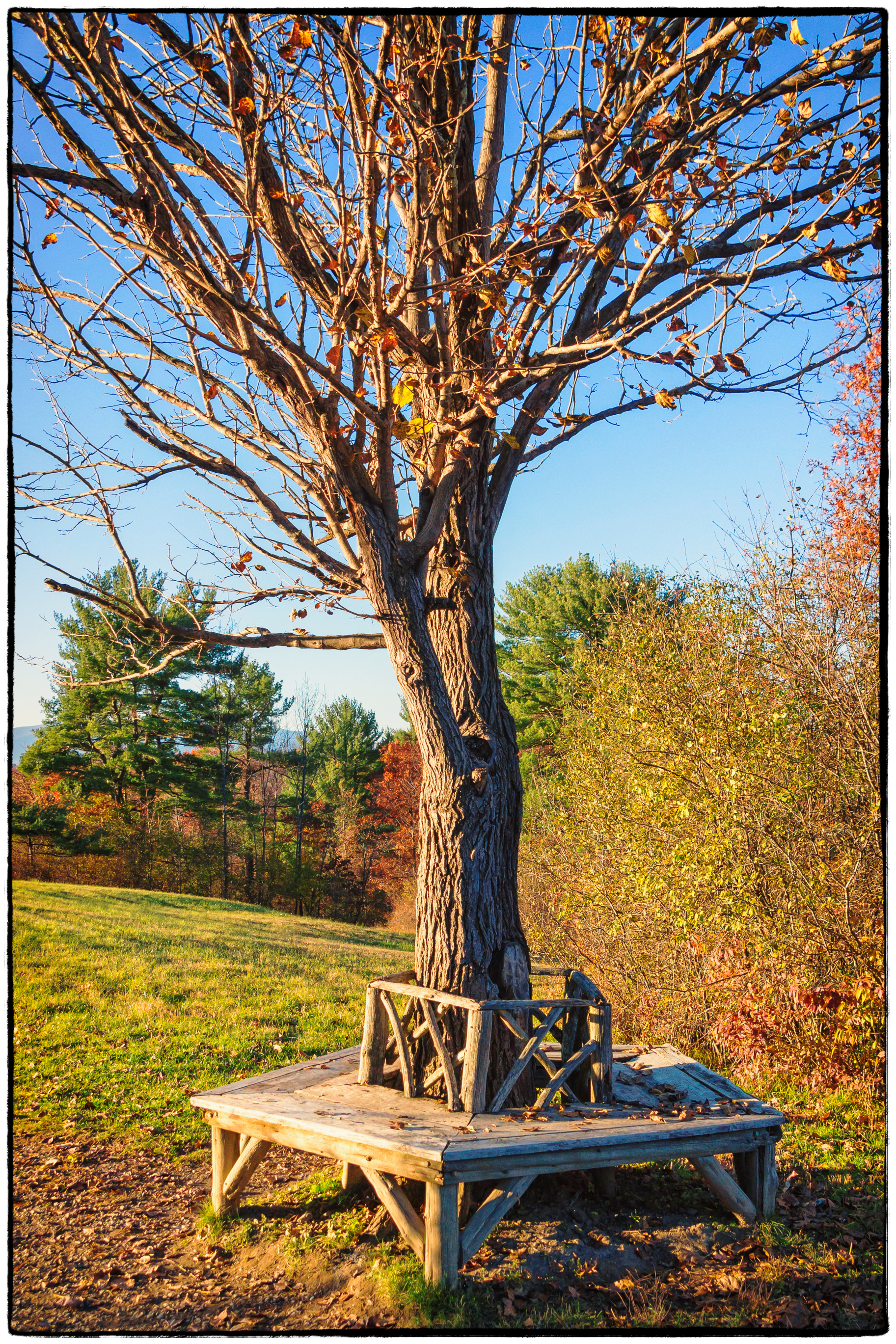
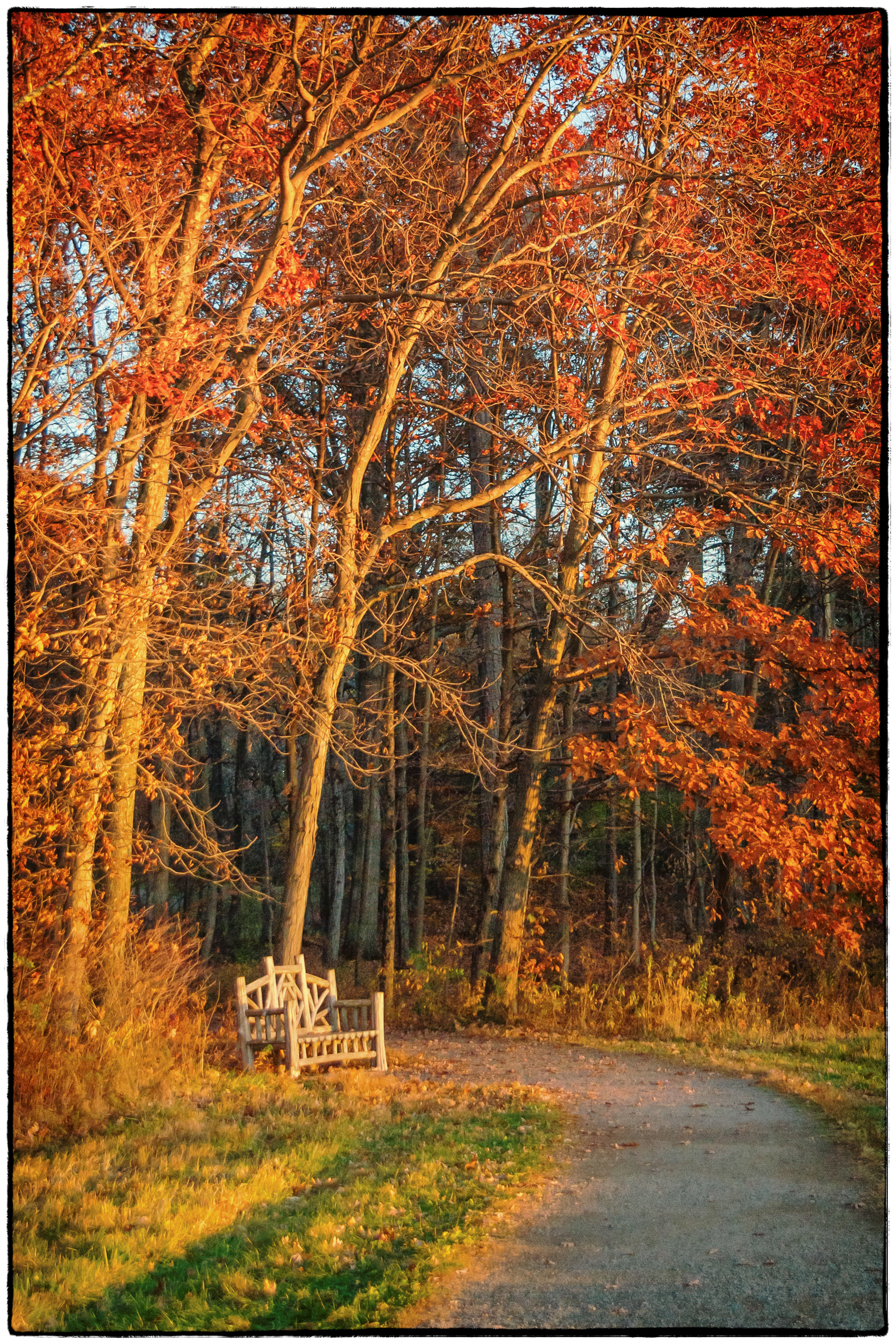
Tree and Bench
It’s an idyllic spot, but apparently there it has a dark history. According to the information board.
Behind the sunny meadows of Poet’s Walk lies a story of intrigue and betrayal. It begins in 1710, when a band of German refugees arrived in the Hudson Valley, lured by promises of jobs and land for farms. The scheme fell through. Some historians dispute the accuracy of this story.
As the refugees starved, wealthy landowner Robert Livingston refused to give them the land he had promised. Taking advantage of their distress, his brother-in-law, Colonel Henry Beekman, offered to rent them some of his land. This was a poor substitute for owning their own farms, but the refugees had few options. Some accepted his offer. They cleared the forest and created the first agricultural landscape of Poets’ Walk. Finally in 1839, farmers throughout the region went into open revolt. They marched, demonstrated and petitioned the politicians. Within a few years the Anti-Rent War had ended the worst abuses and curbed the landlords’ power
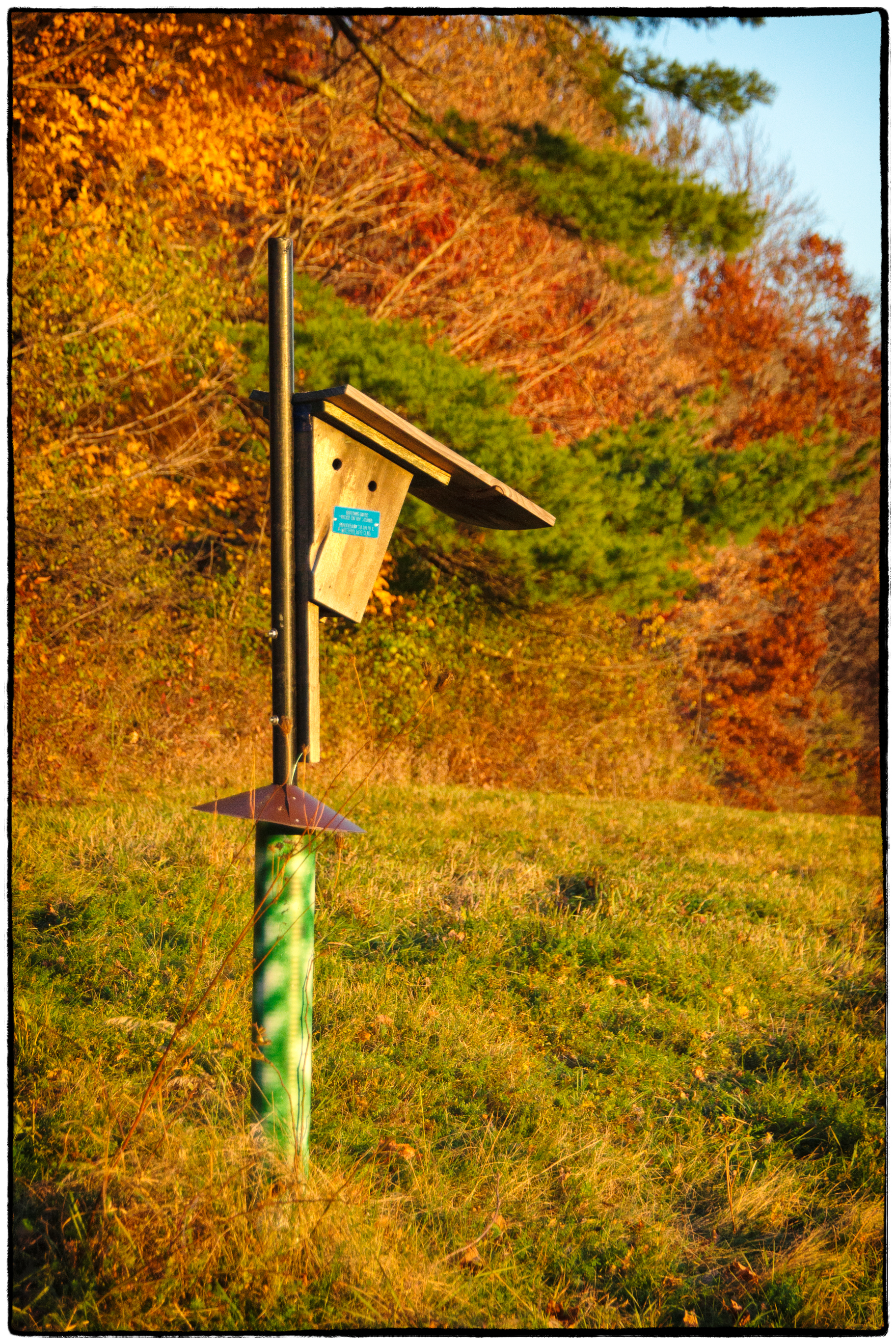
Bird House Face.
On the way back.
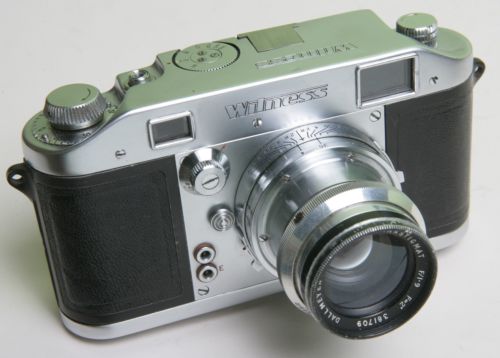
Rare Ilford Witness – You’ll just have to see this…
The title above relates to a post on Rangefinder Forum: Rare Ilford Witness – You’ll just have to see this…
It refers to an Ilford Witness camera that sold for US $18,262.96 with shipping costs of about $700.
Collectiblend (a site which provides values for vintage cameras provides the following estimates:
Average condition $3,200-3,400 body only; $11,500-$12000 with lens
Very good condition $4,000-4,600 body only; $16,000-17,000
Mint condition $7,500-8,000 body only; $25,000-26,000 with lens
They also provide examples of prior auction sales (the first three are from Westlicht and the fourth from Everard & Company Auction): 2014-03-25, “A-” Condition: $18,084; 2013-05-25, “B-” Condition: $18,576; 2012-11-24, “B-” Condition: $19,094; 2011-10-09, “B+” Condition: $13780.
Reading the thread what struck me was the overall tone: amusement, shock, incredulity as if the posters just could not believe the cost of this item. Yet from the information on Collectiblend it seems that this is not an aberration. This is what this camera, with this lens (and it seems as if the lens makes up the bulk of the value) goes for. It’s not as if this is the only camera that fetches large sums of money. Leica “null series” cameras typically fetch in the millions. Collectiblend estimates that a Nikon SP with lens will fetch between $5,600 and $14,000 depending on condition. Collictiblend also provides a list of the 100 most valuable cameras. None of them are below $60,000. Needless to say the Ilford doesn’t come close to making the list.
So are these cameras worth the money they command. To me they aren’t, but obviously they are to the people who buy them. Who knows maybe if I had the kind of money that would allow me to drop $60,000 plus on a camera I might buy one too. I just don’t understand the amusement, shock, incredulity etc. Maybe it’s because the Ilford is an interloper i.e. a valuable camera that isn’t a Leica? If I counted correctly Leicas make up 65 of the 100 most valuable cameras on Collectiblend’s lists.

A Couple of Snakes
A couple of snakes have recently made their way into my life.
First, I was scanning some old negatives when I came across the picture above. It shows a younger me posing for the usual ‘cheesy’ tourist shot in a market outside of Bangkok, Thailand. I would guess that it was taken sometime in the early 2000s. The snake is, I believe a Python. It was heavy, very strong but not at all ‘slimy’ as I had expected. In retrospect I’m not sure it was such a good idea to put it around my neck. If it had decided to constrict I doubt that there was anything that I, or anyone else could have done about it. I can’t take any of the credit (or otherwise) for the picture as I clearly didn’t take it. It was taken with my camera though.
Then while walking the dog the other day I came across the snake in the picture below. I believe that there are three types of venomous snake in NY State: timber rattlesnake, the massasauga, and the copperhead. While I’m certainly no snake expert I didn’t think it was any of these (although there is a passing resemblance to a copperhead). I looked it up when I got home and I believe it’s an Eastern Milk Snake. Interestingly, when I stayed stationary (e.g. when I taking the picture) it would turn and start to move in my direction. When I moved, however, it would rapidly move away.
I wonder if I’ll come across any more in the near future? I could do without an encounter with any of the venomous snakes though.
Tuba Quintet

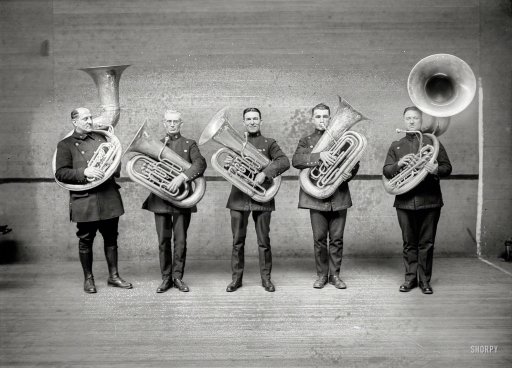
New York circa 1915. “Police tuba players.” HALT OR WE’LL TOOT. 5×7 inch glass negative, George Grantham Bain Collection.
About 45 years ago I was a semi-professional trumpet player. By semi-professional I mean that I was paid, but not an awful lot. It did give me an opportunity to travel around the UK quite a bit and to play in some nice venues (e.g. York Minister; the Royal Albert Hall). I thoroughly enjoyed it, but then real life crept in and I moved on to other things – specifically working with the United Nations for 38 years. I’ve always retained a love of brass instruments and music that features them so I was excited to come across the wonderful picture. Look at the expressions on their faces: the guy in the middle seems to really be enjoying himself; the one on the left looks as if he’s supervising; the one second from right looks as if he’s been told to pretend that he’s playing. I found myself wondering what they might be playing: maybe Berlioz March to the Scaffold arranged for five tubas as seen in this video (thus proving that tuba quintets do actually exist. If you ‘google’ ‘tube quintet’ a surprising amount comes up):
Source: Brass Coppers: 1915 | Shorpy Historic Picture Archive