Lovely Depression era Kodachromes

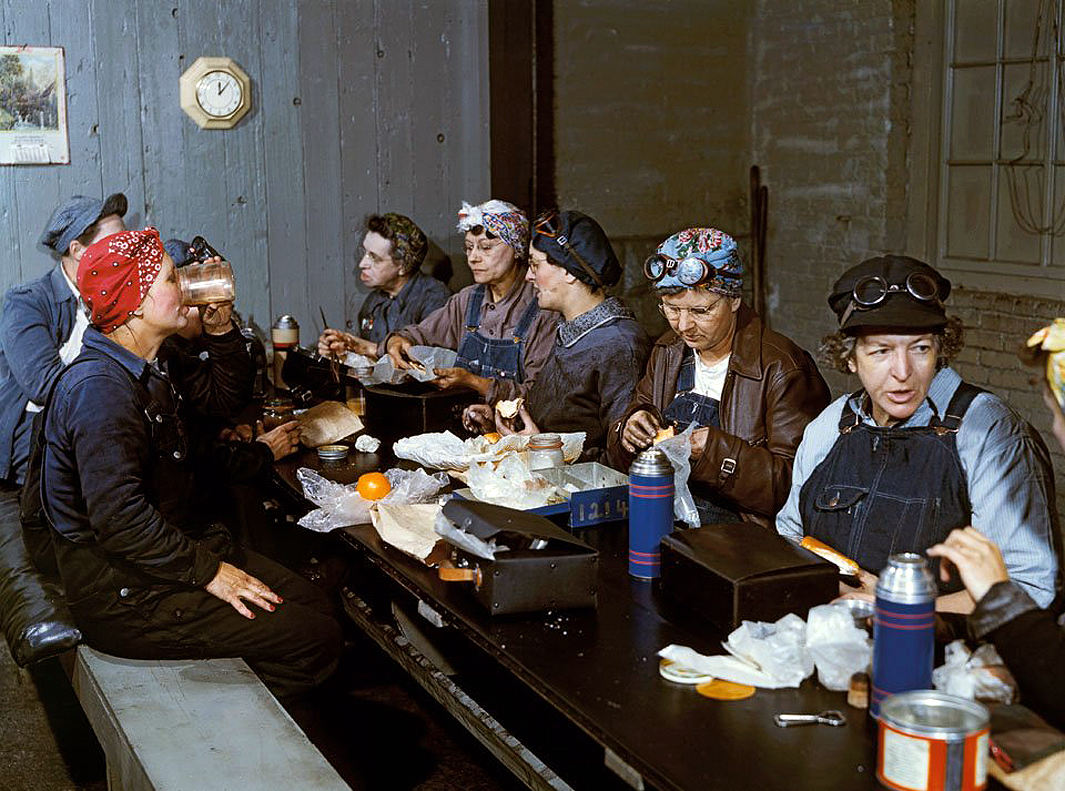
Female workers employed as wipers in the roundhouse having lunch in their break room, Chicago and Northwestern Railroad, Clinton, Iowa, April 1943. Source: FSA documentary color photos featured in New Deal Photography: USA 1935-1943 from Taschen.

When I think of the Great Depression I tend to think of photographs like “Migrant Mother” by Dorothea Lange and the movie “The Grapes of Wrath“. Lange’s photographs, and most of those by her colleagues photographing for the Farm Security Administration were shot in black and white so I tend to think of the Great Depression in black and white as was The Grapes of Wrath. It came as quite a revelation to me to come across these spectacular Depression era photographs in color. I guess I shouldn’t have been so surprised through. The Great Depression didn’t end until the late 1930s and Kodachrome came out in 1935 so it was likely that someone would have been shooting in color during that period.

They also reminded me that Kodachrome really was quite a remarkable film. It’s too bad that it’s now no longer available and even if it were couldn’t be processed.

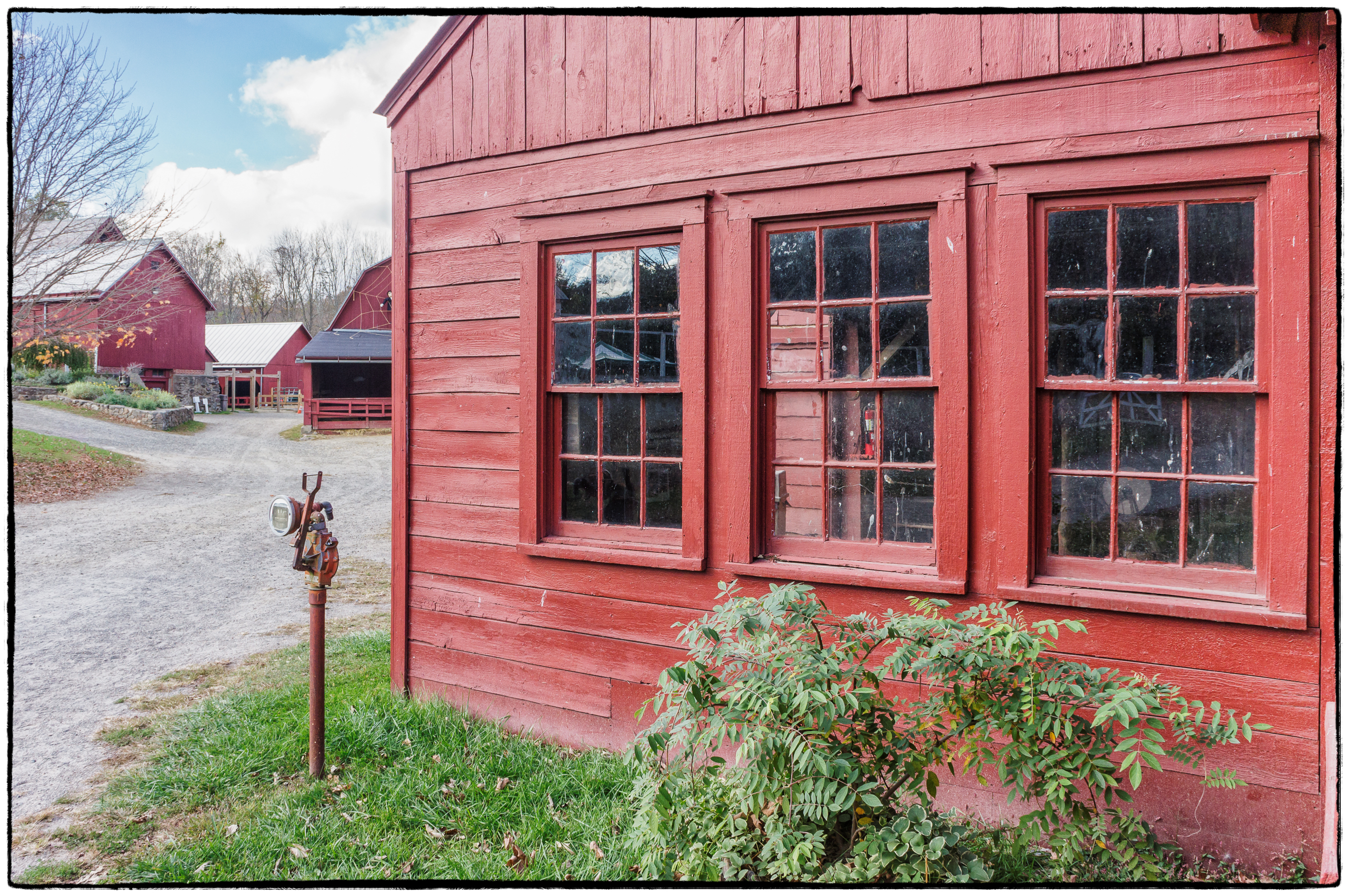
Red barns

Taken at Muscoot Farm in October, 2013. According to Wikipedia the farm has a long history:

The land on which Muscoot Farm is situated was part of the 86,000 acres (350 km2) Van Cortlandt Manor chartered in 1697. After the death of Stephanus Van Cortlandt in 1700 and his wife Gertrude in 1734, the manor was surveyed and divided into twenty large lots and twenty small lots. The Muscoot lands are located in “Great South Lot #6” which was inherited by Stephen Van Cortlandt. At that time, this region was very remote, inaccessible by roads, and probably uninhabited.

In 1802, the Great South Lot No. 6 was resurveyed by Ebenezer Purdy, Jr. and was subdivided into smaller lots proposed as tenant farms. Most of today’s Muscoot Farm lies within the Purdy’s lot number 3 and 5. The boundary separating lot 5 to the north and lot 3 on the south is still evident as the long straight stone wall that runs east and west across the park just north of the gazebo.

The part of Muscoot Farm that lies north of the stone wall (lot 5) was sold by Stephen Van Cortlandt in 1803 to Absalom Nelson, and it remained in the Nelson family for over 100 years.

The part of Muscoot Farm south of the stone wall (lot 3) was being leased by Joseph Montross at the time of the 1802 survey. A road ran through the property roughly coinciding with today’s Rt. 100, and Montross had a house on the west side of the road apparently near the site of the present Muscoot farmhouse. By the mid-19th century, after several land transactions, the Montross farm ended up in the hands of Ezra VanTassel at 157 acres (0.64 km2) in size. Peter Carpenter owned a 100-acre (0.40 km2) farm to the north; William Vail owned a 140-acre (0.57 km2) farm across the road to the east; and Lewis Ferris owned a small farm, about 30 acres (120,000 m2), to the south.

During the 1870s, at a time when farmland in Westchester was being sold off fairly cheaply, the three main farms (VanTassel, Carpenter and Vail) were purchased by Benjamin Brandeth, a pharmaceutical magnate from Ossining who had been dabbling in real estate ventures. During 1880’s this land was bought up by Ferdinand T. Hopkins another pharmaceutical executive from New York City.

Hopkins took these subsistence farms and developed them into a “Gentleman’s Farm”, a term applied to hobby farms owned by wealthy businessman who wished to maintain a connection with nature or with the farm life of their youth. Since profit was not the motive, Muscoot Farm, like most gentleman farms of that era, operated at a loss. It remained in the Hopkins family for almost 90 years and was finally sold to Westchester County in 1968.

It’s been a favorite spot for us to take visiting grandchildren over the years. When they’re young they like all the farm animals.

I like the bright reds of the barns and the sense of depth that comes from the larger building in the foreground and the smaller ones receding into the background.

Upcoming visit to Untermyer Park

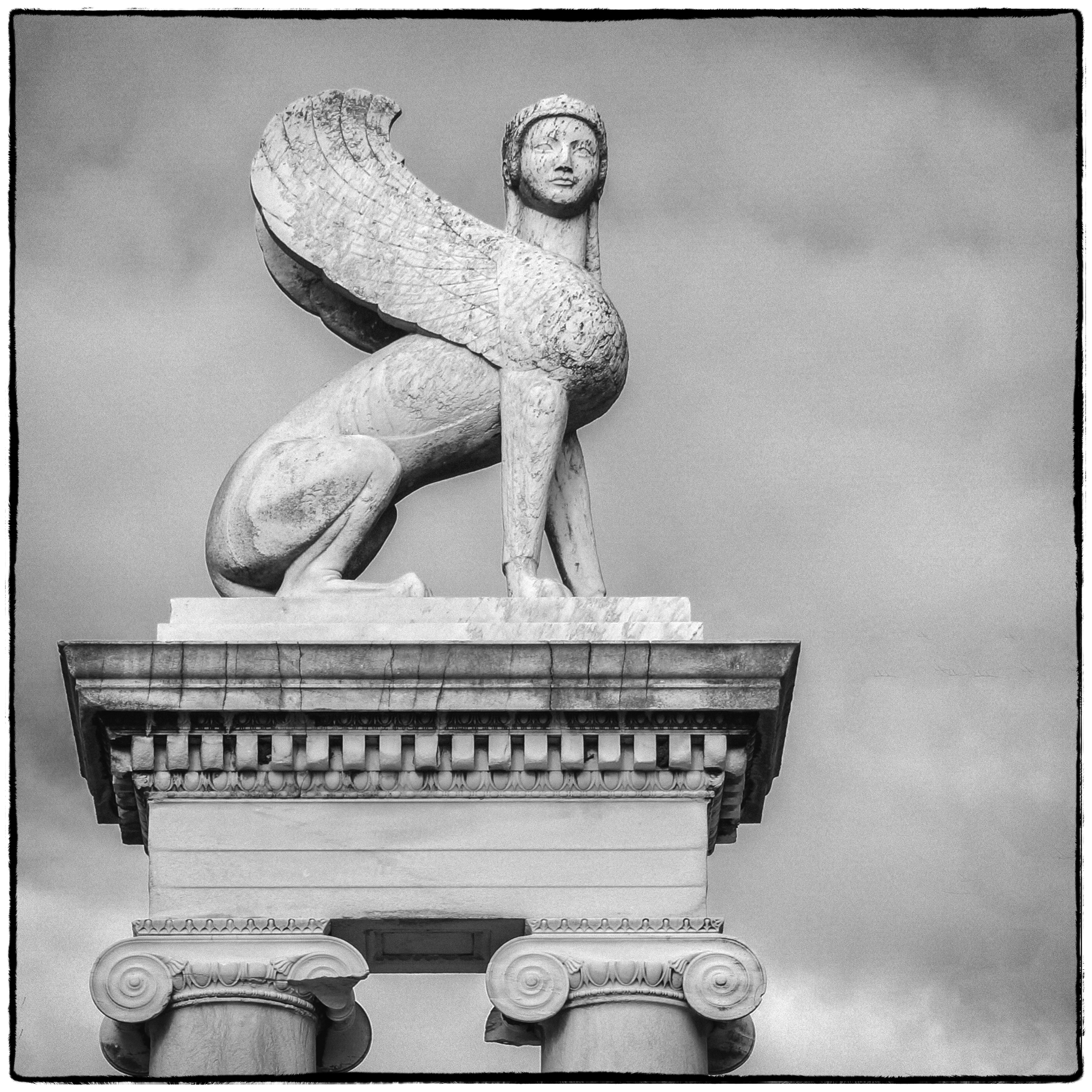
We just had some visitors so as we usually do we prepared a fairly extensive meal and afterwards took them to a nearby attraction: Chuang Yen Monastery. They’ve decided to reciprocate by inviting us later this month to a meal at their home in Hastings-on-Hudson followed by a visit to Untermyr Gardens in Yonkers, NY.

I’ve been to the park before (see Untermyr Park, Yonkers, NY). The picture above is from that visit in January, 2012. The sphinx is one of two sitting on top of very impressive tall double columns. The date tells all: it was the middle of Winter and the park was quite bare and of course none of the flowers were blooming. I’m looking forward to returning when things are in bloom. After the visit I also realized that there was an entire section of the park (closer to the Hudson and the Old Croton Aqueduct) that I missed during that visit (It was cold and I didn’t hang around long enough to explore thoroughly). I’m hoping to find and check out that area too. Should be fun!

Another Freeman Patterson book: Photographing the World Around You

I already have one book by Freeman Patterson: Photography and the art of seeing. I enjoyed reading it so when I came across this one for sale (used) for a very reasonable price I decided to get it. Where my initial purchase focused very much on developing photographic vision this one focuses more on elements of design. It’s based on actual workshops conducted by Mr. Freeman who attempts to create a workshop in a book – not always successfully I felt. You just can’t create the feel of a workshop: the interaction with the faciliators; the interaction between the participants; the social aspects etc. in a linear print presentation.

The first sections explain the basic building blocks of visual design and how to put them together into a coherent whole. They were somewhat interesting, but I’d read similar material before and so didn’t find a lot that was new.

I enjoyed the third section on “Evaluating your Photographs”, which was really Mr. Freeman trying to explain how to do this by evaluating some of his own photographs. I didn’t always agree with the points he was trying to make.

The next section is on “Assignments”. Once again it’s Mr. Freeman discussing some assignments that he had set for himself in the following areas: people; natural things; human constructions and manufacturer things. It’s really about the importance of setting yourself assignments and not just randomly shooting.

The final (very short) section is about “Making an Album”. This, too, is carried over from Mr. Freeman’s workshops. It seems that on the final afternoon of each workshop the participants show their ten favorite photographs. Here it seems to be just another opportunity for Mr. Freeman to present some of his photographs – in this case eight rather than the ten the workshop would demand.

As with the earlier book I learned a few things; picked up a few ideas and enjoyed some of his anecdotes. However, I’m not sure that I learned enough to justify the purchase. Had I paid full price I would probably have been disappointed.

I also discovered that I don’t actually like his photographs all that much. They’re competent enough, but they don’t really engage me much emotionally. I don’t feel the desire to look at them over and over again the way I would with a Weston; a Strand; a Cartier-Bresson etc. I felt that I could, and have, made photographs similar to many of his. Maybe that’s the point: follow my advice and almost anyone, even you, can make pictures of a certain quality. That may be true, but for me at least I want to get past this point and make pictures that say something; that people want to look at. And I’m finding it extremely difficult to do so. I’m not sure that this book helps me much.
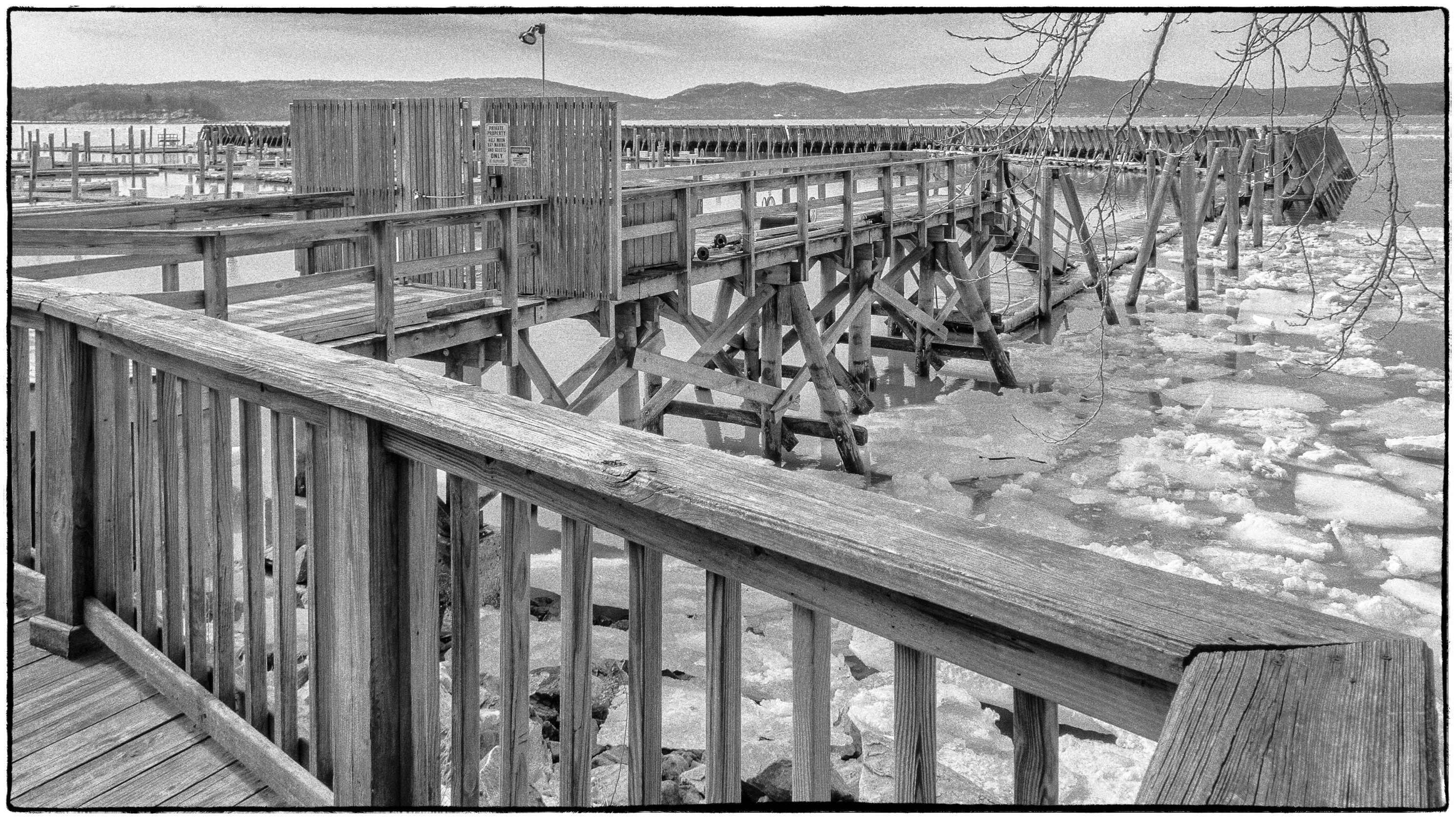
Wooden pier

Seen at Half Moon Bay in Croton-on-Hudson, NY. I liked the way this long, wooden pier zigzagged out into the Hudson. Also the textures of the wood. I find the branches to the top right of the picture distracting, but I couldn’t get this shot without including them and removing them in Photoshop was too much trouble.