Hudson view

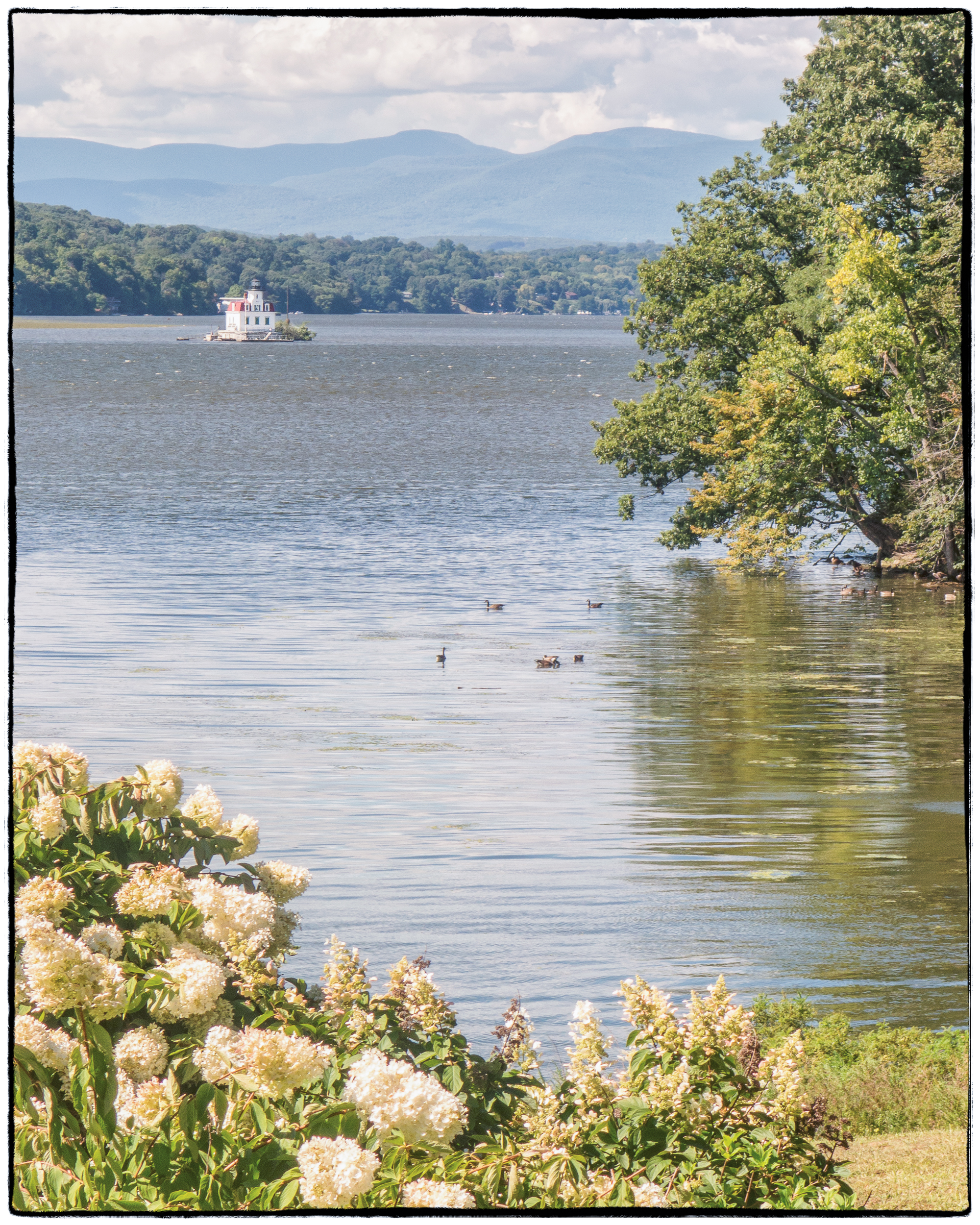
Esopus Meadows Lighthouse and the Catskills in the background.

Wikipedia describes the lighthouse as follows:

…nicknamed “Maid of the Meadows” and often simply referred to as the Esopus Light or Middle Hudson River Light is a lighthouse on the Hudson River near Esopus, New York. The lighthouse stands on the west side of the channel, in the river, its granite foundation built atop piles that have been driven into the riverbed, and is accessible only by boat.

Construction of the first lighthouse on the site began in 1838 when the land was ceded for $1.00 by the town of Esopus to the US government and the US government appropriated $6,000 to build the light. The light became active in 1839. It was a twin to the Roundout II lighthouse further north up the Hudson River. By 1867, however, the building was heavily damaged by flood and ice and funds for a new lighthouse were appropriated in 1870.

The current lighthouse was completed in 1871 and is the last wooden lighthouse in existence on the Hudson and the only Hudson lighthouse with a clapboard exterior. It was lit in 1872. One of a group of lighthouses in the Northeast built to an award-winning design by a Vermont architect, Albert Dow, Esopus Meadows Light has sister lights at Rose Island Light, Sabin Point, Pomham Rocks, and Colchester Reef. Esopus Meadows Light was closed in 1965 and by the 1990s it had fallen into a state of disrepair. The most serious problem was the deterioration of the foundation, which had begun to fall apart due to ice damage.

The Save Esopus Lighthouse Commission leased the lighthouse from the United States Coast Guard in 1990 for the purposes of restoration. They eventually took ownership in September 2002, as part of the pilot program for the National Historic Lighthouse Preservation Act. It was added to the National Register of Historic Places in 1979 as Esopus Meadows Lighthouse.

Esopus Meadows Light is shown on the NOAA Chart 12347.
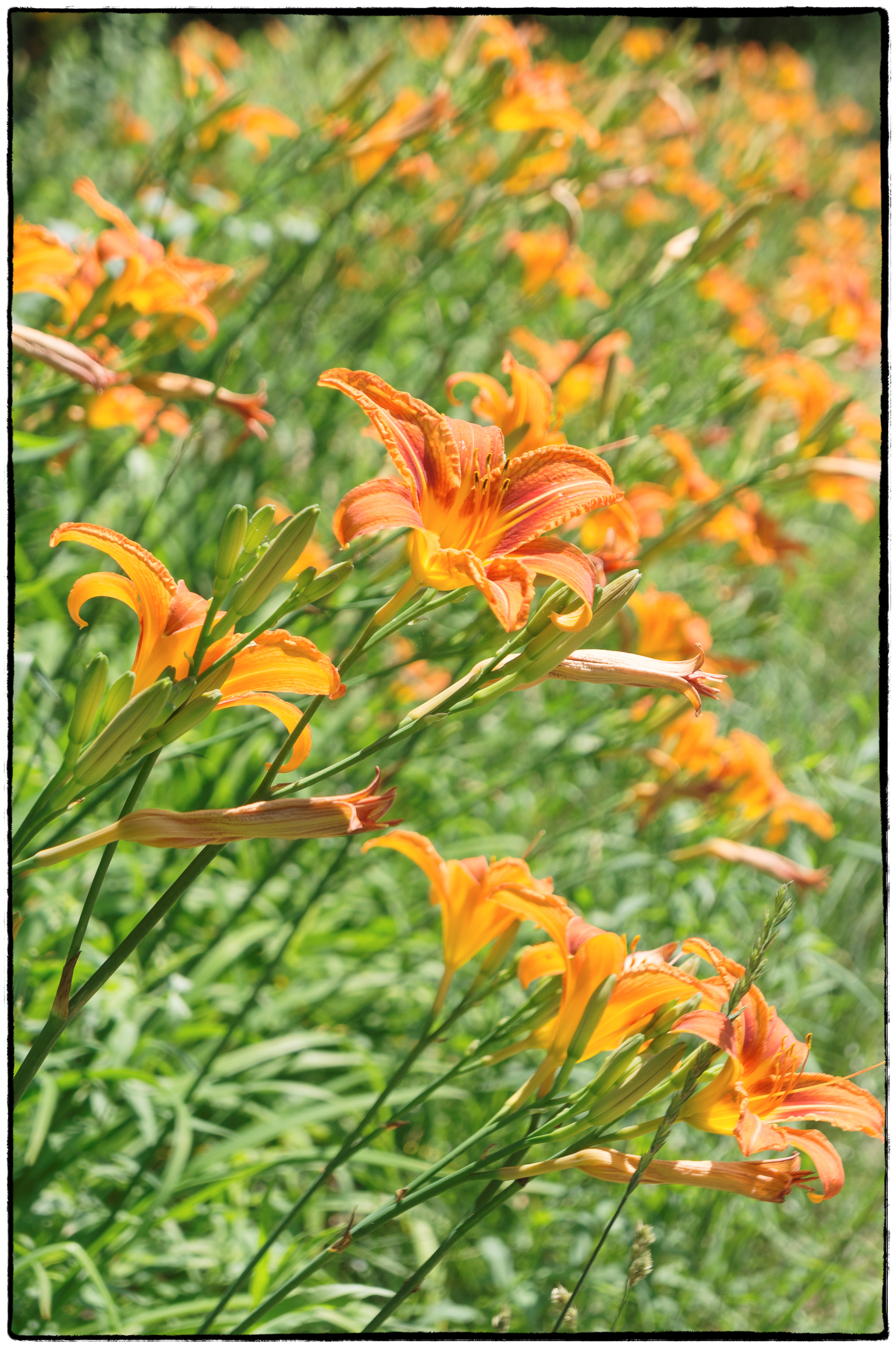
By the roadside 14: Hemerocallis fulva

At first I was reluctant to include this thinking that such a spectacular plant could not possibly be a wildflower. However, it seems to grow wild in large numbers around our lake and it is included on the “Wildflowers of he United States” site.

Wikipedia describes it as follows:

Daylilies are perennial plants, whose name alludes to the flowers which typically last no more than 24 hours. The flowers of most species open in early morning and wither during the following night, possibly replaced by another one on the same scape (flower stalk) the next day. Some species are night-blooming. Daylilies are not commonly used as cut flowers for formal flower arranging, yet they make good cut flowers otherwise as new flowers continue to open on cut stems over several days.

Hemerocallis is native to Eurasia, primarily eastern Asia, including China, Korea, and Japan. This genus is popular worldwide because of the showy flowers and hardiness of many kinds. There are over 60,000 registered cultivars. Hundreds of cultivars have fragrant flowers, and more scented cultivars are appearing more frequently in northern hybridization programs. Some cultivars rebloom later in the season, particularly if their capsules, in which seeds are developing, are removed.

Most kinds of daylilies occur as clumps, each of which has leaves, a crown, flowers, and roots. The long, linear lanceolate leaves are grouped into opposite fans with arching leaves. The crown is the small white portion between the leaves and the roots. Along the scape of some kinds of daylilies, small leafy “proliferations” form at nodes or in bracts. A proliferation forms roots when planted and is often an exact clone of its parent plant. Many kinds of daylilies have thickened roots in which they store food and water.

A normal, single daylily flower has three petals and three sepals, collectively called tepals, each with a midrib in either the same or a contrasting color. The centermost part of the flower, called the throat, usually is of a different color than the more distal areas of the tepals. Each flower usually has six stamens, each with a two-lobed anther. After successful pollination, a flower forms a capsule (often erroneously called a pod).

The Tawny or Fulvous Daylily (Hemerocallis fulva) is invasive in some parts of the United States, such as in Wisconsin (Wisconsin Department of Natural Resources). People sometimes plant the Fulvous Daylily and other stoloniferous daylilies, which have underground runners. These kinds can overrun one’s garden and can take an appreciable amount of time and effort to confine or remove.

By the roadside 13: Impatiens capensis

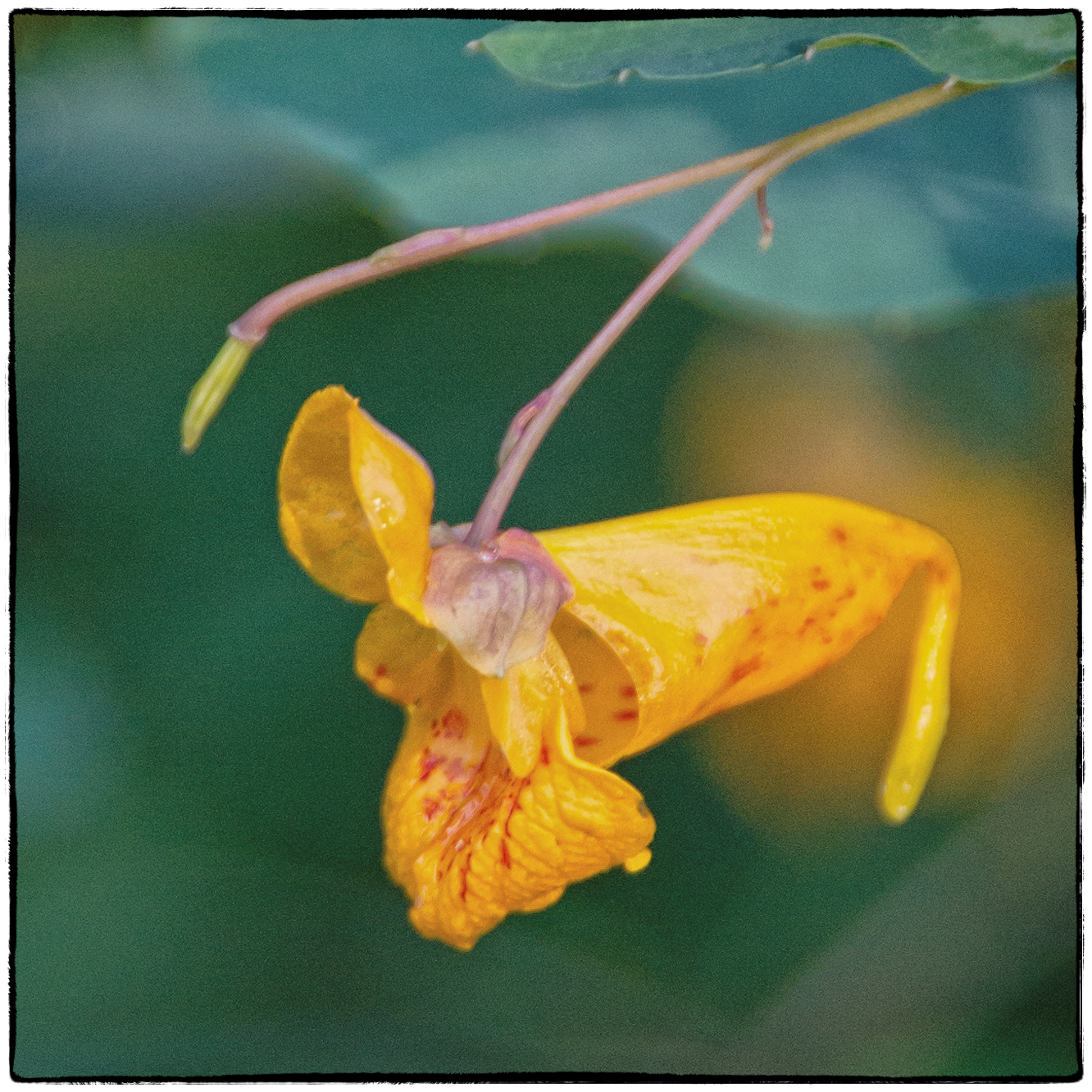
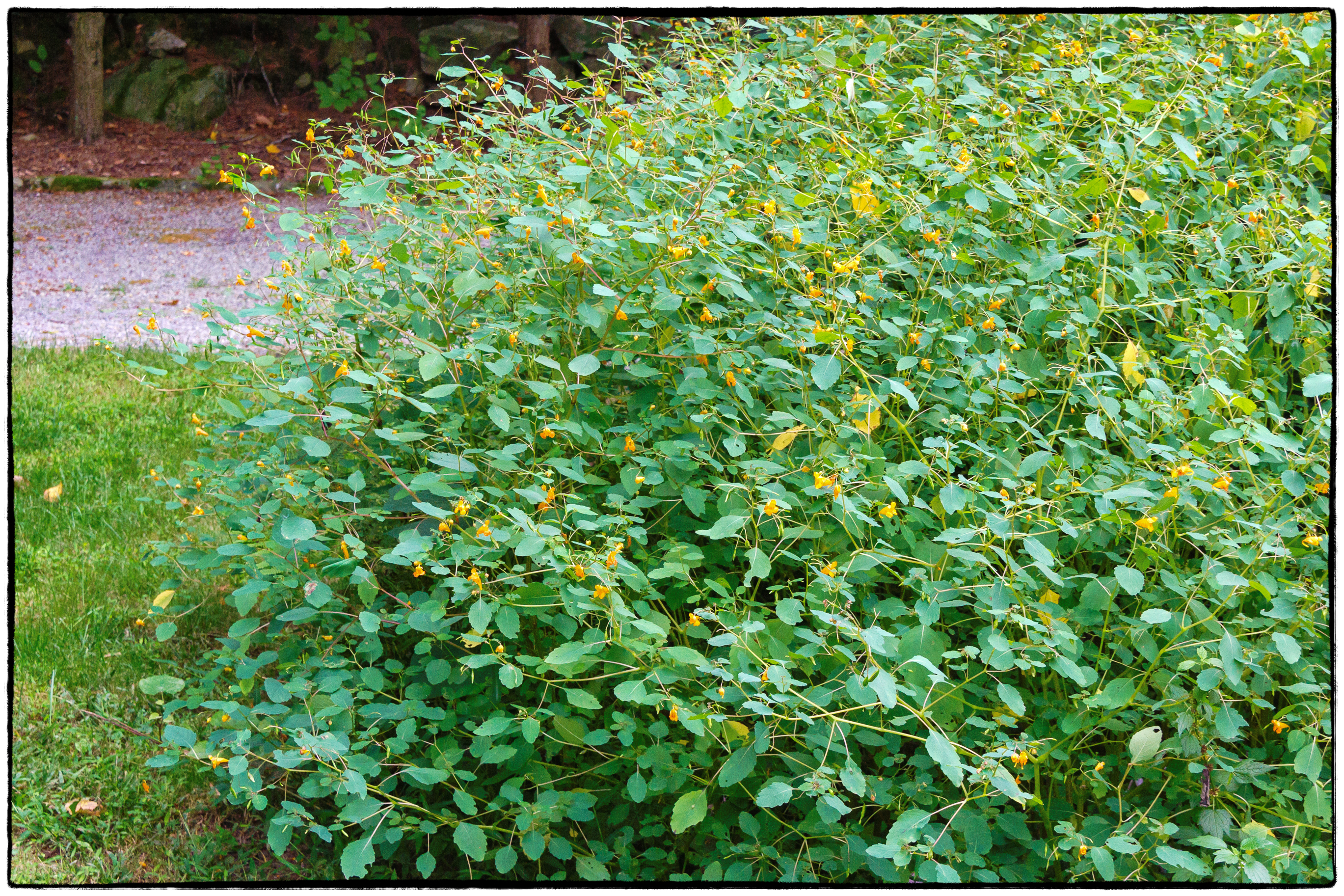
You’ve got to like something called “spotted touch-me-not”. Actually the picture above is a bit misleading. It’s a detail of one of the small, yellow-orange flowers. The plant can grow into large bushes (see picture below).

According to Wikipedia:

Impatiens capensis, the orange jewelweed, common jewelweed, spotted jewelweed, spotted touch-me-not, or orange balsam, is an annual plant native to North America. It is common in bottomland soils, ditches, and along creeks, often growing side-by-side with its less common relative, Yellow Jewelweed (I. pallida).

Flowers and leaves

Jewelweed plants grow 3 to 5 feet tall and bloom from late spring to early fall. The flowers are orange (or rarely yellow) with a three-lobed corolla; one of the calyx lobes is colored similarly to the corolla and forms a hooked conical spur at the back of the flower. Plants may also produce non-showy cleistogamous flowers, which do not require cross-pollination. The stems are somewhat translucent, succulent, and have swollen or darkened nodes (on only some plants). The seed pods are pendant and have projectile seeds that explode out of the pods when they are lightly touched, if ripe, which is where the name ‘touch-me-not’ comes from. The leaves appear to be silver or ‘jeweled’ when held underwater, which is possibly where the jewelweed name comes from.

Along with other species of jewelweed the juice of the leaves and stems is a traditional Native American remedy for skin rashes, including poison ivy and such use has been supported by at least one peer-reviewed study.
The species name “capensis”, meaning “of the cape”, is actually a misnomer, as Nicolaas Meerburgh was under the mistaken impression that it was native to the Cape of Good Hope, in southern Africa.

Impatiens capensis was transported in the 19th and 20th centuries to England, France, the Netherlands, Poland, Sweden, Finland, and potentially other areas of northern and central Europe. These naturalized populations persist in the absence of any common cultivation by people. This jewelweed species is quite similar to Impatiens noli-tangere, an Impatiens species native to Europe and Asia, as well as the other North American Impatiens. No evidence exists of natural hybrids, although the habitats occupied by the two species are very similar.

By the roadside 12: Eurybia divaricata

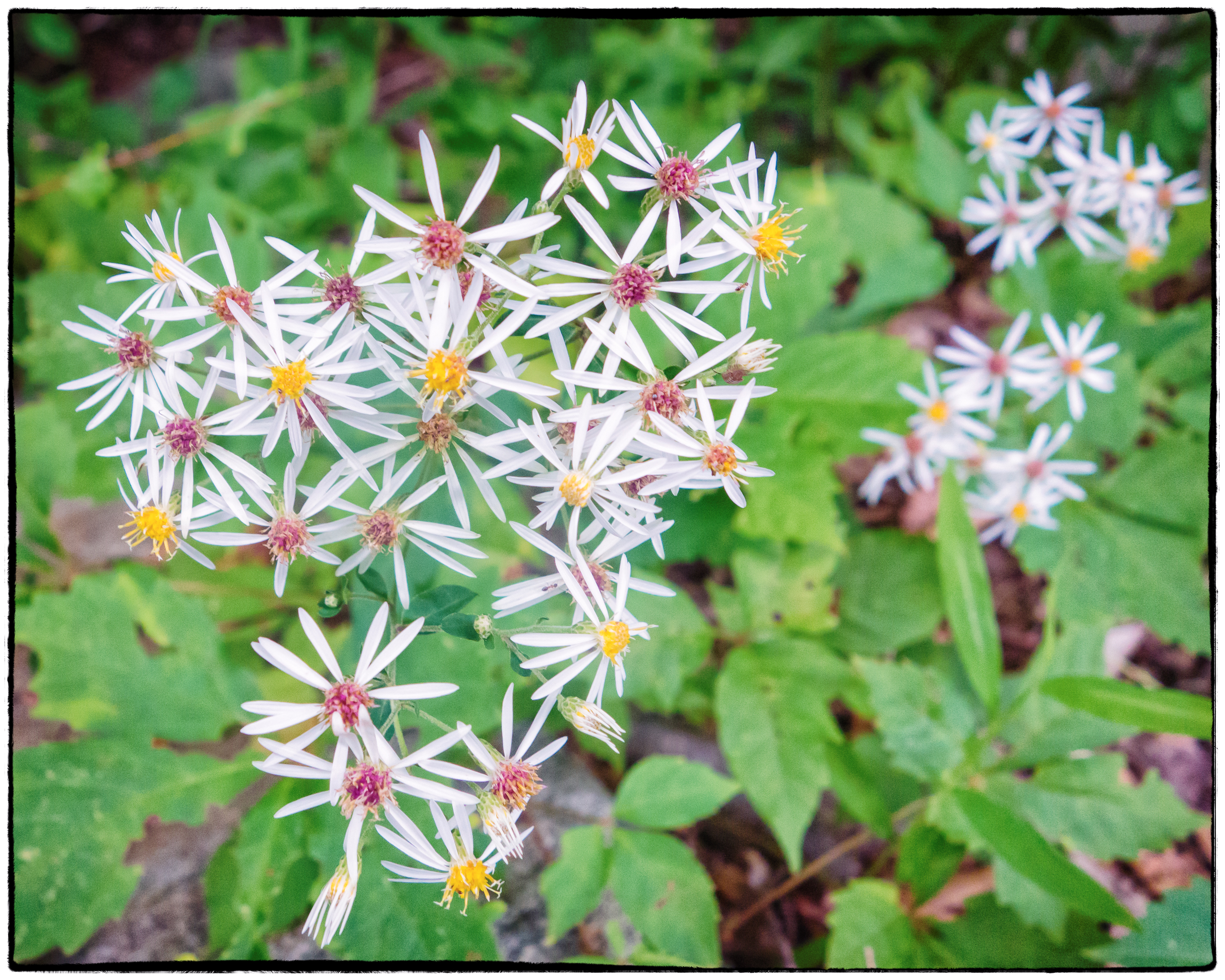
Also known as ‘White Wood Aster’. According to the Missouri Botanical Garden:

Eurybia divaricata is native to Eastern U.S. and typically grows in the wild in dry open woods. It grows in loose clumps with dark, sprawling, sometimes zigzag stems up to 2.5′ tall. Distinctive leaves are heart-shaped, stalked and coarsely toothed. Small but abundant flowers (to 1 inch across) have white rays and yellow to red center disks and appear in flat-topped, terminal clusters in late summer to early fall. Attractive to butterflies.

By the roadside 11: Solidago gigantea (with bee)

According to Wikipedia:

Solidago gigantea is a North American plant species in the sunflower family. Its common names include tall goldenrod and giant goldenrod, in reference to its height of up to 2 m tall, rather large for the genus, smooth goldenrod and late goldenrod. It is a widespread species known from most of non-arctic North America east of the Rocky Mountains. It has been reported from every state and province from Alberta to Nova Scotia to Florida to Texas, and also from the State of Nuevo León in northeastern Mexico.

Solidago gigantea is an herb up to 200 cm (80 inches) tall, sometimes spreading by means of underground rhizomes. They often grow in clumps, with no leaves as the base but numerous leaves on the stem. At the top, each stem produces a sizable array of many small flower heads, sometimes several hundred. Each head is yellow, containing both disc florets and ray florets.

Solidago gigantea is the state flower of Kentucky and Nebraska.