According to Wikipedia:
Solanum dulcamara, also known as bittersweet, bittersweet nightshade, bitter nightshade, blue bindweed, Amara Dulcis, climbing nightshade, fellenwort, felonwood, poisonberry, poisonflower, scarlet berry, snakeberry, trailing bittersweet, trailing nightshade, violet bloom, or woody nightshade, is a species of vine in the potato genus Solanum, family Solanaceae. It is native to Europe and Asia, and widely naturalised elsewhere, including North America, where it is an invasive problem weed.
…
It occurs in a very wide range of habitats, from woodlands to scrubland, hedges and marshes. It is an invasive species in the Great Lakes region and was first spotted in 1843.
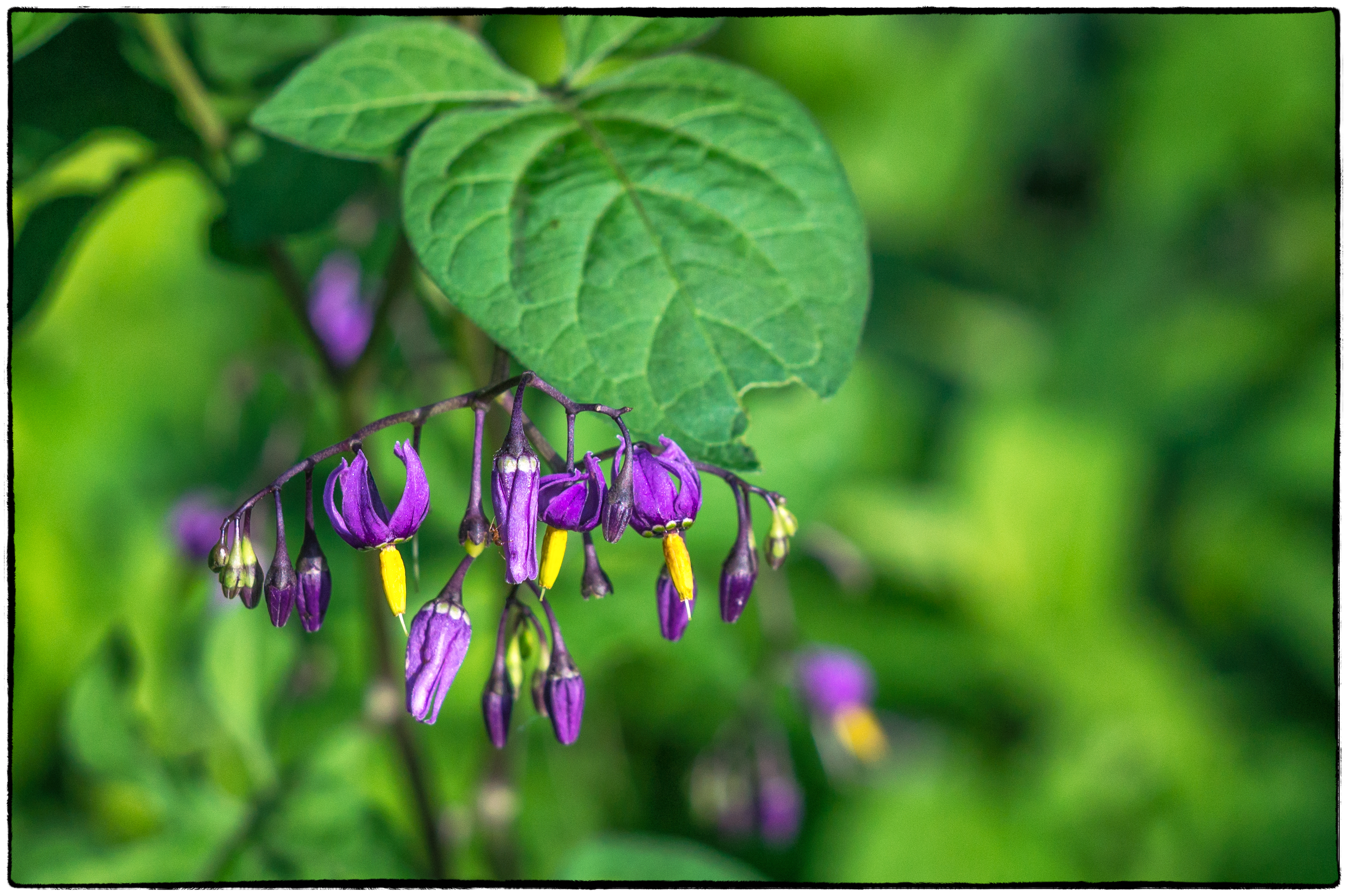
Bittersweet is a semi-woody herbaceous perennial vine, which scrambles over other plants, capable of reaching a height of 4 m where suitable support is available, but more often 1–2 m high. The leaves are 4–12 cm long, roughly arrowhead-shaped, and often lobed at the base. The flowers are in loose clusters of 3–20, 1–1.5 cm across, star-shaped, with five purple petals and yellow stamens and style pointing forward. The fruit is an ovoid red berry about 1 cm long, soft and juicy, with the aspect and odor of a tiny tomato, and edible for some birds, which disperse the seeds widely. However, the berry is poisonous to humans and livestock, and the berry’s attractive and familiar look make it dangerous for children.
It is native to northern Africa, Europe, and Asia, but has spread throughout the world. The plant is relatively important in the diet of some species of birds such as European thrushes, which feed on its fruits and are immune to its poisons, scattering the seeds abroad. It grows in all types of terrain with a preference for wetlands and the understory of riparian forests. Along with other climbers, it creates a dark and impenetrable shelter for varied animals. The plant grows well in dark areas in places where it can receive the light of morning or afternoon. An area receiving bright light for many hours reduces their development. It grows more easily in rich wet soils with plenty of nitrogen.
This is not the same plant as the extremely toxic (and thankfully quite rare) deadly nightshade (or belladonna). It is, however, still somewhat toxic and has been known to cause deaths of livestock and pets. More rarely it can also cause sickness and even death in children who eat the berries. Poisonings from this plant are, however, quite uncommon.
Ripe fruits are generally less toxic than the leaves and unripe berries, but even ripe berries can be poisonous.