Watkins Glen State Park

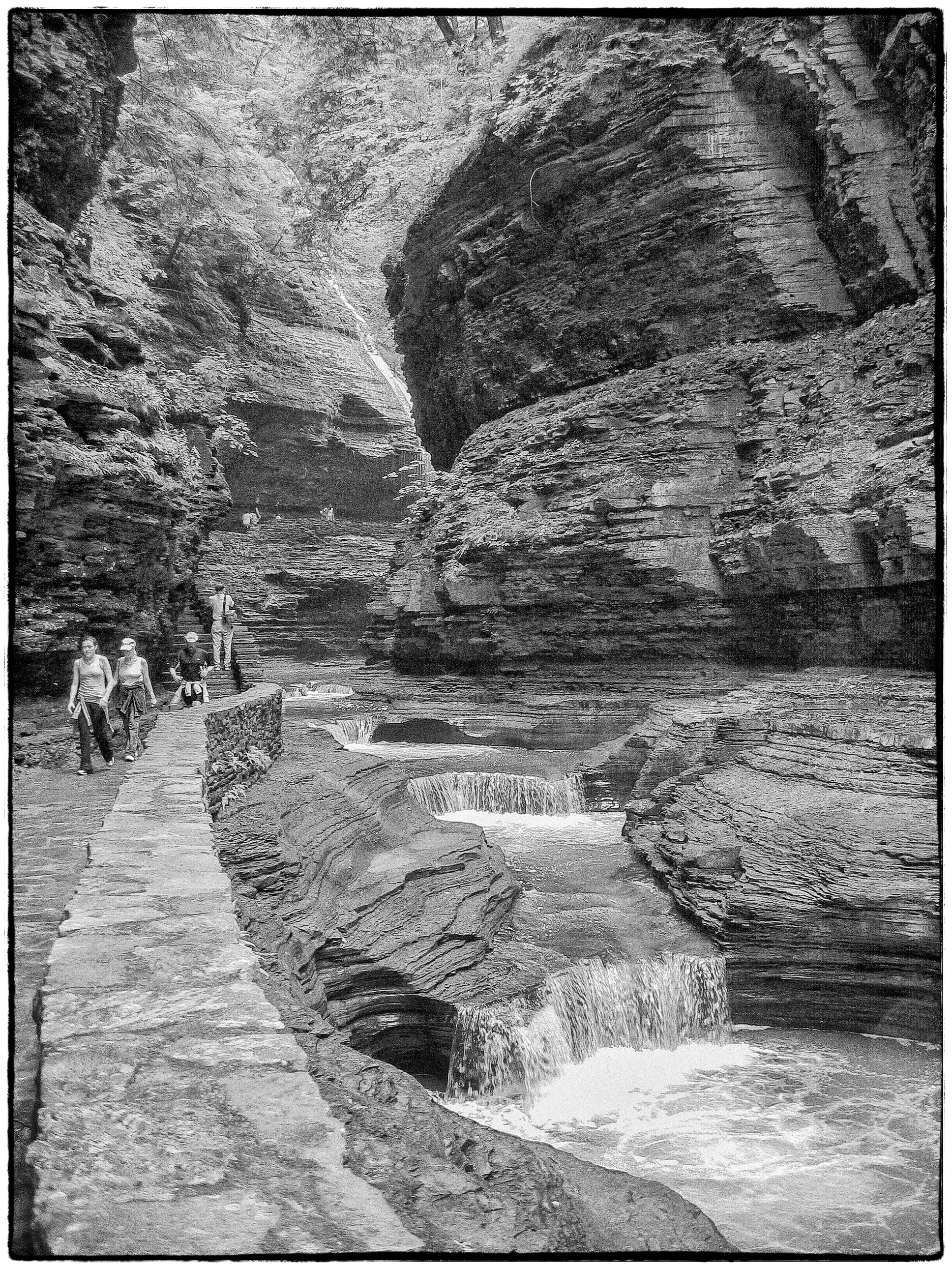
Watkins Glen State Park taken in July, 2006 with a Canon Powershot S50. Quite remarkable rock formations. According to Wikipedia:

Watkins Glen State Park is located outside the village of Watkins Glen, south of Seneca Lake in Schuyler County in New York’s Finger Lakes region. The park’s lower part is near the village, while the upper part is open woodland. It was opened to the public in 1863 and was privately run as a tourist resort until 1906, when it was purchased by New York State. Since 1924, it has been managed by the Finger Lakes Region of the New York State Office of Parks, Recreation and Historic Preservation.

Jacob’s Ladder, near the upper entrance to the park, has 180 stone steps, part of the 832 total on the trails.
The centerpiece of the 778-acre (3.15 km2) park is a 400-foot-deep (120 m) narrow gorge cut through rock by a stream – Glen Creek – that was left hanging when glaciers of the Ice age deepened the Seneca valley, increasing the tributary stream gradient to create rapids and waterfalls wherever there were layers of hard rock. The rocks of the area are sedimentary of Devonian age that are part of a dissected plateau that was uplifted with little faulting or distortion. They consist mostly of soft shales, with some layers of harder sandstone and limestone.
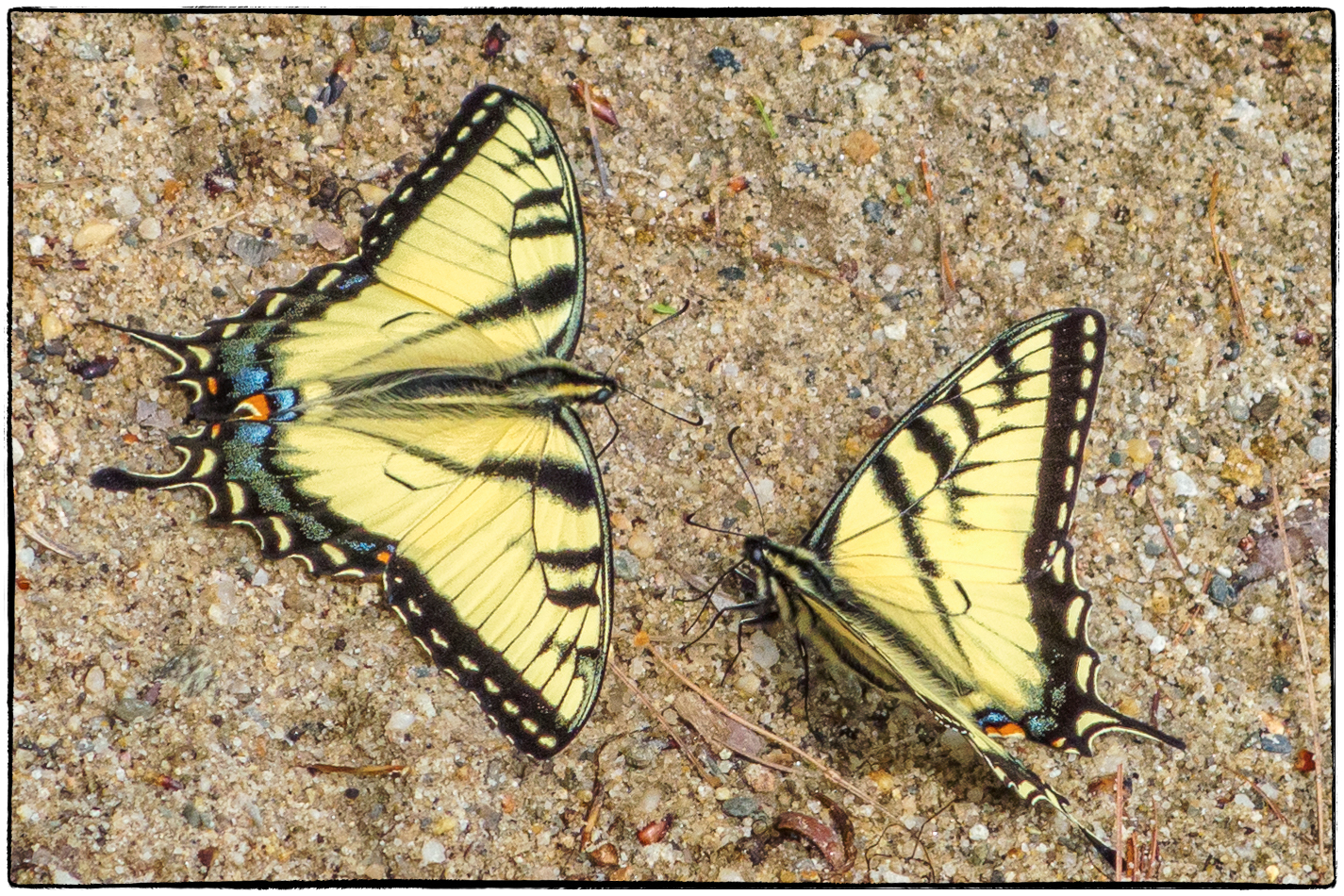
A pair of swallowtails

I came across this pair of butterflies on a nearby beach – Moon Beach. At first I thought that they were Monarch butterflies and described them as such in a post on Facebook. I was politely informed that they are not in fact monarchs. So I replied: “I’ve been told in a comment that these are NOT monarch butterflies. Shows how much I know about butterflies. Anyone know what kind of butterfly they are”. Back came the response that they are Eastern Tiger Swallowtail butterflies. You live and learn!

Great quote from W. Eugene Smith

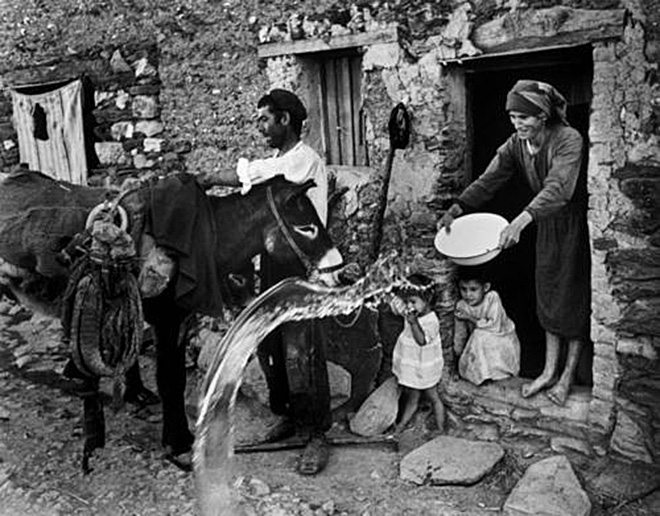
A farmer unloads his donkey in front of his home. His wife throws out the dirty dishwater. Extremadura. SPAIN. 1951. Copyright: Magnum Photos via Eric Kim: 7 Lessons W. Eugene Smith Has Taught Us About Street Photography

With all the fuss of late about digital manipulation of Steve McCurry’s pictures (for an insightful article on this topic see: Steve McCurry and photojournalism’s burden of truth on Disphotic) it was refreshing to come across this quote from W. Eugene Smith. Philippe Halsmann interviews Smith and at one point asks if a famous picture by Smith of a Spanish woman throwing water into the street (see above) was staged. Smith replied: “I would not have hesitated to ask her to throw the water. (I don’t object to staging if and only if I feel that it is an intensification of something that is absolutely authentic to the place). “Halsmann replies: “Cartier-Bresson never asks for this…. Why do you break this basic rule of candid photography?”. Smith’s response is brilliant:

I didn’t write the rules — why should I follow them? Since I put a great deal of time and research to know what I am about? I ask and arrange if I feel it is legitimate. The honesty lies in my — the photographer’s — ability to understand.

The rest of the interview is well worth reading.

Source: Discussing Honesty in Imagery – The New York Times

Seen by the side of the road

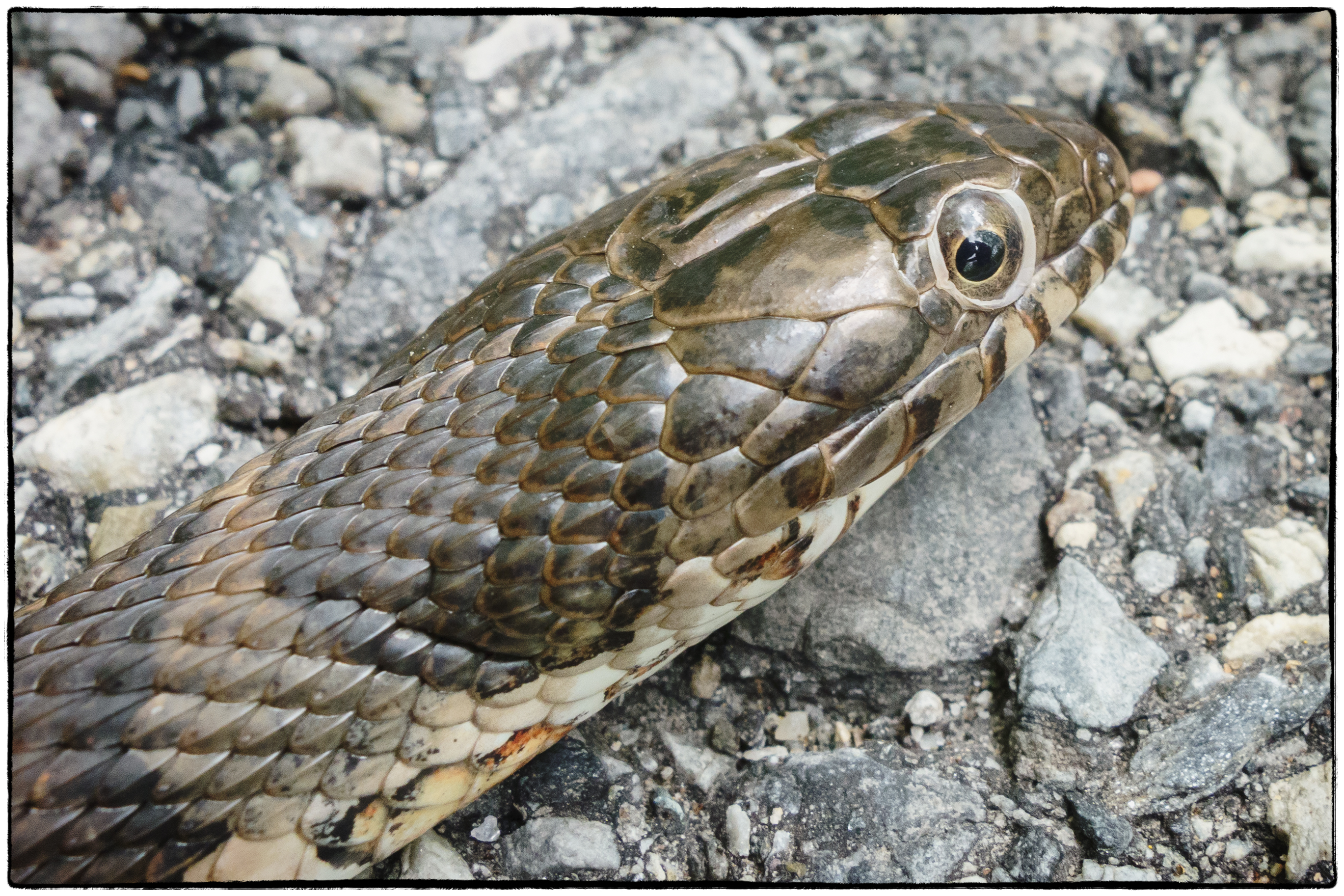
I was walking the dog when I came across this snake by the side of the road (actually the dog noticed it first. I would probably have walked right by it). It didn’t look in great shape, inert even and I assumed that it was dead. So I thought that this would be a great opportunity to get really close without any concerns about it slithering away. I got right down to the snake’s level and had the camera literally a couple of inches away from it when it lifted it’s head, stuck out it’s tongue and hissed at me. I guess it wasn’t dead after all. Needless to say I beat a hasty retreat. I’m pretty sure that it’s not venomous, but just the same I could do without being ‘nipped’ on the nose by an irate reptile.