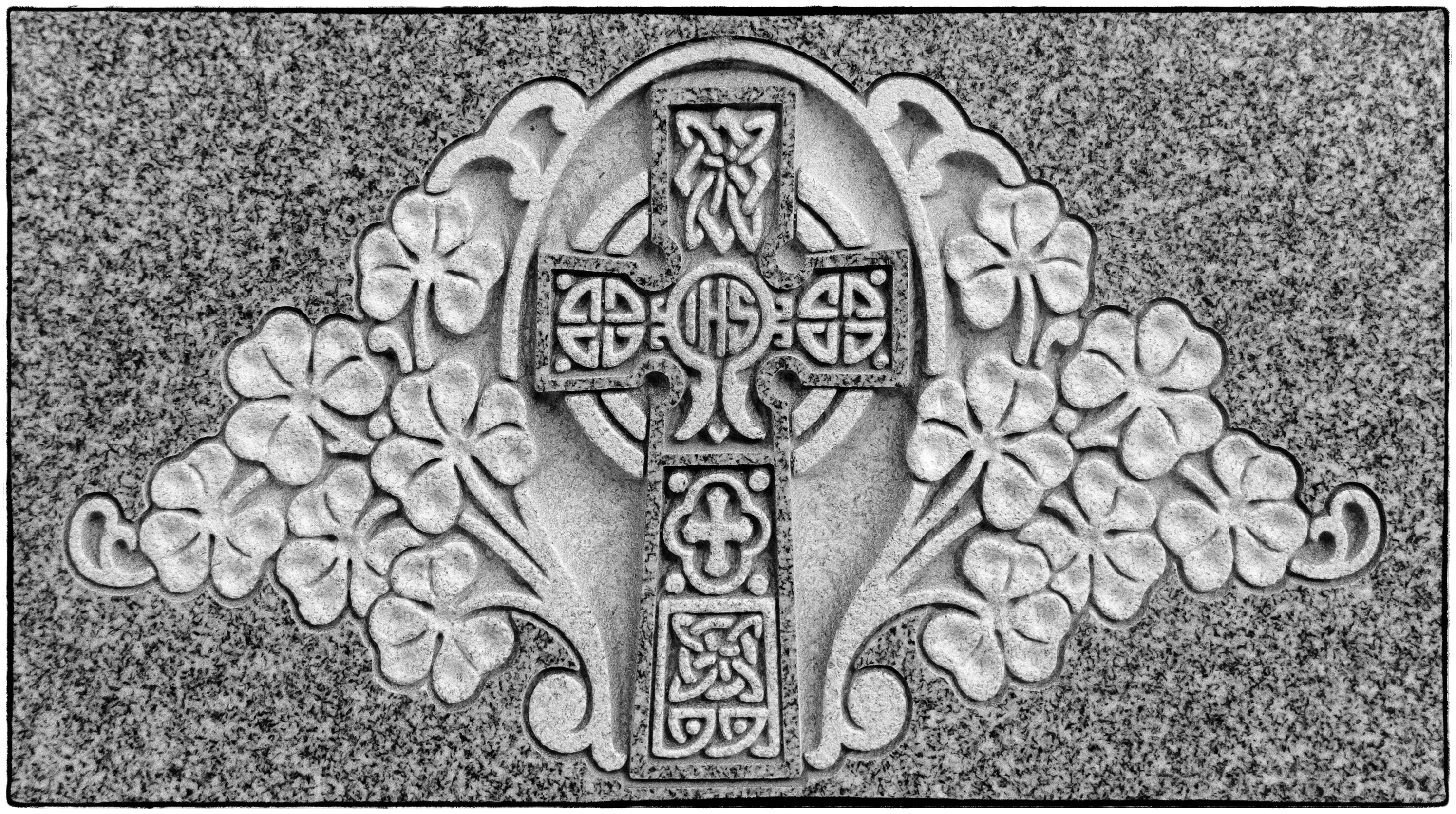
One of the relatively few interesting gravestone designs in this cemetery with a celtic cross and shamrocks (I think).
According to Memorials.com website:
Celtic Cross- The circle around the crosspiece symbolizes eternity. Its’ origin can be traced to the Celtic cultures of the British Isles. There is a legend of how St. Patrick when preaching to some soon to be converted heathens was shown a sacred standing stone that was marked with a circle that was symbolic of the moon goddess. Patrick made the mark of a Latin cross through the circle and blessed the stone making the first Celtic Cross. It is said to serve as a double symbol of eternity and unity, both that of the Son with the Father and the Holy Spirit and that of the believer with the Trinity. That was a common theme of St. Patrick’s preaching.
The Cemetery Symbolism site describes the use of shamrocks as follows:
The shamrock marks Irish ancestry…In Irish legend, the druids believed the shamrock had mystical properties because it had three leaves, a sacred number. The number three is significant in Celtic art and many Celtic symbols incorporate this number.
The shamrock was later adapted into Christianity. It was believed that St Patrick used the shamrock to demonstrate the Holy Trinity in introducing Ireland to Christianity.
It later became a symbol of Irish identity in the face of rebellion against the British. The shamrock was the symbol of the Irish Volunteers, a republican militia, which lead to Queen Victoria banishing its display. To wear a shamrock during the 19th century was to risk punishment by the British.
The artistic basis of the symbol is debated. The exact plant species the shamrock is unknown. The plants most believed to be the shamrock are the White (Dutch) Clover, the Red Clover, Lesser Yellow Trefoil, Black Medic and Wood Sorrell. All of these share similar features as small, three-leaved green leafs plants.
In contemporary society, the shamrock a popular symbol used to associate with Irish cultural identity and is thus popular symbol used in advertising and branding, particularly aimed at tourism.
Although I recall looking at the name on the gravestone, I didn’t retain it. I have always had a terrible memory for names. However, I feel sure that if I went back I’d find that the name was Irish.