Still life with lilacs

One of the books I got for my birthday was “Sudek” by Sonja Bullaty. I’ve become something of a fan of Josef Sudek of late – ever since I saw some pictures he’d taken of St. Vitus’ Cathedral in Prague. Some of his pictures remind me a little of another one of my idols: Eugene Atget. There’s a certain ‘stillness’ about both of them and Sudek, in particular had a wonderful feeling for light.

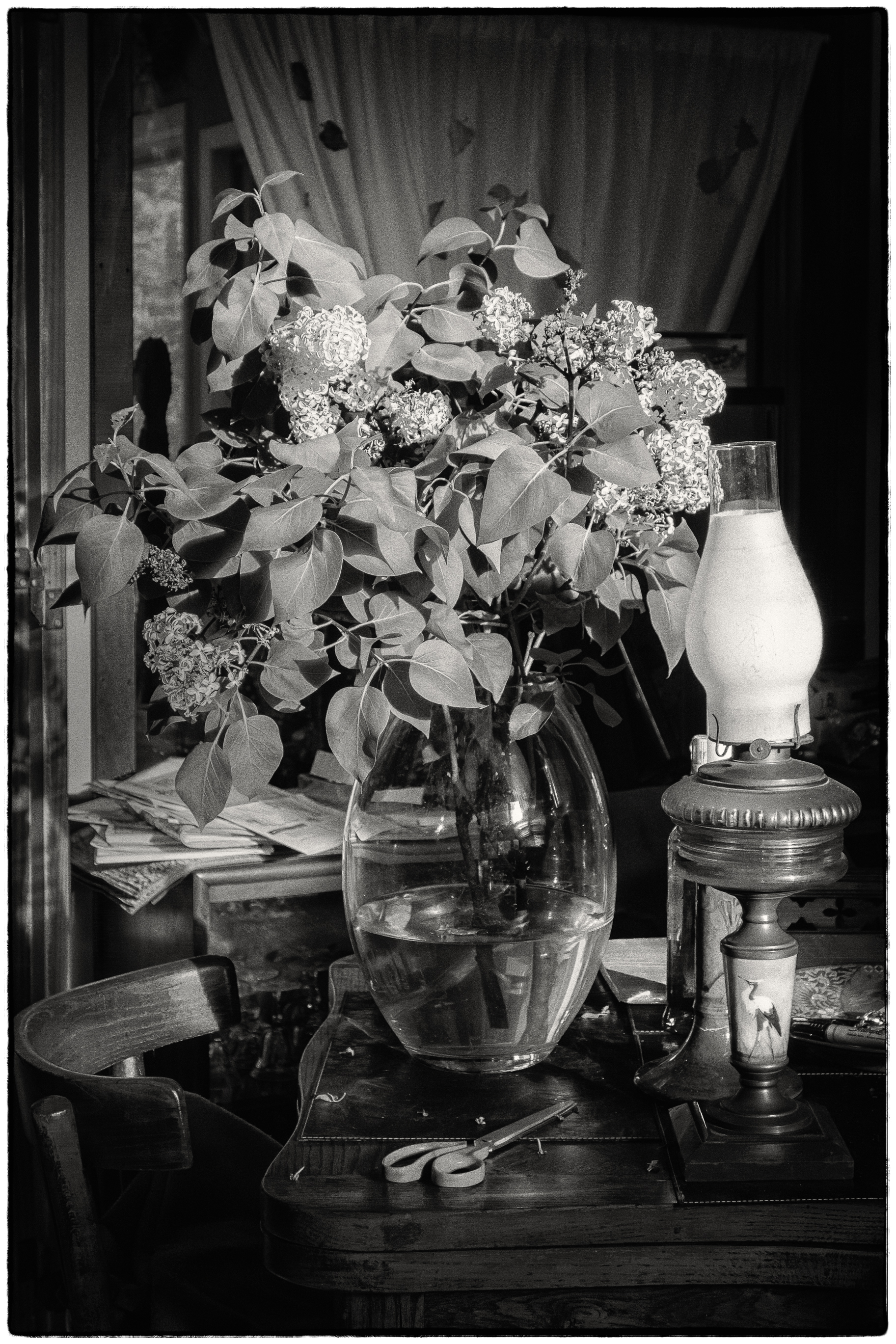
I was over at a friend’s having a drink when I noticed the light coming through the window and falling on this glass vase with lilacs in it. It reminded me a little (a very little) of some of Sudek’s still lifes – simple pictures taken in his house and and in his studio. Because of the delicate color of the lilacs I was tempted to leave the picture in color, but as a kind of hommage to Sudek I decided to go for a black and white treatment instead.

Drewsclift Cemetery

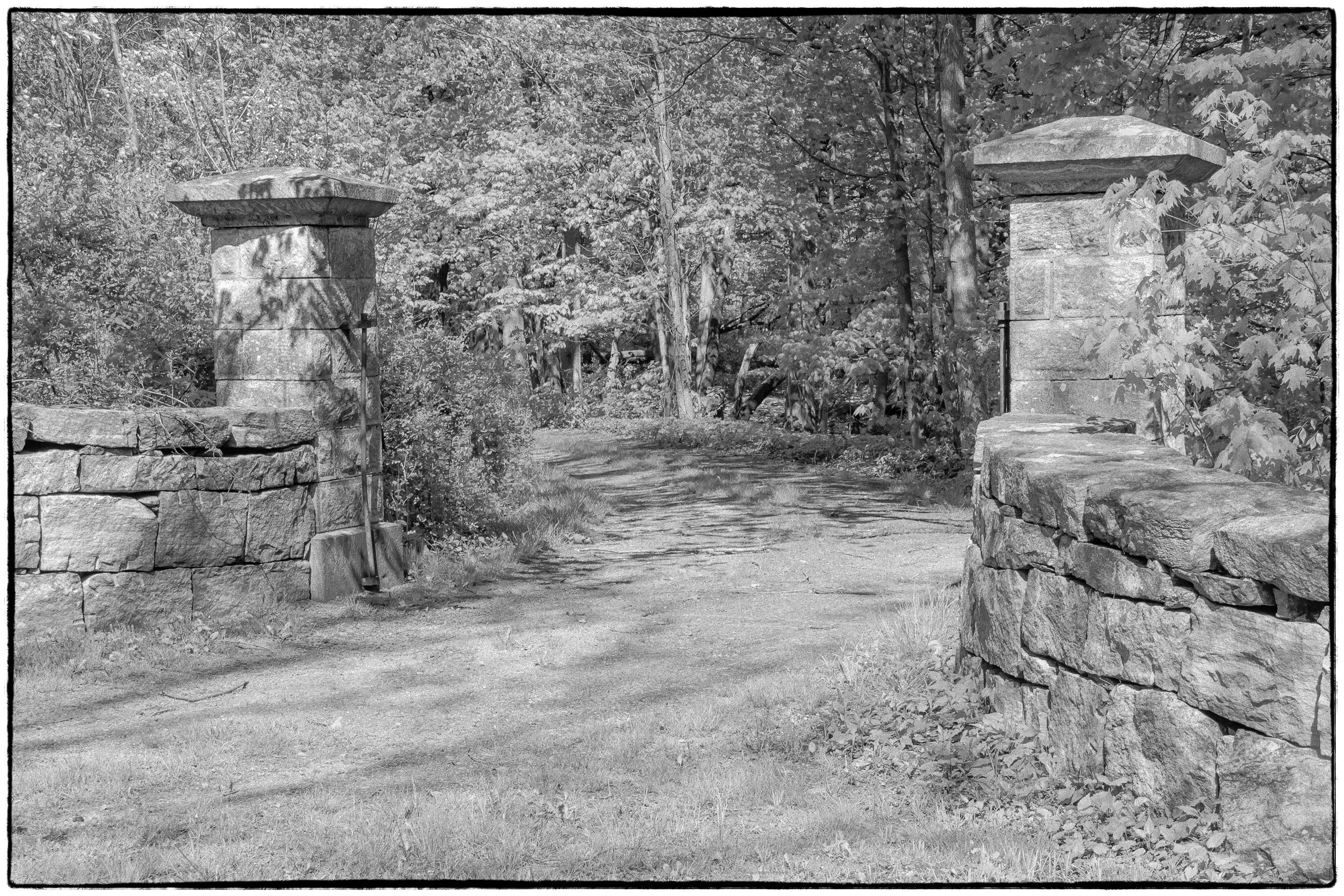
Entrance to the cemetery looking from inside. A small, pleasant cemetery in the town of Southeast. You approach the cemetery along a short trail (where I saw the Dryad’s Saddle fungus). It would have been a tranquil walk if not for the close proximity to a major highway (Route 684) and the constant drone of traffic. The cemetery does not have much in the way of statuary, but there are a number of ornamental flowering shrubs, which would probably have been quite spectacular had they been in bloom – unfortunately they weren’t.

A nearby historical marker sign reads: “Drewsclift Cemetery. Daniel Drew, railroad and steamboat promoter, found of Drew Seminary and University, builder of churches buried here”. Other than that I haven’t been able to find out much about this cemetery apart from the description in Adventures around Putnam:

The cemetery itself has a beautiful stone wall around the perimeter, laid out in a large square. The graves and walking path form a circle within the outer square. Some of the headstones are worn and illegible, while others look like they were replaced or refurbished recently. Some are tiny, and some are grandiose. A few of the headstones have been knocked over.

The plants and trees in the cemetery really added to the experience. Botany is not one of my strong points, so I can’t tell you what kind of plants and trees were there, but they added something ineffable to the experience.

The dates on the headstones at Drewsclift range from the late 1700’s to as recent as 1961. The family names include Adams, Bailey, Clift, Drew, Mead and many others. The most notable historical figure to be buried in Drewsclift is Daniel Drew. Mr. Drew was a businessman in the 1800’s whose pursuits included cattle, stock brokerage (and stock manipulation), steamships and railways. He declared bankruptcy a few years before his death, but at one point owned almost 1000 acres in Putnam County. He was very involved with the Methodist Church, and founded the Drew Seminary.
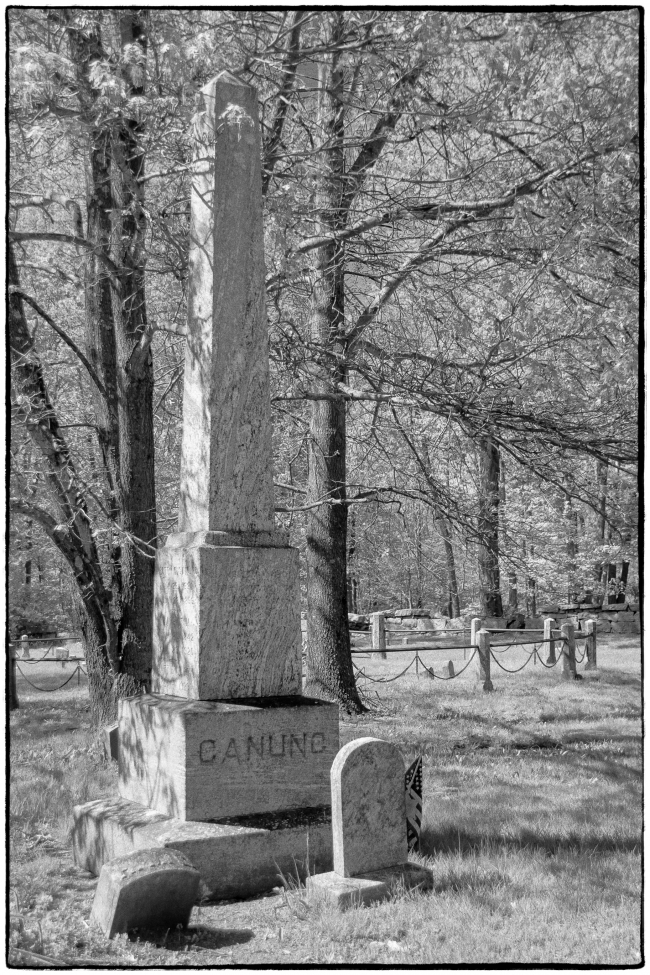
Obelisk (of which there were a number)

Zigzag fence.

Weeping Willow motif on a gravestone. According to Engraved. The Meanings Behind Nineteenth-Century Tombstone Symbols:

Carvings of weeping willows became very prevalent on gravestones in the early 19th century. Use of this graceful symbol reflected the young United States’ growing interest in ancient Greece. Beginning in 1762 with the publishing of The Antiquities of Athens by Stuart and Revett, which produced the first accurate surveys of ancient Greek architecture, Great Britain, Europe and eventually the United States began copying Greek style in architecture and interiors. This emulation even carried over into funerary art. For the United States, the comparison between ancient Greece and its democracy with the former colonists’ “grand new experiment” in government was inspiration for copying everything Greek.

Gravestone carvers created weeping willows alone or with Greek-inspired urns, obelisks, or monuments. The most obvious meaning of a weeping willow would seem to be the “weeping” part…for mourning or grieving for a loved one. The saying “she is in her willows” implies the mourning of a female for a lost mate. And while the Victorians took the art of mourning to new heights, the weeping willow was not just a symbol for sadness.

[In Ancient Greece] It was common to place willow branches in the coffins of the dead, and then plant young saplings on their graves, with the belief that the spirit of the dead would rise up through the tree.
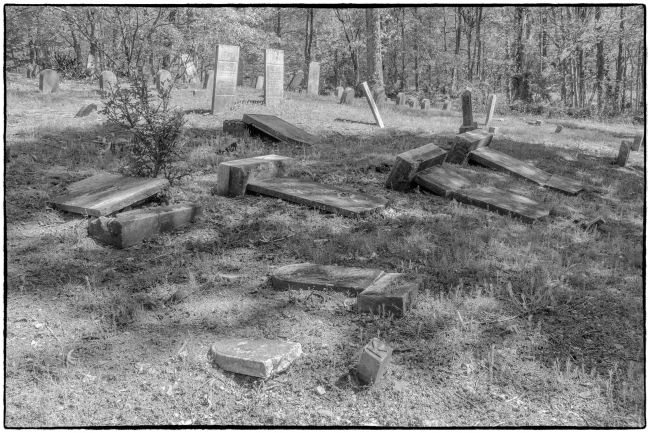
Fallen gravestones.

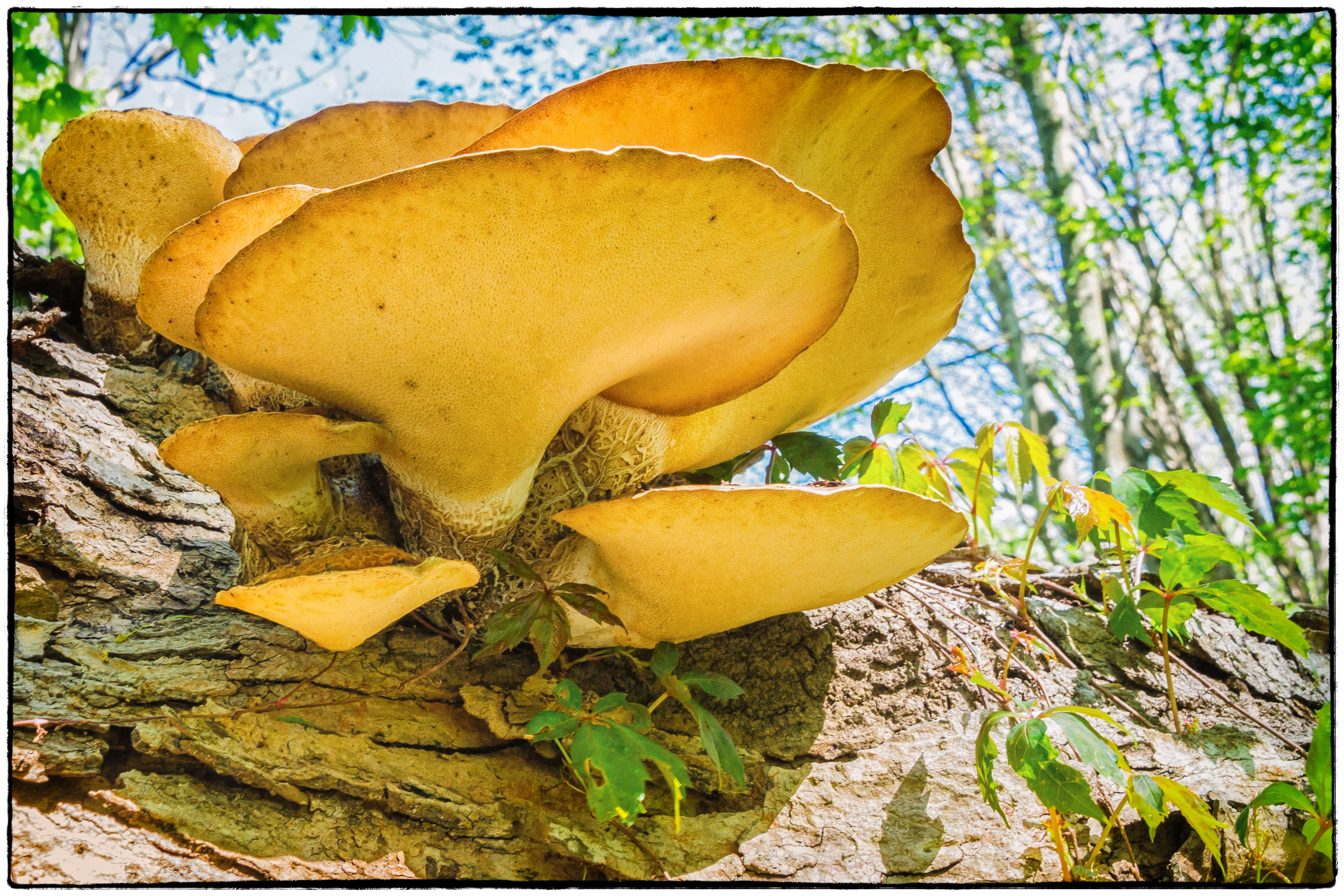
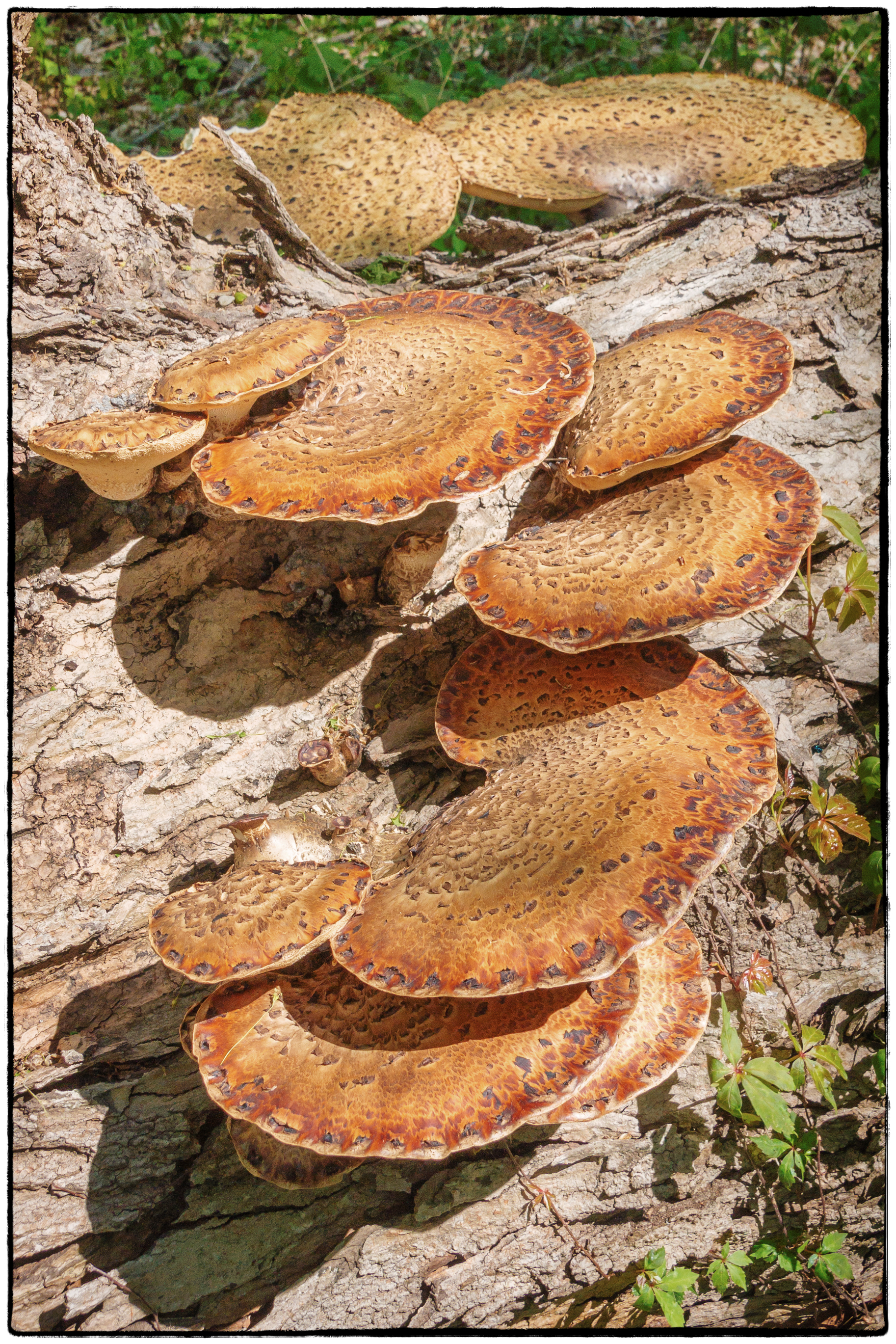
Large fungus

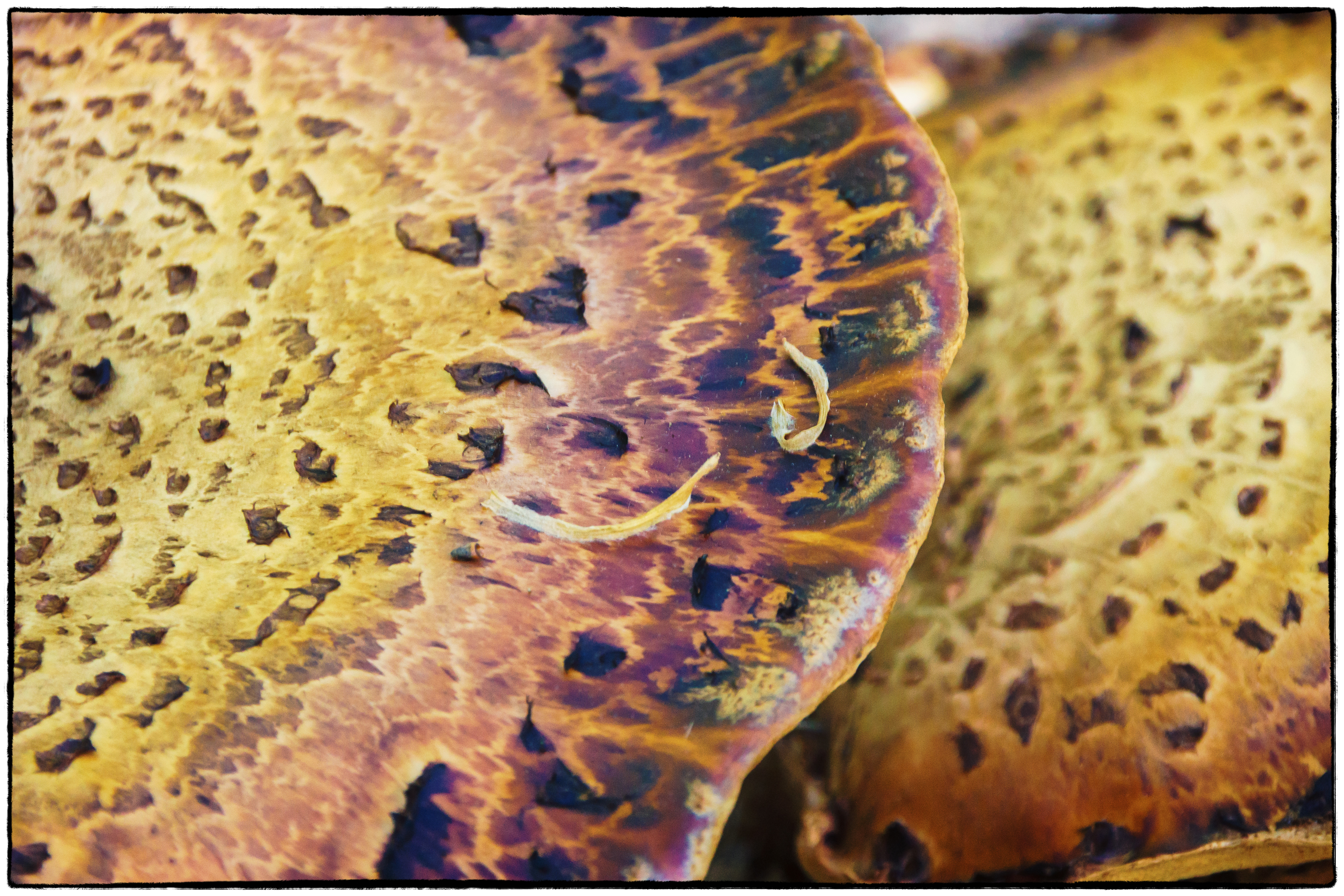
I came across this huge fungus while walking up to Drewsclift Cemetery. While I’m no great expert on funghi I believe this is a dryad’s saddle or pheasant’s back mushroom (Polyporus squamosus). The University of Wisconsin Plant Teaching Collection sheds some light on the origins of the name:

So, what about the common names for this mushroom? The “pheasant’s back mushroom” is quite obvious from the above pictures. Many a hunter has been startled in the woods or has stalked one of these mushrooms thinking it was a pheasant seen from the back.

Dryad’s Saddle is a little more complicated. You’re thinking “what the heck is a dryad?” Well in Greek mythology a dryad is a tree-dwelling nymph, also known as a tree sprite. Someone with an overactive imagination decided that Polyporus squamosus looked like a saddle that one of these tree-dwelling nymphs would sit on.

While it’s certainly not toxic opinions vary as to how edible it is. The consensus seems to be that when it’s young and small it’s certainly edible, but when it grows old and large it becomes very tough. The Forager|Chef . Hunting mushrooms, wild and obscure food site has this to say (In a post on the Dryad’s Saddle):

Some people say Dryad Saddles smell and taste of fresh cucumber, and I agree, along with some watermelon rind-a bit like comparing chanterelles to apricots.

I’ve heard of people eating it and not liking it, and saying it is inedible. I have also heard people praise it for being delicious. The confusing part is that both could be right, It just depends on what age you find the mushroom. You wouldn’t want to eat the stem of asparagus when it’s old and woody, although you could make soup with them. The dryad saddle is the same way.

When they’re young and soft, these are succulent little nuggets. When they get older, they are tough and inedible, similar to chicken of the woods, but unlike chickens, are absolutely, positively, un-chewable, no matter the age.

Preparation wise, the first thing I do with dryad saddles is cut off the black stem, and then trim and scrape away the pores on the bottom side of the cap. The pores on the underside of the cap are a bit textural for me, so I remove them by scraping with the side of a paring knife. You don’t have to remove the pores from the dryad sadldle, but I do when I serve it.

Another thing I suggest is to slice these very thin, as in near transparent. Don’t worry about them breaking up or disintegrating into a sauce, their firm texture makes them resilient, like shiitakes.

You really want to keep this moist while cooking, browning a little bit is ok, and will make them taste better, but heavy browning or sauteing can make them toughen and dry out. I like to cook thin slices in a covered pan with a bit of water, butter and salt added until the liquid evaporates, and the mushrooms brown, just a little.

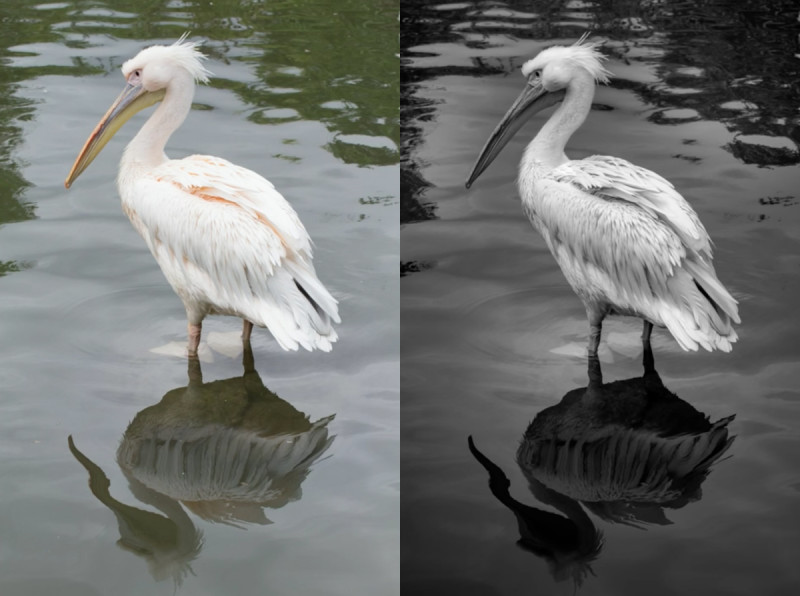
Can you really transform a bland picture into “fine art”???

In this video, Swiss photographer and YouTuber YuriFineart shows you how he took a bland snapshot and turned it into a “fine art” looking black and white image. Scroll down and hit play to see how he does it:

Source: Petapixel – How to Transform a Bad Snapshot Into ‘Fine Art’ with Lightroom

What an astonishing title! Hopefully it’s not meant to be serious? A bad snapshot is a bad snapshot no matter what you do to it. And certainly converting it into black and white doesn’t turn it into “fine art”, or art of any kind for that matter. I know – I do it all the time, but I’m not under the illusion that it turns them into “art”. I just like the way they look a little more.

Notice that the extract above reads: “YuriFineart shows you how he took a bland snapshot and turned it into a “fine art” looking black and white image”. Maybe it should be changed to: “…shows you how he took a bland snapshot and turned it into a black and white bland snapshot”.

To be fair to the article it does later say:

Obviously, the final product is not all of a sudden a beautiful image. There are still issues, and to reiterate the idiom, you can’t make a silk purse out of a sow’s ear—but the final image is significantly nicer than the original snapshot.