January film camera – Fuji GS645S

I started to collect cameras about five years ago and over the years I’ve acquired quite a lot. However, looking back over my collection I realize that I’ve only actually used a few of them.

So I’ve made a couple of New Year’s resolutions.

The first is to limit new acquisitions. Notice that I said ‘limit’ and not ‘stop’. I reserve the right to acquire cameras if a) they’re on my list of cameras I really, really want; b) they’re especially inexpensive. If I see something that takes my fancy and it will cost me less than I would usually spend for lunch then why not? The point of this is to limit additional cameras so I can try to use more of those I already have, which leads me to my second resolution.

Second. Most of my camera collection consists of old film cameras so I’m going to try to use a different one each month for the foreseeable future.

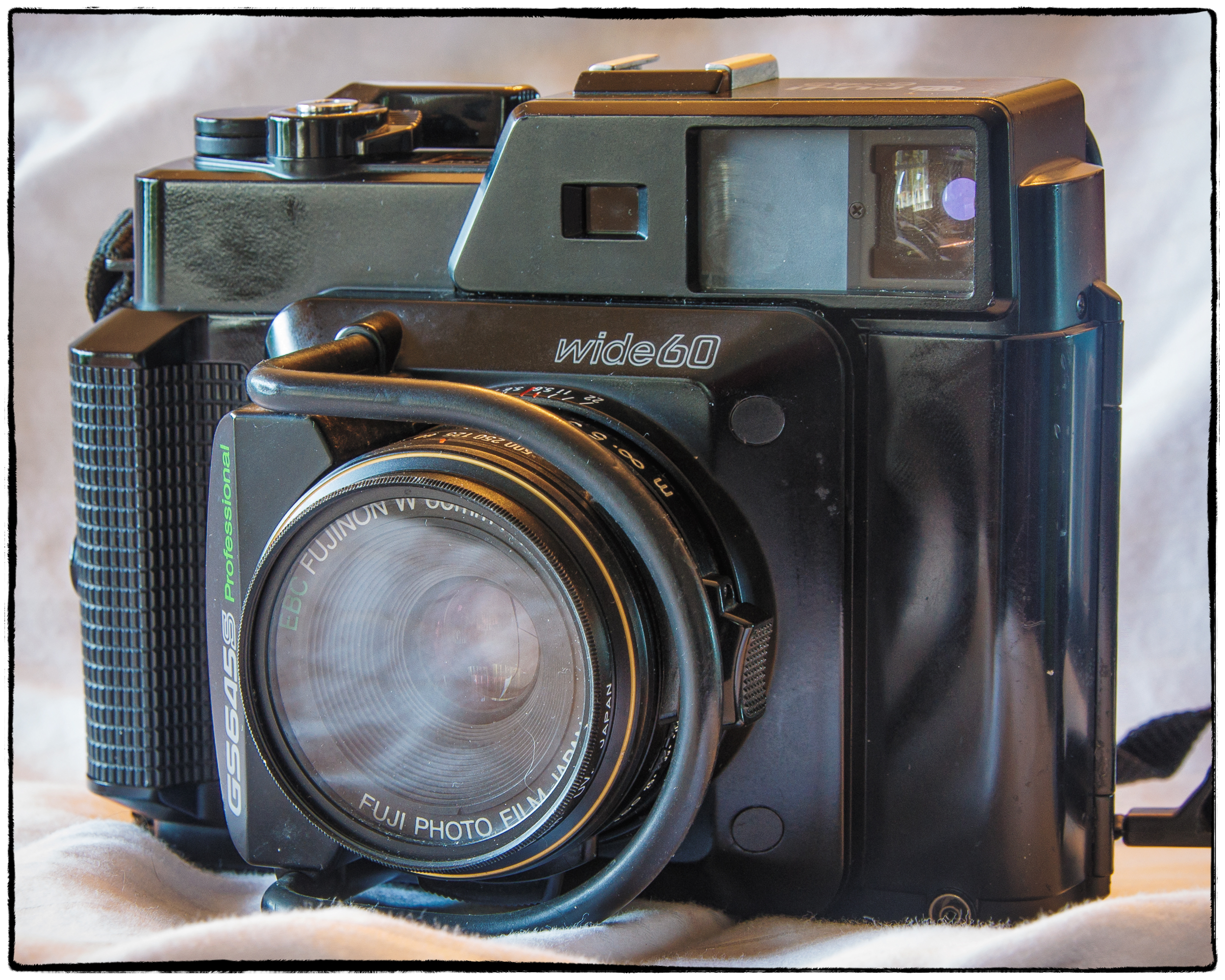
January 2017’s camera is the Fuji GS45S, which I acquired a few years ago and have never used. It’s a medium format film camera, first produced in 1984. It uses 120 roll film (15 6cm x 4.5cm exposures per roll) and 220 roll film. It’s a manual (rangefinder) focus camera that uses batteries only to power the center-weighted meter, which displays correct, over and under markings in the viewfinder. One quirk: when you look through the viewfinder the image you see is portrait format. To get a landscape (i.e. horizontal) format the camera must be turned on its side. It has a 60mm (35mm equivalent of 35mm) f4 Fujinon lens with focus, aperture (f4-f22), and shutter speed (1/15 – 1/500) settings on the lens barrel. ISO settings are from 25 to 1600. Another prominent feature is the ‘bumper’ around the lens barrel. Apparently the lens mount is quite fragile and the bumper is needed to stop it from shearing off. Looks like I’ll have to be particularly careful with this one.

A couple of reviews provide additional information:

Fuji GS645S Review by H W Kately on Film Shooters Collective.
Camera review: Fuji GS645s by Roy on Printer Attic.

For a medium format camera it’s not so large (about the same size as a large 35mm SLR) and it’s comfortable to hold. Despite the complaints about the fragility of the lens mount (which I’m convinced are valid) it otherwise feels quite solid. The meter worked well. My only real complaint relates to the rangefinder: the spot is quite small and somewhat difficult to see, particularly when the camera is held on its side for a horizontal shot. I found that I had to check the focus in the vertical position and then turn the camera sideways afterwards. I read somewhere that you can make the rangefinder spot brighter by placing a small piece of tape on the front of the viewfinder (see Resurrect Your Dim Rangefinder by Rick Olson). I may try this. Turning the camera sideways for a horizontal picture is, in any case, a little uncomfortable so if the majority of your pictures are horizontal this camera may not be for you.

I enjoyed using it, but since it was my first time I allowed for possible problems by framing wider than I usually would so that I could crop later if need be. This turned out to be a good idea because the camera had a light leak – fortunately fairly small and on the edge of the negative where it was easy to crop out. The leak is probably caused by old, decaying light seals and if I find I’m using the camera a lot I’ll consider having them replaced. If, as seems more likely, I use it infrequently I’ll probably just cover the offending area (I’m pretty sure I know where it is) with tape.

For some pictures taken with this camera see: Amawalk Friends Meeting House.

Another Christmas Present

I didn’t mention this one before, because it wasn’t supposed to be a Christmas present for me. It has, however, become so.

My wife has often complained that we don’t print enough photos. Most of the photos she’s referring to come in to her iphone – often photographs of grandchildren sent to us by their parents. She wants to print them and then display them in frames.

The problem is that I always got the job of printing them – a fairly tortured process involving sending them by email from her to me; me downloading them to my computer, importing them into Lightroom and trying to improve them; and then finally downloading them to a usb drive, taking it to CVS or somewhere and then printing them.

One day, while browsing through my photography feeds I came across a review of the above printer, a Canon Selphy CP 1200, which would print directly from her iphone via wireless.

Perfect, I thought – wrong! What I failed to realize is that to my wife printing photographs is clearly my responsibility and no matter how easy I make for her to do it herself it will remain my responsibility. So this is how the printer became my Christmas present rather than hers.

I thought about returning it, but then decided to keep it and I’m glad I did. I quite like the results it produces. Printing directly from the iphone leaves something to be desired as you can’t control the cropping and I don’t always like the way it crops. I find it’s better if I download the pictures to a USB drive and then plug this directly into the printer. This way I have better control over the cropping (it still tends to crop more than it shows on the printer’s screen though). Of course, this doesn’t help my tortured process much other than eliminating the trip to CVS (which is not to be sniffed at as it’s about a one hour round trip).

I also find it fascinating to watch to printer at work. First it prints a yellow layer and spits it out. Then it sucks it back in, prints a magenta layer and spits it out. It repeats this process twice more, each time printing a layer (cyan followed by white) spitting it out and sucking it back in until its finished. The whole process takes no more that a few seconds.

Of course you’re limited to 4×6 pictures, but that’s fine. If I want larger printers I’ll spend more time and effort getting them done. It will, however, print multiple copies on a single sheet of 4×6 paper. I had my doubts about how well it would print black and white, but I was pleasantly surprised with the results.

While not perfect it’s a handy device to have for small, quick, snapshot prints.

Sleepy Hollow Cemetery – Journey’s End

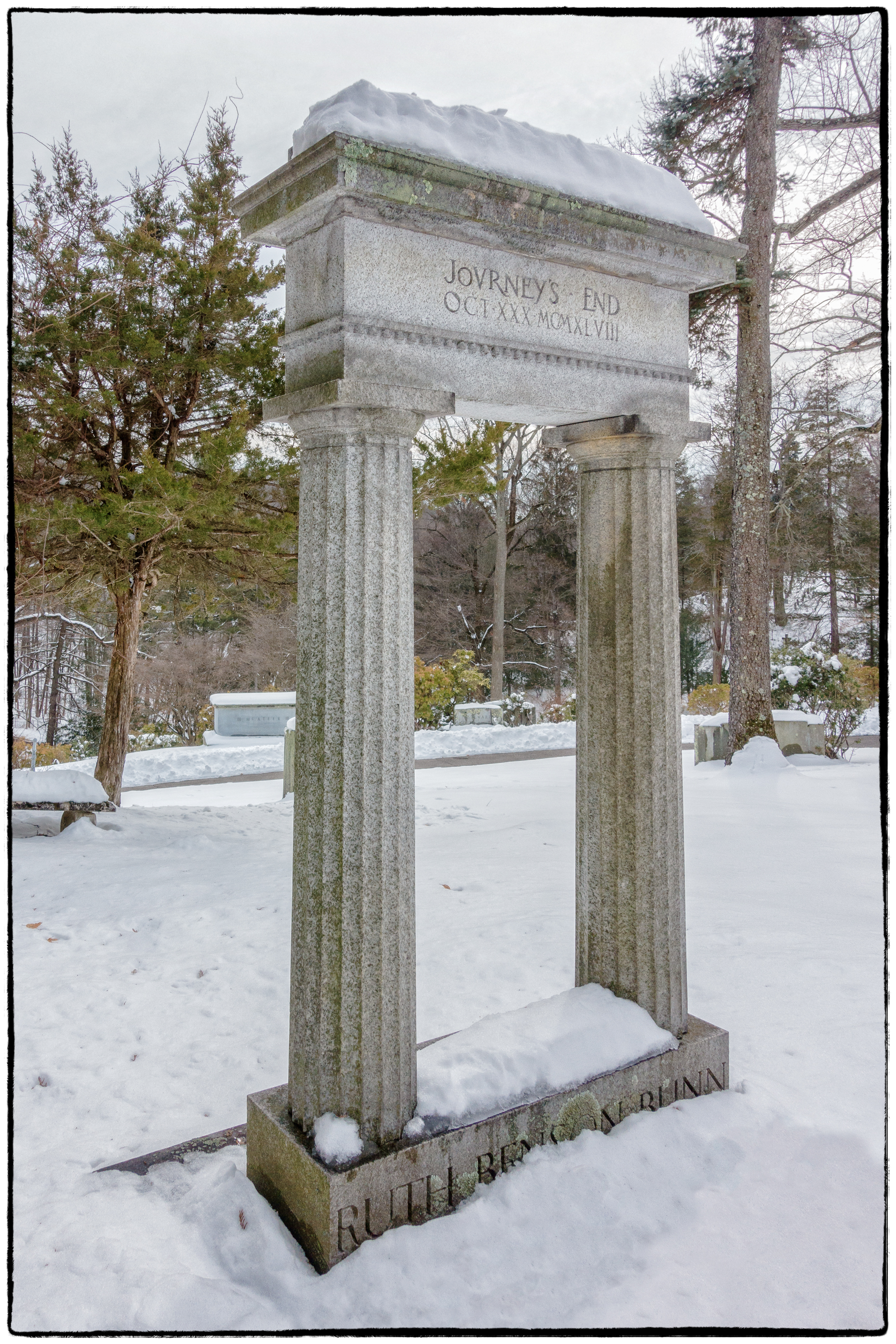
I found this small and simple memorial to be very appealing: a base (with the name Ruth Benson Blinn); two doric columns (the simplest of the Greek column styles); and a cornice with the words “Journey’s End. Oct XXX MCMXLVIII” (October 30, 1948).

I realized after conducting some research that this may actually be the rear of the memorial. If so the front bears the name “Holbrook Blinn” and also has the inscription “Journey’s End. June XXIV. MCMXXVII (June 24, 1928)

Sleepy Hollow Cemetery – Grant Family Plot

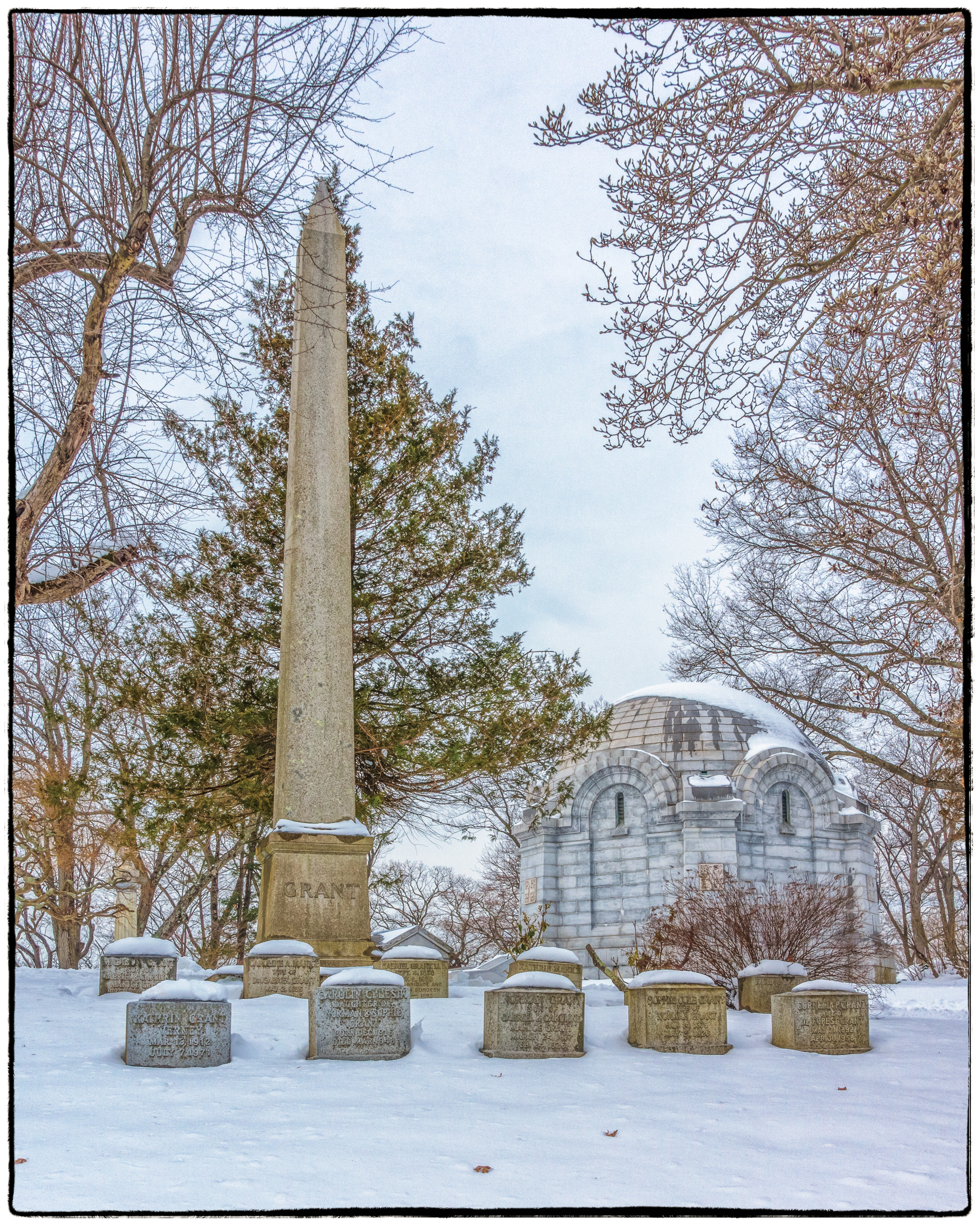
More Egyptian symbology – this time an obelisk (with the Archbold mausoleum in the background).

According to Wikipedia:

Dr. Gabriel Grant (September 4, 1826, Newark, New Jersey – November 8, 1909, Manhattan, New York) was an American doctor and Union Army major who was awarded the Medal of Honor for his actions at the American Civil War Battle of Fair Oaks.

Grant obtained A.B. and A.M. degrees from Williams College in 1846 and graduated from the College of Physicians and Surgeons in 1851. In 1852, he worked as a surgeon in Panama during the height of the California Gold Rush (when hordes of prospectors traveled across the isthmus on their way to the gold fields by sea) and organized the American Hospital the following year. While there, he also edited the Panama Herald. He then returned to practice medicine in his hometown of Newark. In 1854, he was part of a special commission set up to fight the cholera epidemic in the city.

With the onset of the Civil War, he served as the surgeon of the 2nd Infantry Regiment of New Jersey Volunteers from June to October 1861. He was a member of French’s Brigade during the Battle of Fair Oaks (better known as the Battle of Seven Pines), where his actions on June 1, 1862, earned him the Medal of Honor (awarded July 21, 1897). His Medal of Honor citation reads as follows:

Removed severely wounded officers and soldiers from the field while under a heavy fire from the enemy, exposing himself beyond the call of duty, thus furnishing an example of most distinguished gallantry.

In February 1863, he was appointed Medical Director of Hospitals in Evanston, Indiana, and was placed in charge of the United States Army Hospital in Madison, Indiana, on September 4 of the same year. He resigned his commission in January 1865 due to a wound he received while operating in the field.

Grant married the “wealthy Caroline Manice” in 1864. After the war, they lived in Newark, but soon moved to New York City, where all four of their children (three sons, one daughter) were born. The eldest was the lawyer, eugenicist and conservationist Madison Grant (1865–1937).

Gabriel Grant died at his home at 22 East 49th Street, Manhattan, New York, at the age of 83. He was survived by his wife and three sons

Sleepy Hollow Cemetery – Harris Plot

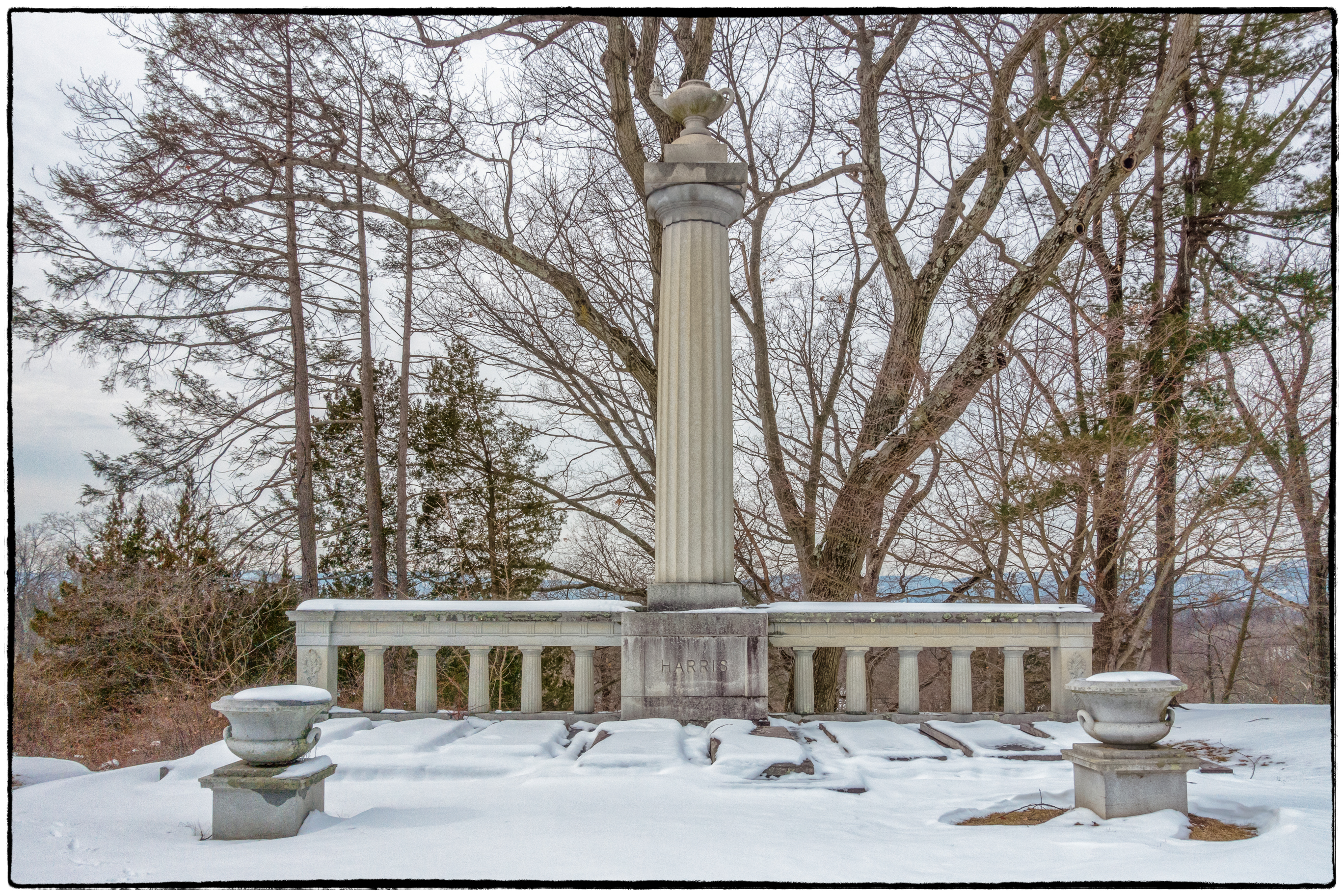
What caught my attention here was the large lamp on top of the central column. It looked like something out of The Arabian Nights.

According to Douglas Keister in Stories in Stone. A Field Guide to Cemetery Symbolism and Iconography:

Because of the light emitted by it the lamp is a symbol of wisdom, faithfulness and holiness. In 2 Samuel 2, a lamp is a symbol for God.

28 And the afflicted people thou wilt save, but thine eyes are upon the haughty, that thou mayest bring them down.
29 For thou art my lamp, O LORD: and the LORD will lighten my darkness.
30 For by thee I have run through a troop by: by my God have I leaped over a wall.

I was unable to discover which of the Harris’s built the memorial, but quite a few of them have grave markers right in front of the balustrade including:

William Rees Harris (1855 – 1915)
Florence Mary Harris (1858 – 1919)
Ieuan Harris (1881 – 1940)
Laura Houghton Harris (1879 – 1925)
Gwendoline Matthews Harris (1887 – 1981)
Hugh Harris (1883 – 1899)
John Houghton Harris (1915 – 1954)