The ‘Daniel P. Hays’ in the title is descended from an eminent Pleasantville family. His forefathers came from Holland and one of them fought in the Revolutionary War.
While David was serving with the American forces on Long Island in the Revolutionary War, the British burned the Hays home in Bedford, and then burned the entire village. In bed with a newborn infant, Esther Hays had refused to disclose the whereabouts of a party of patriots attempting to drive a herd of cattle through the British lines to the American camp at White Plains.
Servants removed Esther and her infant and hid them in the woods until they could be rescued. Among the young boys engaged in moving the cattle through enemy lines was a son, Jacob, then 7 years old. Jacob later became New York City’s High Constable, or chief of police, for nearly a half-century.
The infant Hays, the youngest of four daughters and three sons, became celebrated as Benjamin Etting Hays, who lived in Pleastantville for 75 years. He gave pastureland to the village for its first public school ”for the full enjoyment and benefit of all inhabitants,” he wrote, ”without any discrimination whatsoever.”
Uncle Ben’s Deeds
Having inherited the farm from his father, he lent money at no interest to his neighbors, following the Biblical injunction, and for those and other deeds ”Uncle Ben,” as he was known, was characterized by the Methodist minister as ”the best Christian around.”
In fact, he remained an observant Jew throughout his life, not an easy task living apart from a Jewish community, and learned how to slaughter meat so it would be kosher. Mr. Maass, who has studied the Hays papers and will speak about them at Sunday’s gathering, said that ”the documents and material include a certificate from an itinerant rabbi authorizing Mr. Hays to commit kosher slaughter, and the knife he was given to do it.”
David Hays inherited the Pleasantville farm from Benjamin, but he had other interests, moving to New York City to become a pharmacist. He was one of the founders of the New York College of Pharmacy. He sold the property but later his son Daniel Peixotto Hays, a partner in a successful law firm, began buying back the Hays land, eventually acquiring 52 acres, including the homestead.
Several years later he had built a new home and had established himself in the village, as his grandfather had. He was the Village Counsel, helped sponsor the village library, led the fight to incorporate the village and served for seven years as its second mayor.
Homestead Is Torn Down
Daniel and his wife, Rachel, had five children. They spent winters in the city and summers in the new home in Pleasantville, filling it with friends and relatives. They included Daniel’s sister, Rachel; her husband, Cyrus Sulzberger, and their son, Arthur Hays Sulzberger, publisher of The New York Times from 1935 to 1961.
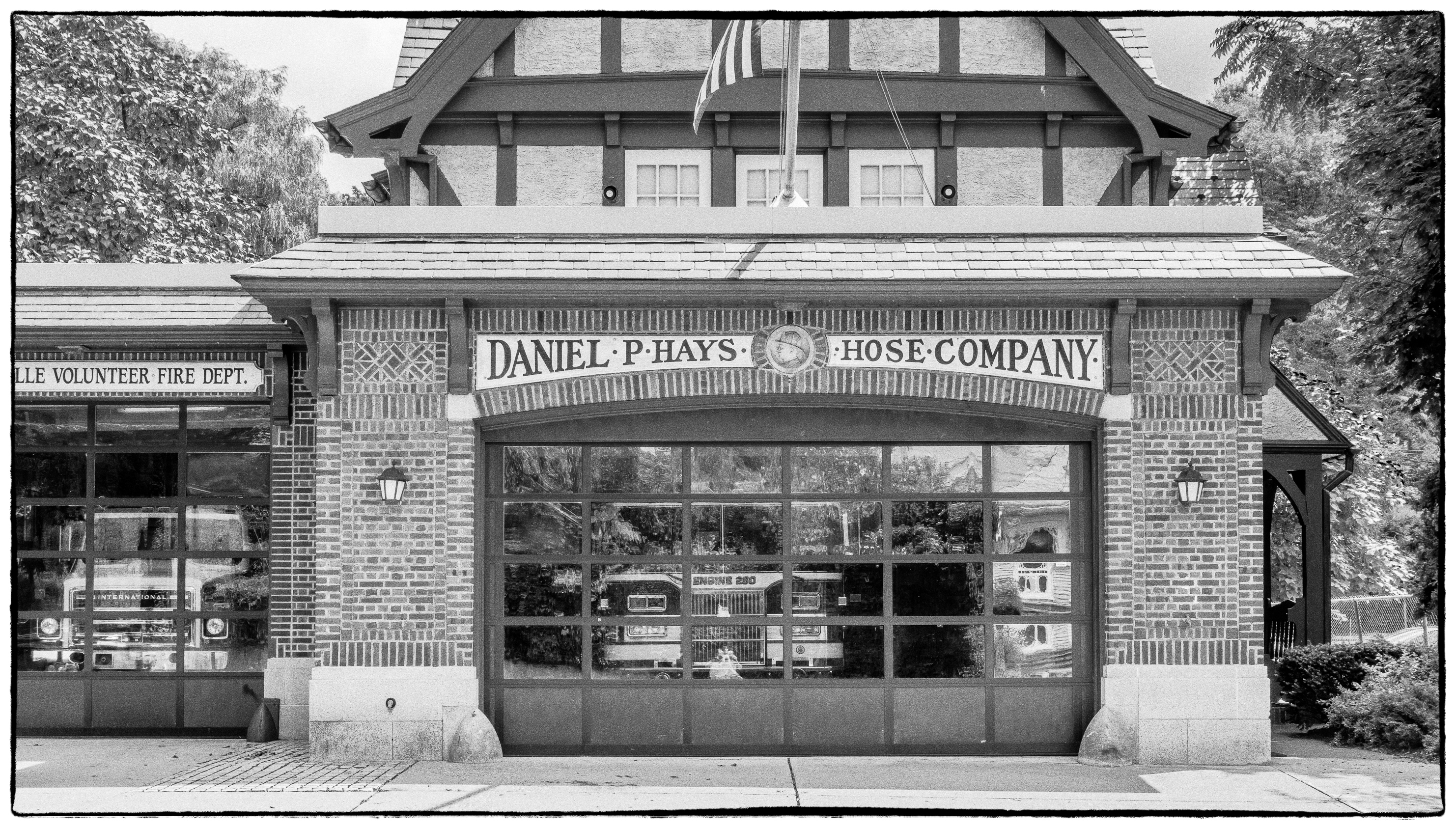
Daniel Hays died in 1923 and three years later the old homestead was torn down. That year, the village named a local fire company the Daniel P. Hays Hose Company for the man they called ”the patron saint of the village.” One of Daniel’s children, a daughter, Mabel, remained in Pleasantville, living on family land.
She died in 1965, but her husband, Irving Lachenbruch, and their daughter, Alva L. Middleton, remained in a white frame house directly across the street from the site of the old homestead. In 1977, the mansion on the hill – known as ”the Hays place” – and six acres were donated by its most recent owner, Anthony J. De Vito, to the St. Jude’s Habilitation Institute for children with multiple handicaps.
Taken with a Sony RX100 M3.