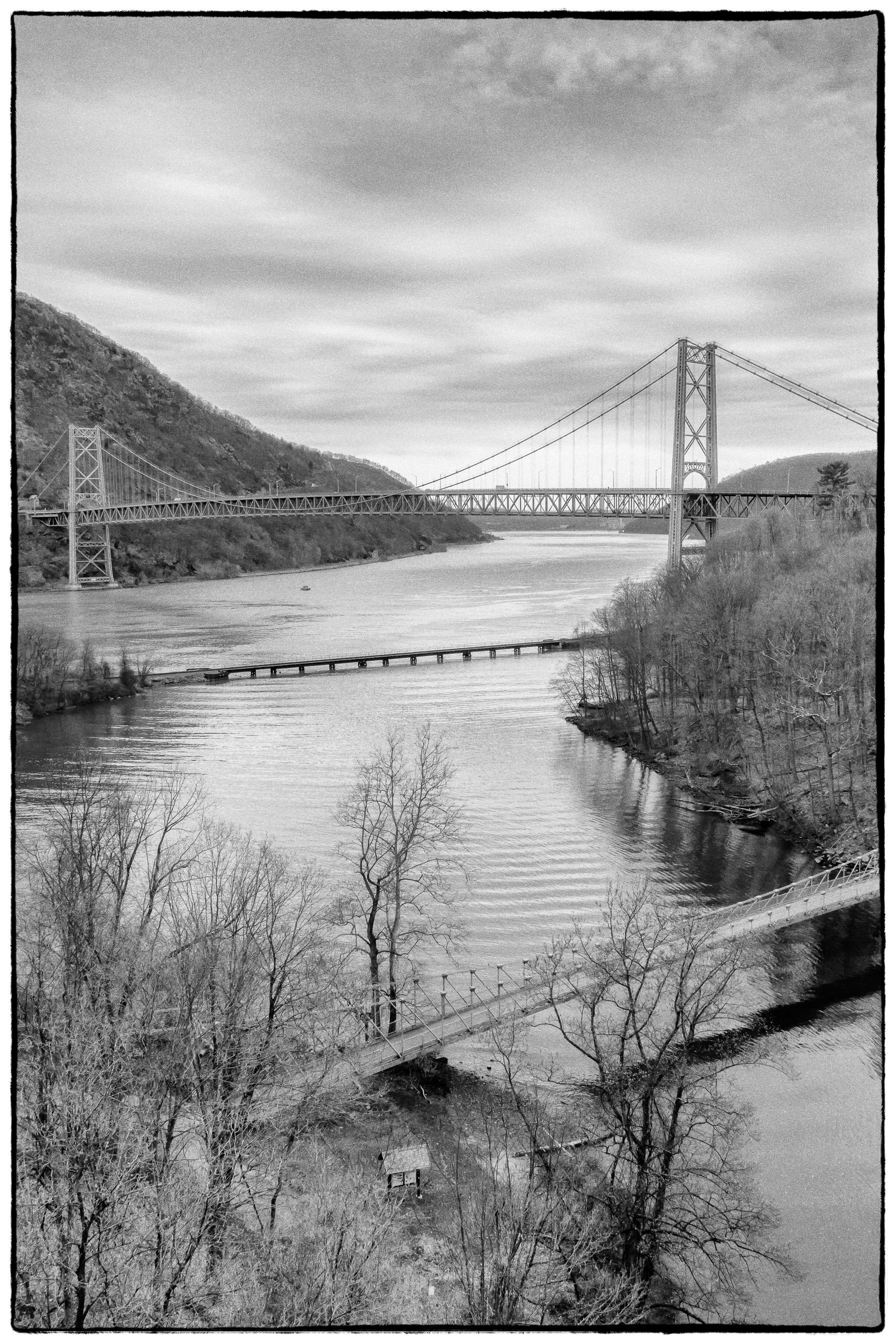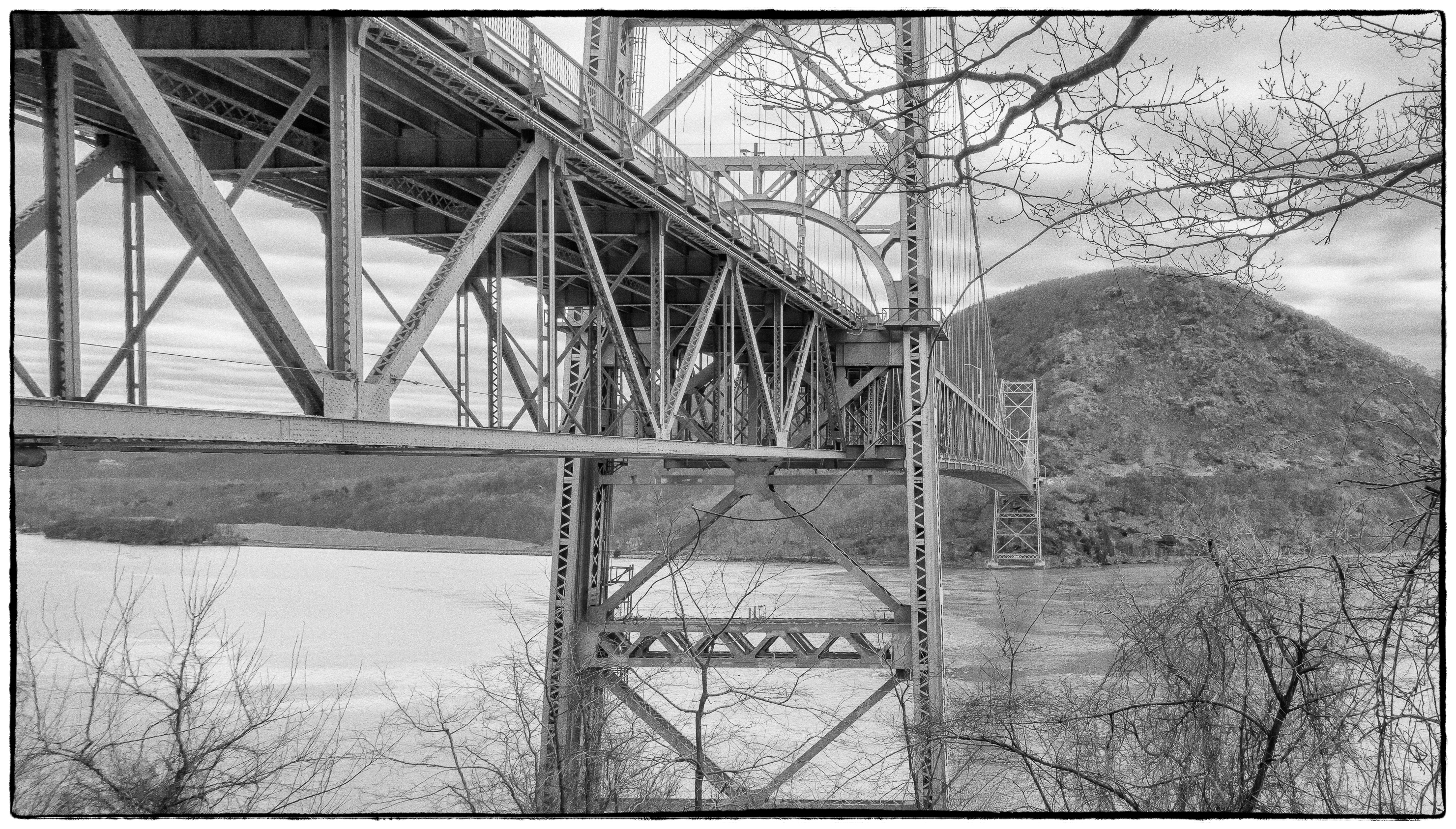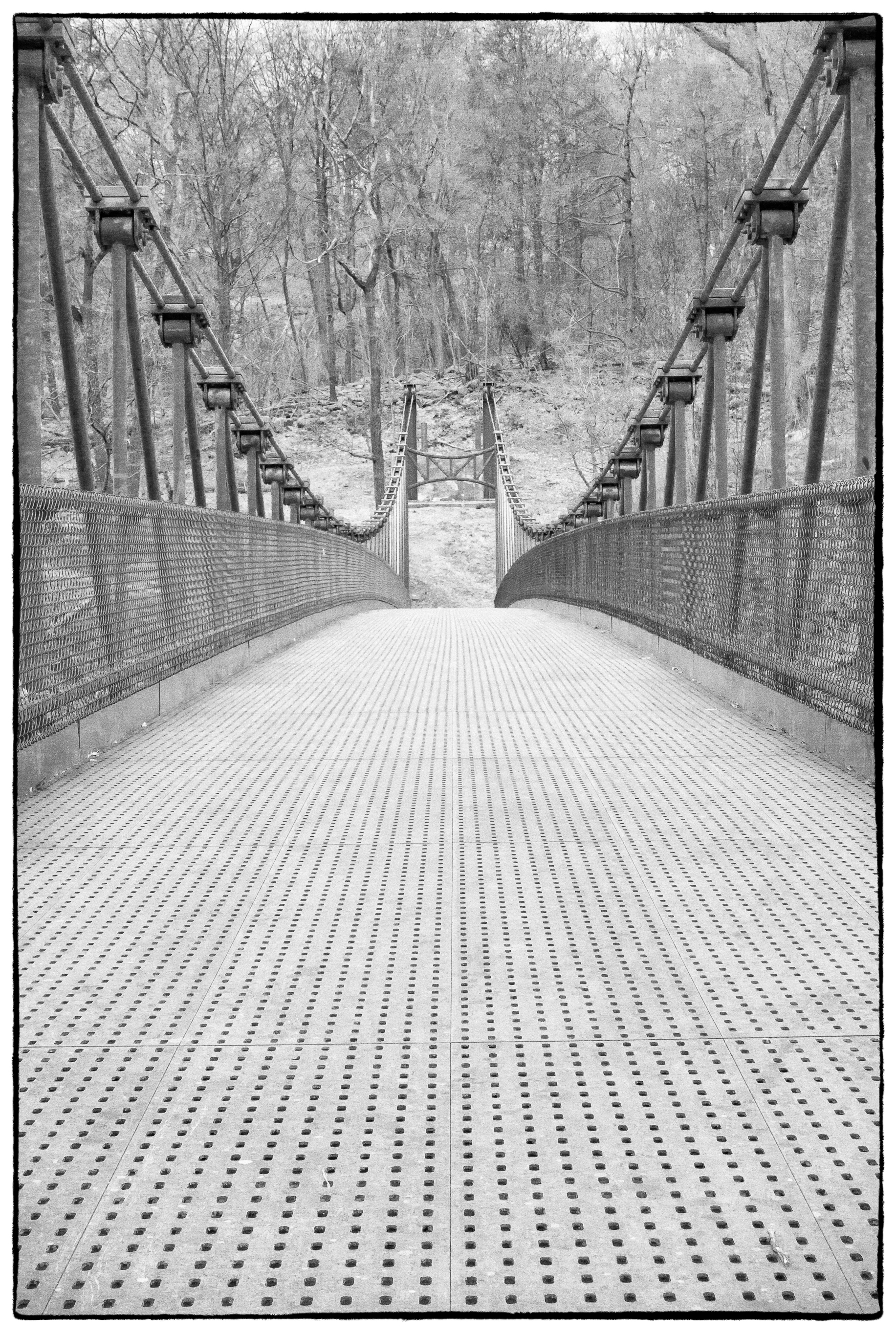
Fort Montgomery – Footbridge over Popolopen Creek.

As mentioned in earlier posts the pontoon bridge that crossed Popolopen Creek during the Revolutionary war was eventually (and much much later) replaced by a permanent structure. According to Wikipedia:

The red-blazed Popolopen Gorge Trail runs along the south side of the creek to a foot bridge just south of Popolopen Torne. Here, it joins the blue-blazed Timp-Torne, 1777 West and 1779 trails. These run along the north side of the creek from Hell Hole to the bridge, with the Timp-Torne detouring over the summit of Popolopen Torne. They cross the footbridge and join the Popolopen Gorge Trail to detour around West Point property, and the combined trails turn southwest and follow the valley of Queensboro Brook.

On October 6, 2002, New York Governor George Pataki dedicated a long suspension foot bridge which spans the creek a short distance further downstream. The novel design embracing a stiffened Suspended Rope Truss Bridge was proposed by Bruce Ramsay & Jim Hume of Cleveland Bridge Ltd. The final design & construction was carried out by Cleveland Bridge Ltd. The foot bridge connects the Twin Forts Trail to its intersection with the Appalachian Trail on the western side of the Bear Mountain Bridge.

As noted above a new footbridge (built 2002) has been constructed across the Popolopen Creek just downstream from this bridge. The concept design of this bridge was proposed by Bruce Ramsay & Jim Hume of Cleveland Bridge Pty. Ltd. of the U.K., Cleveland Bridge were also responsible for its construction. The footbridge was designed as a suspended rope truss, which results in a very stiff bridge due to its diagonal braces. Another special feature is the fiber composite deck in lieu of a traditional timber deck for this type of structure. The fiber composite deck adds lightness, long term durability and reduced maintenance requirements.

According to the Dorman Long Technology (the US arm of Cleveland Bridge) site:

Completed in 2002, the Popolopen Creek Footbridge was designed by DLT to create an economic and aesthetically pleasing river crossing of 140m main span on the Appalachian Trail in Bear Mountain Park, Fort Montgomery, NY. The bridge is a hybrid of a suspension bridge and a truss bridge and was designed for ease of construction. The suspension cables alone support the dead weight of the bridge whilst the live loads are resisted by a combination of the suspension cables and the truss formed by the suspension cable, suspenders, diagonal bracings and the deck edge girder. The result is a stiff bridge that is comfortable to walk across despite having a visually pleasing low span to sag ratio for the main suspension cables. The deck panels are fibre reinforced composite panels that bolt to the steel deck frame. Use of these panels significantly reduced the dead weight of the bridge. Main cables are anchored to rock at either end of the bridge at the top of slopes leading down to the bridge.

A plaque on the bridge reads:

The William J. Moreau Popolopen Bridge. “Bill” Moreau, Chief Engineer at the New York State Bridge Authority for 27 years. He is recognized world-wide and at home in the Hudson Valley for his strong willed, expert dedication to safe bridge design, function and maintenance for long-lived and beloved bridges. Dedicated 27 June 2014.

Below a view of the Bear Mountain Bridge from the footbridge.
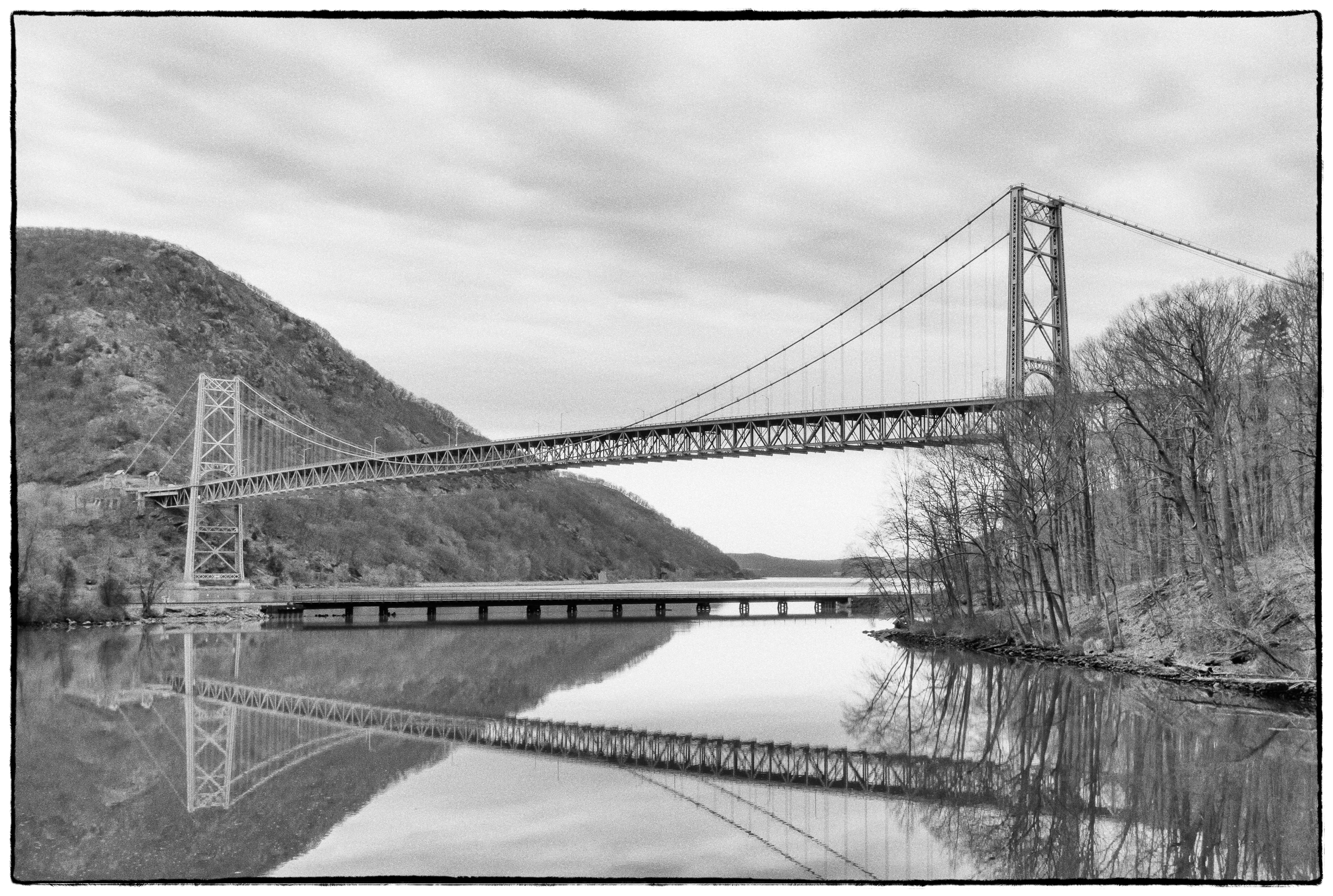
Fort Montgomery – A view from the 9W bridge

Route 9W passes across a bridge over Popolopen Creek just steps away from Fort Montgomery. This is the view from the bridge. Farthest away is the Bear Mountain bridge over the Hudson River. Next comes a railway bridge and finally the footbridge over the creek that replaced the pontoon bridge in use during the Revolutionary War to connect Forts Montgomery (on the left in the picture) to Fort Clinton (on the right).

I read somewhere (but can no longer remember where) that the bulk of the ammunition for the twin forts was stored at Fort Clinton – to be taken down and over Popolopen Creek to the more heavily fortified Fort Montgomery as required. Unfortunately the British surprise attack over the Timp pass, through Doodletown and down Popolopen Creek cut Fort Montgomery off from Fort Clinton and meant that it soon ran out of ammunition.

Fort Montgomery – A view from Fort Clinton

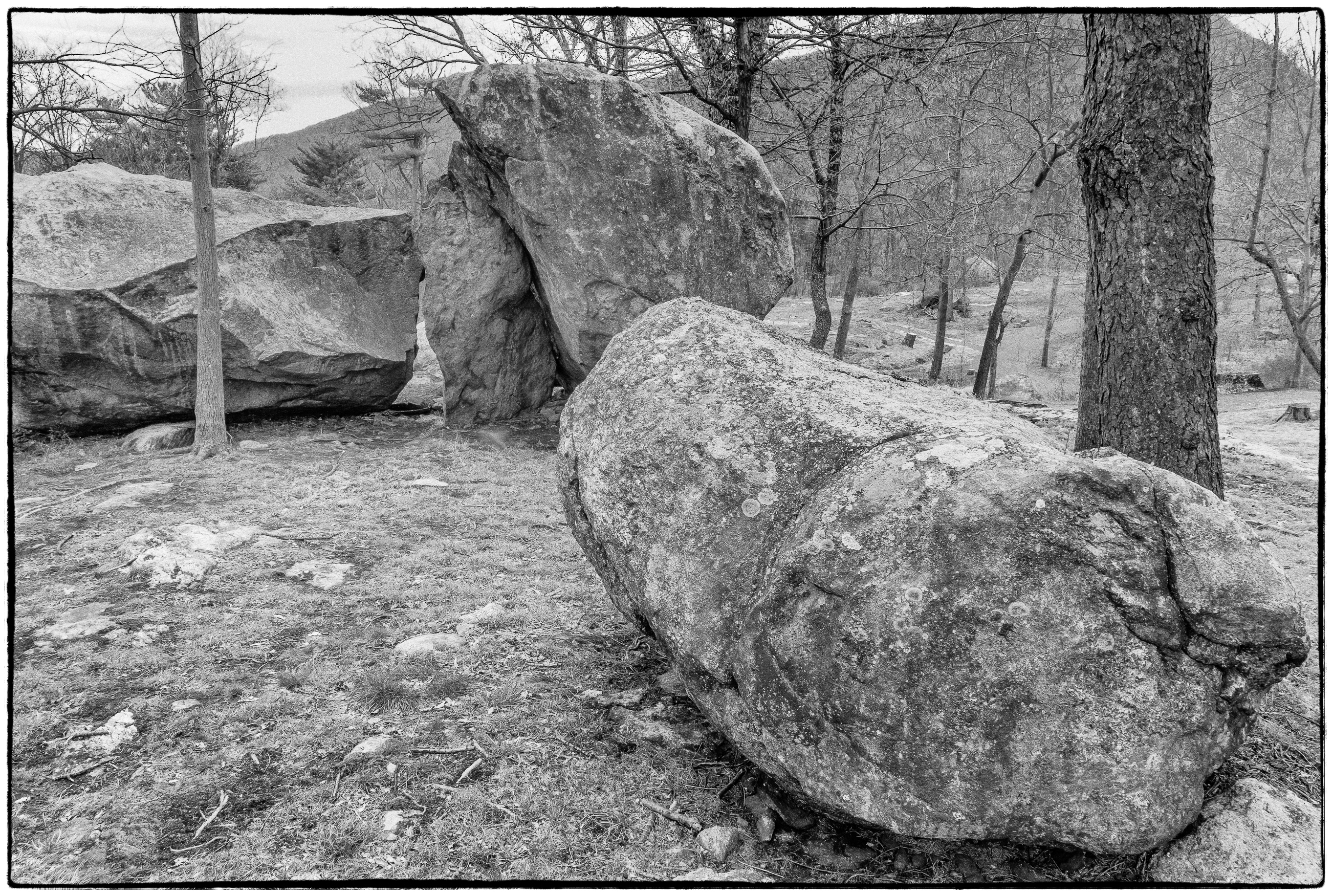
Once upon a time Fort Montgomery sat on the heights above the north side of Popolopen Creek. On the heights on the other side of the creek stood Fort Clinton. Almost nothing of Fort Clinton remains today, but it once stood where the Bear Mountain tolls now stand. This is taken from a spot just below the tolls looking across towards Anthony’s Nose, and I imagine this is pretty much what the view from Fort Clinton looked like – without the commanding presence of the Bear Mountain Bridge of course.

According to Wikipedia:

Fort Clinton (demolished) was one of a pair of American Revolutionary War fortifications located at the confluence of the Popolopen Creek and the Hudson River. It stood on the south side of Popolopen Gorge, and its companion fort, Fort Montgomery, stood on the north side. The forts defended a Hudson River Chain that stretched from Fort Montgomery on the west side of the Hudson River to Anthony’s Nose on the east side. The sites of both forts are in present-day Highlands, Orange County, New York.

The Fort Clinton site is near the west end of the Bear Mountain Bridge. Fort Clinton’s garrison of 300 soldiers was smaller than Fort Montgomery’s, but it was built on higher ground, and its defenses were more complete. The fort was commanded by General James Clinton, for whom it was probably named.

On October 6, 1777, Forts Clinton and Montgomery were attacked by the British 63rd Regiment led by Sir Henry Clinton (no relation). The Battle of Forts Clinton and Montgomery was intense but brief: Both forts were overrun within an hour, and the wounded General James Clinton retreated with his men through Popolopen Gorge. Fort Clinton and Fort Montgomery were razed by the British, and the iron chain they defended was dismantled.

Although the ruins of Fort Montgomery survive and the site is a National Historic Landmark, the Fort Clinton site was destroyed in the 1920s during the construction of U.S. Route 9W and the Bear Mountain Bridge. Today, the Fort Clinton site is part of Bear Mountain State Park and is used for the Trailside Museum and Zoo.

Fort Montgomery – The Naval Battle

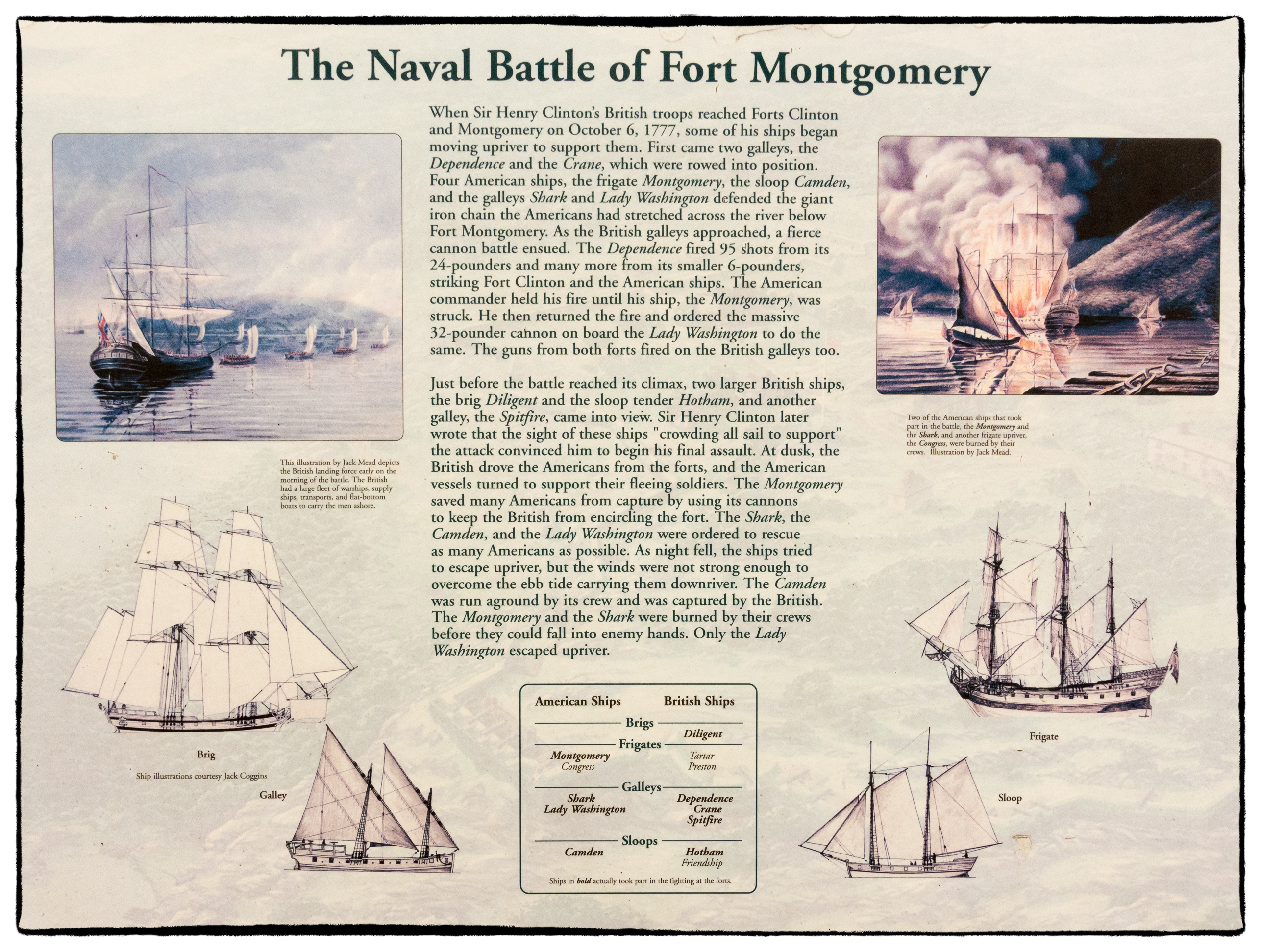
I usually illustrate this posts with pictures I’ve taken. However, you can’t really take a picture of an event that took place 240 years ago, so I’m forced to take a picture of the information board that explains what happened. I’ve quoted liberally from these boards in other posts, so it is perhaps appropriate that I show what one of them looks like.

When Sir Henry Clinton’s British troops reached Forts Clinton and Montgomery on October 6, 1777, some of his ships began moving upriver to support them. First came two galleys, the Dependence and the Crane, which were rowed into position. Four American ships, the frigate Montgomery, the sloop Camden, and the galleys Shark and Lady Washington defended the giant iron chain the Americans had stretched across the river below Fort Montgomery. As the British galleys approached, a fierce cannon battle ensued. The Dependence fired 95 shots from its 24-pounders and many more from its smaller 6-pounders, striking Fort Clinton and the American ships. The American commander held his fire until his ship, the Montgomery, was struck. He then returned the fire and ordered the massive 32-pounder cannon on board the Lady Washington to do the same. The guns from both forts fired on the British galleys too.

Just before the battle reached its climax, two larger British ships, the brig Diligent and the sloop tender Hotham, and another galley, the Spitfire, came into view. Sir Henry Clinton later wrote that the sight of these ships “crowding all sail to support” the attack convinced him to begin his final assault. At dusk, the British drove the Americans from the forts, and the American vessels turned to support their fleeing soldiers. The Montgomery saved many Americans from capture by using its cannons to keep the British from encircling the fort. The Shark, the Camden, and the Lady Washington were ordered to rescue as many Americans as possible. As night fell, the ships tried to escape upriver, but the winds were not strong enough to overcome the ebb tide carrying them downriver. The Camden was run aground by its crew and was captured by the British. The Montgomery and the Shark were burned by their crews before they could fall into enemy hands. Only the Lady Washington escaped upriver.

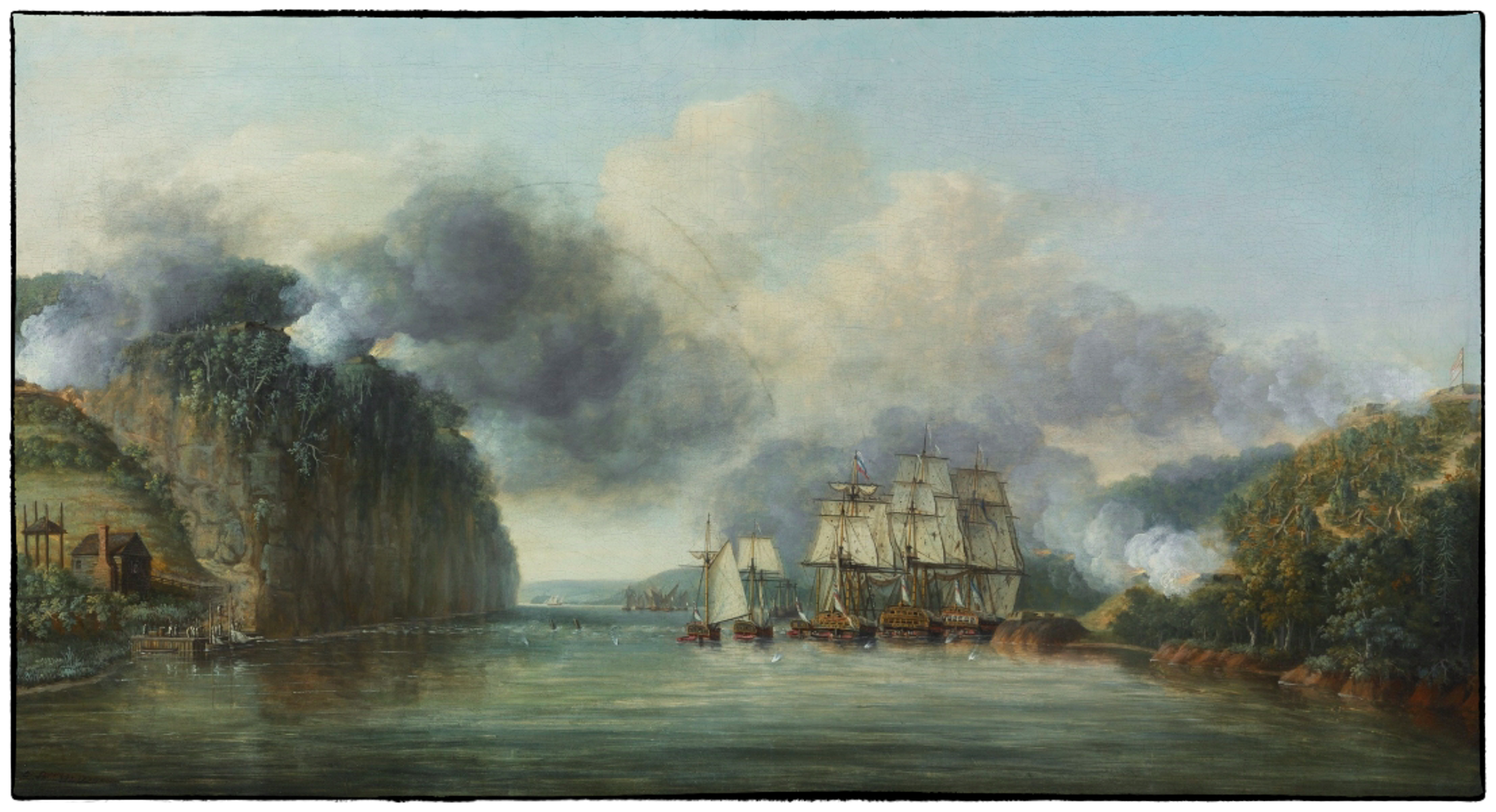
I looked for something to show what the actual battle was like, but I was unable to find anything suitable. The painting below shows another battle on the River Hudson during the Revolutionary war, but farther south and from a slightly earlier time period. It’s by Dominic Serres, R.A. (Auch 1722 – 1793 London) and depicts: “His Majesty’s ships Phoenix, Roebuck and Tartar (which also took part in the engagement at Fort Montgomery), accompanied by three smaller vessels, forcing their way through the Cheval-de-Frise on the Hudson River between Forts Washington and lee, New York, 9 October 1776. I imagine that the naval battle at Fort Montgomery was somewhat similar.