Fort Montgomery – Soldier’s necessary

According to a nearby information board:

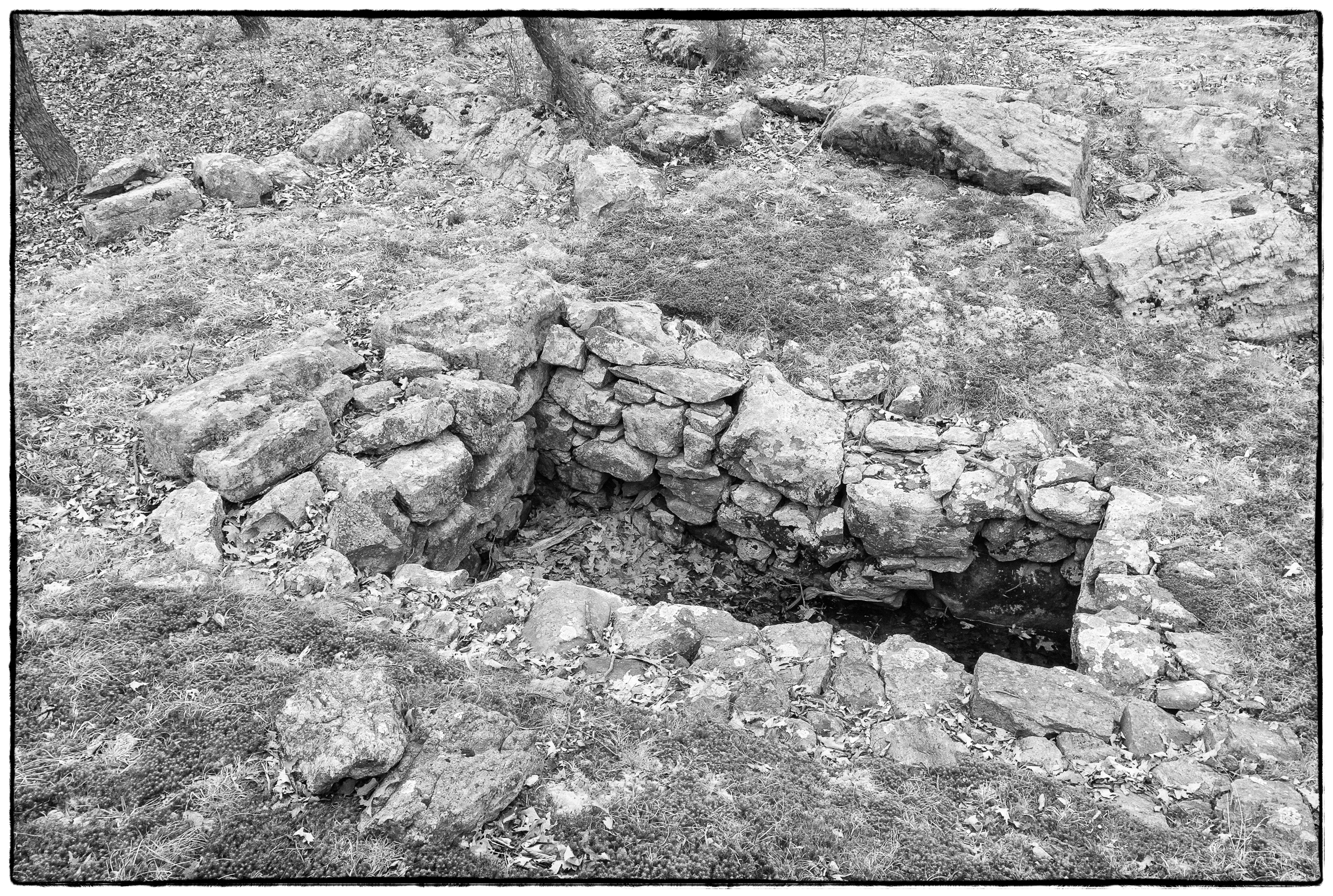
A “necessary” is a privy, or outhouse. In front of you is the vault of the only necessary known to have existed at Fort Montgomery. When it was finished in April 1776 it was described as “a large necessary, for soldiers”. It is hard to imagine that this one small building served the needs of hundreds of soldiers, so it is possible that there were other necessaries within the fort that have not yet been identified.

In privies, archaeologists usually find large quantities of discarded material like bottles and broken dishes as well as things that were inadvertently lost like coins and buttons. However, relatively little was found at the bottom of Fort Montgomery’s necessary. One possible explanation is that soldiers may have avoided using this necessary to keep it in readiness in case the fort was ever besieged.

Fort Montgomery – Regimental Gardens

According to a nearby information board:

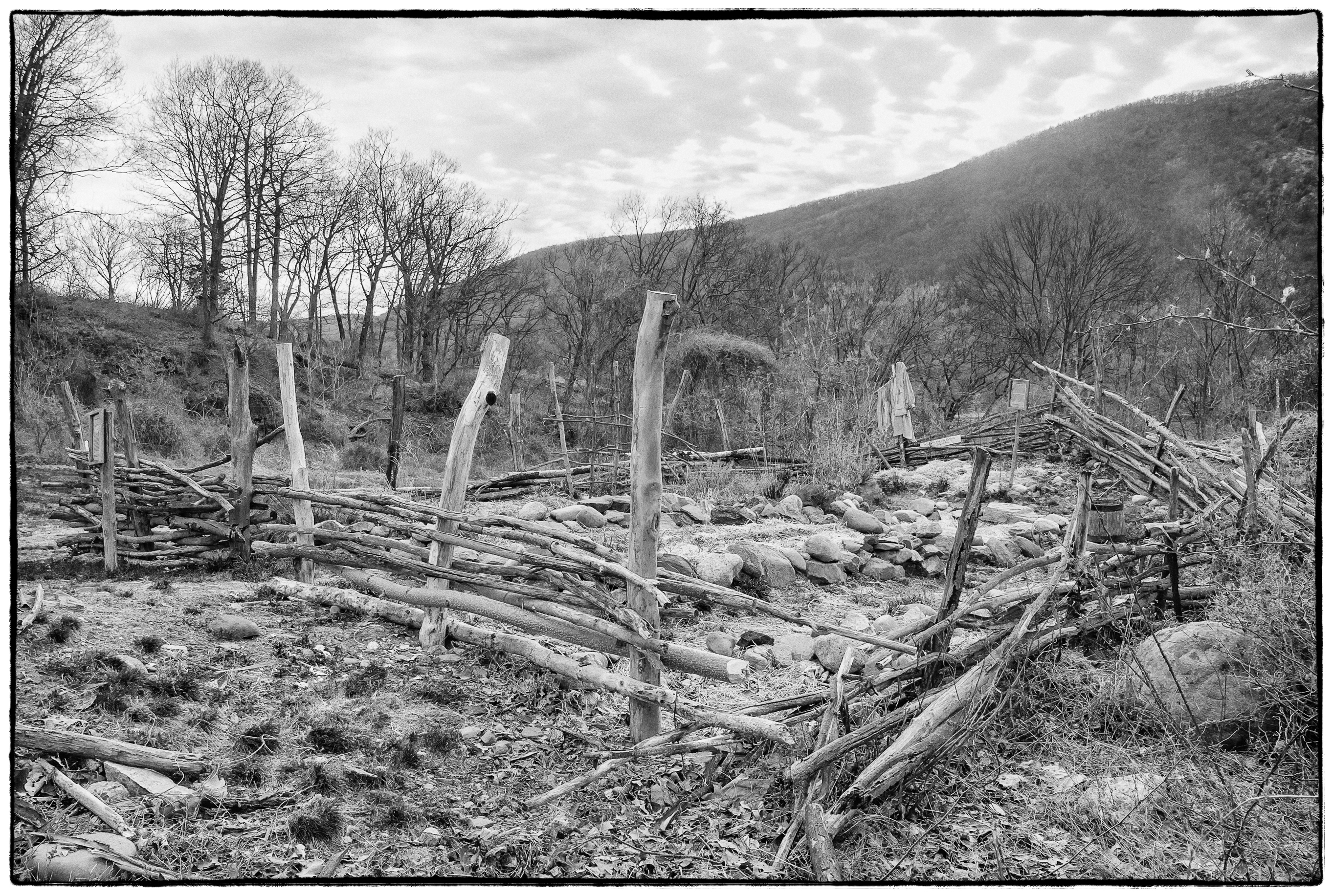
The raised beds you see in front of you are a recreation of an 18th century garden. Research has shown that the soldiers at Fort Montgomery had gardens to supplement their food supply. Although we do not know precisely what the soldiers were growing we can speculate on the types of crops they might have had, that were popular in the region during the period. Taking this into account, in this garden we have grown turnips, carrots, peas, lettuce, onions, squash and beans. Many of these crops were relatively easy to grow and preserved well during the cold winter months when vegetables were direly needed. To learn more about how vegetables were preserved before refrigeration, visit the root cellar exhibit in the history museum at Trailside Museum and Zoo (a short hike away!)

Fort Montgomery – Overview

According to the Fort Montgomery State Historic Site:

Fort Montgomery was the scene of a fierce Revolutionary War battle for control of the Hudson River. Visitors today can tour the remains of the 14-acre fortification, perched on a cliff overlooking the magnificent Hudson. On October 6, 1777, British, Loyalist and Hessian forces attacked Fort Montgomery and nearby Fort Clinton. The defending American Patriots, outnumbered 3 to 1, fought desperately until driven out of their forts at the points of the enemy bayonets. More than half of the Patriot forces were killed, wounded or captured.

Visitors can learn about this important military post at the site’s museum, which showcases original artifacts and weapons, large scale models of the fort and the attack, highly detailed mannequins frozen in poses of battle, and an action packed fifteen minute movie of the 1777 assault. Archeologists have revealed many of Fort Montgomery’s remains, including stone foundations of barracks, the gunpowder magazine and eroded redoubt walls. There is a spectacular view of the Hudson River from the Grand Battery, where reproduction cannon stand guard and are occasionally fired by the fort’s staff. The past comes alive at Fort Montgomery with living history demonstrations of artillery, musketry, music and camp life activities.

The fort is quite close to where I live. I’d been there briefly once before and my impression at that time was that there was little there of interest except a spectacular Hudson River view and a quite small visitor center/museum. Many years have elapsed since that visit so I don’t know if they have excavated more of the fort since then, or if I just missed significant parts of it (little is actually visible from the visitor’s center).

Apart from the visitor’s center there are two distinct areas. The first takes you along a meandering trail through what used to be the Fort. It took me close to an hour to make my way around, but bear in mind that I stopped a lot to read the informative signs (from which most of the descriptions in this series of posts are taken), take pictures and generally admire the view. The second trail takes you down a steep path to Popolopen Creek and the footbridge (a replacement for the pontoon bridge which existed at the time of the battle) which crosses it. There are some spectacular views of the Bear Mountain bridge from here. After crossing the bridge the trail ascends rapidly and steeply and eventually takes you up under the bridge from where you can get access to the Trailside Museums and Zoo at Bear Mountain State Park. At least you can get access if you arrive when the museums are open (10:00 am). Unfortunately, I arrived early and so couldn’t get in. From here you could retrace your steps, of as I did, make your way to Route 9W passing over the bridge over Popolopen Creek (with more spectacular views of the Hudson and the Bear Mountain bridge) and back to Fort Montgomery.

The view above was taken from where the main battery once stood. According to a nearby information board:

Fort Montgomery was built to prevent British ships from sailing up the Hudson River. The centerpiece of the forts river defenses was its Grand Battery of six 32-pounder cannons. One of the largest cannons of the Revolutionary War, a 32-pounder was a formidable piece of artillery with a range of well over a mile. The term 32-pounder refers to the weight of the gun’s cannonball. Each cannon weighed more than 6,000 lbs. Enemy ships sailing up the river would be exposed to these giant guns before they could return the fire.

The cannons sat on a platform of 2.5 to 3-inch thick planks. The large mound just in front of this sign is all that remains of the battery’s defensive wall. The wall was made by stacking bundles of sticks, called fascines, and filling the space between them with dirt. The guns fired through open spaces in the wall, called embrasures. The embrasures were covered with a thick layer of mortar to prevent the fascines from igniting when the cannons were fired.

I’m fond of useless trivia, and one such curious fact caught my attention with the regard to the battle at Fort Montgomery. The overall commander of the forts Montgomery and Clinton was Brigadier General George Clinton (Also Governor of New York from 1777 to 1795, and again from 1801 to 1804, and fourth Vice President of the United States from 1805 to 1812, under Presidents Thomas Jefferson and James Madison). He was also in command of Fort Montgomery. Fort Clinton was under the command of his brother, Brigadier General James Clinton. The opposing British forces were commanded by Sir Henry – you guessed it – Clinton. Way too many Clintons for a single battle.

A view from “The View” – Hudson River

I include this picture, not because it’s such a stunning photograph, but because of its subject. Living in the Hudson Valley I post a lot of pictures of the Hudson River, usually flowing through some idyllic rural setting. It’s easy to forget that the Hudson flows into the sea at New York City, where the view of it is quite different.

This is a view of the Hudson River, and New Jersey opposite.

Taken with a Sony RX-100 M3

A view from “The View” – Bank of America Tower

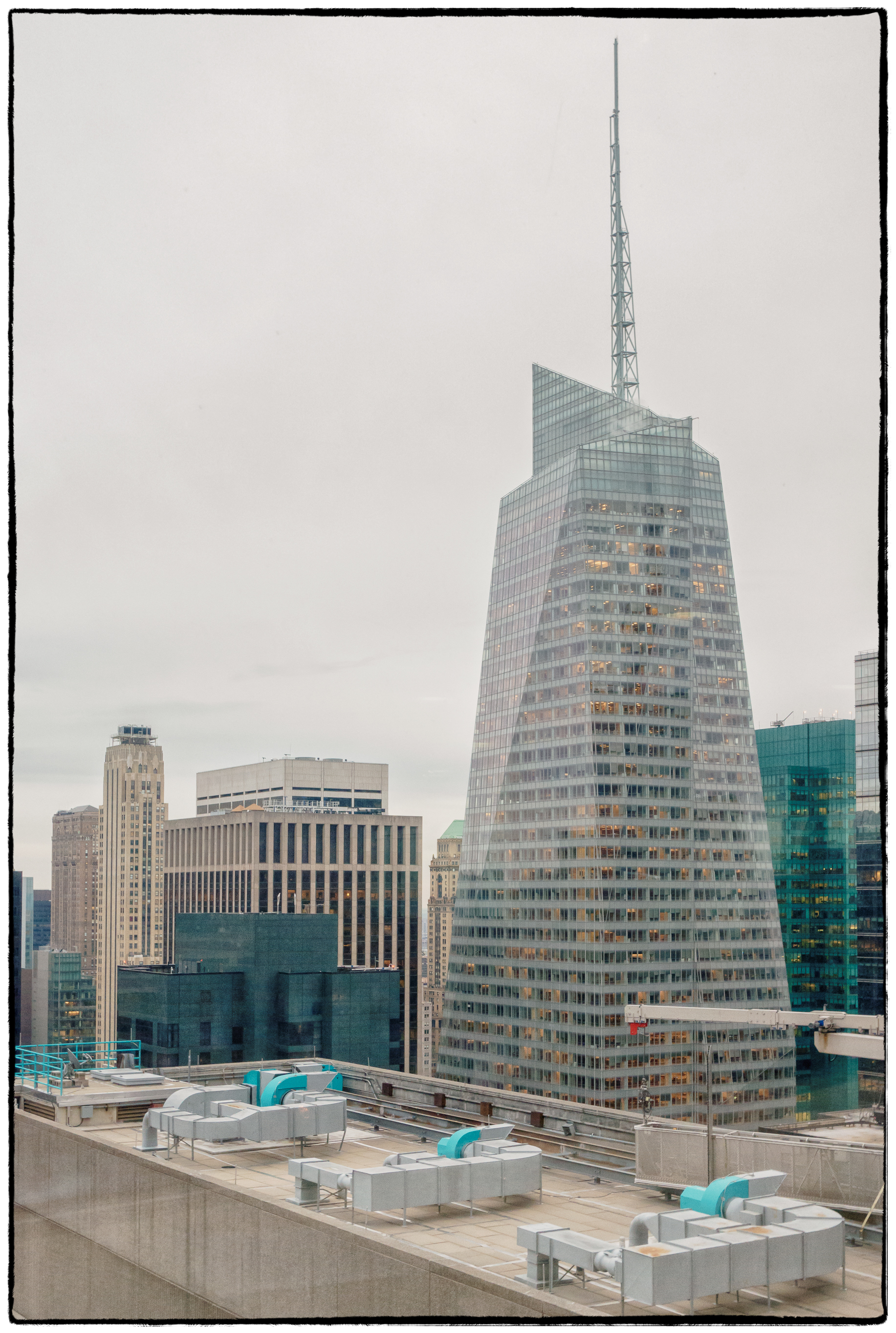
I’ve seen this spectacular building many times from street level, and have even photographed it. Seen from up high it looks completely different – especially since the other buildings obstruct the view and you can only see the upper part.

According to the The Skscraper Center:

The Bank of America Tower at One Bryant Park was designed to set a new standard in high-performance buildings, for both the office workers who occupy the tower and for a city and country that are awakening to the modern imperative of sustainability. Drawing on concepts of biophilia—or humans’ innate need for connection to the natural environment—the vision at the occupant scale was to create the highest quality modern workplace by emphasizing daylight, fresh air, and an intrinsic connection to the outdoors. At the urban scale, the tower addresses its local environment as well as the context of midtown Manhattan, to which it adds an expressive new silhouette on an already-iconic skyline.

The building responds to the dense urban context by weaving into the existing grid at street level, yet challenging the boundaries of public and private space with a highly transparent corner entry. As it rises, the tower shears into two offset halves, increasing the verticality of its proportions as well as the surface area exposed to daylight. Mass is sliced from these two rectilinear volumes, producing angular facets that open up light and oblique views beyond the typical limits of urban geometry. The crystalline form—inspired by the legacy of the 1853 Crystal Palace, which once stood adjacent in Bryant Park, and by a quartz crystal from the client’s collection—suggests an appropriate natural analogue, both organic and urban in nature. With its crisp, folded façade, the tower changes with the sun and sky; its southeast exposure, a deep double wall, orients the building in its full height toward Bryant Park, its namesake and the most intensively-used open space in the US.

With the Bank of America as its primary tenant, occupying six trading floors and 75% of its interior, the tower signals a significant shift in corporate America and in the real estate industry, acknowledging the higher value of healthy, productive workplaces. One Bryant Park’s most lasting achievement is to merge the ethics of the green building movement with a twenty-first century aesthetic of transparency and re-connection.

Bank of America Tower is the first commercial high-rise to earn LEED Platinum certification from the US Green Building Council. The building’s advanced technologies include a clean-burning, on-site, 5.0 MW cogeneration plant, which provides approximately 65% of the building’s annual electricity requirements and lowers daytime peak demand by 30%. A thermal storage system further helps reduce peak load on the city’s over-taxed electrical grid by producing ice at night, melted during the day to provide cooling. Nearly all of the 1.2m (4ft) of annual rain and snow that fall on the site is captured and re-used as gray water to flush toilets and supply the cooling towers. These strategies, along with waterless urinals and low-flow fixtures, save approximately 7.7 million gallons of potable water per year.

Recycling was a prominent factor throughout the building’s construction, with 91% of construction and demolition waste diverted from landfill. Materials include steel made from 75% (minimum) recycled content and concrete made from cement containing 45% recycled content (blast furnace slag). To protect indoor air quality as well as natural resources, interior materials are low-VOC, sustainably harvested, manufactured locally, and/or recycled wherever possible.

The building’s exceptionally high indoor environmental quality results from hospital-grade, 95% filtered air; abundant natural daylight and 2.9m (9.5ft) ceilings; an under-floor ventilation system with individually-controlled floor diffusers; round-the-clock air quality monitoring; and views through a clear, floor-to-ceiling glass curtain wall. This high-performance curtain wall minimizes solar heat gain through low-E glass and heat-reflecting ceramic frit; it also has allowed the Bank of America Tower to reduce artificial lighting with an automated daylight dimming system, reducing lighting and cooling energy by up to 10%.

On an urban level, the project also represents the culmination of the developer’s multigenerational efforts to revitalize the Times Square area, and gives back to the city with a street-level Urban Garden Room, a mid-block pedestrian passage/performance space, and the first “green” Broadway theater, the LEED Gold Stephen Sondheim Theater.

In an era of heightened security, a central challenge of the project was balancing the complexities of program and scale with high-performance architecture and urban design. In its layered connection to the ground plane, Bank of America Tower resolves this question with a progression of public and private spaces—from Bryant Park to the Urban Garden Room to the semi-public lobby. As a total response to the urban environment, the building’s restorative connections therefore work on many levels, from green roofs and views of the park to more subtle and expressive elements. A highly integrated approach to architecture and engineering ensured a close relationship between form and function. Bridging contexts as vastly different as Times Square and Bryant Park, the project makes a highly visible statement on urban stewardship and global citizenship for the 21st century

Taken with a Sony RX-100 M3.