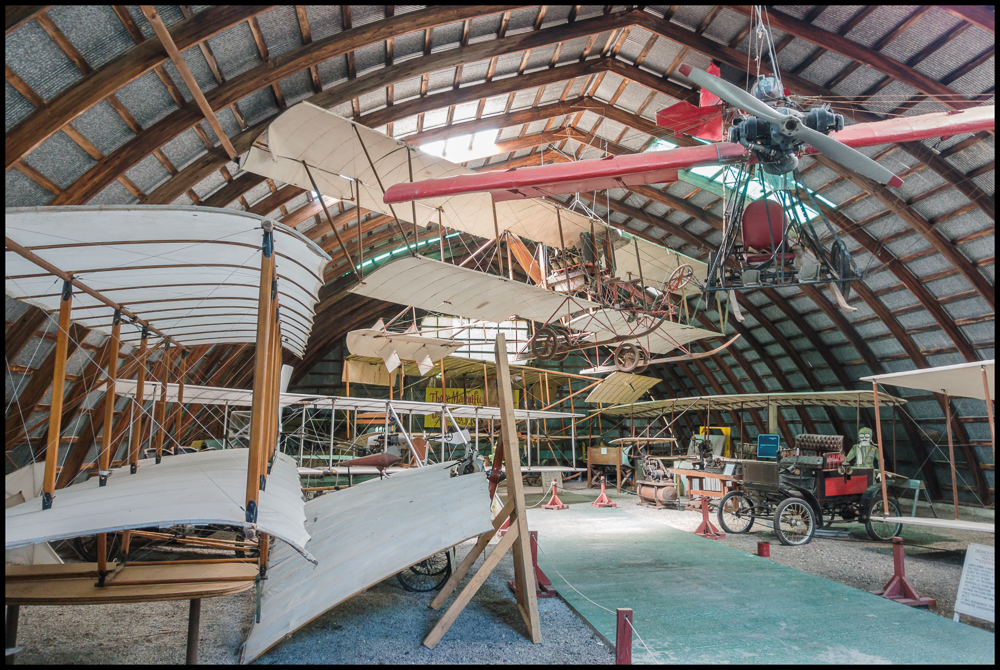
Old Rhinebeck Aerodrome – Pioneer Age Hangar. 1902 Wright Glider (Reproduction)

According to Wikipedia:

The 1902 Wright Glider was the third free-flight glider built by the brothers. This was their first glider to incorporate yaw control by use of a rear rudder, and its design led directly to the powered 1903 Wright Flyer.

The brothers designed the 1902 glider during the winter of 1901/02. The wing design was based on data from extensive tests of miniature airfoils in their homemade wind tunnel. They built the components of the glider in Dayton and completed assembly at their Kill Devil Hills camp in September 1902. Flights took place between 19 September and 24 October. In order to cope with 1901 glider discovered adverse yaw, the Wrights tested a double fixed rear rudder, hoping improve turning control, but several times the pilot was unable to stop turning and collided with the ground. “The addition of a fixed vertical vane in the rear increased the trouble, and made the machine absolutely dangerous”. The brothers decided to remove one rudder, without success, then make the remaining rudder steerable to solve the problem. With this modification, they achieved a better control and made between 700 and 800 glides (as estimated by the brothers, who did not keep detailed records). The longest glide was measured and timed at 622.5 ft (189.7 m) in 26 seconds.

In September 1903 they brought the 1902 glider out of storage and made over 200 glides to hone their piloting skills while preparing the powered Flyer. One of their photographs shows they installed a second vertical fin as part of the steerable rear rudder, matching the original design and also that of the powered Flyer’s twin rear rudder. The glider was last flown in November 1903. After their successful powered flights, they put the glider back in storage at camp before returning home for Christmas. When they next visited Kitty Hawk in 1908 to test their improved Flyer III, Outer Banks weather had taken its toll: the storage shed and glider inside were wrecked.

Today a salvaged piece of wingtip from the 1902 Glider is preserved at the National Air and Space Museum a few feet from the 1903 Wright Flyer.

Taken with a Sony RX-100 M3.
Old Rhinebeck Aerodrome – Main Hangar. American Eagle A-129

According to Revolvy:

The American Eagle A-129 was a 1920s biplane built in the U.S.A.

Design and development
The preceding American Eagle A-101 of 1926 had achieved some success, but its fierce spin characteristics had resulted in several crashes during training flights. Giuseppe Bellanca redesigned the biplane with a longer fuselage and narrower cowling to accommodate the five-cylinder Kinner K-5 100 h.p. radial engine, which had its cylinder heads exposed. To mark the year of its first appearance, the designation A-129 was applied.

Operational history
Initially designed to replace the Porterfield Flying Schools A-101s, the new biplane proved to have good flying characteristics and more than 400 were built. The aircraft were also flown by “barnstormers” and sportsmen pilots.

Several A-129s remain airworthy and examples are preserved at the Rhinebeck Aerodrome Museum at Old Rhinebeck in New York state and in the Kansas Aviation Museum Wichita, Kansas.

Variants
A range of engines was fitted to the A-129 without changing the type designation. They included the 90 h.p. Curtiss OX-5 and others up to the 200 h.p. Wright J-4.

Taken with a Sony RX-100 M3.

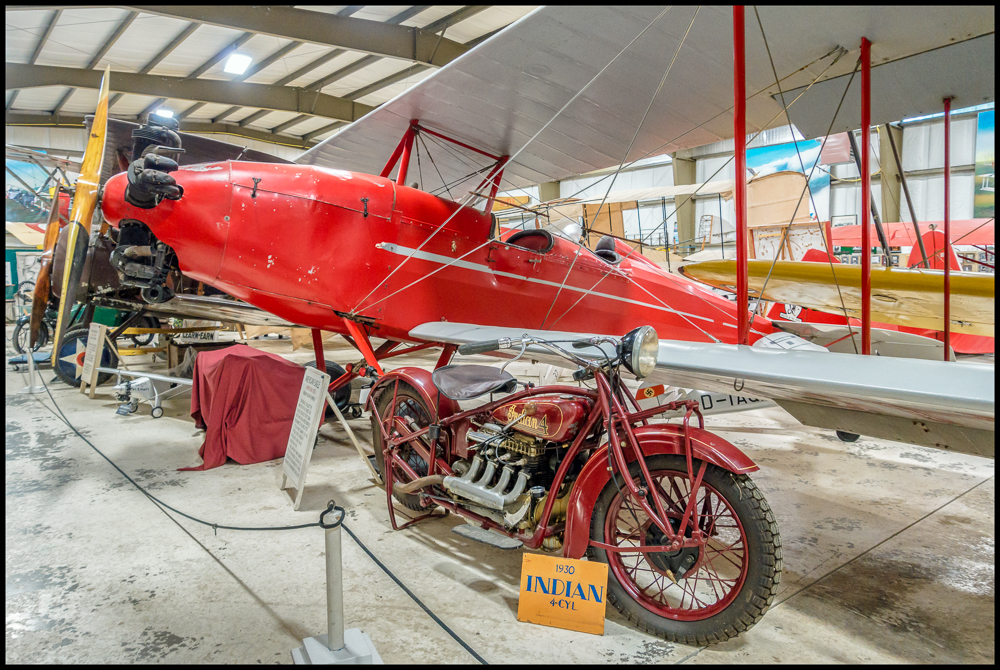
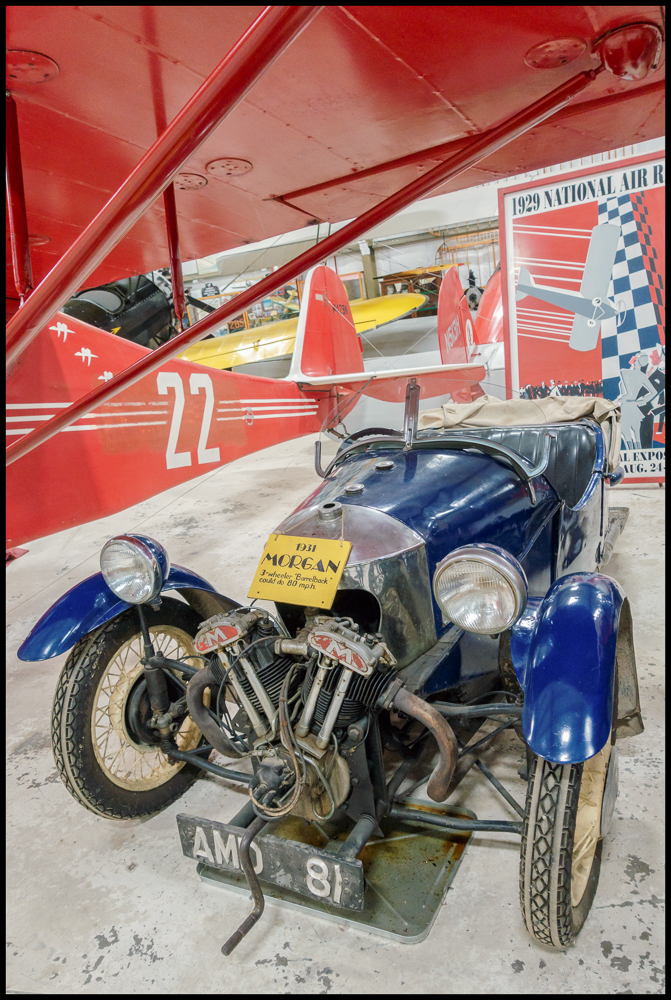
Old Rhinebeck Aerodrome – Main Hangar. 1931 Morgan

According to Conceptcarz

1931 Morgan Aero Super Sport

More than a motorcycle and not quite a car, the Morgan is the best known and the finest of the British 3-wheelers. Morgan’s were popular during the 1930’s in Britain due to a tax advantage that allowed three-wheeled car to be registered as a motorcycle. Low and purposeful, the Morgan Super Sports J.A.P. engine is slung aggressively in front of a beautifully rounded radiator with its single rear wheel almost concealed.

H.F.S. Morgan, founder of the Morgan Motor Company LTD, completed his first 3-wheeler in 1909. The factory continues to produce cars and the waiting period for a new Morgan can be as long as 6 years. The new cars are not three-wheelers, however, as the tax advantage has been significantly reduced, and production of the Super Sports ended in 1952. The hand built cars retain features found on the original 1909 model, such as their famous ‘sliding pillar’ front suspension and ash wood sub-frames as in this model.

Still favored by vintage racers today, the Morgan Super Sports was much raced in its day. The John Alfred Prestwich (JAP) engine was a favorite of motorcyclists and was used in many fine bikes including the Brough Superiors. In 1930 Mrs. Gwenda Stewert of France drove a similar Morgan Super Sports at a record speed of 115.66 mph, an astonishing and probably terrifying feat.

Taken with a Sony RX-100 M3.

Old Rhinebeck Aerodrome – Main Hangar. Excelsior Motorcycle.

According to the Old Rhinebeck Aerodrome web site:

Excelsior Motorbike (1913)

Chicago, Illinois U.S.A. The Excelsior Supply and Manufacturing Company was the biggest factory to produce Excelsior motorcycles and was part of the well-known Schwinn Bicycle Company. Excelsiors were produced in the U.S.A. from 1908 through 1931 when Ignaz Schwinn decided to discontinue manufacture of motorcylces. This motorcycle was donated by Paul Richards of Poughkeepsie, New York.

Taken with a Sony RX-100 M3.