Around the neighborhood – Old Croton Aqueduct Trail

I mentioned in the preceding post that the old building featured there was directly opposite the Old Croton Aqueduct Trail. So at this point on my walk I decided to turn onto the trail.

The Aqueduct was built in response to the fires and epidemics that repeatedly devastated New York City, owing in part to its inadequate water supply and contaminated wells.

Major David B. Douglass, the project’s first chief engineer, planned the route and structures and established the project’s hydraulic principles. He was succeeded in 1836 by John B. Jervis, who achieved the final design of the Aqueduct and its major structures and led the complex construction effort. Work began in 1837, carried out largely by Irish immigrant labor.
For most of its length, the Aqueduct is a horseshoe-shaped brick tunnel 8.5 feet high by 7.5 feet wide, set on a stone foundation and protected with an earthen cover and stone facing at embankment walls. Designed on principles dating from Roman times, the gravity-fed tube, dropping gently 13 inches per mile, challenged its builders to maintain this steady gradient through a varied terrain.
To do so the Aqueduct was cut into hillsides, set level on the ground, tunneled through rock, and carried over valleys and streams on massive stone and earth embankments and – at Sing Sing Kill, the Nepperhan (Saw Mill) River, and the Harlem River – across arched bridges. Typically it is partly buried, with a telltale mound encasing it. As one learns to read the “clues.” an understanding of how the tunnel engages the landscape deepens the trail experience.

Croton water first entered the Aqueduct at 5 am on June 22, 1842 (followed by a dauntless crew in a small boat, the Croton Maid) and emerged at the Harlem River 22 hours later. The water eventually filled two above-ground reservoirs – on the present sites of the Great Lawn in Central Park and the New York Public Library on Fifth Avenue – to great civic rejoicing.

The trail is virtually as old as the Aqueduct. It was created for reasons of security – to prevent local opponents of this massive, intrusive construction from attempting to sabotage the water supply – and to facilitate workers’ access to the water conduit. It was not for intended for recreational purposes, though it quickly started being used that way.

During the active days of the Aqueduct, overseers in charge of patrolling and maintaining specific sections of this infrastructure vital to New York City were provided with houses on or near the section of the tunnel for which they were responsible.

The only one of these houses that survives in its original location is the classic, brick Italianate-designed structure on the trail at Walnut Street in Dobbs Ferry. The Keeper’s House was built in 1857, and was the home of James Bremner, the principal superintendent of the Aqueduct, north of New York City. The house is a contributing feature of the aqueduct trail, which was designated a National Historic Landmark in 1992.

Until 1955 the Old Croton Aqueduct brought water to New York City. (The northernmost portion reopened in 1987 and continues to supply water to the town of Ossining.) Though the Aqueduct was built to meet the city’s needs for 100 years, the supply was soon insufficient due to the spiraling population growth to which it contributed. The New Croton Aqueduct, triple the size and much deeper underground, lies a few miles to the east. Built under Chief Engineer B. S. Church, it began service in 1890 and remains in service today. It has no walking trail.
In 1968, New York State purchased from the city the land and structures that constituted the Weschester County section of the Old Croton Aqueduct, between Croton Gorge Park and the Yonkers-New York City line. This 26.2-mile portion of the total 41-mile Aqueduct route became the Old Croton Aqueduct State Historic Park, a recreational and cultural resource that appeals to a wide range of visitors. Tree-lined and grassy, traversing local villages and varied landscapes, the trail offers the pleasures of nature and glimpses of historic and architectural treasures along the way. Twenty-two miles are a designated part of the Hudson River Valley Greenway Trail, and sections are being incorporated into Westchester County’s RiverWalk.

While the state park designation ends at the New York City line, the Aqueduct continues for four or five miles through the Bronx. There its green corridor, managed by New York Parks & Recreation, follows a southward route through Van Cortlandt Park, past the east edge of Jerome Park Reservoir and along Aqueduct and University avenues to the famed High Bridge, which carried water in iron pipes cross the Harlem River to Manhattan to serve a growing population (Friends of the Old Croton Aqueduct)

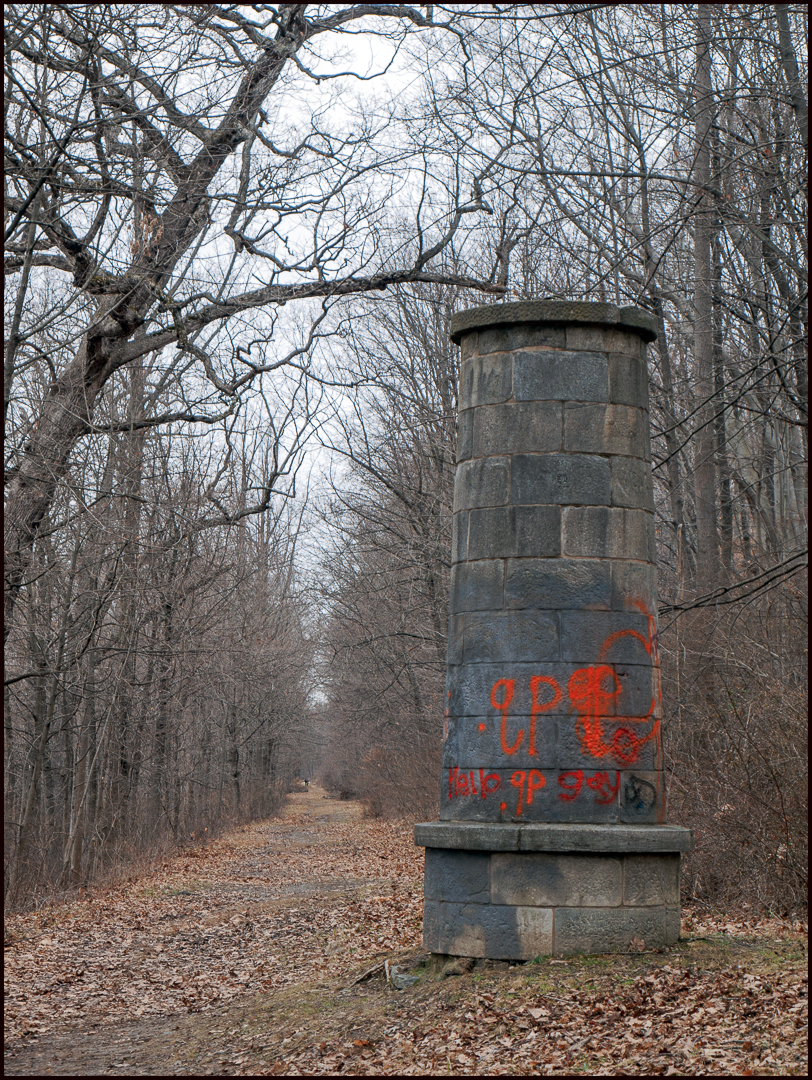
The picture above shows the trail and one of the ventilators. Unfortunately, as with most of old buildings in the area its covered in graffiti.

Taken with a Panasonic Lumix GF-1 and Lumix G Vario 45-150mm f4-5.6
Around the neighborhood – Old building on Scarborough Road

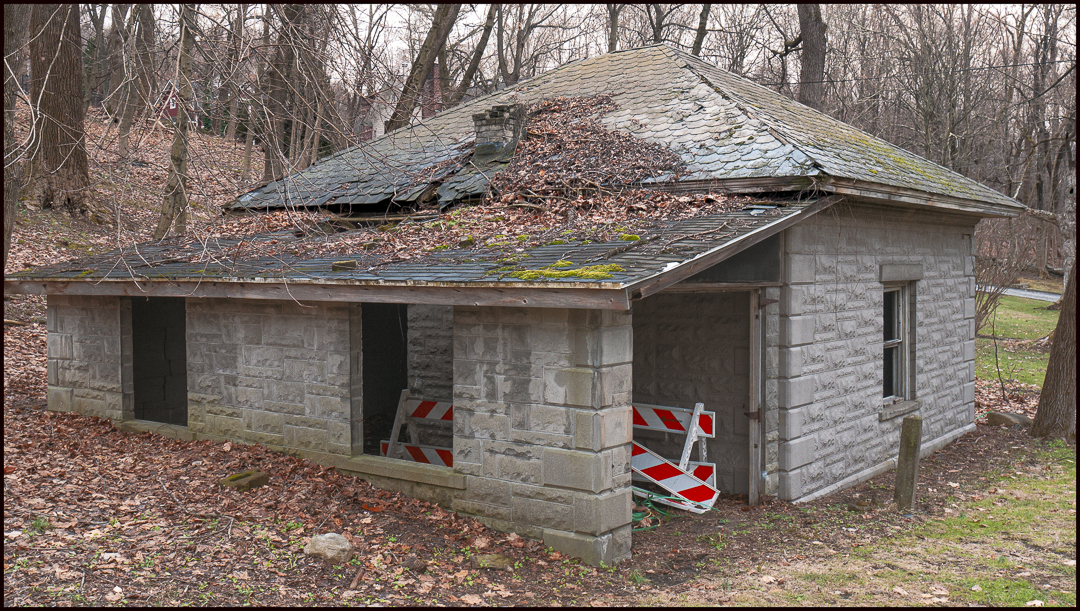
This building stands on Scarborough Road right where it intersects with the Old Croton Aqueduct. It’s seems to be used for storage by the town Department of Public Works. I don’t know if this was its original purpose. As you can see it’s not in the best of shape.

Taken with a Panasonic Lumix GF-1 and Lumix G Vario 45-150mm f4-5.6
Around the neighborhood – Ashridge

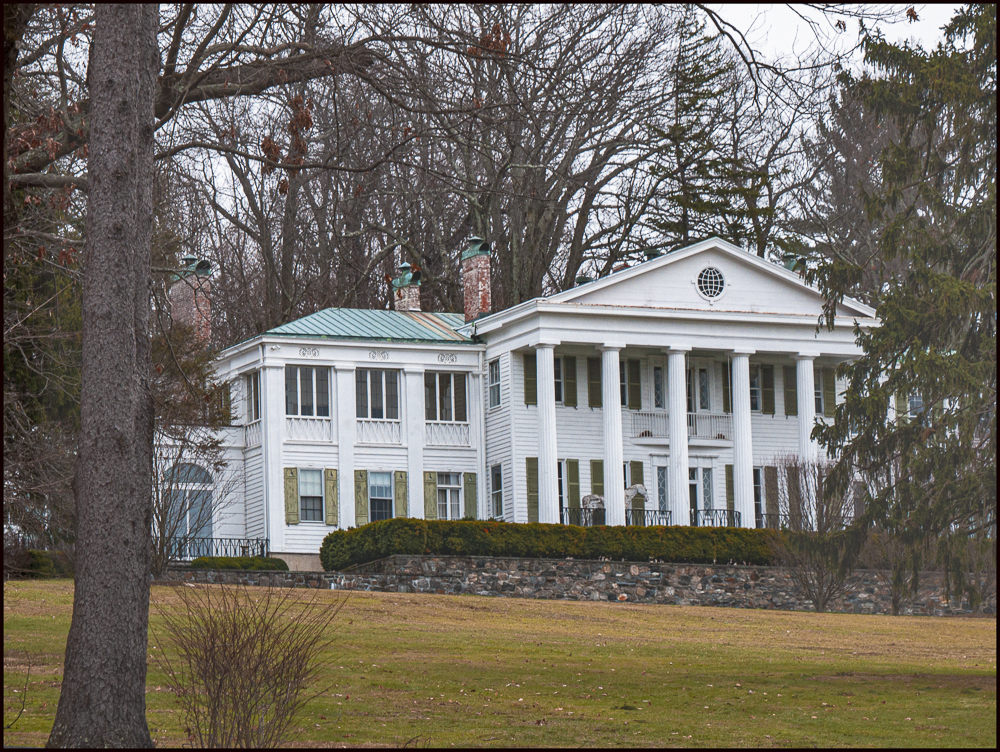
One of the many well-known people who have called Briarcliff Manor home is Flora Ettlinger Whiting. Flora was a pioneer in collecting American antique furniture and decorative arts. Much like Henry DuPont at his “Winterthur” estate in Delaware, Flora Whiting at the “Ashridge” estate in Briarcliff Manor filled it with the prized specimens of this aesthetic of American design.

Flora was born in 1878, the daughter of printing magnate, Louis E. Ettlinger, the director of Cromwell Publishing Company which published Collier’s Weekly and Woman’s Home Companion, and later as Cromwell-Collier published such authors as Martha G. Gellhorn, F. Scott Fitzgerald and Arthur Schlesinger Jr. Flora began collecting antiques with her father’s encouragement at the age of nine and continued for 84 years. Her first purchase was a set of New England Queen Anne and Chippendale candle stands. She began collecting American lusterware and china, and moved on to hooked rugs, silver, furniture, lighting devices, fireplace equipment, pewter, paintings and quilts.(2) She had an eye for antiques with aesthetic appeal. Her friend, Joseph T. Butler, curator of Hudson Valley Restoration, now Historic Hudson Valley, said “She would always spot the best thing in the shop instantly.”

Always on the lookout for a bargain, she preferred to find items for her collection in the Hudson Valley rather than the galleries and shops in Manhattan. Again, according to Joseph Butler, “ nothing pleased her more than going into Ossining, to Mitch Grossman’s on Spring Street, to see if she could find a bargain” Although she considered herself an accumulator and not a collector, she counted collectors like Henry DuPont, John D. Rockefeller and Mabel Brady Gavin as friends. Flora was also a founding member of the Friends of the American Wing of the Metropolitan Museum of Art which houses much of her collection today. She helped organize the 1929 Girl Scouts Loan Exhibition along with the wives of Grover Cleveland, Theodore Roosevelt, William Taft, Calvin Coolidge and Woodrow Wilson. This exhibition is regarded as the first serious exhibition of American antiques and the “opening shot in the race to collect American antiques”. This exhibition is regarded as the first serious exhibition of American antiques and the “opening shot in the race to collect American antiques”.

Flora married Giles Whiting, an architect and President of the Persian Rug Manufacturing Company on May 18th, 1899. In 1910 Giles and Flora Whiting purchased a mansion named Ashridge on Scarborough Road in Briarcliff Manor as a suitable place to house her growing collection of antiques. The house had been built in 1825 by George Swords on the Albany Post Road, now Route 9, near the present site of the pool and tennis courts at Sleepy Hollow Country Club. In 1862 it was disassembled and moved to its present location by its second owner C. C. North, who also enlarged it and named it Ashridge. The Whitings also purchased a nearby house to serve as a guest house which they named “The Cottage”. Today this house, no longer part of the estate, is called “Hoover Cottage” because it was used by President Herbert Hoover every Labor Day weekend for many years.

Flora’s collection or “accumulation” of American antiques continued to grow filling Ashridge, The Cottage, and the Whiting’s apartment on Park Ave. According to Joseph Vech Noble, former director of the Museum of the City of New York, “All three homes were crammed with things, especially the attics and basements.” Pieces from her collection appeared in magazines, books and in exhibits at Ophir Hall and the Museum of City of New York.

Flora died in 1971. Her collection which was valued at $20 – $25 million was auctioned at Parke-Bernet Galleries in over the period of two weeks. The majority of the proceeds from the sale went to The Girls Clubs of America of which Flora was a founder. Among the major purchasers, were the Museum of the City of New York, The Metropolitan of Art, Hudson Valley Restorations (Historic Hudson Valley), and the Yale University Art Gallery. Her home in Briarcliff, Ashridge, continues to be a private residence as does the guest house, Hoover Cottage. (Briarcliff Manor-Scarborough Historical Society)

More recently Ashridge was used briefly as a location in the 2007 movie, American Gangster starring Denzel Washington and Russell Crowe. If memory serves the Washington character buys the house for his mother.

Taken with a Panasonic Lumix GF-1 and Lumix G Vario 45-150mm f4-5.6