Watching Alec Soth

Alec Soth is a well known photographer. According to his Magnum profile:

Alec Soth’s work is rooted in the American photographic tradition that Walker Evans famously termed “documentary Style.” Concerned with the mythologies and oddities that proliferate America’s disconnected communities, Soth has an instinct for the relationship between narrative and metaphor. His clarity of voice has drawn many comparisons to literature, but he believes photography to be more fragmented; “It’s more like poetry than writing a novel.”

Aside from his many critically acclaimed personal projects, selected clients include The New York Times Magazine, The New Yorker, W Magazine, Vogue, GQ, Wall Street Journal Magazine.

Much of Soth’s work is tied to an interest in the photobook and in 2008, he started his own publishing company, Little Brown Mushroom. His major series have all become critically acclaimed monographs; the first Sleeping by the Mississippi (Note I have a copy of this one), was published by Steidl in 2004, NIAGARA (Steidl, 2006), Broken Manual (Steidl, 2010), Songbook (MACK, 2015), I Know How Furiously Your Heart Is Beating (MACK, 2019).

Soth has received fellowships from the Guggenheim, McKnight, Bush, and Jerome Foundations and was the recipient of the 2003 Santa Fe Prize for Photography. His photographs are represented in major public and private collections, including the Museum of Modern Art, the Museum of Fine Arts, Houston, and the National Gallery of Art. His work has been featured in numerous solo and group exhibitions, including the 2004 Whitney Biennial and career surveys by Jeu de Paume (2008), Walker Art Center (2010) and Media Space (2015).

Soth, who is based in Minneapolis, Minnesota, is represented by the Sean Kelly Gallery in New York, Fraenkel Gallery in San Francisco and the Weinstein Hammons Gallery in Minneapolis.

He became a nominee of Magnum Photos in 2004 and a full member in 2008.

As mentioned above Soth (rhymes with Both) loves photobooks and has a massive collection. About a year ago he started a YouTube Channel where he discusses photobooks in general and uses photobooks from his collection as examples. I find the videos to be absolutely fascinating, and I like Soth himself – he seems to be a very genuine person.

His most recent photobook is “A Pound of Pictures“.

Passing Bannerman’s Island

Passing Bannerman’s Island on my way up to Beacon, NY. Bannerman’s castle – now in ruins – on Pollepel (also known as Bannerman’s) Island in the middle of the Hudson River, just north of Cold Spring. Looks impressive, but was never more than a very fancy military surplus warehouse (although a smaller structure was used as a residence).

It’s quite hard to get close enough to take a picture. The Metro North train lines get in the way. This picture was taken from a metro north train. There is an overlook, but it’s quite hard to find and even when you do (as I did) the views are not particularly good. You get the best pictures from a boat, which unfortunately I don’t possess. There are, however, tours to the island leaving from the Beacon Waterfront, right next to the Beacon Metro North Station. It’s about a 25 minute boat ride. Although there’s not a lot to see on the island, what there is is interesting and you won’t find anything like it anywhere else in the lower Hudson valley.

According to “Scots and Scots Descendant in America. D. MacDougall. New York, April 10, 1917. Part V – Biographies“:

FRANCIS BANNERMAN, the noted merchant and authority on war weapons, is the sixth Frank from the first Frank Bannerman, standard-bearer of the Glencoe MacDonalds, who escaped the massacre of 1692 by sailing to the Irish coast. His descendants remained in Antrim for 150 years, intermarrying with Scottish settlers. In 1845, Mr. Bannerman’s father removed to Dundee, Scotland, where Francis VI was born, March 24, 1851. He came with his parents to the United States in 1854 and has resided in Brooklyn since 1856. The eldest son in each generation is always named Frank. The surname originated at Bannockburn, where an ancestor rescued the clan pennant, whereupon Bruce cut off the streamer from the Royal ensign and conferred upon him the honour of “bannerman.”

Young Francis left school at ten, when in 1861 his father went to the war. He secured employment in a lawyer’s office at two dollars a week, each morning, before going to the law-office, supplying with newspapers the officers of the warships anchored off the Brooklyn Navy Yard, near his home. Summer evenings, after work hours, he dragged the river with a grapple for bits of chain and rope, which he sold to junkmen. When his father returned disabled, he became a dealer in the material the boy collected, with a storehouse at 18 Little Street, also attending the Navy auctions, and later established a ship-chandlery business at 14 Atlantic Avenue. Frank went back to school for a time and won the scholarship for Cornell University, but could not accept owing to his father’s war disability requiring his assistance in carrying on the business.

In 1872 Francis began business for himself, attending army auctions and, noting the destruction of useful and historic war weapons for old metal, began buying them and sending out an illustrated catalog to collectors. He also supplied frontiersmen with fowling-pieces made over from the old army rifles, which he also altered into Quaker guns for boys’ brigades and military schools. The Assistant Chief of Ordnance stated that “Bannerman has done so much good toward training the youth of America with his Quaker drill guns that the United States could well afford to pay him a bounty on each gun made.” He opened stores in New York City first at 118 Broad Street, then 27 Front Street, and finally, in 1897, at 579 Broadway, where he fitted out many regiments for the Spanish-American War. After the war, he purchased from the United States Government over 90 per cent. of the captured war material, and bought historic Polopel Island, in the Hudson Highlands opposite Cornwall, known to the public as Bannerman’s Island, and erected large arsenals patterned after the Scottish baronial castles. This beautiful island, 13 acres in extent, he also makes his summer home. In 1905, he bought 501 Broadway from the trustees of the Metropolitan Museum, who greatly “reduced the price in recognition of his maintenance of a Free Public War Museum.” The building has seven floors, 40,000 square feet, devoted to museum and salesroom. The collection contains ancient and modern weapons from every country covering hundreds of years. All his goods are sold on Government auction sale terms – cash with order. Even the Standard Oil Company in purchasing had to send check with order.

Mr. Bannerman is not only the largest dealer in the world, but is the acknowledged founder of the military goods business and the foremost authority on military supplies. His illustrated catalog, of more than 400 pages, is known to collectors as the best book on the subject. At the request of the Government, he has in preparation a History of War Weapons. He originated the “sealed bid” plan of selling obsolete Government stores. His goods go all over the world. A large number of transactions have been with Central and South American countries; but he has consistently refused to sell to revolutionists, or to minors or irresponsible persons – he recently cancelled a large order, and refunded the money, when he discovered it was from revolutionists. His stock and facilities are so extensive that he once converted a large ocean steamer into a warship and delivered it in one week. At the outbreak of the European War, in 1914, in seven weeks he supplied the French Army with 8,000 saddles, and as a loyal Scot, donated thousands of rifles, cartridges, etc., to the British Army.
While on a business trip to Europe in 1872, he visited his grand- mother in Ulster. There he met Helen Boyce, of Huguenot-Scotch-Irish descent, to whom he was married, June 8, 1872, in Ballymena, by Rev. Frederick Buick who had married his father. They have three sons: Frank VII, David Boyce, and Walter Bruce; one daughter died in infancy. The two eldest sons are in business with their father. Walter Bruce is a physician in Bridgewater, Mass.

Mr. Bannerman is a most genial and energetic man. Notwithstanding his busy life, he is active in philanthropic and Christian work. He is a great lover of boys, and in connection with boys club church work for years has devoted one evening in the week to studying with them the Sunday-School lesson. He is a member of the St. Andrew’s and many other societies, and was an organizer and one of the first trustees of the Caledonian Hospital.

Taken with a Sony A7IV and Samyang 45mm f1.8

Happy Independence day 2022

On July 4 I was invited by some friends to go with them to a fireworks display. It seems that every year the Sleepy Hollow Country Club puts on a display and you can go down to the parking lot of a church on Route 9 (about a five minute drive) and watch it from there. I almost declined thinking that once you’ve seen one fireworks display you’ve seen them all. But I decided to go and I’m glad I did. I was right in that the display itself was just like all the others I’ve seen. What was different was the perspective from which I saw it. Usually the fireworks are set off a long way from where you’re watching and I’m sure that was the case here too – if you were watching from the Country Club. However, from where we we sitting they were being set off right next to us. It seemed like they were bursting right over our heads. Very impressive if a little scary, and I imagine not all that safe.

Note: Since I wasn’t expecting to take any pictures I didn’t take a camera with me (who was it who in answer to the question “What’s the best camera” replied “The one you have with you”. The picture above was taken July 2017 at a fireworks display by the Hudson River in Ossining, NY (for more pictures see: Independence Day 2017 Fireworks on the Ossining Waterfront).

Taken with a Sony A500 and Tamron A18 AF 18-250mm f3.5-6.3

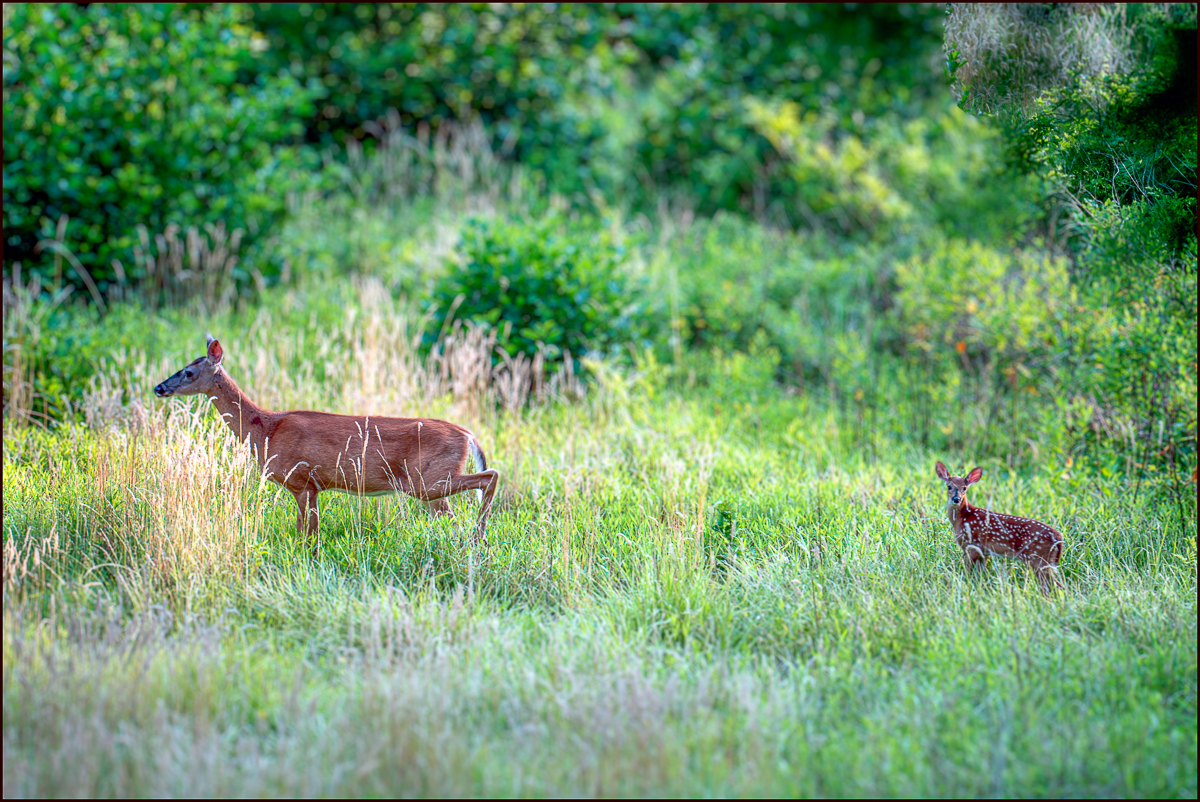
Deer and Fawns

It’s funny how things happen. I was talking to my grandson, Alexander and he mentioned how, during a previous visit some years ago he’d been impressed by the number of deer he’d seen in close proximity to the house. We were talking about my photography and I told him that I’d rather lost interest in deer as I see so many of them.

Fast forward to this evening. As is my habit I was sitting on the balcony outside my bedroom reading when I noticed some movement in the meadow. I took a quick look. Just another deer I thought and turned back to my book. However, this time was a little different. The deer was accompanied by two adorable little fawns.


Deer and one of the fawns


One of the fawns. Aren’t they cute? I could almost forgive the deer for eating all my plants.


I little later this one appeared. I don’t know if it’s the same one as before. It was alone (i.e. not accompanied by any fawns) so either it had left the fawns somewhere safe or it was a different deer entirely.


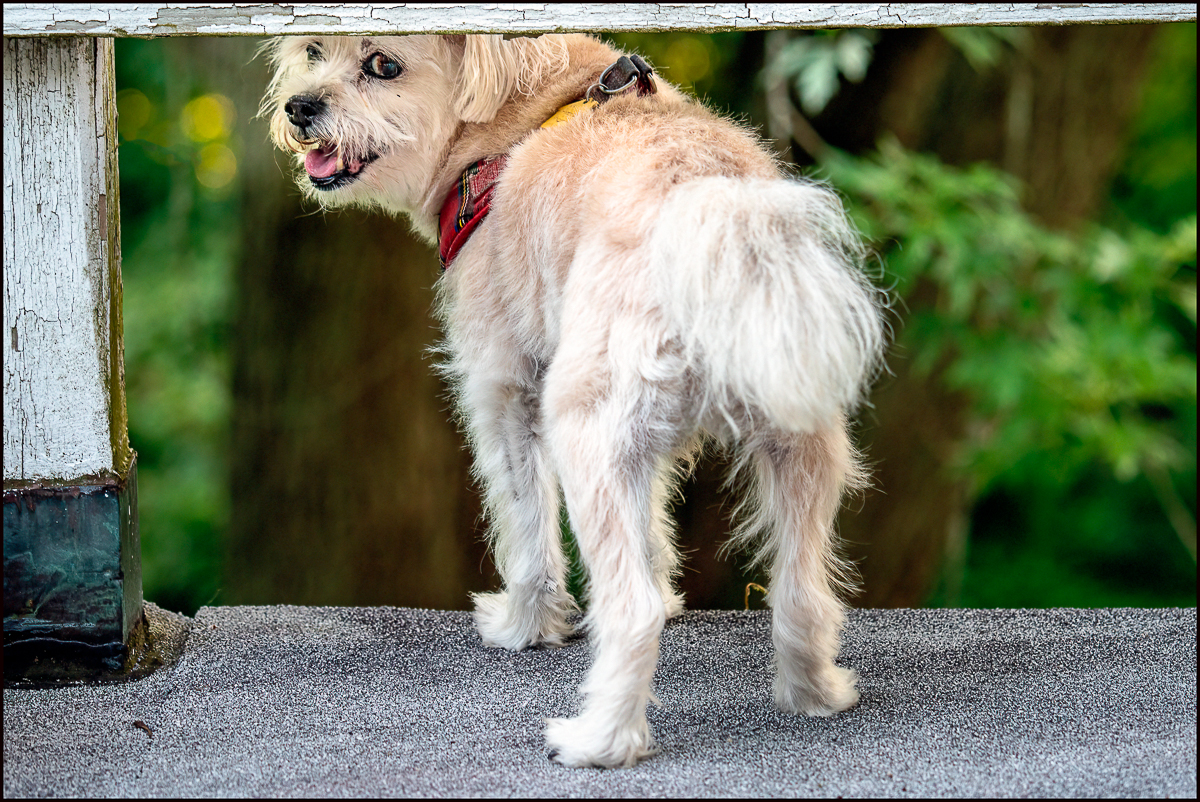
My dog, Harley is usually indifferent to other animals. Other dogs, chipmunks, squirrels, rabbits, skunks…he couldn’t care less. But the deer are his mortal enemies and he loves to bark at them, which he did a lot on this occasion. Can you tell from the glint in his eye that he’s having a great time barking at them?


This is of course the new look Harley. He finally had his grooming. He’s usually quite placid when he’s being groomed. However, this time the groomer said that it seemed that he really didn’t want to be there and was wriggling a lot. Of course this might have just been a ploy to suggest that he had to work harder and thus get a bigger tip. Who knows? He looks a lot better. He has nice eyes and before he was groomed I couldn’t even see them. This is how he looked towards the end of May.. It only got worse since then. I’m sure that he’ll do better now in the heat of a New York summer.

Taken with a Sony A7IV and Sigma 150-600mm f/5-6.3 DG DN OS Sports Lens

In Manhattan. Two hippos and a rhinoceros

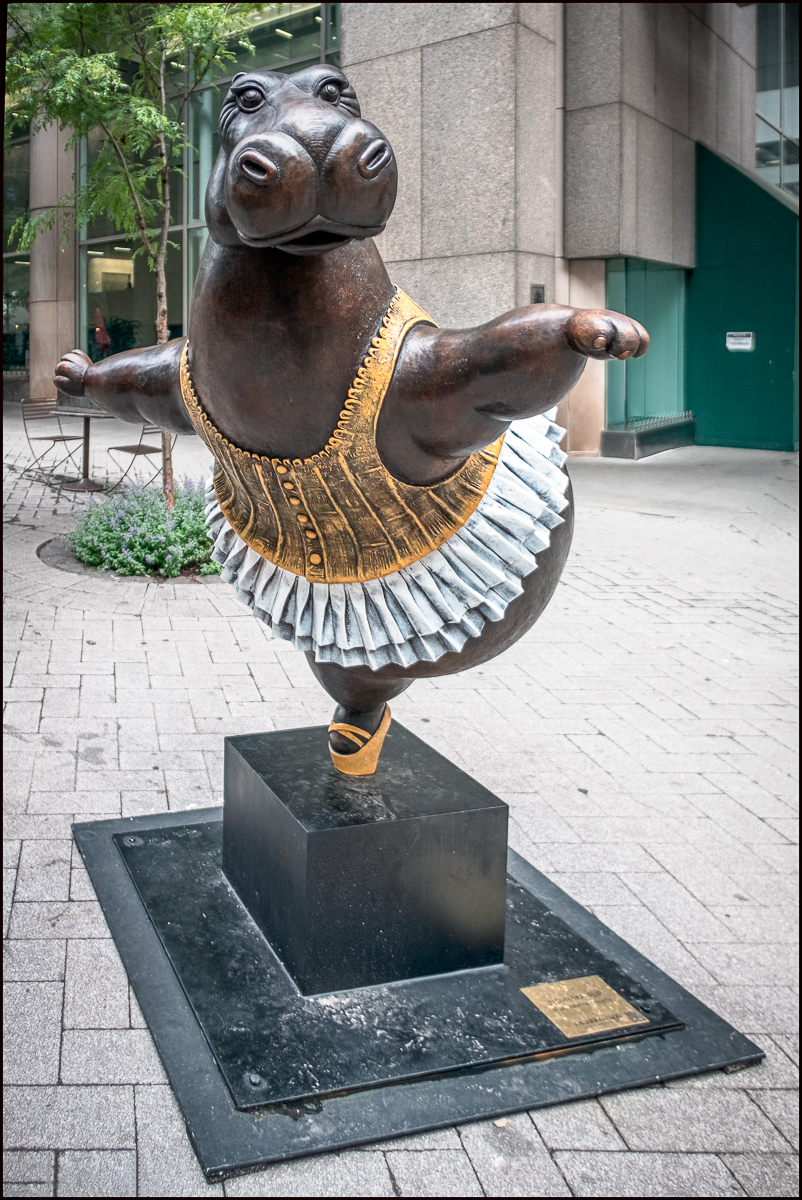
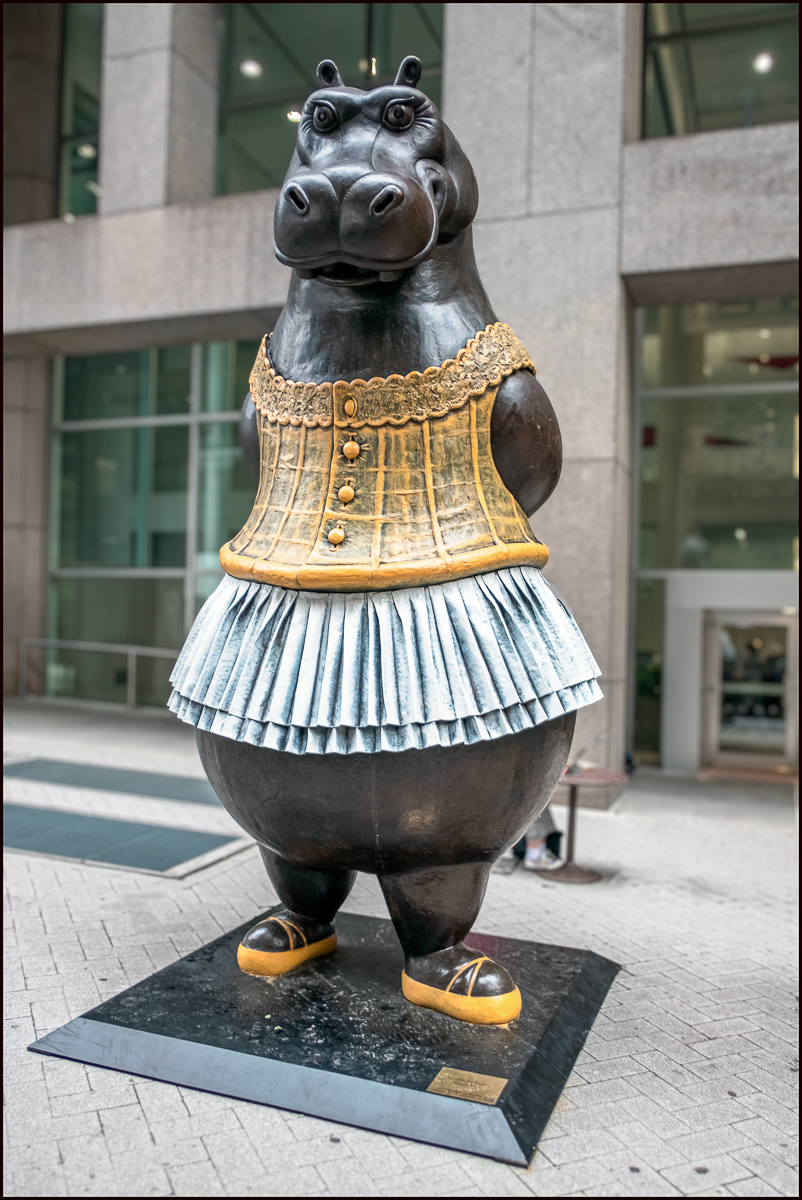
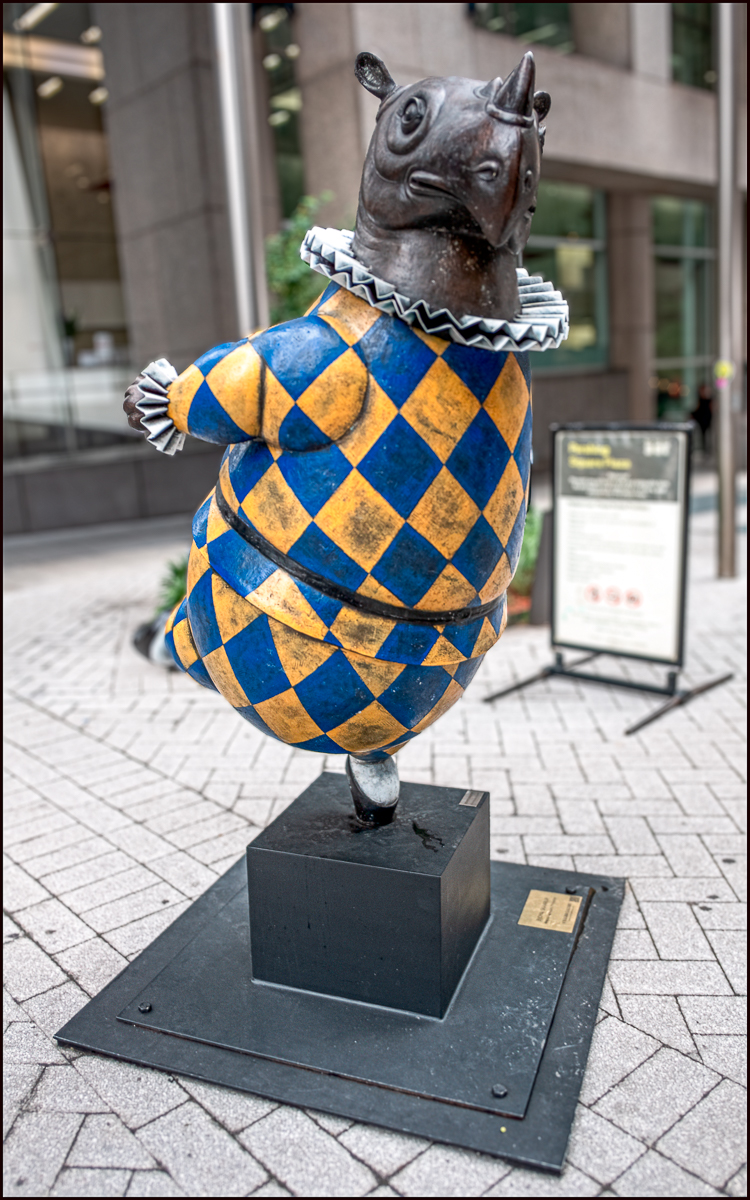
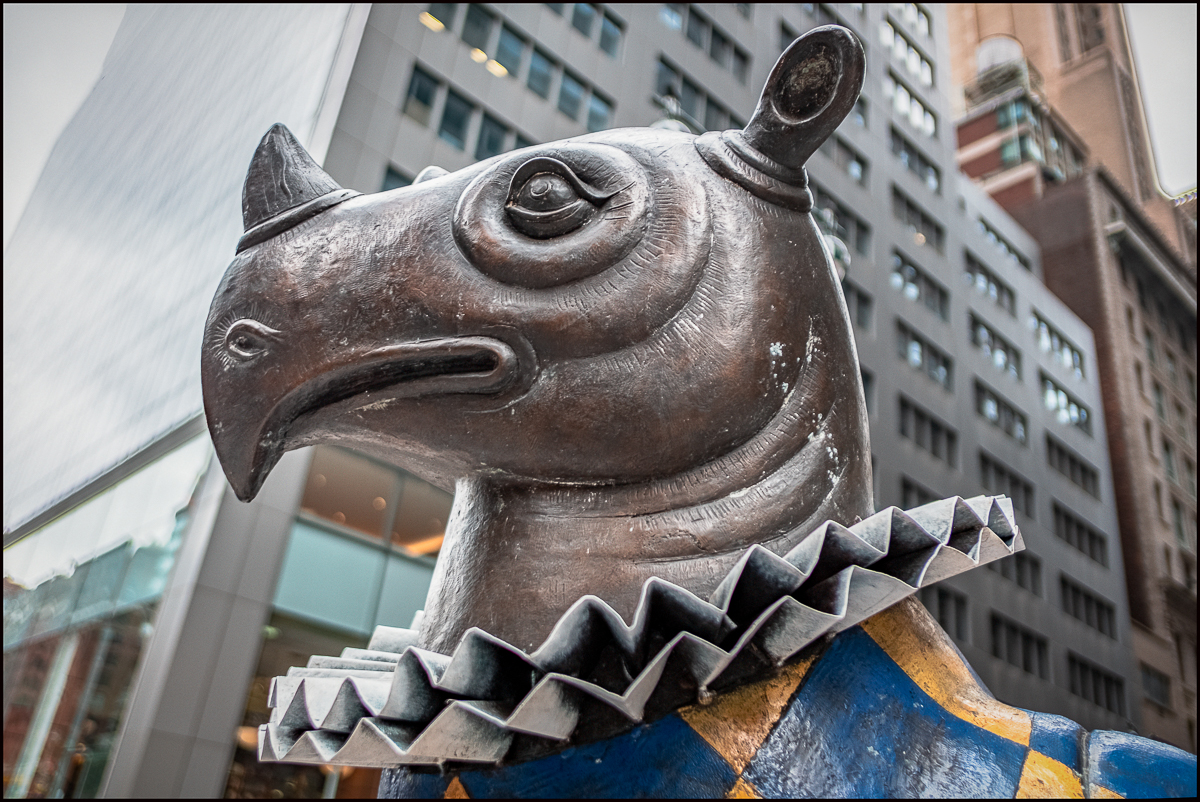
I recently went into New York City to take some photographs. On the train down I found I had a bit of a dilemma. Do I go to some of the ‘sights’ that I haven’t yet visited (e.g. South Street Seaport, Ellis Island, The High Line etc.)? Or do I just walk around and see what I bump into? I chose the latter option largely because I didn’t feel like mingling with thousands of tourists. So I decided to walk down Lexington Avenue as far as 14th Street, have a poke around Union Square and then go east and walk back to Grand Central on Third Ave. I left Grand Central, crossed 42nd Street and immediately came across these sculptures. There are three of them and they’re named Hippo Ballerina; Hippo Ballerina, pirouette; and Rhino Harlequin and they’re by Danish artist Bjørn Okholm Skaarup. For more information see here.

Above: Hippo Ballerina, pirouette


Hippo Ballerina

Rhino Harlequin

Rhino Harlequin close up

Taken with a Fuji X-E3 and Fuji XF 18mm f2 R