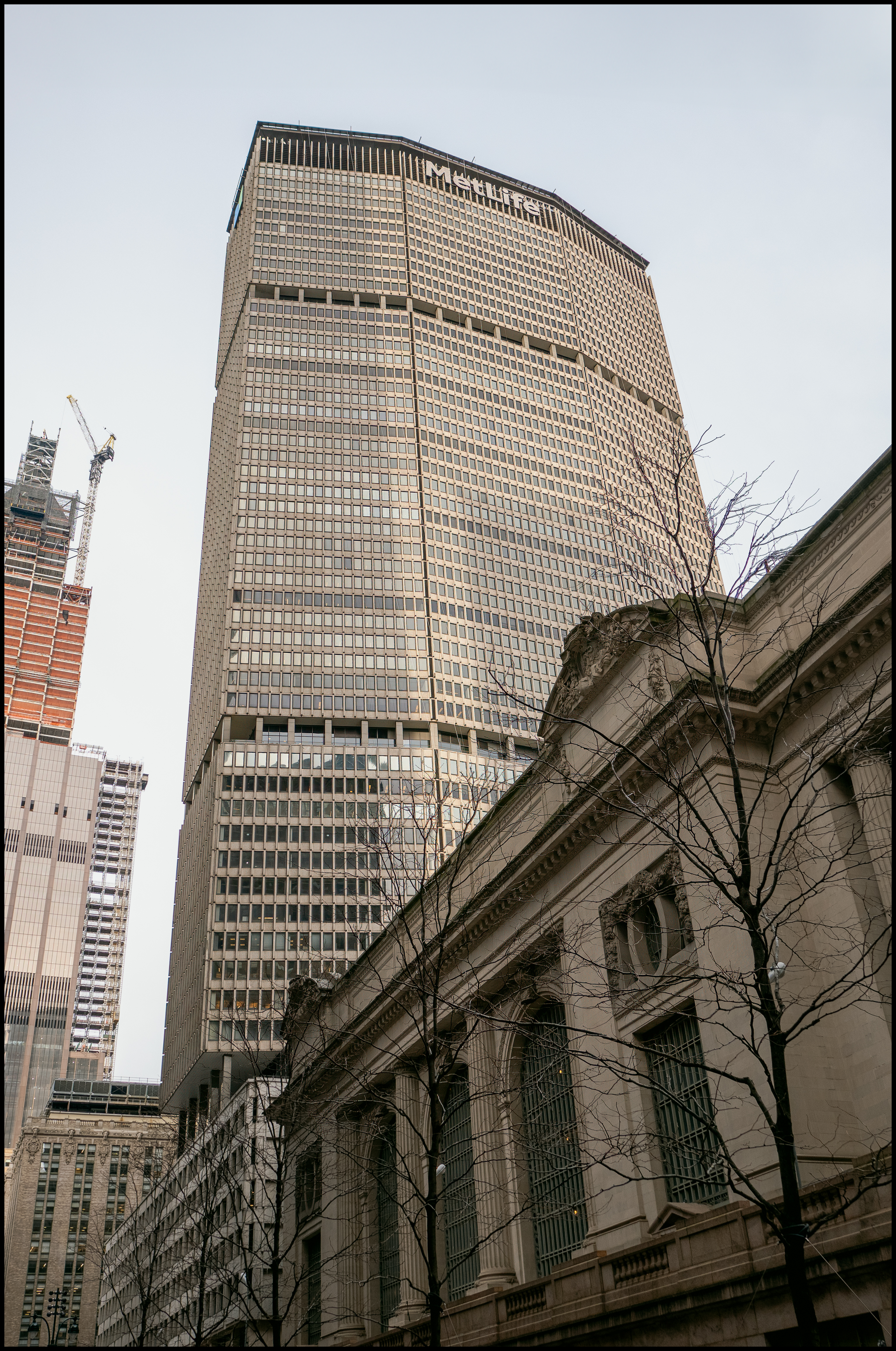
The Met Life Building

I noticed this building soon after my arrival in New York in 1974. It was then called the Pan Am Building.

According to Wikipedia:

The MetLife Building (also 200 Park Avenue and formerly the Pan Am Building) is a skyscraper at Park Avenue and 45th Street, north of Grand Central Terminal, in the Midtown Manhattan neighborhood of New York City. Designed in the International style by Richard Roth, Walter Gropius, and Pietro Belluschi and completed in 1962, the MetLife Building is 808 feet (246 m) tall with 59 stories. It was advertised as the world’s largest commercial office space by square footage at its opening, with 2.4 million square feet (220,000 m2) of usable office space. As of November 2022, the MetLife Building remains one of the 100 tallest buildings in the United States.

The MetLife Building contains an elongated octagonal massing with the longer axis perpendicular to Park Avenue. The building sits atop two levels of railroad tracks leading into Grand Central Terminal. The facade is one of the first precast concrete exterior walls in a building in New York City. In the lobby is a pedestrian passage to Grand Central’s Main Concourse, a lobby with artwork, and a parking garage at the building’s base. The roof also contained a heliport that operated briefly during the 1960s and 1970s. The MetLife Building’s design has been widely criticized since it was proposed, largely due to its location next to Grand Central Terminal.

Proposals for a skyscraper to replace Grand Central Terminal were announced in 1954 to raise money for the New York Central Railroad and New York, New Haven and Hartford Railroad, the financially struggling railroads that operated the terminal. Subsequently, plans were announced for what later became the MetLife Building, to be built behind the terminal rather than in place of it. Work on the project, initially known as Grand Central City, started in 1959 and the building was formally opened on March 7, 1963. At its opening, the building was named for Pan American World Airways, for which it served as headquarters. The Metropolitan Life Insurance Company (MetLife) bought the Pan Am Building in 1981 and used it as their headquarters before selling the building in 2005. The MetLife Building has been renovated several times, including in the mid-1980s, early 2000s, and late 2010s.

Taken with a Panasonic Lumix GX85 and Leica DG Summilux 15mm f1.7
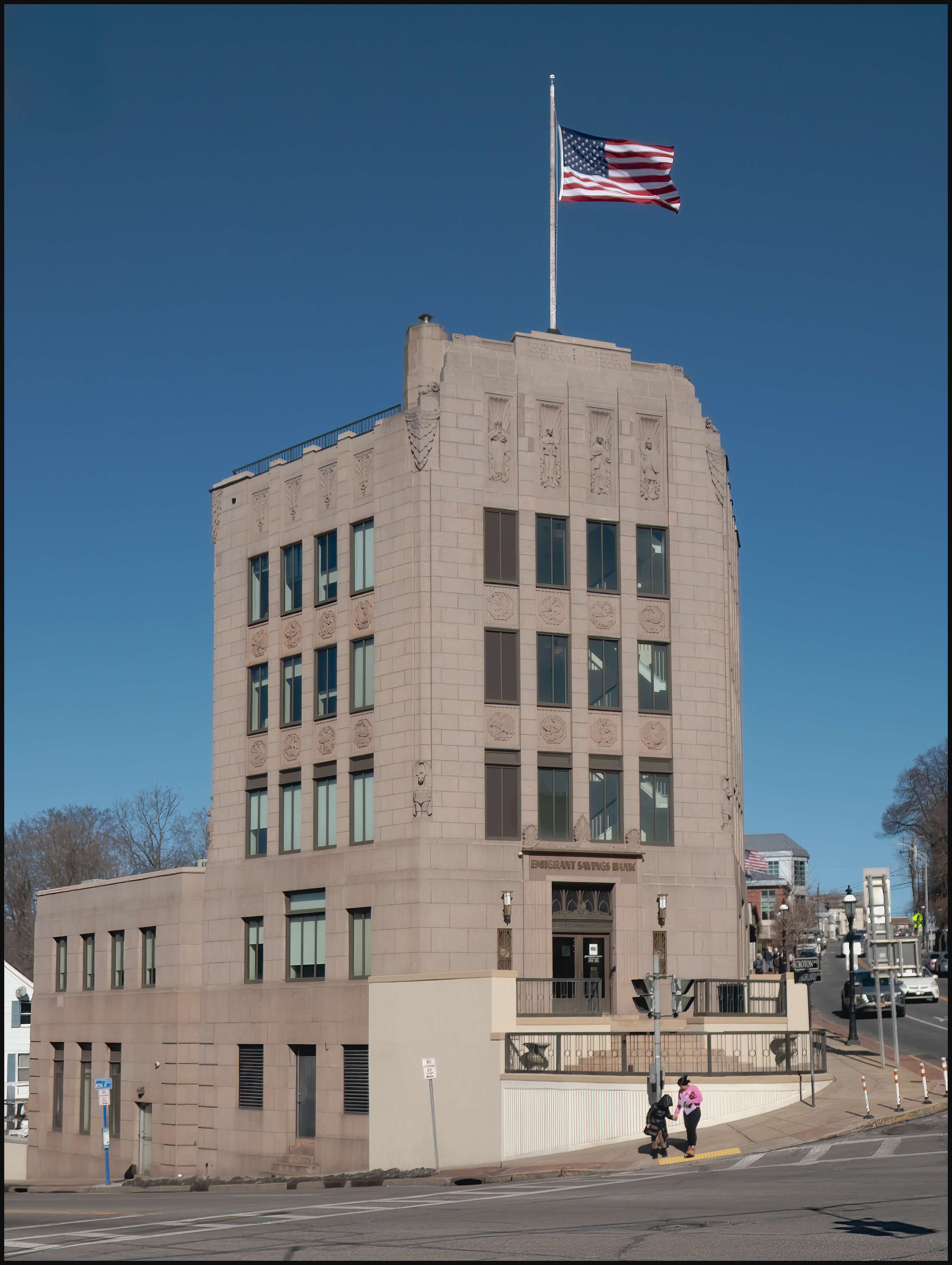
Ossining, First National Bank and Trust Company

“Art Deco architecture, which originated in France, was a style that came into vogue between the World Wars and was heavily influenced by the architecture of ancient, Egypt, Greece and Rome as well as the streamlined forms of the modern, industrial age.

The First National Bank and Trust Company structure has a stepped design, with a four story, hexagonal-shaped main wing and a one story northern secondary wing. The upper three stories of each of the four facings contains four bays of one over one metal sash casement windows, with
carved stone detailing between each window bay, carved gargoyle sculptures at each façade’s corner, and additional ornamentation along the upper frieze. The front façade also contains a raised parapet inscribed with the founding date for the First National Bank and Trust and the
bank’s construction date, along with a flagpole on the horizontal portion of the parapet just behind the façade. The front entryway draws slightly from classical styles with its fluted columns, and it is set back from the street by a series of steps on Croton Avenue. The lintel above the doorway was originally inscribed with First National Bank and Trust Company but is now inscribed with Emigrant Savings Bank to reflect the current owner. The Bank’s exterior walls are made of limestone.

The building is listed on the National Register of Historic Places as part of the Downtown Ossining Historic District. It is architecturally significant as the best example of 1930s Art Deco architecture within the Village.

The original First National Bank and Trust Company Building was constructed in 1930 by the bank of the same name, the most prominent commercial bank in Ossining at the time. The company’s previous building at the site (see photo on next page), constructed circa 1850, was demolished to construct a new bank in the popular Art Deco style. The architectural firm Hoggson Brothers of New York City designed the structure, which is singular as the sole Art Deco structure within the Downtown Ossining Historic District. Following the closure of First National Bank and Trust Company, the building hosted a branch of Barclays Bank of New York for a period of time. After a number of years of vacancy, it was purchased by Emigrant Savings Bank, who now own and operate the building.” (Village of Ossining Significant Sites and Structures Guide, Page 217)

Taken with a Panasonic Lumix GX-85 and Panasonic Lumix G Vario 14-42 f3.5-4.6 II

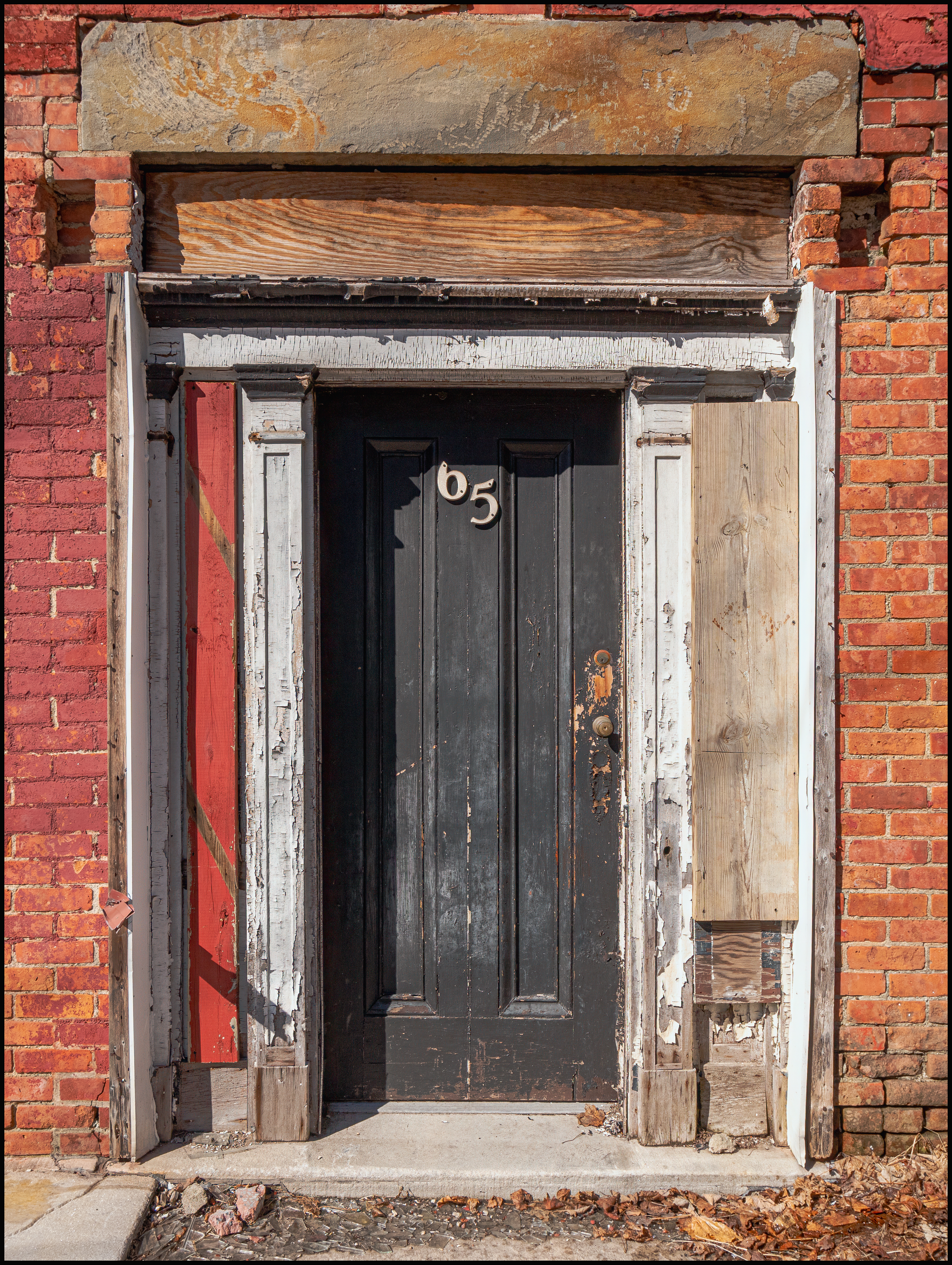
Two doors

A while back I thought it would be nice to go for walk down to a restaurant (3 Westerley Bar and Grill) by the Hudson in Ossining. It was a very nice day and there, I thought I could have a bite to eat, gaze out over the river and read for a while. Alas, it was not to be. It was Monday, and like many restaurants around where I live the restaurant was closed.

The restaurant is down by the MTA station, and the area has lots of industrial buildings. So thought I’d walk around and take some pictures of them. During my walk I came across this interesting, but rather dilapidated door (see picture above) on a house that, to put it mildly had seen better days.

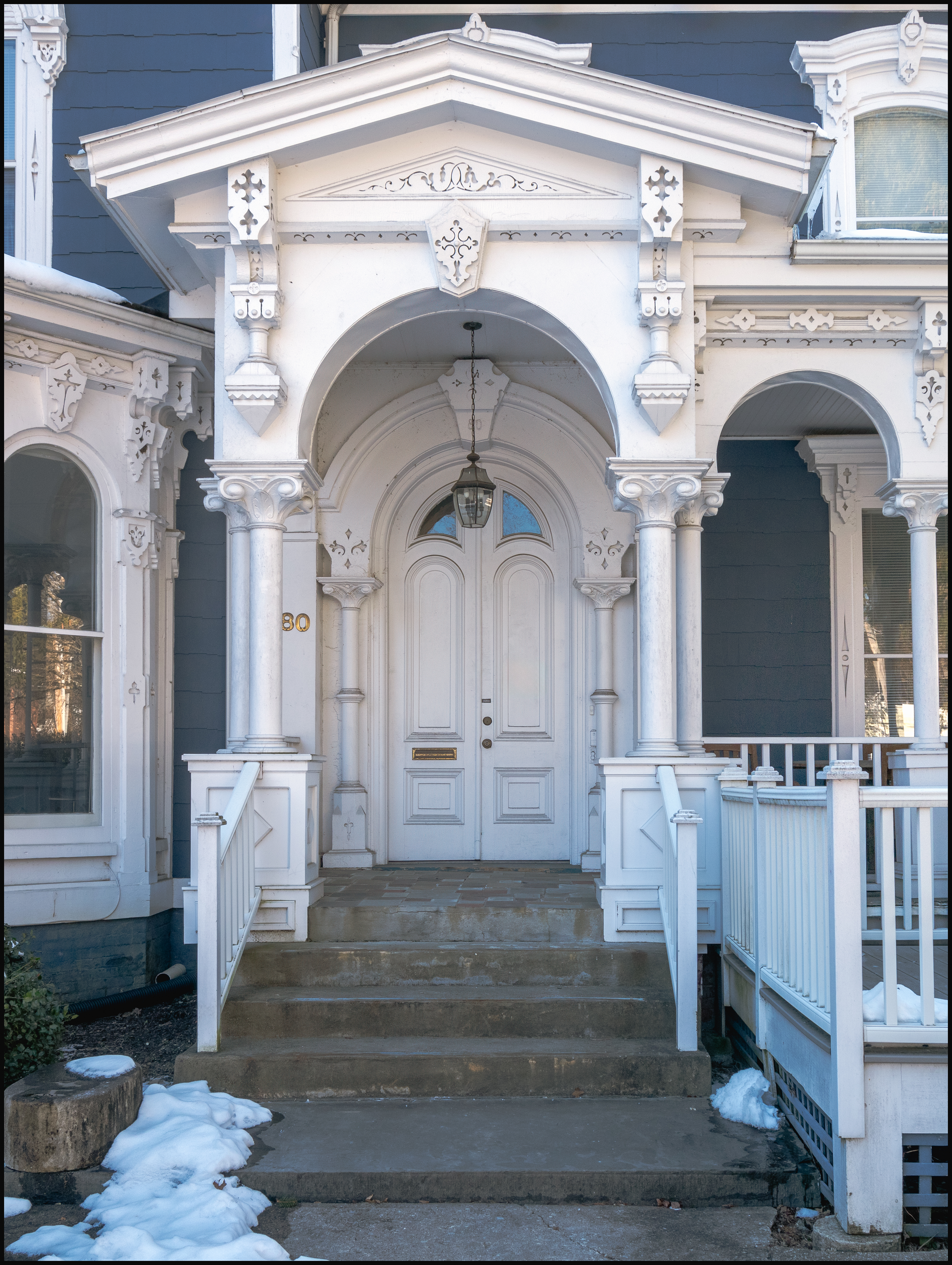
I continued my walk uphill looking for somewhere to eat that wasn’t closed on Monday, which I finally did (See: Lunch at Aji Limo). After eating I headed back home. As I was walking along Route 9 (Albany Post) I noticed this much more elaborate doorway (See below).

Quite a contrast!

Taken with a Panasonic Lumix GX-85 and Panasonic Lumix G Vario 14-42 f3.5-4.6 II

Too Late

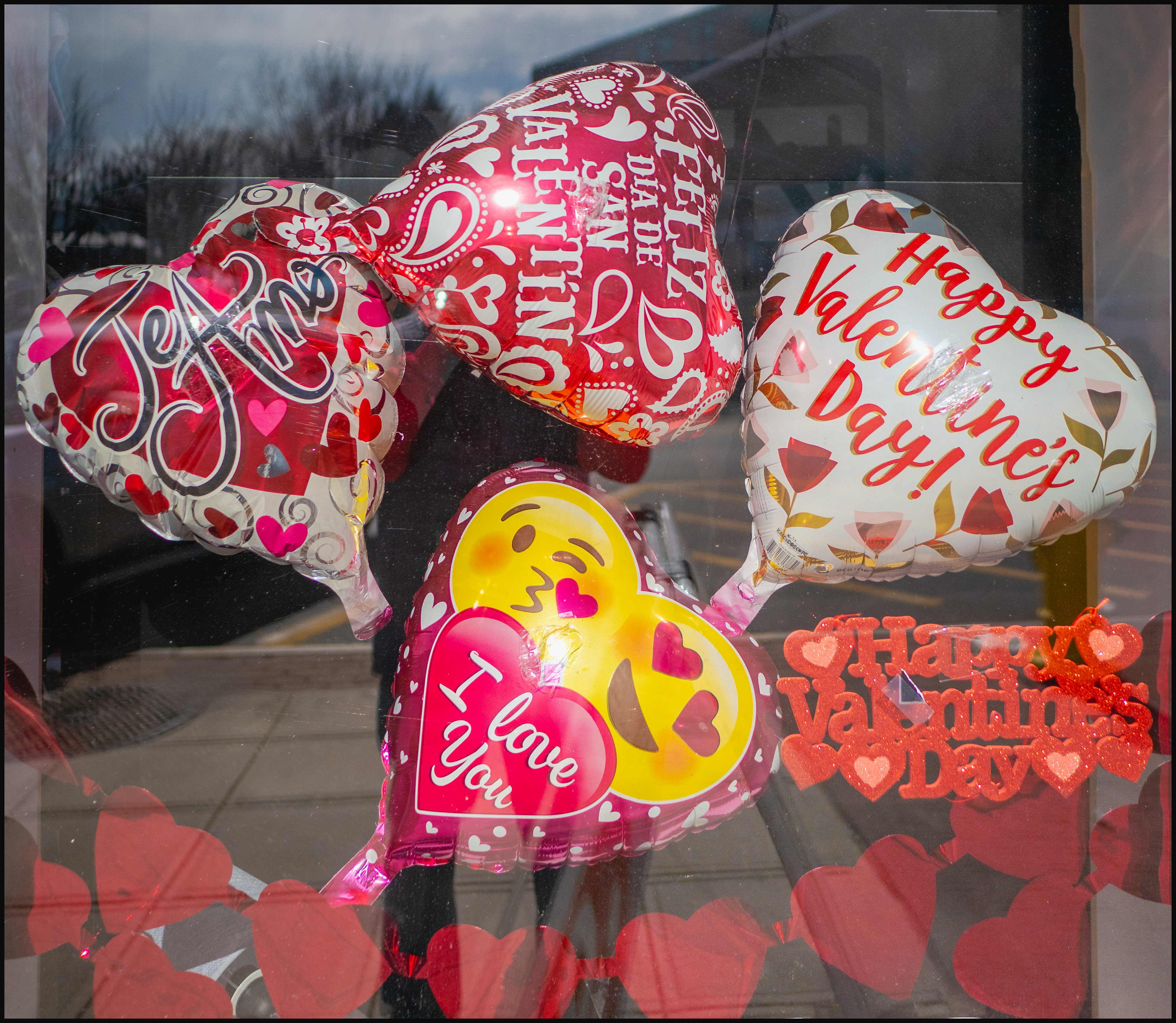
This picture was taken on 24 February so by my calculations it’s a bit late – to be specific 10 days too late. Maybe to tempt people to buy early for next year?

Taken with a Panasonic Lumix GX85 and Leica DG Summilux 15mm f1.7