Deep South

About a week ago I felt like going somewhere pleasant where I could sit and read. So, I decided to go walk down to a restaurant (3 Westerly) on the Hudson River – about a 45-minute walk from where I live. On the way I stopped at a great local bookstore: Hudson Valley Books for Humanity where I picked up a copy of “Deep South” by Sally Mann.

Publishers weekly described the book as follows:

Mann rose to prominence with Immediate Family, a collection of photographs of her children that some saw as emotionally direct and others found disturbingly erotic. Regardless, these photographs, and her subsequent work, demonstrate that Mann has a preternatural eye for light and composition. In this book, Mann, inspired by “”a cache of glass negatives…of familiar local places,”” set off with her camera through the South, using eighteenth century photographic techniques to capture the “”radical light of the American South,”” and the results are fascinating. In Georgia, a column of leaves dissipates into a luminous mist; in Virginia, a scumbled field with an empty cart in the distance suggests a test shot by Matthew Brady. Many of these photographs are startling in their intimations of violence: in the section called “”Deep South,”” Mann depicts the thick shaft of a venerable tree with a wound-like, horizontal slash near the trunk. Mann has also included the inevitable mistakes involved with such a tricky process: indiscernible unhappy accidents and washed-out near-abstractions. This is brave but puzzling. In one of her short essays, Mann writes that the Southern dusk makes “”the landscape soft and vague, as if inadequately summoned by some shiftless deity, casually neglectful of the details.”” A god may enjoy such prerogatives, but shouldn’t artists be more mindful? Most of the 65 images here are hauntingly beautiful and offer a stunning tour of a very off-the-beaten-path part of the country.

I’m a big fan of Sally Mann’s work and already own a couple of her books: her memoir: Hold Still: A Memoir With Photographs; and A Thousand Crossings.

For a good overview see: Sally Mann Photos – Intimate, Visceral.

I love this book. It’s large so the quality of the photographs is good. But it’s not so large that I can’t conveniently pick it up and read it. It’s a nice mix of text and photographs. I often come across photobooks with almost no text at all. I can understand why, but personally I like to have some text. I also come across photobooks that have acres and acres of text: multiple long articles, which I don’t usually mind to much unless they’re full of “criticspeak”.

In my opinion this book is a perfect blend of text and photographs. And the text is not coming from academics pontificating about here work. It’s Ms. Mann telling a story, which complements her photographs. In addition to being a great photographer, Ms. Mann is an excellent writer (she has an MA in creative writing and her mother ran a bookstore). I find the photographs to be atmospheric, and more than a little disturbing. I’m sure that those who insist on ultimate sharpness will not like this book. But I do.

This book is not easy to find and if you can find one it’s usually somewhat expensive. I was very pleased to find it, at a reasonable price in my local bookstore.
Vermeeresque

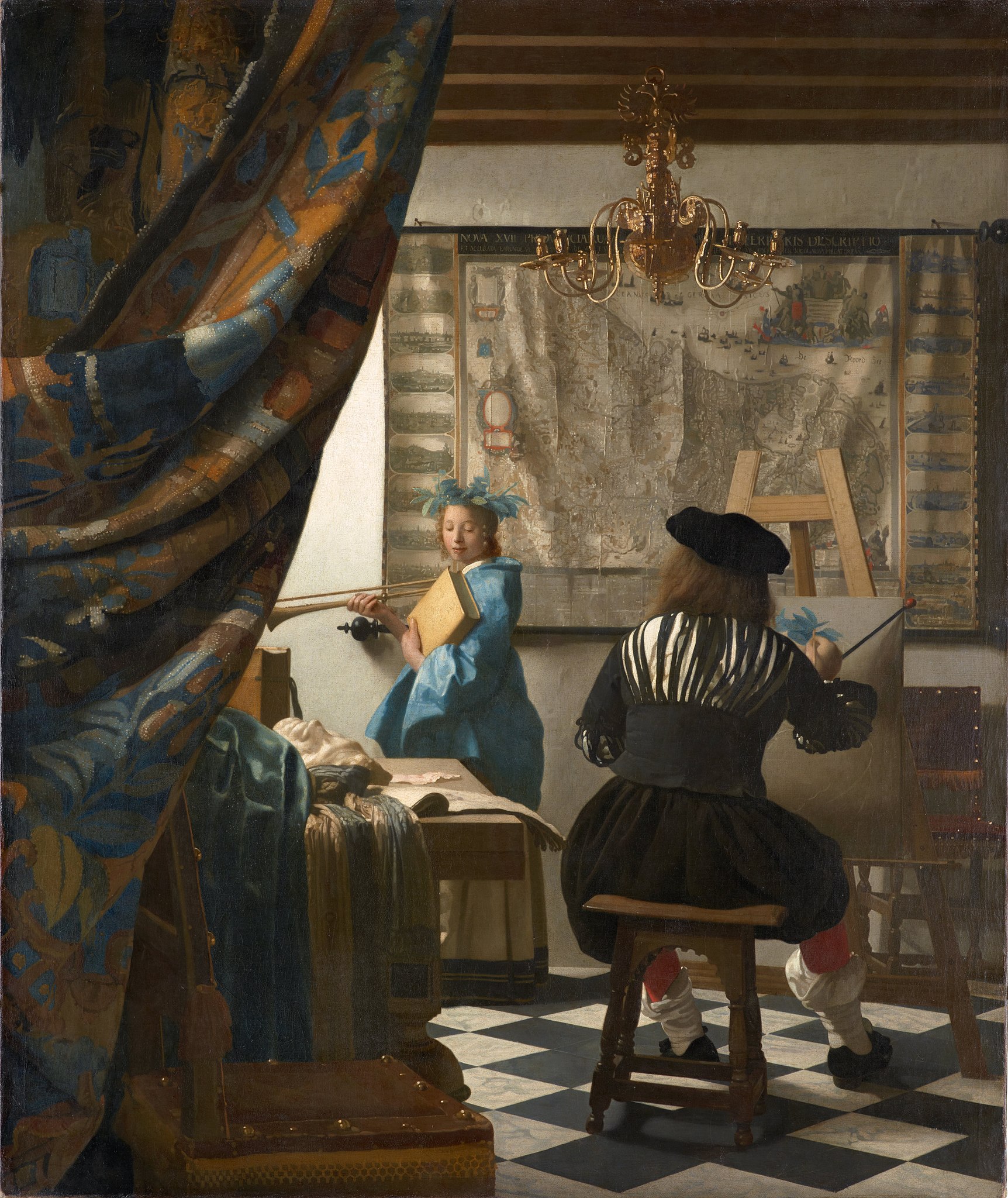
In my previous post (See: Am I an Artist?) I waffled on on about whether or not I should think of myself as an artist. To illustrate that post I chose, pretty much at random a Vermeer painting.

Towards the end of what was, for me a fairly long post I noted:

So, in light of the above, am I an artist? I still feel that calling myself an artist feels a little pompous. However, I suspect that I probably am. I’m just a very mediocre (at best) one. I don’t think Vermeer has much to worry about.

Not long afterwards I went to a presentation jointly organized by the Briarcliff Manor-Scarborough Historical Society (where I volunteer) and the Briarcliff Manor Congregational Church. The presentation took place in the church, which is an early 20th Century Norman style church built on land donated by the founder of the village. After a great presentation we adjourned to another room (maybe the vestry?) for refreshments.

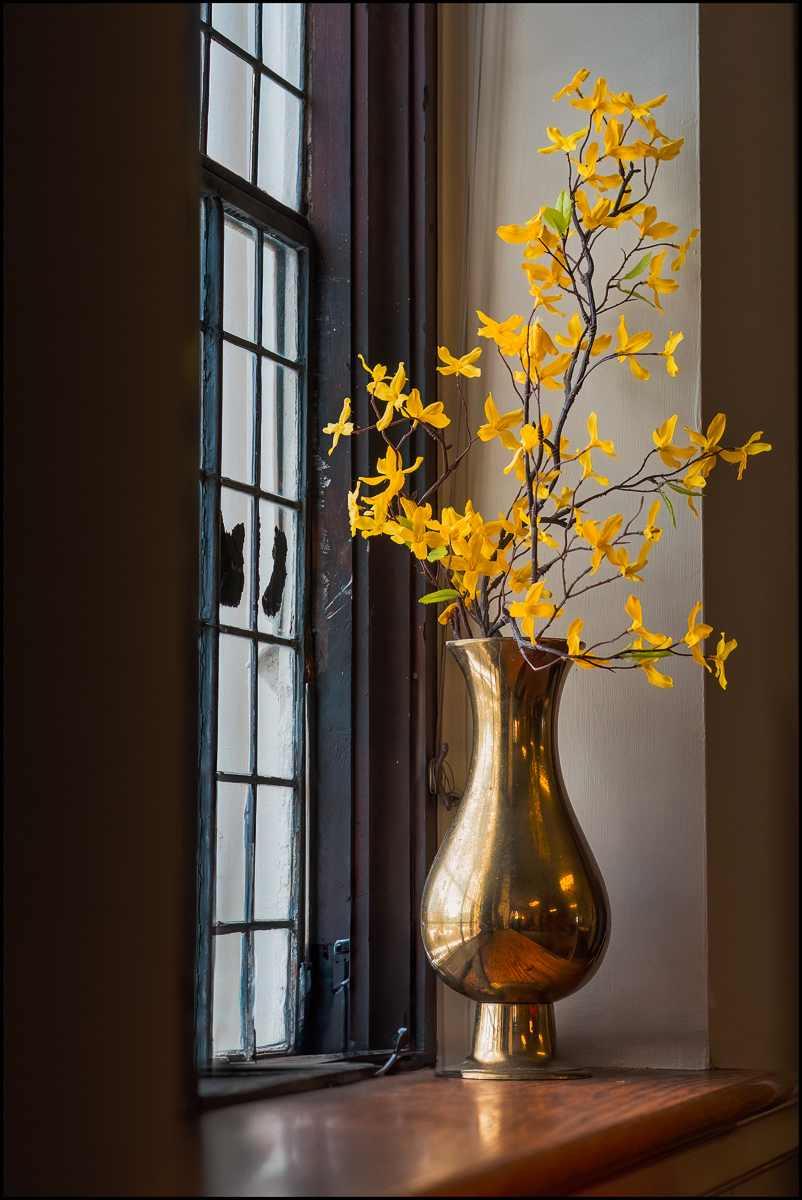
While there I noticed this attractive arrangement on one of the windowsills.

I still don’t think that Vermeer has much to worry about, but I’m getting closer and I really like the photograph.

Taken with a Sony A7IV and Rokinon/Samyang AF 75mm f1.8 FE

Am I an Artist?

I had a friend, now departed, called Paul. Once upon a time he was a well-known daytime TV star. When I first met him, he was 80 years old, but still very active. One of his activities was to periodically have lunch with a group of people who called themselves: “Writers, Artists, and Thinkers”. He encouraged me to come along to these gatherings. Although I did go to a few I was somewhat reluctant for two reasons: First, I’m a bit of a loner and don’t like to mix with people I don’t know; and second, and perhaps more importantly, I’ve never really thought of myself as belonging to any of these categories.

However, lately I’ve been reading a lot of stuff about art, creativity, imagination etc. So I’ve decided to give a bit more thought to the subject of whether or not I might be an artist.

I suppose the first thing to consider is how do you define art? The Merriam Webster dictionary defines art as:

“The conscious use of skill and creative imagination especially in the production of aesthetic objects.” The dictionary also defines a work of art as something that is “produced as an artistic effort or for decorative purposes.”

Another thing to consider might be: Is Photography even an Art? This question has been debated since the appearance of the first camera. It’s still being discussed today. I don’t want to get into the details of this discussion here, but I’m convinced that it has now been decided in favor of photography being an art. Photographs now appear on the walls of museums and prestigious galleries and often command large sums of money. Because of all the challenging creative decisions (e.g. regarding lighting, composition, subject, symbolism, lens choice, point of view, timing etc.) the photographer has to make in order to make a compelling picture, it’s not a stretch to see photography as an art.

Billions of photographs are taken every day. Should they all be considered art? Perhaps not. I think it all depends on the intent of the photographer. Many, probably most of billions of photographs don’t intend to be anything more than a simple record shot e.g. here’s a picture of mum and dad at the beach. I believe that to aspire to be an artist the photographer must go beyond the simple record shot, generally taking more time over the selection of a subject, looking at the the subject from all angles to find the best position, patiently waiting for the right light, pressing the shutter just the right moment etc.

“Put another way, a photographer’s art is the ability to capture a moment of reality and turn it into viewable image of interest and/or beauty…The process of judging whether photography is art, reminds us that neither painting nor sculpture is as pure an art form as is sometimes supposed. Bronze sculpture can be cast and recast in a large number of copies; and our knowledge of Greek sculpture comes not from original Greek statues but from Roman copies. Furthermore, it has been estimated that as many as 1 in 10 paintings that hang in the best art museums, are copies not originals. At the end of the day, a camera along with a dark room and its processing chemicals, is not so very different from a painter’s brushes and paints. It remains no more than a set of tools with which a photographer tries to create an image: an image to stir our soul, in the way that images do.” (Is Photography Art?).

Of course, none of the above addresses the issue of talent. I might be able to meet the standard of the definition, practice all the creative factors mentioned above and still produce mediocre (or worse) results).

Salieri in the movie “Amadeus” comes to mind. He had some talent (probably much more in reality than in the movie). His tragedy was that he had devoted himself whole-heartedly to God and his music and probably thought he was doing all right, but then came Mozart, and unlikeable person with who had much, much more musical talent and to whom composing remarkable music seemed to come easily. In the photography world (and in other creative endeavors) I imagine that there a many more Salieris than there are Mozarts.

So, in light of the above, am I an artist? I still feel that calling myself an artist feels a little pompous. However, I suspect that I probably am. I’m just a very mediocre (at best) one. I don’t think Vermeer has much to worry about.

In future I’ll refer to myself as an artist who uses a camera as a tool, rather than as a photographer, which seems to emphasize the technical aspects (F-Stops, Apertures, Shutter Speeds, ISO, burst rates etc.) over the more creative aspects. As I’ve discovered you can (and should) master the technical aspects, but even if you do this alone won’t necessarily make you a better photographer.

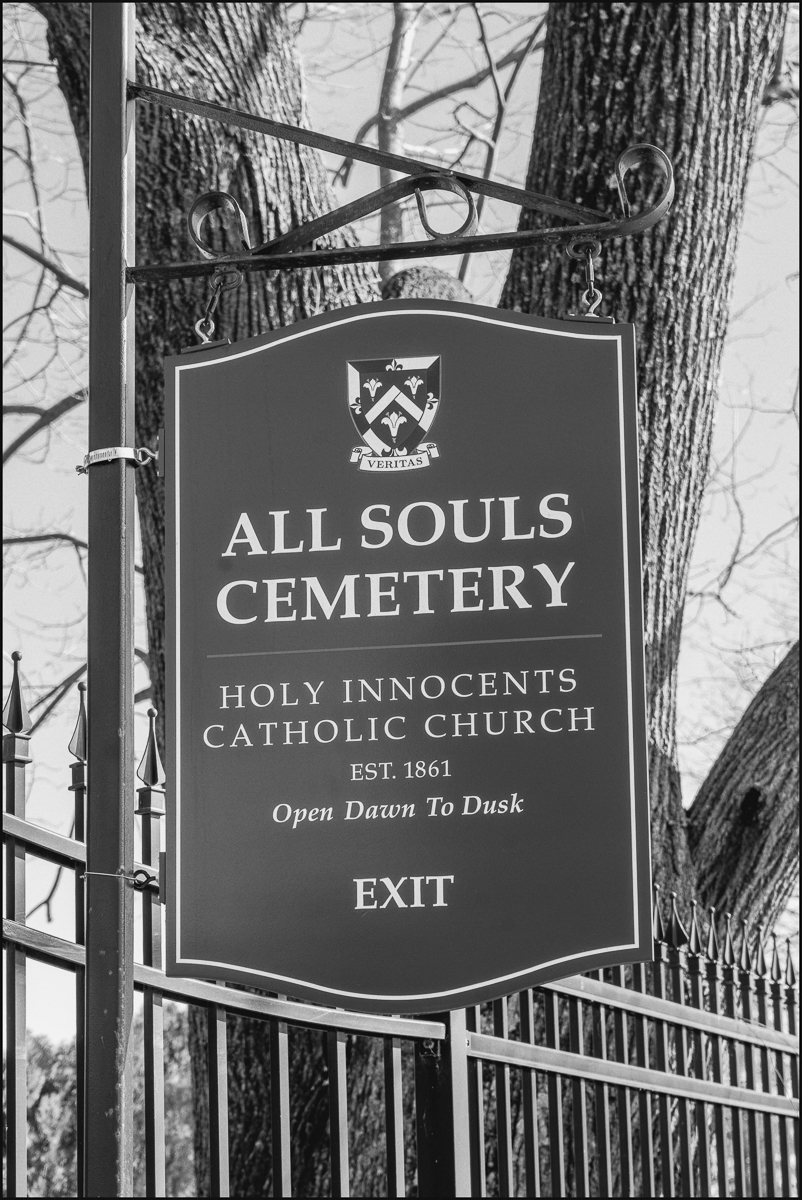
The one I missed. Pleasantville, All Souls Cemetery

Last month I did posts on three small cemeteries located in the same vicinity in Pleasantville, NY (See: Three Cemeteries in Pleasantville – Overview and Methodist Church; Three Cemeteries in Pleasantville – Palmer Family Plot; Three Cemeteries in Pleasantville – Banks Cemetery.

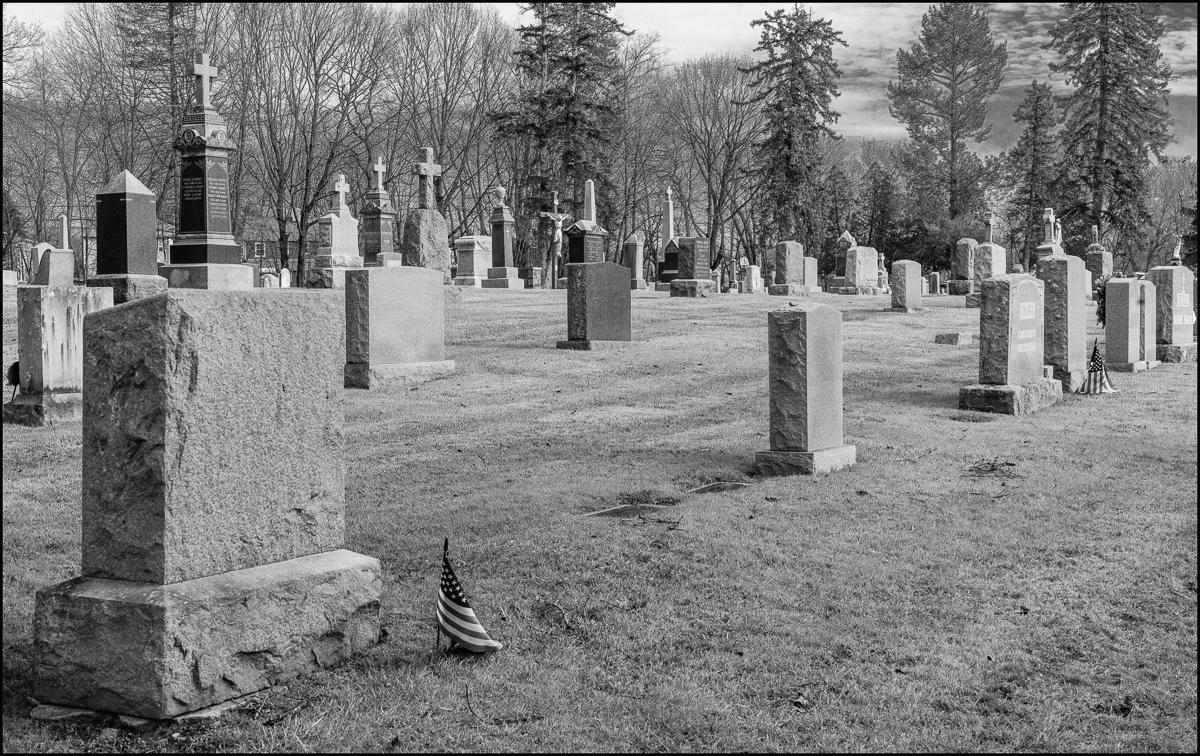
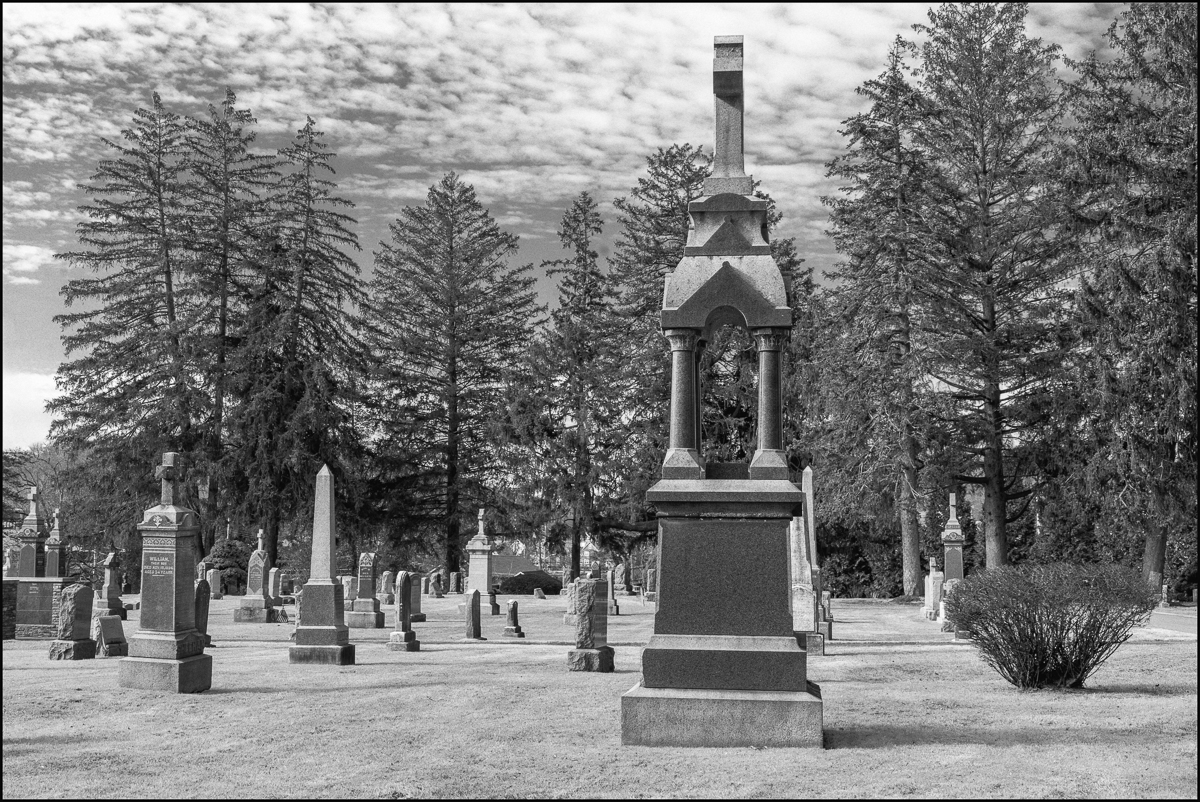
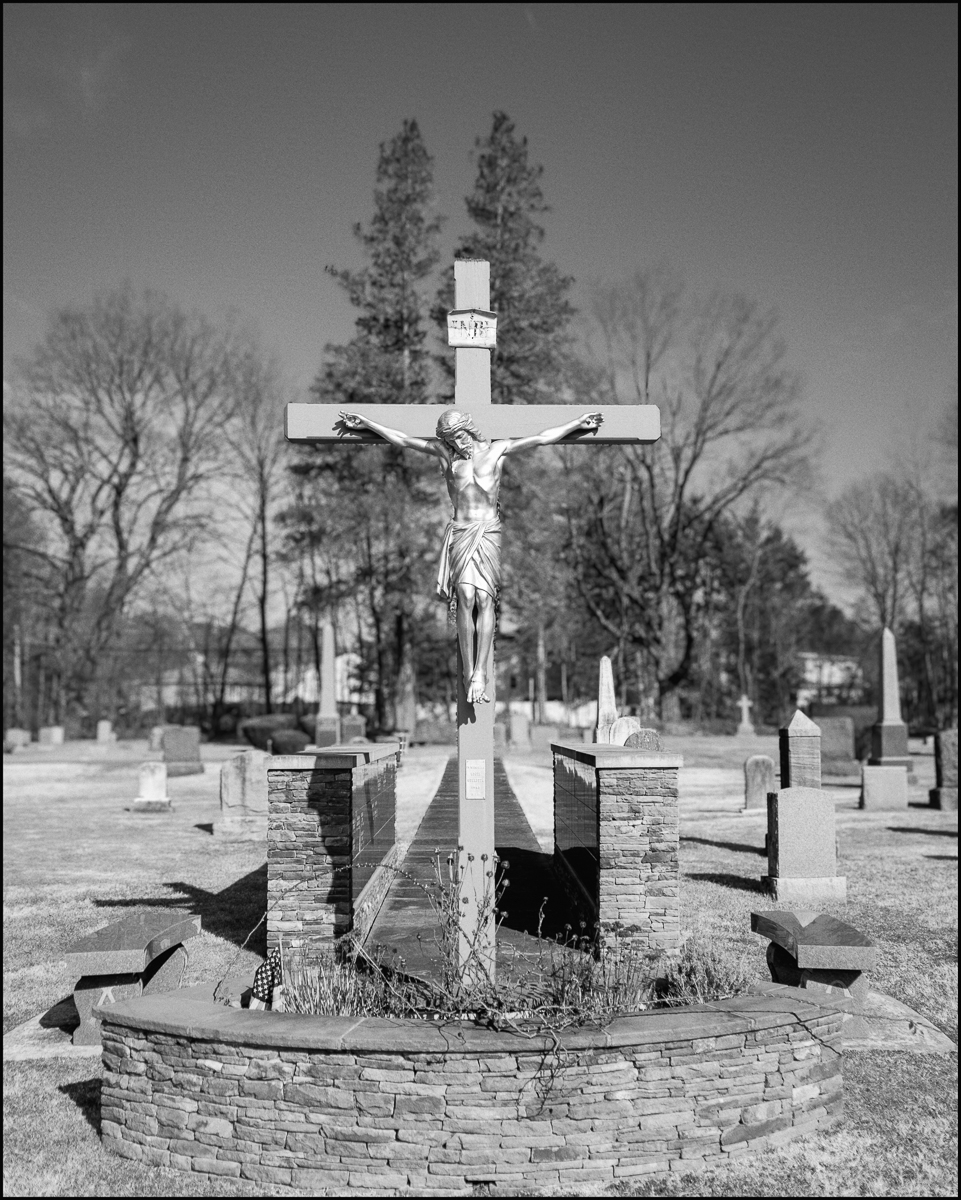
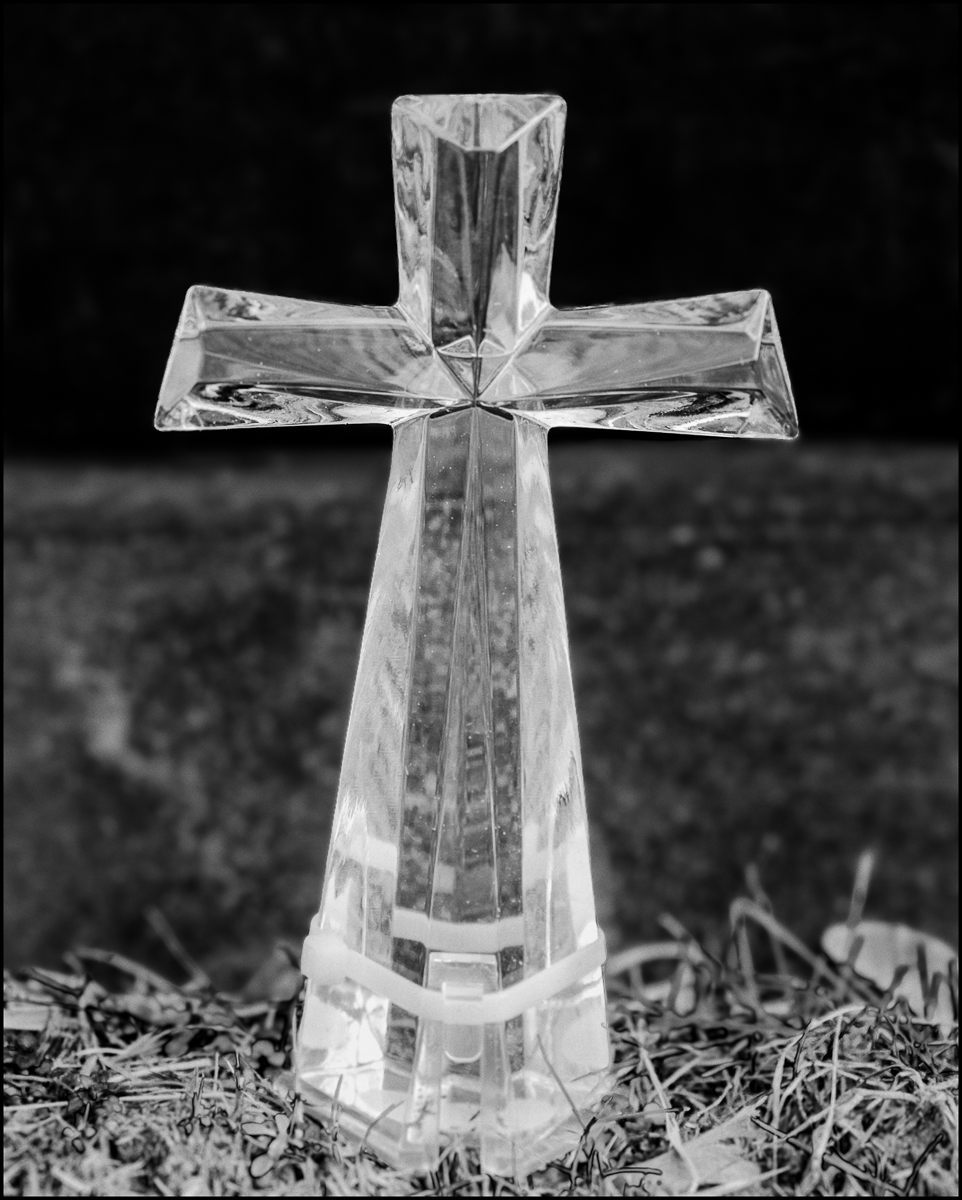
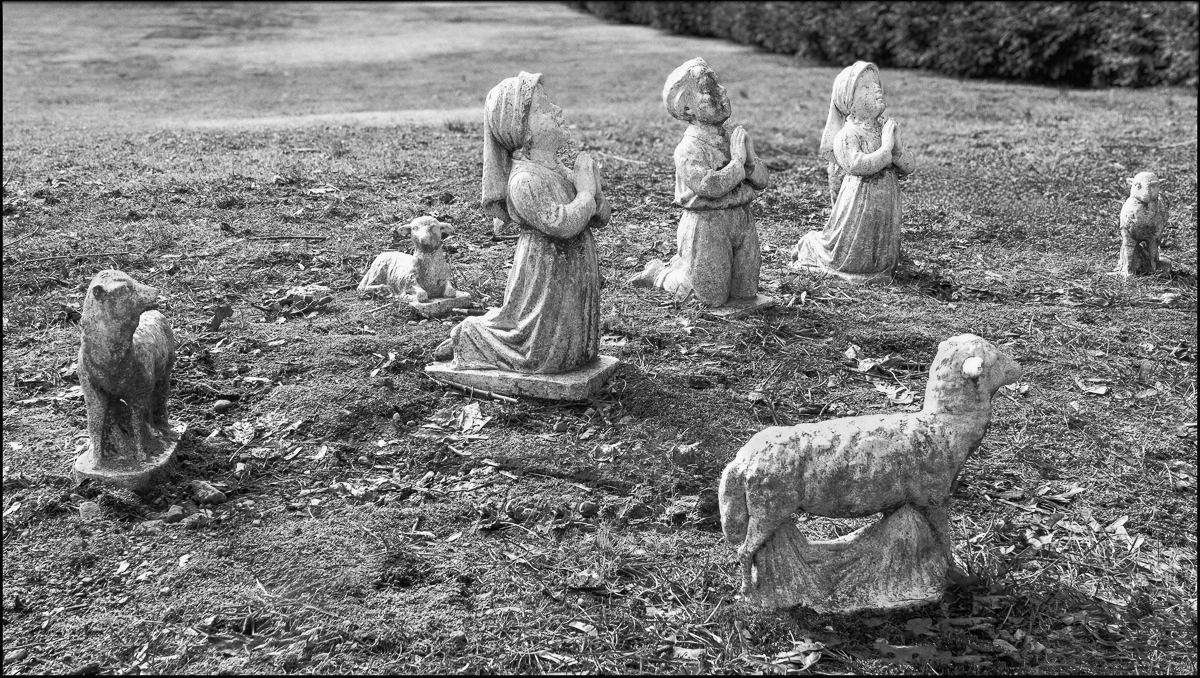
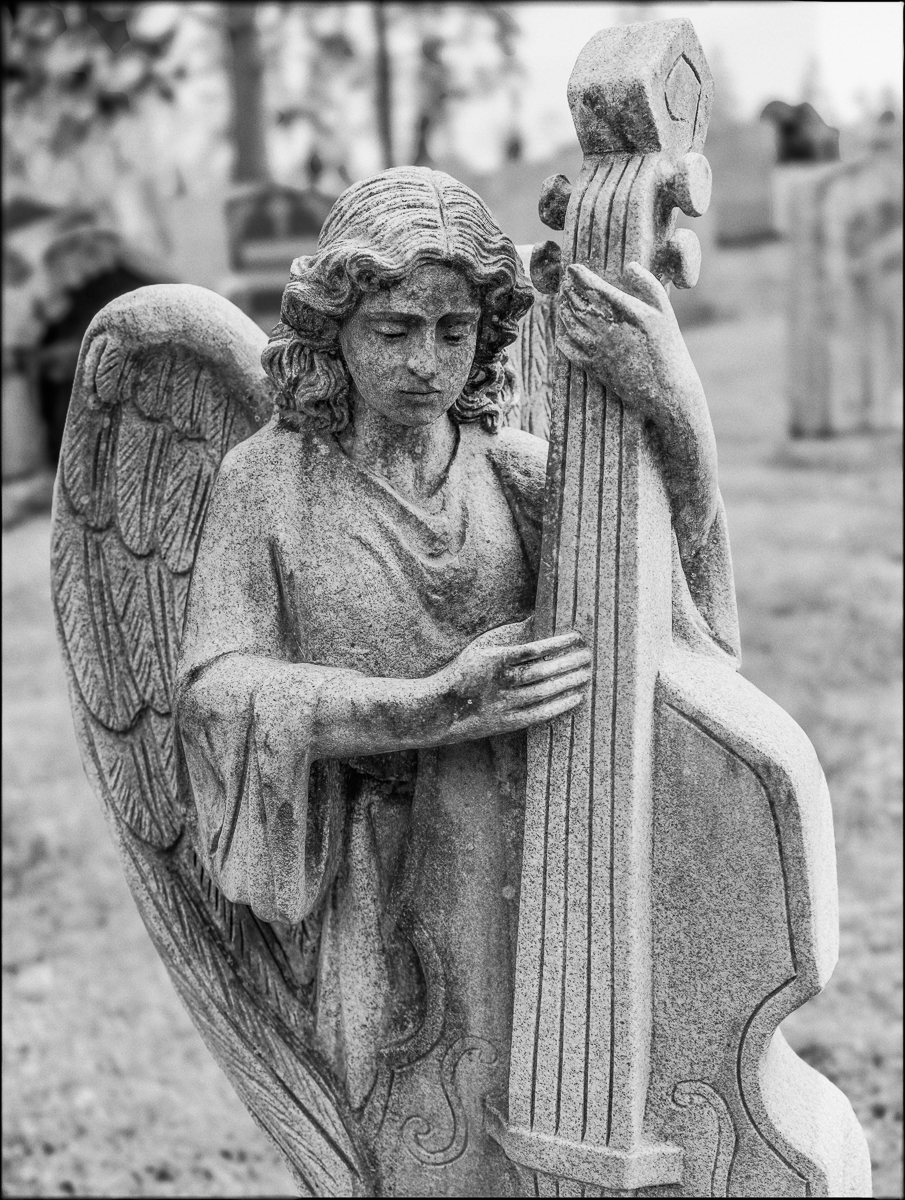
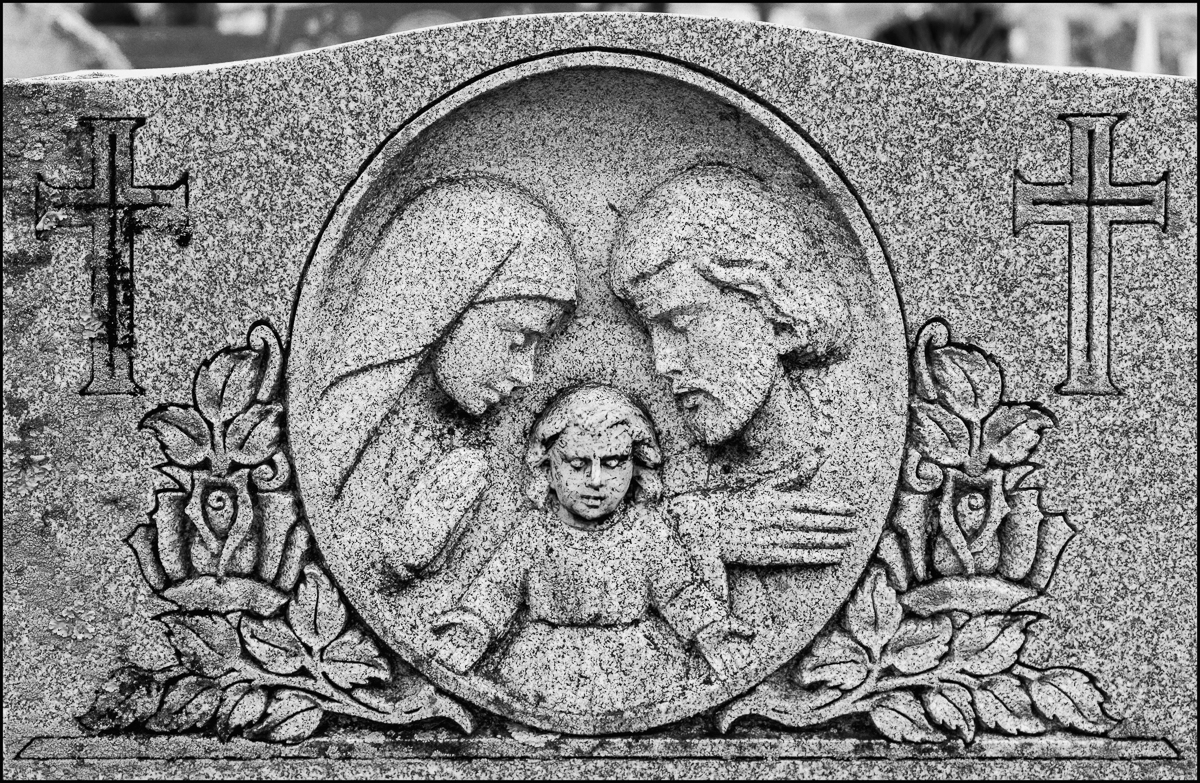
At the time I didn’t realize that there was another cemetery in Pleasantville: All Souls Cemetery. When I discovered that there was, off I went to check it out. It’s a lot larger than the other three. I tend to like older cemeteries and at first glance this seemed to be just another late 19th Century cemetery. It doesn’t have any celebrity interments and seemed to have little to commend it. However, as I walked around, I noticed a lot of interesting statuary and gravestones. I particularly liked the grotto mentioned below. All things considered a pleasant cemetery. I might come back in spring to see what it has in terms of flowering plants and shrubs.

According to Patrick Raftery:

The first Catholic Church in Pleasantville was built on the present site of Holy Innocents Church in 1876. At the time it was constructed, the church was not a part of a separate parish, but rather was administered from the Church of Saint Francis in Mount Kisco. At the urging of the pastor of Saint Francis, Father Michael Newman, Archbishop John McCloskey purchased a five-acre parcel on Marble Avenue from Letty J. Rosell on April 27, 1882, for use as a cemetery. Sadly, Father Newman died five years later at the age of 39. The Pleasantville church became a separate parish on July 1, 1894

The southeast section of the cemetery is reserved for deceased priests, nuns and brothers, whose graves a generally marked by simple crosses. An exception is the grave of Father Newman, whose interment is marked by a column acknowledging him as the founder of the cemetery. A grotto near the eastern fence of the cemetery notes that many of the nuns buried here had served at Saint Thomas School, an elementary school operated by the Dominican Sisters from 1897 to 1985 and attached to the Holy Innocents parish. Perhaps the most notable of the clergy and religious buried here is the Reverand Andrea Felix Morlion (190-1987), a native of Belgium who founded the International Pro Deo Union, the L’Università Pro Deo, and Libera Università Internatzionale degli Studi Sociali in Italy. Today [Note: the book was published in 2011] All Souls Cemetery is nearly full. Overshadowed as the favored final resting place for the area’s Roman Catholics by nearby Gate of Heaven Cemetery, it is still occasionally used by parishioners of Holy Innocents. (Patrick Raftery, “The Cemeteries of Westchester County, Volume II“. Westchester Historical Society, 2011.


For more pictures see All Souls.

Taken with a Sony A7IV and Sony FE 28-70 f3.5-5.6 OSS.

White rectangle

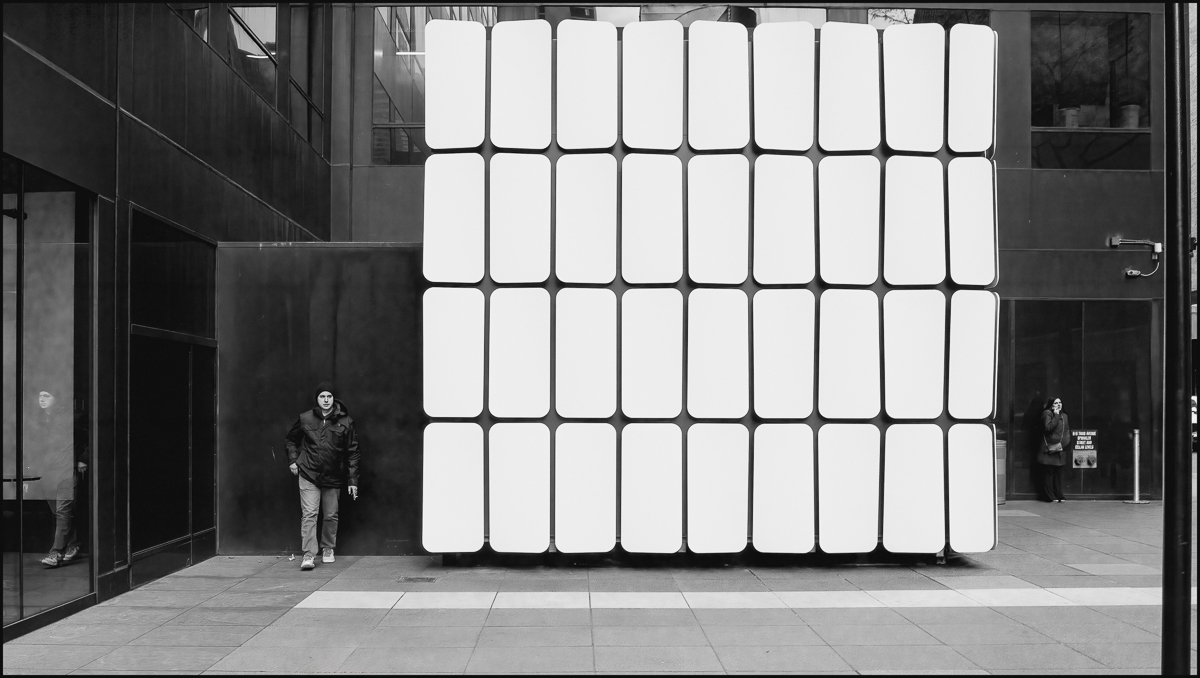
Taken in Manhattan. Somewhere in the ’50s on the East Side. I don’t remember exactly where.

I first noticed this white sculpture. As I got closer, I noticed the guy the left who had apparently come outside for a smoke. Soon afterwards I saw his almost surreal reflection in the window to his left. It was starting to look good, but there was still something missing. The area to the right needed something to provide balance so I waited for a while, hoping someone would turn up. Sure enough – someone did, the woman on her phone to the right.

Taken with a Sony A6000 and Sony FE 24mm f2.8 G.