A Visit to Boston – Day Two – In and around Quincy Market

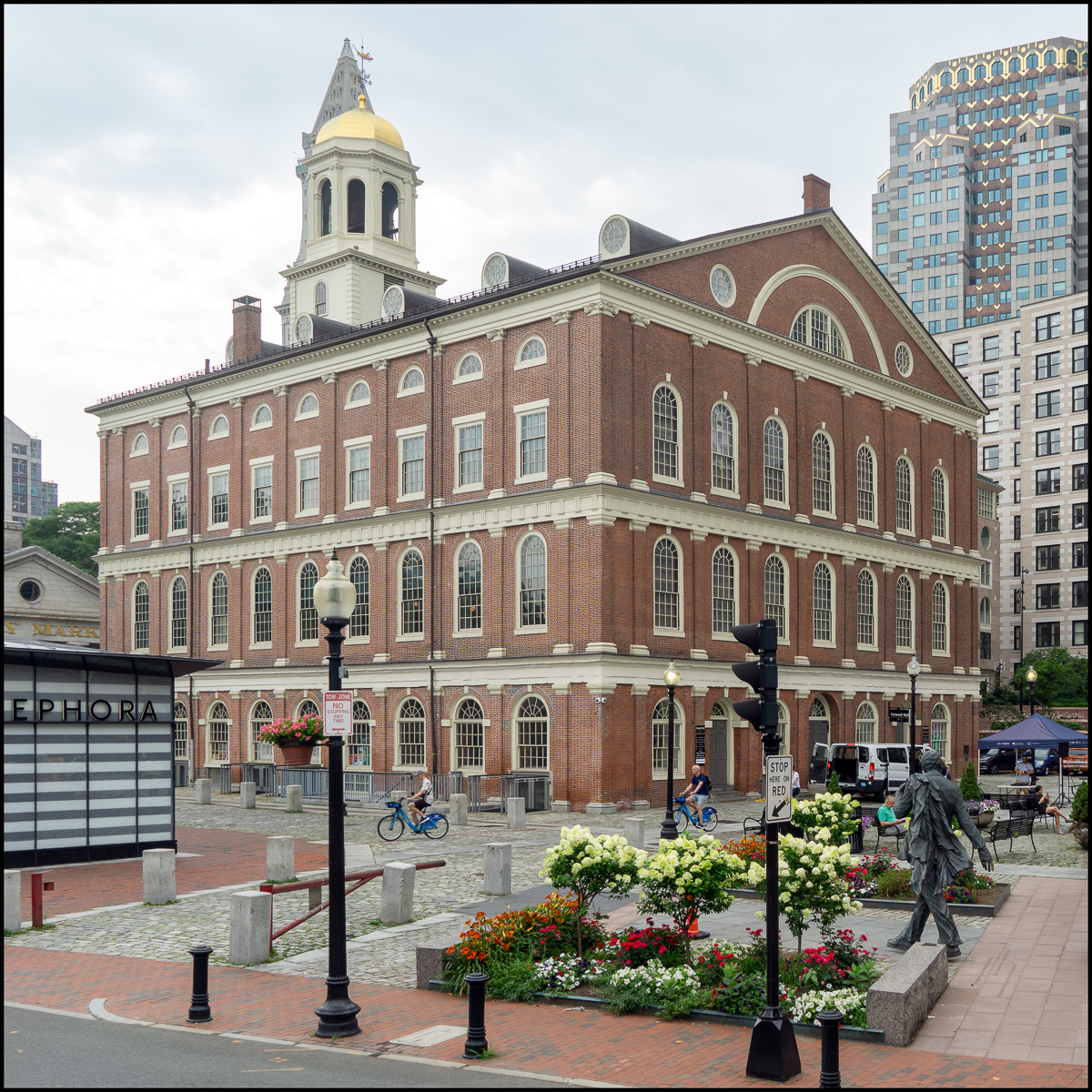
“Quincy Market is a historic building near Faneuil Hall in downtown Boston, Massachusetts. It was constructed between 1824 and 1826 and named in honor of mayor Josiah Quincy, who organized its construction without any tax or debt. The market is a designated National Historic Landmark and a designated Boston Landmark in 1996, significant as one of the largest market complexes built in the United States in the first half of the 19th century. According to the National Park Service, some of Boston’s early slave auctions took place near what is now Quincy Market.

As the central building of Faneuil Hall Marketplace, Quincy Market is often used metonymically for the entire development. By the mid-20th century it was badly in need of repair, and it was redeveloped into a public shopping and restaurant area in the early 1970s and re-opened in 1976. Today, this includes the original Quincy Market buildings, the later North Market and South Market buildings that flank the main Quincy Market, the historic Faneuil Hall lying at the west end, and two smaller curved buildings, added later to the eastern end.” (Wikipedia)


Taken with a Sony A6000 and 18-135mm f3.5-5.6 OSS.
A Visit to Boston – Day Two – Faneuil Hall

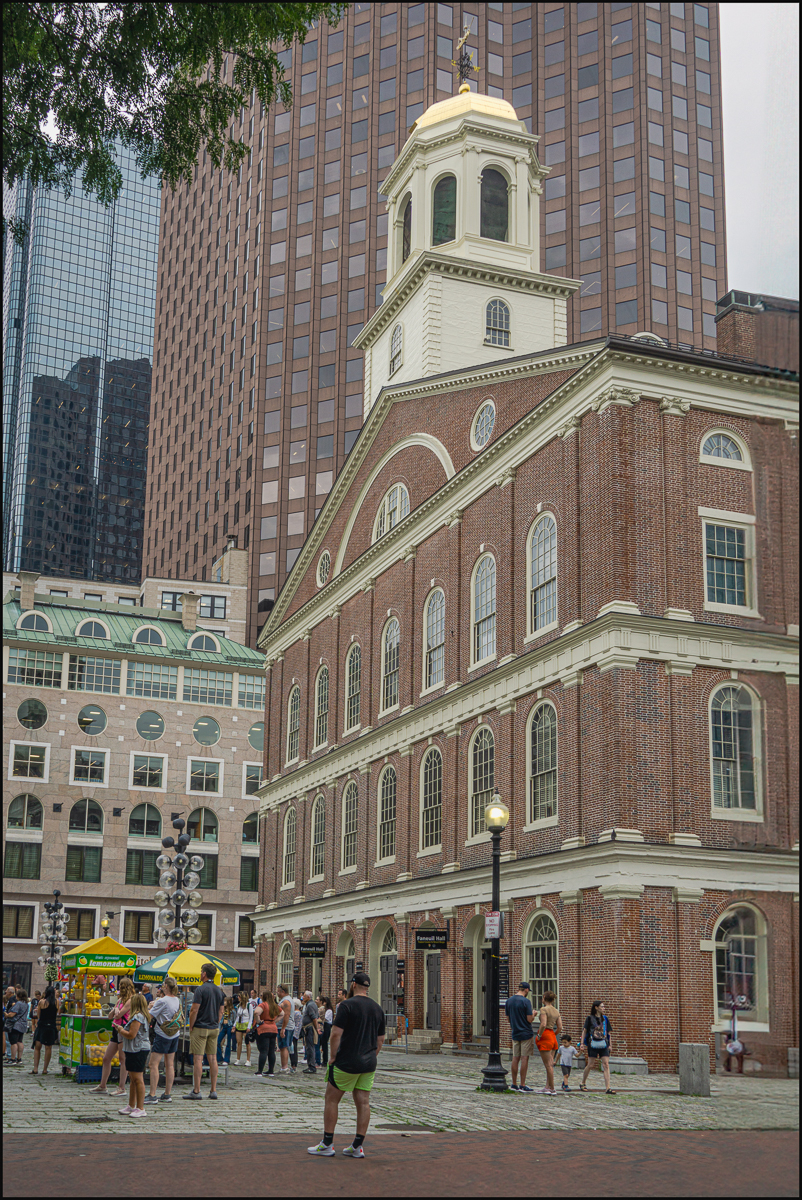
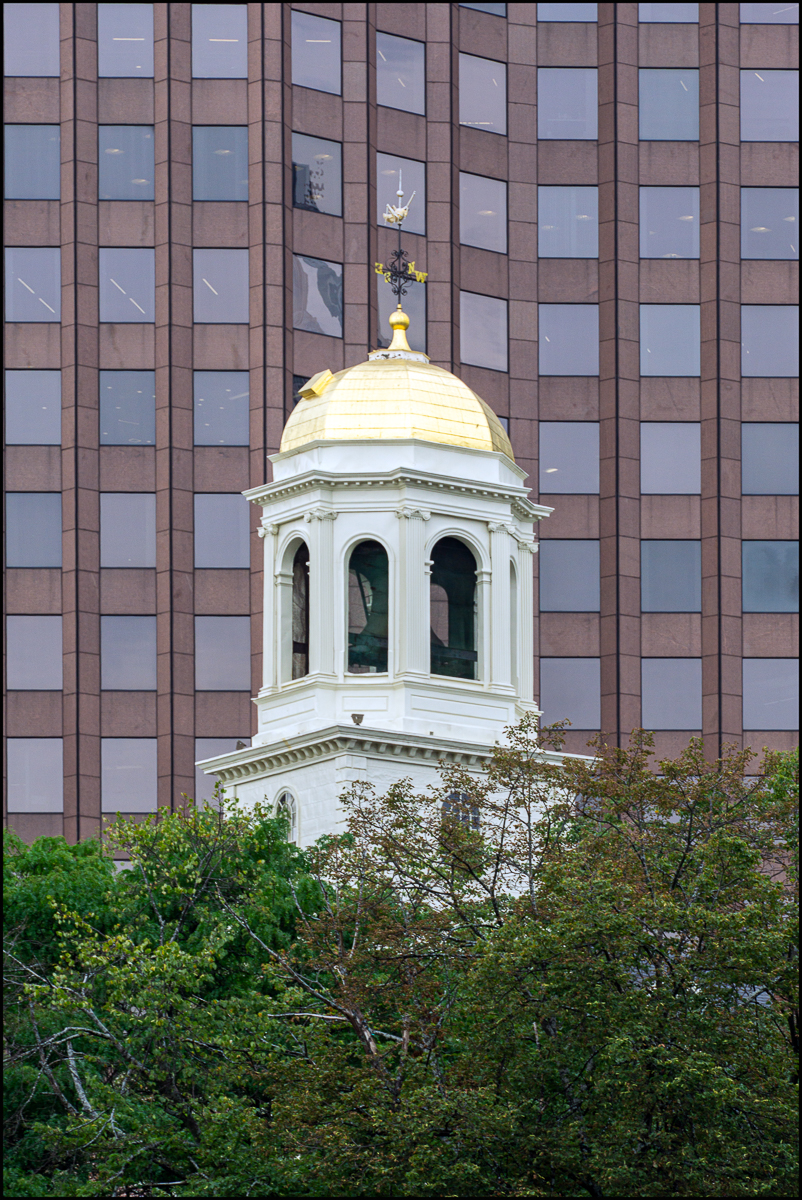
Faneuil Hall is a marketplace and meeting hall located near the waterfront and today’s Government Center. Opened in 1742, it was the site of several speeches by Samuel Adams, James Otis, and others encouraging independence from Great Britain. It is now part of Boston National Historical Park and a well-known stop on the Freedom Trail. It is sometimes referred to as “the Cradle of Liberty”. (Wikipedia)

Taken with a Sony A6000 and 18-135mm f3.5-5.6 OSS.

A Visit to Boston – Day Two – A Huge Milk Bottle

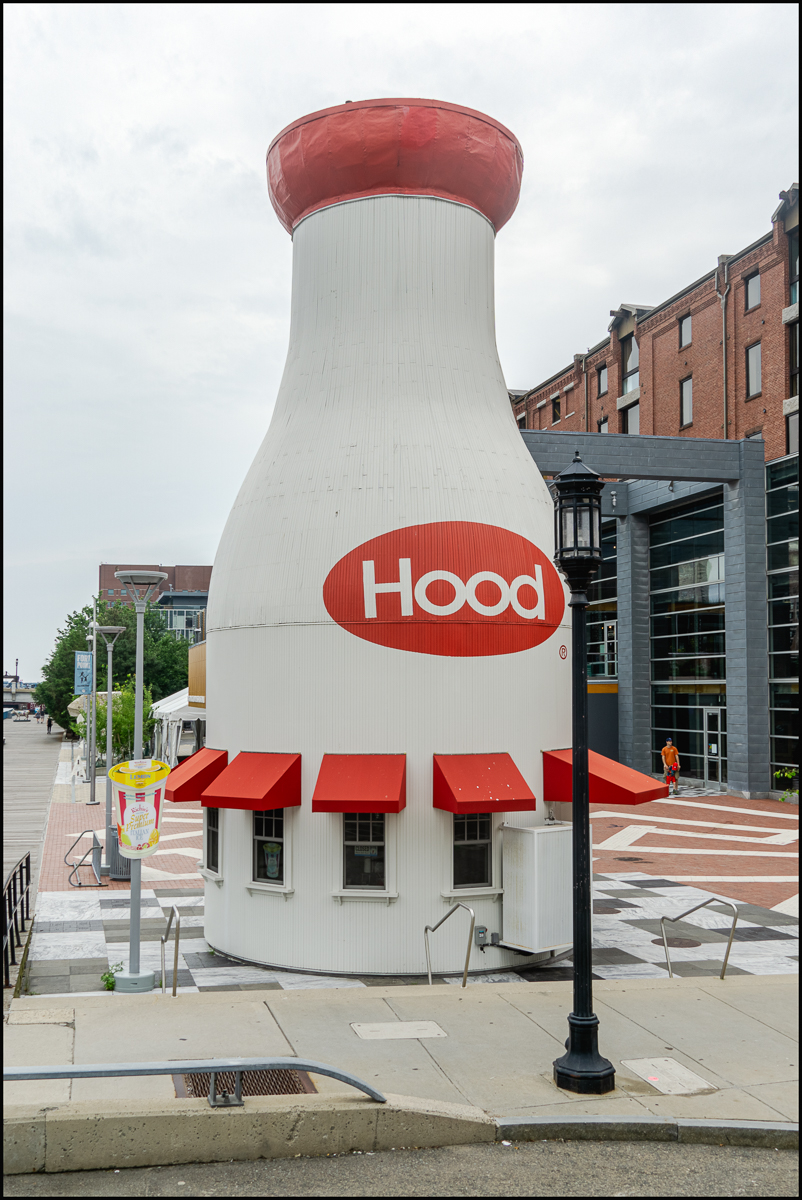
“Standing 40 feet tall, this giant milk bottle sits next to the Boston Children’s Museum, just across the Fort Point Channel. In 1930, Arthur Gagner built the milk bottle next to his store to sell his homemade ice cream. Gagner built the structure entirely of wood, and while these days people are now quite used to this kind of novelty architecture, at that time it was one of the first.Gagner sold his giant bottle in 1943. By that time the shape of milk bottles had already changed to a square squat style bottle, dating the large bottle, and by the 1960s, like glass milk bottles themselves, the bottle was abandoned. It stood empty and neglected for a decade when H.P. Hood and Sons, Inc. a dairy company, was persuaded to buy it and give it to Boston Children’s Museum in 1977”. (Hood Milk Bottle, Boston, Massachusetts)

For more information see How the Famous Hood Milk Bottle Arrived in Fort Point

Taken with a Sony A6000 and 18-135mm f3.5-5.6 OSS.

A Visit to Boston – Day Two – Bus Tour Continued – on the bus

And off we went on the bus tour. It was quite difficult to take pictures from the moving bus. Add to that that the driver/guide seemed more interested in telling jokes than telling us much about the things we were seeing and I didn’t take many pictures. I only vaguely remember what he was saying so at the moment I don’t have much to say about the pictures. If I get a chance, I’ll look them up and add some captions/descriptions.


Taken with a Sony A6000 and 18-135mm f3.5-5.6 OSS.

A Visit to Boston – Day Two – Bus Tour

This was our only full day in Boston, so we decided to take a bus tour. We caught the bus opposite our hotel, and just in front of the Boston Garden.

The Boston Garden was an arena in Boston, Massachusetts. Designed by boxing promoter Tex Rickard, who also built the third iteration of New York’s Madison Square Garden, it opened on November 17, 1928, as “Boston Madison Square Garden” (later shortened to just “Boston Garden”) and outlived its original namesake by 30 years. It was above North Station, a train station which was originally a hub for the Boston and Maine Railroad and is now a hub for MBTA Commuter Rail and Amtrak trains.

The Garden hosted home games for the Boston Bruins of the National Hockey League (NHL) and the Boston Celtics of the National Basketball Association (NBA), as well as rock concerts, amateur sports, boxing and professional wrestling matches, circuses, and ice shows. It was also used as an exposition hall for political rallies such as the speech by John F. Kennedy in November 1960. Boston Garden was demolished in 1998, three years after the completion of its successor arena, TD Garden.(Wikipedia).

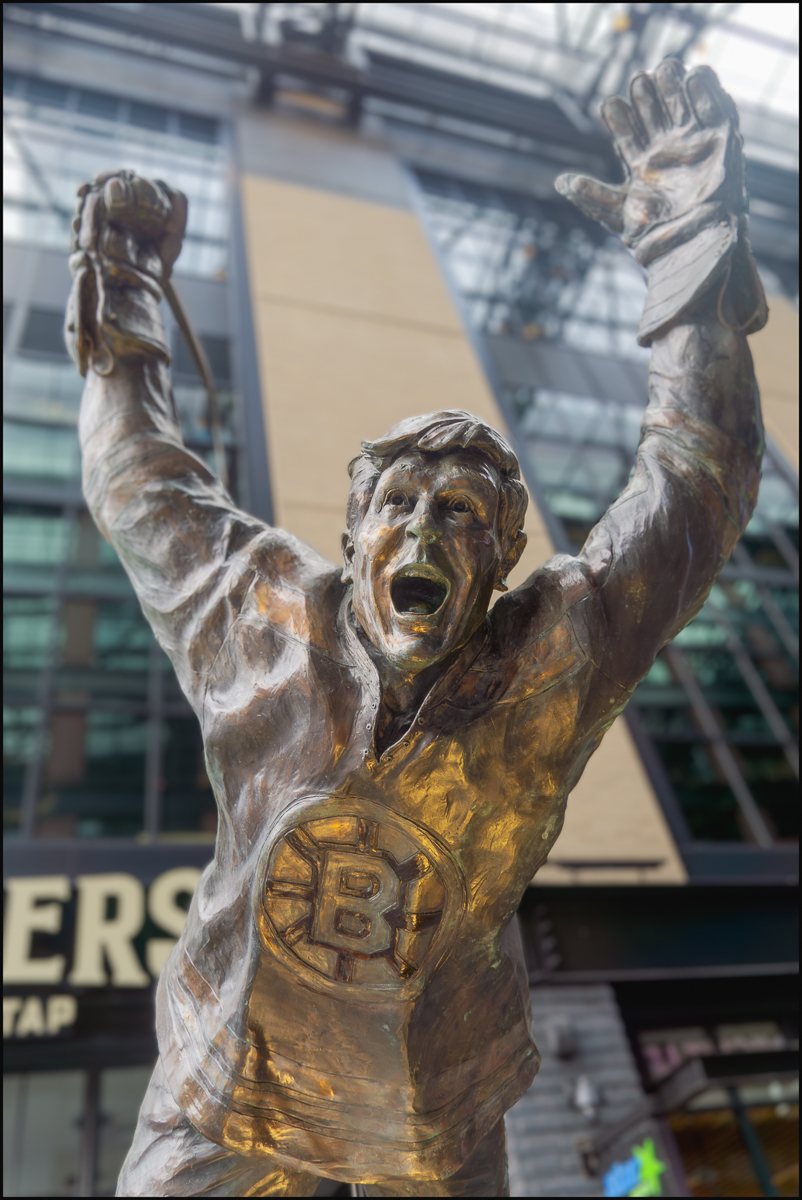
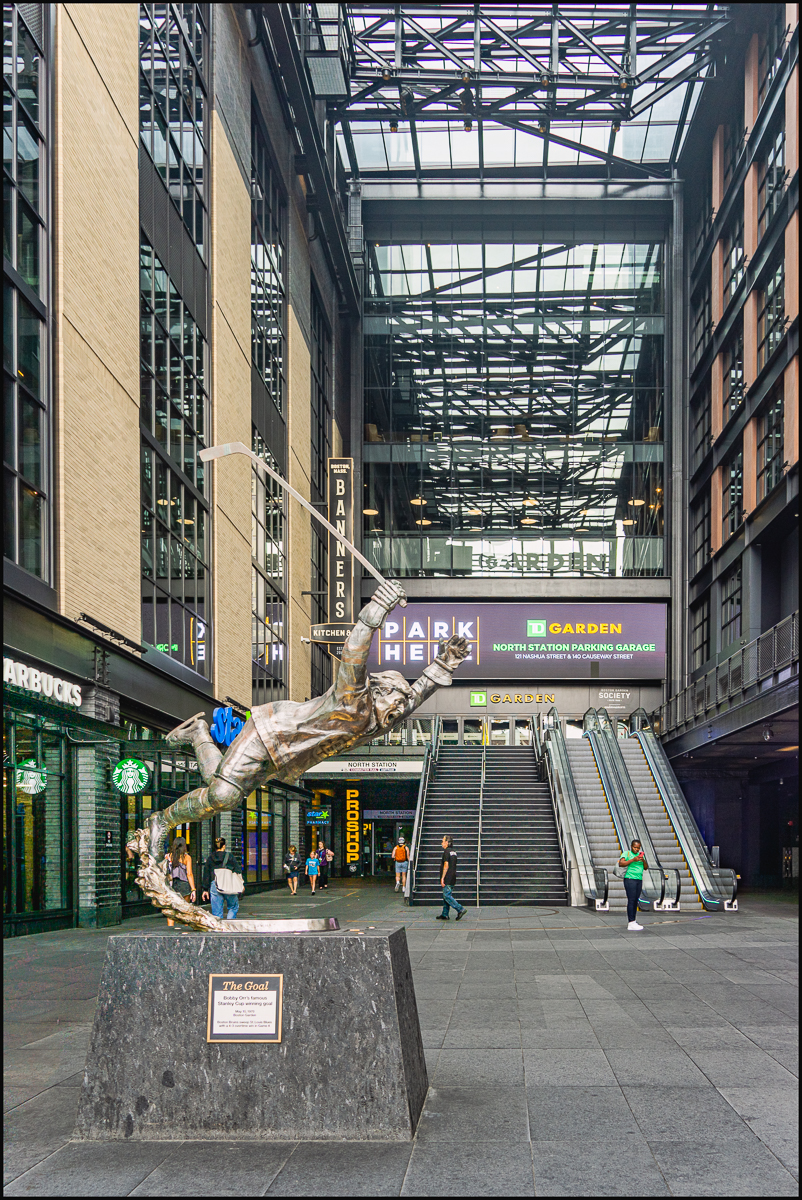
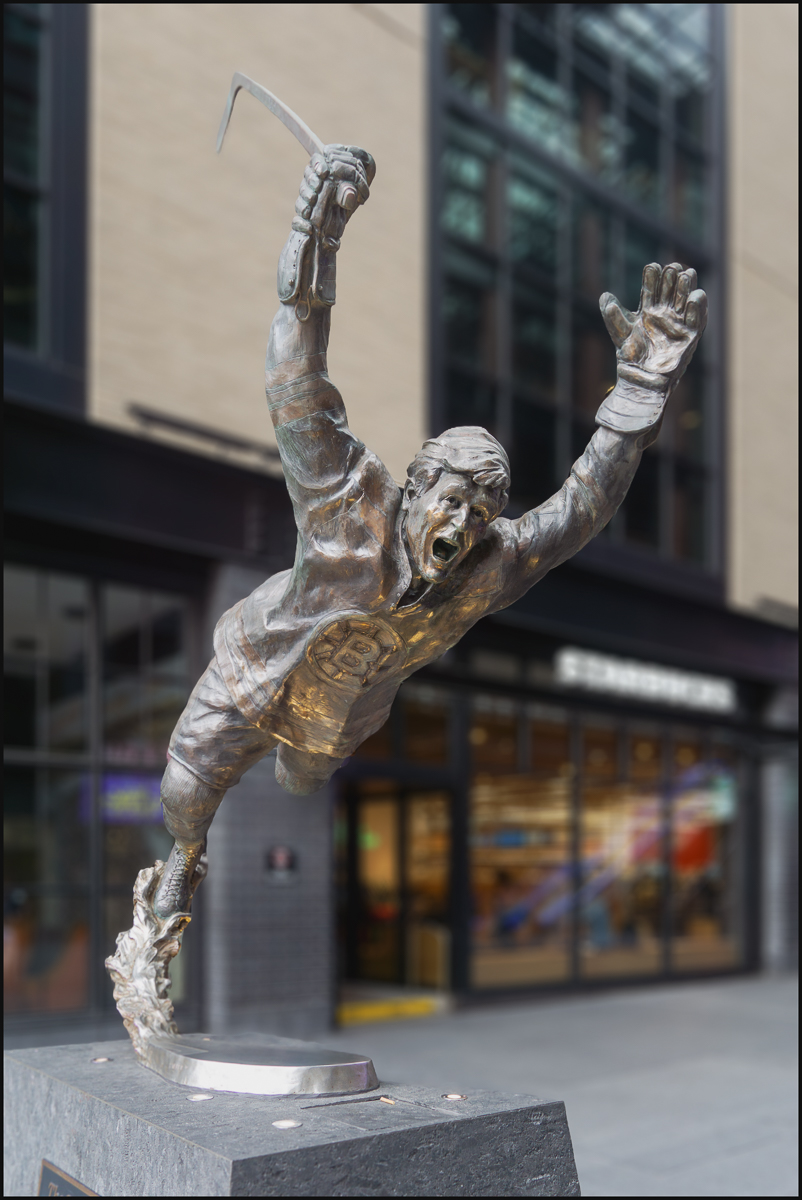
While waiting for the bus I spotted this statue and went over to take some pictures. A sign on the statue read:

The Goal. Bobby Orr’s famous Stanley Cup winning goal. May 10, 1970, Boston Garden. Boston Bruins sweep St. Louis Blues with a 4-3 overtime win in Game 4.

The “goal” in question was one of the most famous goals scored in hockey history and one that gave Boston its first Stanley Cup since 1941. The goal came from a pass from teammate Derek Sanderson at the 40-second mark of the first overtime period in the fourth game, helping to complete a sweep of the St. Louis Blues. According to Orr:

If it had gone by me, it’s a two-on-one, so I got a little lucky there, but Derek gave me a great pass and when I got the pass I was moving across. As I skated across, Glenn had to move across the crease and had to open his pads a little. I was really trying to get the puck on net, and I did. As I went across, Glenn’s legs opened. I looked back, and I saw it go in, so I jumped.

Orr, tripped after scoring “The Goal”, went flying across the ice. The subsequent photograph by Ray Lussier of a horizontal Orr flying through the air, his arms raised in victory – he had been tripped by Blues’ defenceman Noel Picard after scoring the goal – has become one of the most famous and recognized hockey images of all time—and today is highlighted in the opening sequence of the Canadian Broadcasting Corporation’s Hockey Night in Canada telecasts.

The statue is An 800-pound (360 kg) bronze statue of Bobby Orr. The sculpture was designed by Harry Weber and unveiled on May 10, 2010.


Taken with a Sony A6000 and 18-135mm f3.5-5.6 OSS.