Henri Cartier Bresson on Rules

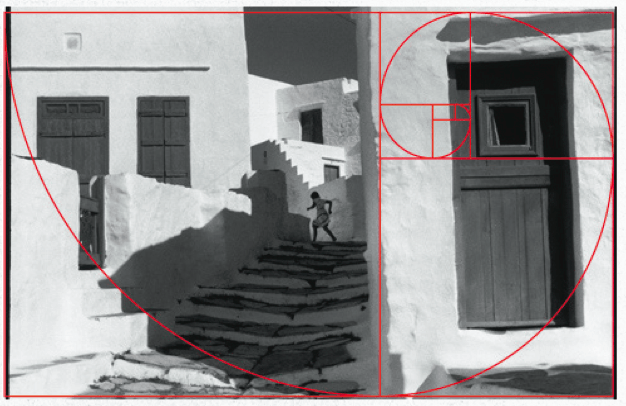
Fibonacci spiral above a photo by Henri Cartier-Bresson. Source: Eric KimObjectivity vs Subjectivity: What Makes a Great Street Photograph?

Here’s what Mr. Cartier Bresson had to say on the subject in “The Decisive Moment“:

In applying the Golden Rule, the only pair of compasses at the photographer’s disposal is his own pair of eyes. Any geometrical analysis, any reducing of the picture to a schema, can be done only (because of its very nature) after the photograph has been taken, developed and printed – and then it can be used only for a port-mortem examination of the picture. I hope we will never see the day when photo shops sell little schema grills to clamp onto our viewfinders; and that the Golden Rule will never be found etched on our ground glass.

Curiously this is exactly what has happened. All three of my digital cameras allow various grids to be superimposed on the viewfinder. Thenkfully it’s possible to turn off the grids rather than have them etched permanently on “our ground glass”.

The above picture is taken from a long (4000 plus words) post on Eric Kim’s blog. It contains many other pictures, several of which have similar geometrical shapes on them. I guess Mr. Kim is engaged in exactly the kind of “post mortem” that Cartier-Bresson talks about. It seems clear that whatever “rules” Cartier-Bresson followed he wasn’t thinking about them too much at the time he pressed the shutter. Possibly he had absorbed them to such an extent that they were such a part of him and had become intuitive. Or maybe he was just a natural.
Stone Building in Fahnestock State Park

Numerous quaint stone buildings are scattered around Fahnestock State Park. I believe they were built by the Civilian Conservation Corps. The Friends of Fahnestock and Hudson Highlands State Parks (FOFHH) site has a section on the history of the park, which states:

Work on park improvements at Fahnestock began almost immediately [1930] and a few years later benefitted from the establishment of Civilian Conservation Corps camps in the park. The CCC program included the construction of dams at Pelton Pond, Stillwater and Canopus lakes, a downhill ski area, the camping area, Pelton Pond picnic area, comfort stations, shelters, roads, hiking and equestrian trails. The parkway was constructed under a series public works contracts and opened to Route 301 in 1935. The Canopus Beach complex and the Taconic Outdoor Education Center were constructed in the late 1970s. Fahnestock continued to expand and at 14,082 acres (in 2010), it is the largest park in the Taconic Region.

A Floating Market

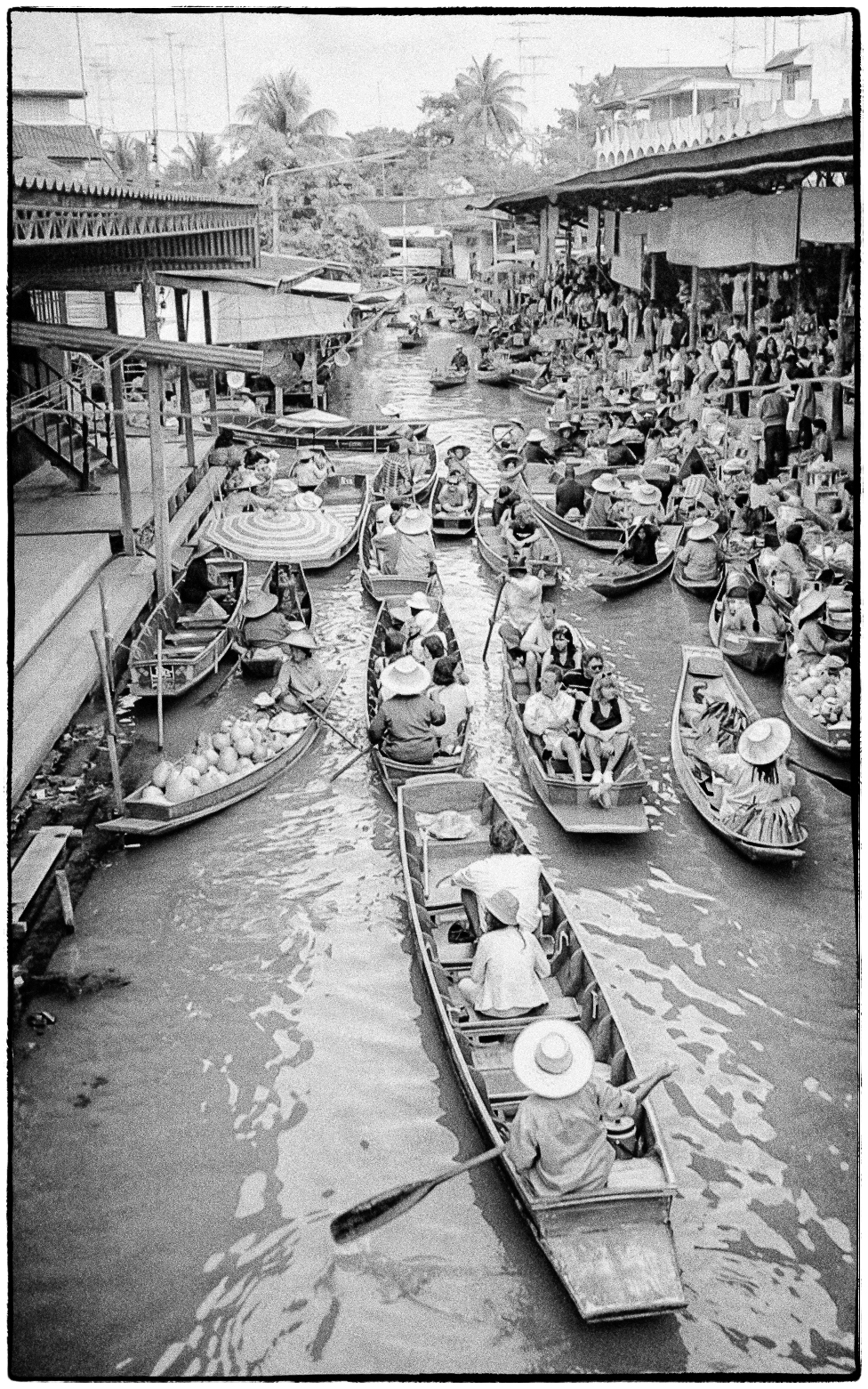
Scan of a negative probably taken in the early 2000s at a floating market outside of Bangkok, Thailand. The floating markets hark back to a time when water transport played a more significant role in everyday life than is now the case. Most of the markets are now tourist traps. I believe this is Damnoen Saduak Floating Market in Ratchaburi. Lonely Planet describes it as follows:

The most famous of the floating markets – the one you’ve seen photographed hundreds of times –is the Damnoen Saduak Floating Market . You can hire a boat from any pier that lines Th Sukhaphiban 1, which is the land route to the floating market area. The going rate is 150B per person per hour, but you’ll need to haggle to get it. The 100-year-old market is now essentially a floating souvenir stand filled with package tourists. This in itself can be a fascinating insight into Thai culture, as the vast majority of tourists here are Thais, and watching the approach to this cultural ‘theme park’ is instructive. But beyond the market, the residential canals are quite peaceful and can be explored by hiring a boat for a longer duration. South of the floating market are several small family businesses, including a Thai candy maker, a pomelo (shaddock, a type of citrus) farm and a knife crafter.

I don’t recall what camera I was using but it was probably either a Canon AE-1 or a Minolta Hi-Matic 7sII.

A Splash of Color in the Woods

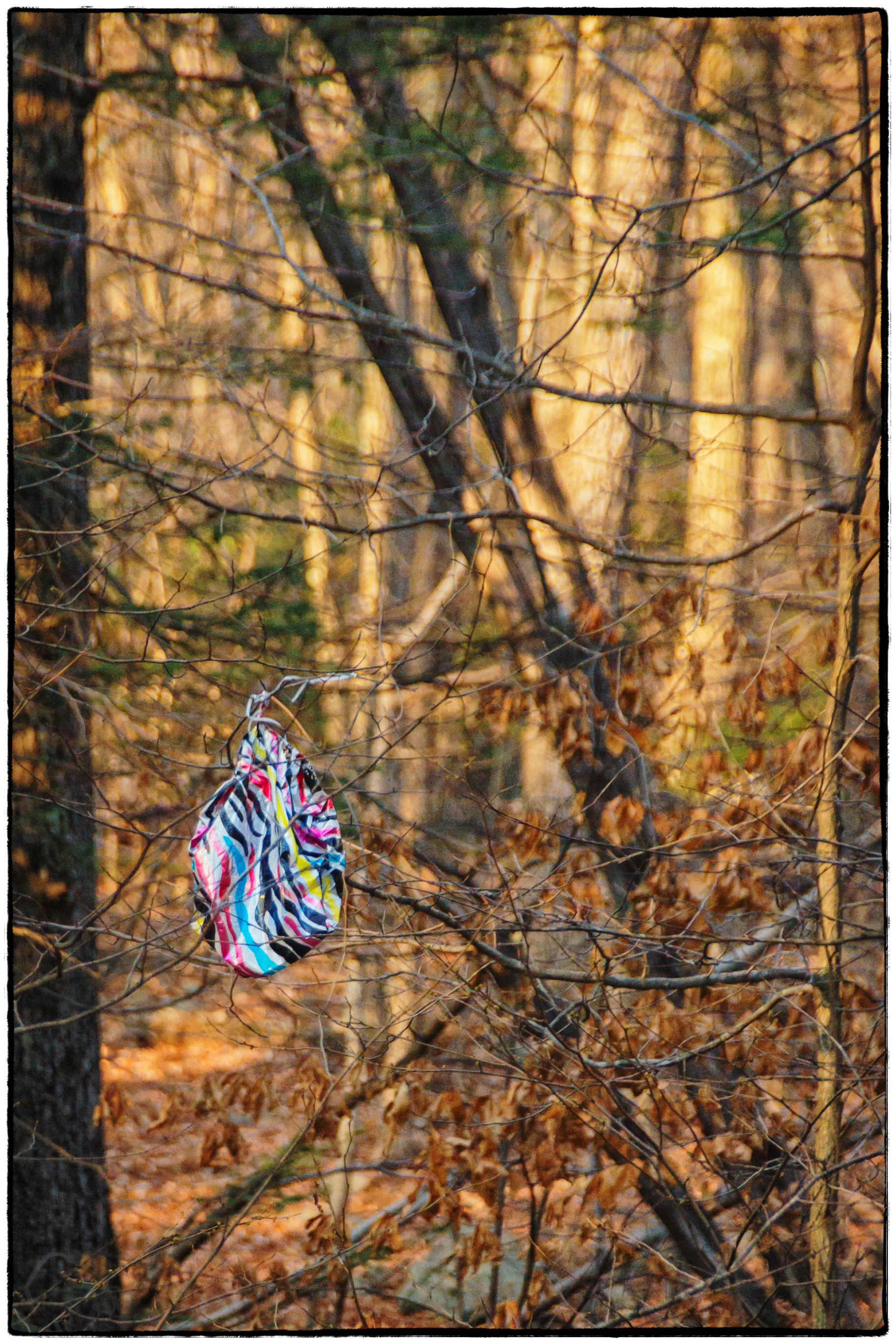
Walking in the woods in late fall is a pretty monochromatic experience – all warm colors: yellows, browns and oranges. So I was quite surprised when I saw a flash of color. It was fairly far away so I didn’t at first know what it was. As I got closer I realized that it was a deflated balloon. It must have just floated over and then got stuck in this tree.