Taken early in the morning of October 2, 2012 with a Sony NEX 5N with its 18-55mm kit lens. The lake was as smooth as glass. I liked the muted colors and the way that almost nothing but the floating dock in the foreground is really clear. Also liked the way that the various objects (dock, island, beach on the right) fade progressively into the background, becoming less and less distinct until the far north end of the lake is virtually invisible. The effect didn’t last long. I have another picture taken about 50 minutes later and the fog has virtually all gone.
A Watcher
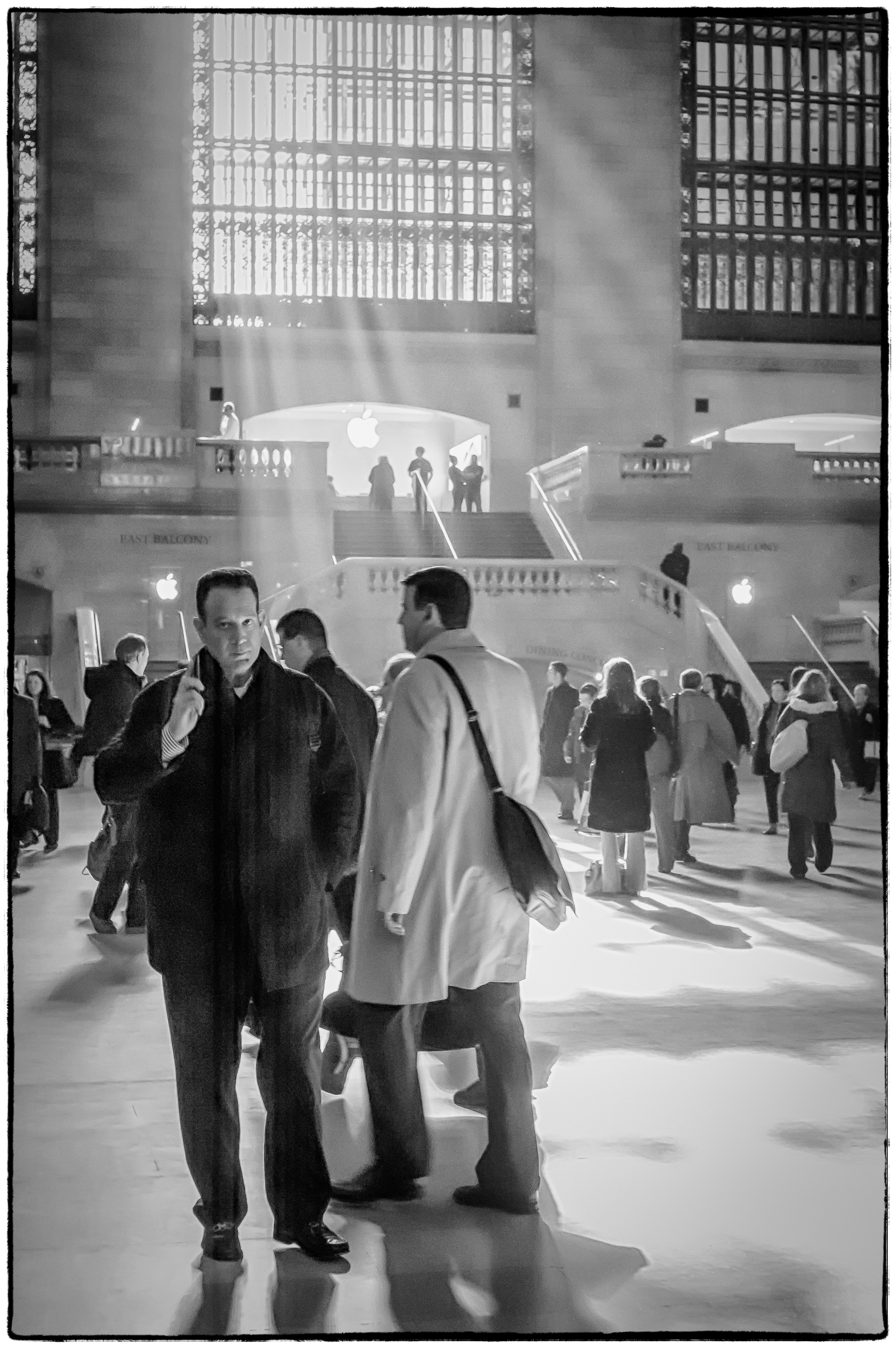
Judging by the time stamp on the picture I was passing through Grand Central on my way to work. What caught my attention first was the bright sunlight streaming through the windows at the east end of the terminal. Then I started to pay more attention to the people busily rushing around inside the terminal – particularly this guy who was watching me (a little suspiciously I thought) take pictures. Remember this was only six months after 9/11 and people were still, perhaps understandably, a little fearful. So I quickly took a few shots and then moved on. In any case I had to get to work even if I was, at that time, only weeks away from retirement (the lens was actually a retirement gift from my colleagues).
Taken fairly early in the morning in March, 2012 with a Sony Nex 5N and a legacy lens of some kind (I didn’t note which one and so can’t identify it although I suspect it is a Voigtlander 35/2.5 C Color Skopar in Leica Thread Mount). Technically it’s not such a great picture. It was quite dark and the contrast was quite extreme. The result is a bit fuzzy – from the high ISO and motion blur from slow shutter speeds. I still like it though.
Photos and Stuff
I came across this blog from Kirk Tuck’s wonderful site: The Visual Science Lab.
This blog’s ‘About’ page says the following:
I’m a cranky old bastard who has been taking crappy pictures for 20 years or so. I’m full of opinions and ideas about photography, but not terribly good at putting them into practice. So it goes.
This blog is a place for me to put those ideas and opinions, so that I don’t have to keep them bottled up inside, nor try to explain them off the cuff and on the fly.
There’s much to like in this blog. The author seems to be very knowledgeable in a number of areas. He writes well and is often quite amusing. As he suggests in his ‘About’ section he’s “full of opinions and ideas about photography” and he’s certainly not afraid to voice them. He’s also quite prolific so there’s no want of things to read. As I only came across his blog yesterday I spent a large part of the day reading it and I thoroughly enjoyed it. I also learned a great deal.
For a photography blog I was surprised to find so little actual photography. The blog is virtually devoid of photographs. Maybe he likes to keep his opinion pieces separate from his photographs. If so then I had great difficulty finding them on the internet. Again maybe he prefers print rather than internet.
Although I like the blog there’s something about it that makes me a bit uneasy. First he really seems to have it in for Ming Thein. Don’t get me wrong these attacks are not directed at Ming himself, as much as they are about what he represents: a certain type of photography pundit that appears to thrive on the internet. He’s even somewhat complementary (very rarely) to some of Ming’s work. I understand, and largely agree, with what he’s saying but after a while harping on this issue becomes too much. The first couple were fun, but after a while I started to thing “Oh no! Not another piece on Ming Thein”. As Internet attacks go though his anti-Ming diatribes are quite mild. Maybe I’m over-reacting. After all I’m British and as someone once said the British and excruciatingly polite to their enemies and insult their friends.
As mentioned above the author is very good at opinion pieces. However, it would be wise not to forget that these are just that:opinions – not gospel. I have a friend who is somewhat similar. He can formulate opinions extremely quickly, perhaps faster then anyone else I know. He too is also very articulate and expresses his opinions quite forcefully. He comes across as if he has all the answers. Unfortunately, knowing him as I do I also know that often his quickly formed opinions are based on quite scanty knowledge. There’s nothing wrong with this and I admire him greatly for the way he’s able to do it. It’s very much a case of ‘buyer beware’. It’s up to those receiving the opinions to validate their worth. The reader must not uncritically take on the views of the author just because they sound convincing.
There’s an interesting section For Beginners.
I heartily recommend this blog. Go take a look!

NY Air Show – ANG 106th Rescue Wing CSRA Demo
According to the NY Air Show Website:
The 106th Rescue Wing deploys worldwide to provide combat search and rescue coverage for U.S. and allied forces. They are a World-Class Team of diverse, adaptable personnel recovery focused war fighters. The mission of the 106th Rescue Wing is to provide worldwide Personnel Recovery, Combat Search and Rescue Capability, Expeditionary Combat Support, and Civil Search and Rescue support to Federal and State authorities. They provide Personnel Recovery to the state of New York and deployed operations that they are tasked to support.
The Pararescuemen of the 106th Rescue Wing or “PJs” are among the most highly trained emergency trauma specialists in the U.S. military. They must maintain an emergency medical technician-paramedic qualification throughout their careers. With this medical and rescue expertise, along with their deployment capabilities, PJs are able to perform life-saving missions in the world’s most remote areas.
The 106th Rescue Wing utilizes HH-60G Pave Hawk helicopters and HC-130 aircraft to carry out their mission. The primary mission of the HH-60G Pave Hawk helicopter is to conduct day or night combat search and rescue, or CSAR, operations into hostile environments to recover downed aircrew or other isolated personnel during war. Because of its versatility, the HH-60G is also tasked to perform military operations other than war. These tasks include civil search and rescue, emergency aeromedical evacuation, disaster relief, international aid, counter drug activities and NASA space shuttle support.
The HC-130’s mission is to rapidly deploy to execute combatant commander directed recovery operations to austere airfields and denied territory for expeditionary, all weather personnel recovery operations to include airdrop, airland, helicopter air-to-air refueling, and forward area ground refueling missions. When tasked, the aircraft also conducts humanitarian assistance operations, disaster response, security cooperation/aviation advisory, emergency aeromedical evacuation, and noncombatant evacuation operations.
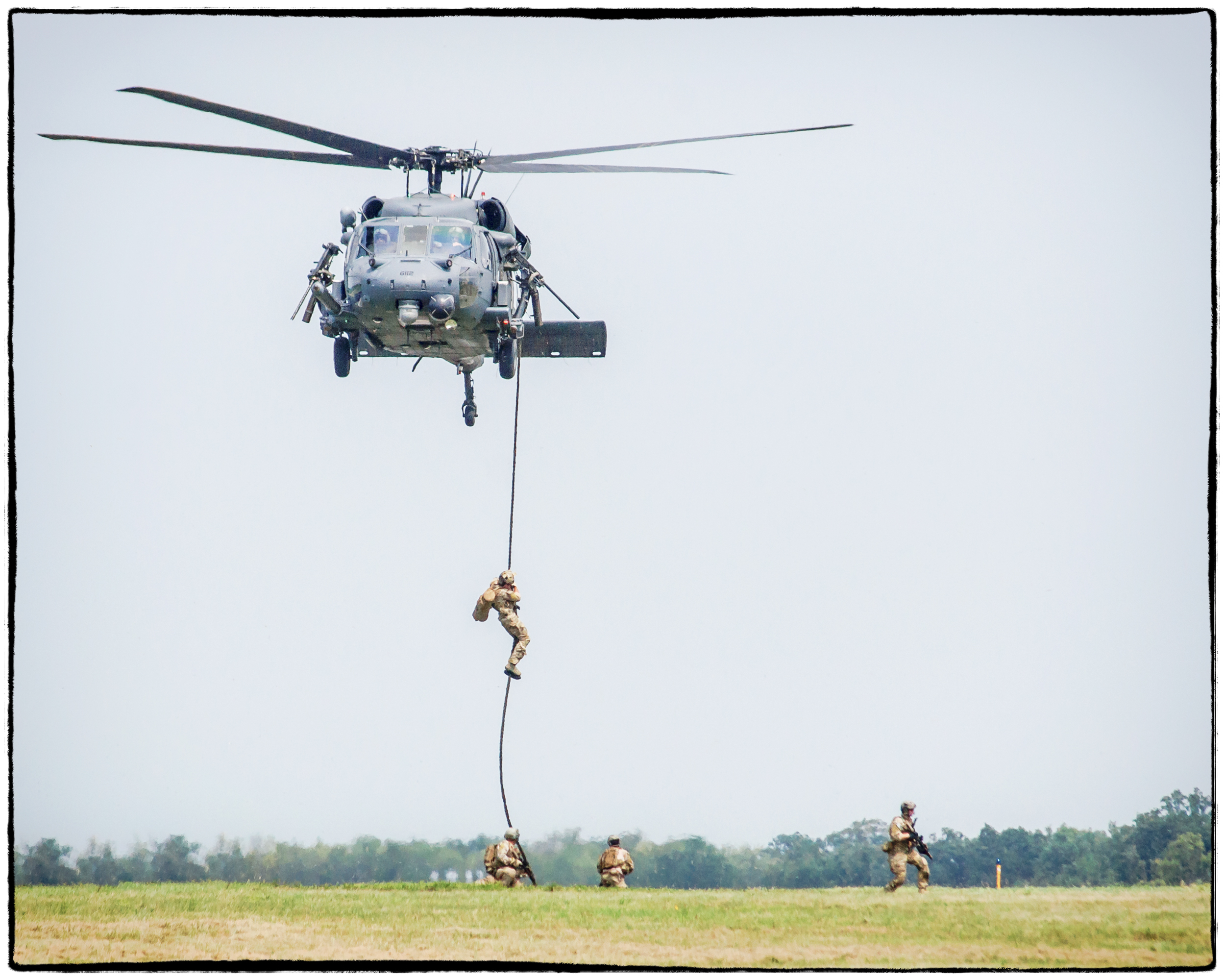
Dropping Off.
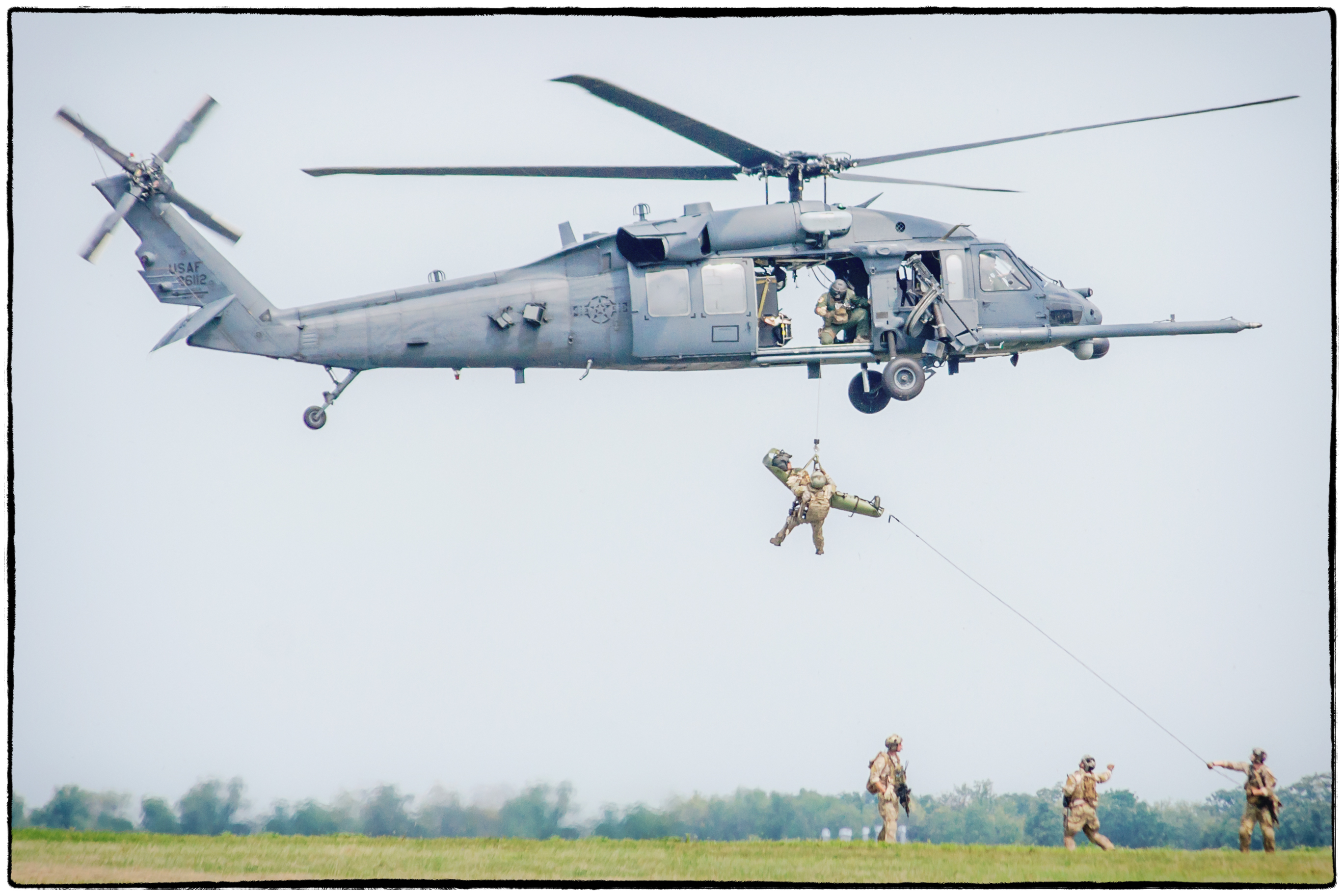
Picking Up.
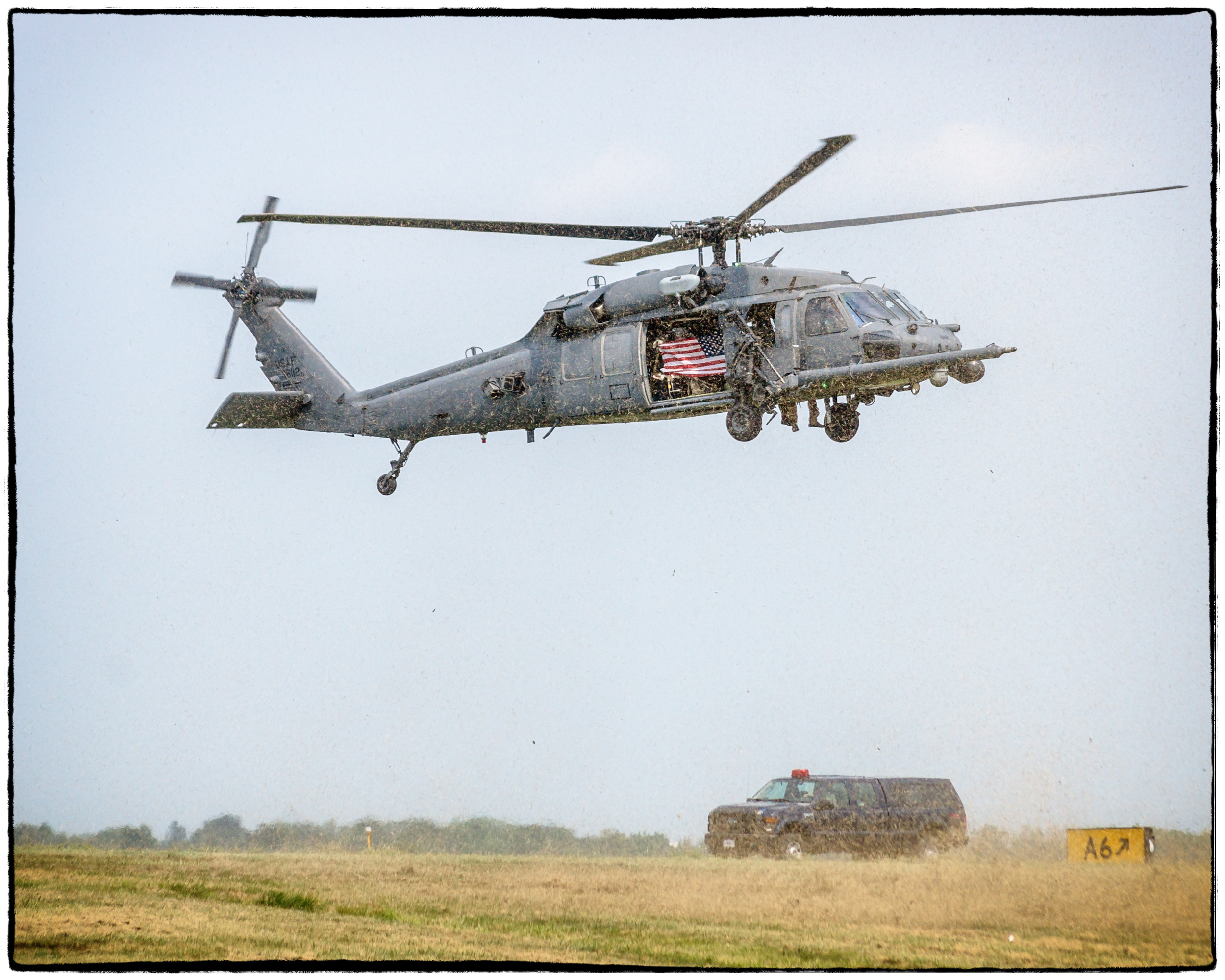
Leaving in a flurry of dust and grass clippings.