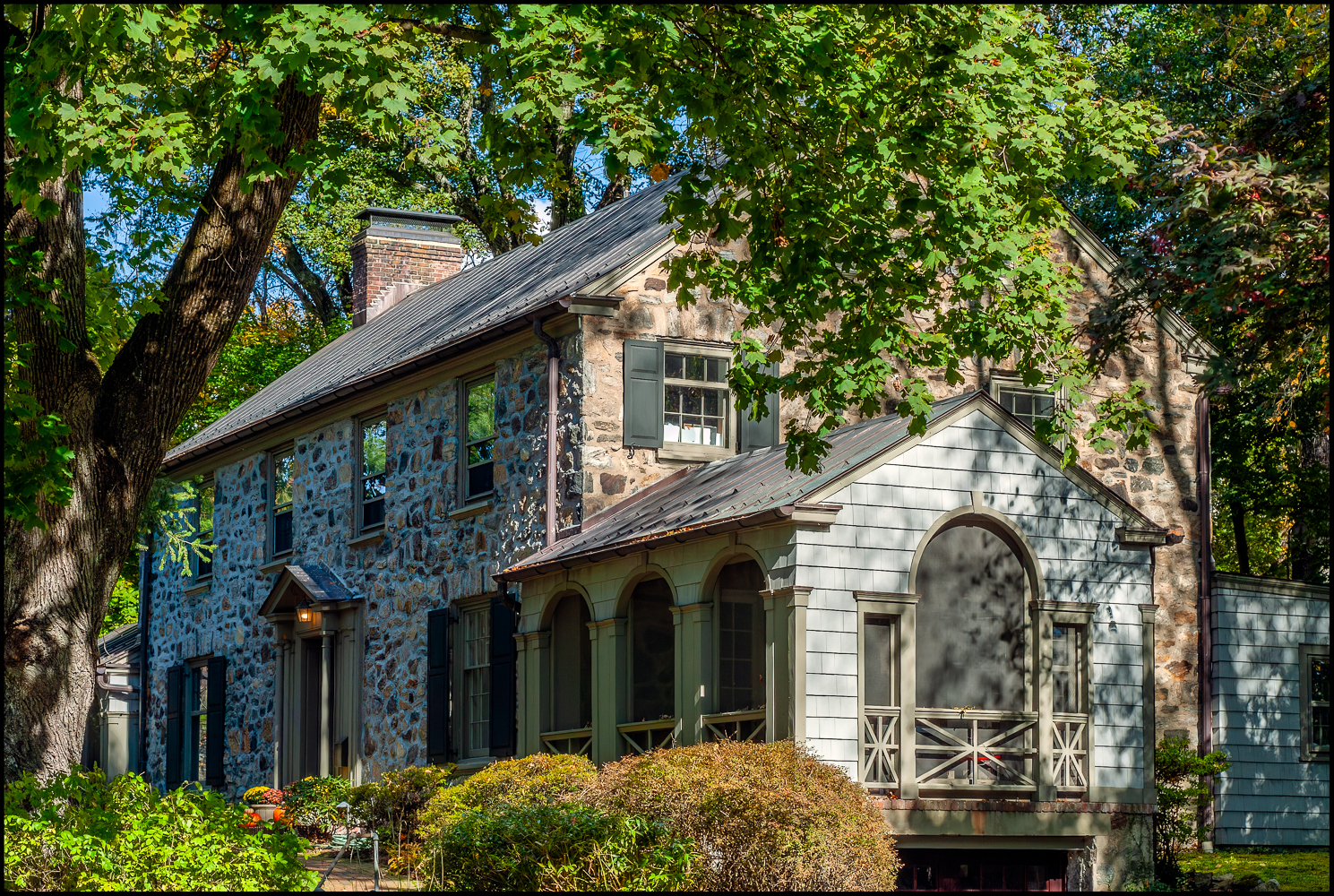
I came across this impressive stone house on a side street in Briarcliff Manor. I’ve haven’t been able to find out much about it so far, other than that it seems it was at one time owned by someone called “Julia”. This was probably Julia C. Stimson, who lived
“…’in Briarcliff Manor after World War II until her death and was the first woman to hold an officer’s rank in the in the Army Nurse Corps. She was designated a major in 1920 and elevated to colonel in 1948, after her retirement. A graduate of Vassar College and New York Hospital School of Nursing, Stimson was a superintendent of Nursing in St. Louis. When the United Stated entered World War I, “she volunteered at once and, in dark blue dress and long cape, sailed…for France to become chief nurse of base Hospital 21, “and was soon directing the activities of ten thousand American Red Cross Nurses in France. From 1919 until 1937 she was superintendent of the Army Nurse Corps. In this post, and from 1938 to 1944 as president of the American Nurses Association, she worked for higher professional standards and improvement of the status of nurses. During World War II, Stimson was chairman of the Nursing Council on Defense until, in 1942, she was recalled to active duty in the Army Nurse Corps and assigned to recruiting more nurses from all over the country.
For her services in World War I, Colonel Stimson received the Distinguished Service Medal, the Florence Nightingale Medal of the International Red Cross, and British and French awards, and was cited by General John J. Pershing for “exceptionally meritorious and conspicuous service.” She was the author of War Letters, published in 1918, a volume based on her experiences in France, and the Nurses’ Handbook of Drugs and Solutions, published in 1910″ (Mary Cheever, “The Changing Landscape, a history of Briarcliff Manor -Scarborough”
In conversation with the owner of the house in 2004 (Betsy Gross) a former member of the Briarcliff Manor-Scarborough Historical Society was told that Ms. Gross’s parents purchased the house directly from “Julia” about 1956 (Note: this is clearly incorrect as “Julia” passed away in 1948!). “Julia” returned to visit them at least once a few years later (she was upset because a tree had been removed from the property). Ms. Gross also mentioned that the house is called “Boulder House”. The house (a fieldstone colonial) was originally built in 1909.
For more information on Julia C. Stimson see her Wikipedia entry, which contains this rather interesting sentence: “Following her death, the Stimson family spread her ashes by a stream on her property in Briarcliff Manor, New York.” That stream is actually the Pocantico River.
Taken with a Nikon D200 and Nikon AF Nikkor 50mm f1.8 D