Confused by the bewildering array of Canonets

In January of 1961, Canon introduced the Canonet, a consumer-friendly 35mm film rangefinder camera aimed at the average person. Over fifty years and fourteen variations later, film photographers still look back on the Canonet as an excellent choice for beginning and experienced photographers alike. Let’s travel back in time to see how it all began and why the Canonet remains popular even today.

Source: A Brief History of the Canon Canonet Rangefinder.

The Canonet QL-17 GIII is one of the best regarded of the fixed lens, compact rangefinder cameras. I have one, but have yet to try it out. However, in browsing around I’ve also noticed that there are many more Canonet models (e.g. original canonet; canonet 28, canonet 25; canonet 17 (no ql); canonet 17 – no GIII. Wikipedia lists no less than 17 different models including four 17’s and four 19’s – only one of which is covered in detail: the QL-17 GIII) I can guess that the number indicates the largest aperture and that the QL indicates that the camera has a “quick load” system. But I’ve no idea what the GIII means (third generation maybe?). I’ve also seen references to something called a “new” canonet. It’s all very confusing. I have a excellent book (Canon Rangefinder Cameras 1933-68 by Peter Dechert) on Canon rangefinder cameras, but it only deals with the older, Leica Thread Mount cameras. There are also multiple models of these – many of which look practically the same (what exactly is the difference between a Canon IV, IVSB, and IVSBII for example?). So the book didn’t help.

So I was excited when I came across this article on Petapixel. After I read it I was still somewhat bewildered, but it certainly helped. Maybe if I read it a few more times it will become clearer.
Mike Eckman on old cameras

Source: Mike Eckman – Breathing New Life into Old Cameras

.

I just discovered this site by Mike Ekman. The photography section has lots of information on classic cameras. Each camera has an extensive review (much more detailed than reviews on most other sites I’ve come across). Pictures of the cameras are also provided as well as sample photographs taken with the camera. So far getting on for 50 cameras have been reviewed (I think the actual number is 43).

There are also other useful articles not related to a specific camera such as: Breathing New Life into Old Cameras; Mike’s Guide to Buying Old Cameras; and What Is My Camera Worth?

If you’re into old cameras this is well worth looking at.

According to Mike:

I made my first old camera post in August 2014. At that time, I had no idea where this hobby would take me. I already had an interest in digital photography, but acquiring 100 year old film cameras wasn’t something I had ever considered. I was on my third Nikon DSLR and had already started to acquire some extra Nikkor lenses and accessories, but never did I think that I would become so interested in this “subculture” of photography, and certainly would have never thought I would one day be a resource for other people to learn about these wonderful devices or how to repair them.

Eighteen months have passed since that first post, and while I still would never consider myself to be an authority on old cameras or their repair, I have learned a few things along the way that I think are worth sharing. I’ve taken apart 20-30 cameras and in most cases, have been able to put them back together in better shape than when I started. Sure, there have been some failures like my attempt at replacing curtains on a Soviet made FED 2 camera, or correcting a mirror problem on a junk box Pentax Spotmatic, but my successes greatly outnumber my failures and I feel the time has come to try and pass on what I’ve learned.

Source: Breathing New Life into Old Cameras

Be sure to read his disclaimers (as described in Breathing New Life into Old Cameras) though.

Old Cameras 

Interesting YouTube channel from Ade Torrent on, as the name implies, old cameras. I’ll leave it to the video to explain what it’s all about, but if you’re interested in camera collecting you’ll certainly find it useful (with certain caveats – see below).

He’s so far considered the following cameras: Zenit-E; Kiev-4; Praktica BX-20; Olympus 35-RC; Ihagee Exa; Lomo Lubitel 166B; Yashica Electro 35 GTN; Lomo Smena 8M; Fotorama PC-500; Holga 120SF; Nikon F-501 AF; Mamiya 16-EE; Zeiss Super Ikonta 530. The videos are quite short (none of them so far are more than about 9 minutes) and fairly basic.

He’s very enthusiastic about his cameras, but this enthusiasm leads him, on occasion, to be less critical than he might be. For example he seems to like the focus free “plastic fantastic” Fotorama PC-500 as much as he likes the Olympus 35-RC, a vastly superior camera. Still if you’re not too familiar with old cameras this basic introduction can be very useful. For example he mentions that on some older cameras (e.g. the Kiev 4) you shouldn’t change with shutter speed until you have wound the shutter. This is certainly useful information as doing it the wrong way can lead to a broken shutter.

You can subscribe on the channel’s home page.

Fujica 35-ML

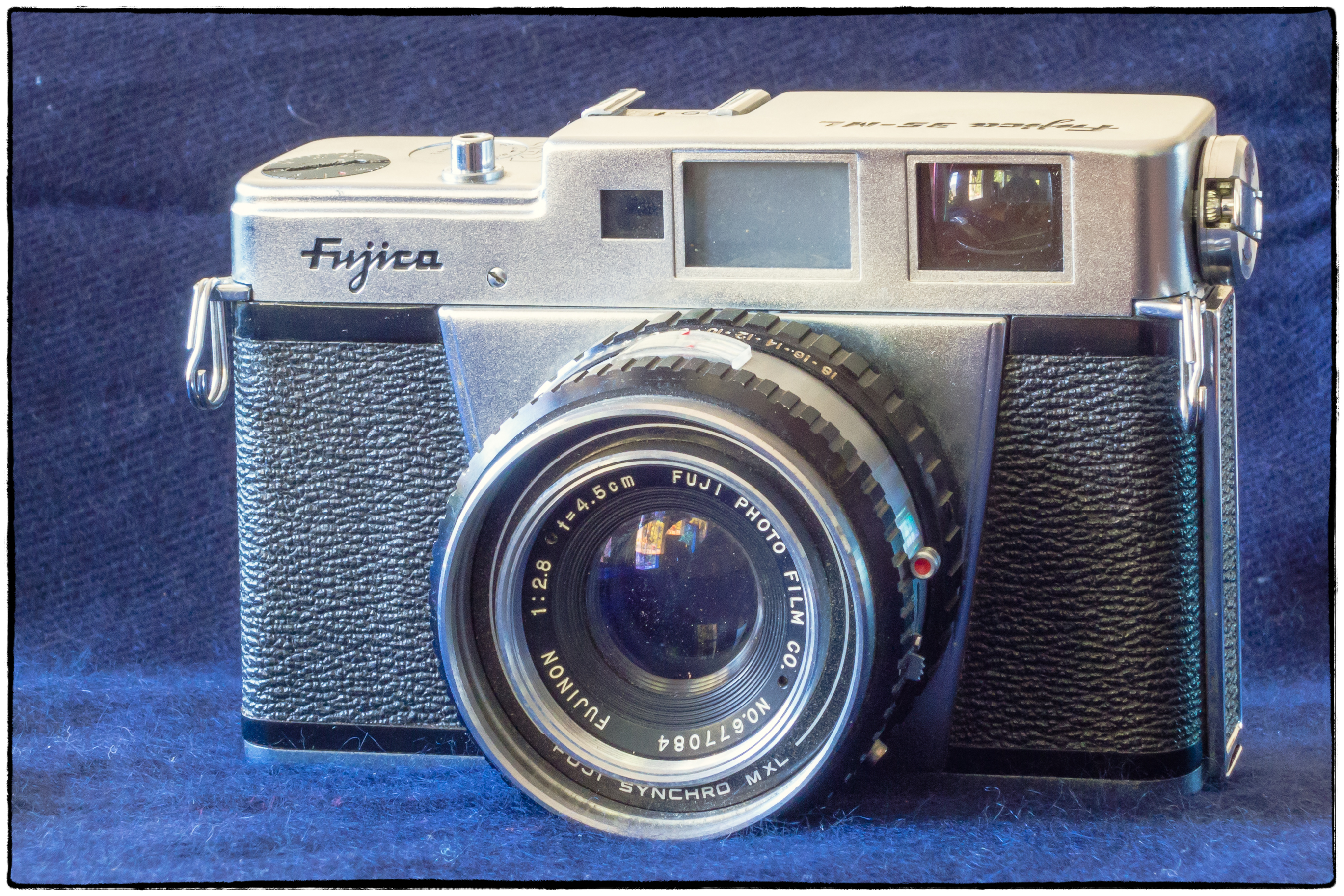
A few years ago I began my camera collection. After getting a couple of rangefinder cameras I started to browse the internet to see what others I might find and bumped into this post on photo.net: The Final Fujica’s Film. I liked the look of the camera and was somewhat taken by the images provided. Time went by and I would occasionally see one for sale, but until now I hadn’t actually gotten around to acquiring one. Recently, however, I saw this one. It was quite inexpensive and looked to be in fairly good condition. So I purchased it.

According to Sylvain Halgand’s wonderful site:

This camera has a coupled rangefinder and a parallax correction. An ultra-bright orange framing view is visible in the viewfinder and moves accordingly to the setting of distance. This setting is a first surprise because the setting is not made by turning a ring around the lens, but by turning a knob located where there is most often a film advance lever, it means under the right thumb. Distances are displayed by a rotating plate, located on the cover of the camera (near the frame counter) also serving as depth of field chart.

Accordingly, the film advance lever is below the camera without doubt in order to leave a body cover as flat as possible; the rewind crank is located on the side, such as a Leica.

The shutter speed and aperture settings are made by turning the two rings around the lens. A small window on the top of the lens displays the selected values. The values are combined using EV (exposure value).

The shutter allows shutter speeds from 1 second to 1/500 per sec, plus B. It has a self-timer, and M sync and X sync.

The lens is a Fujinon 45mm/2.8 with 5 elements.

In 1959, this camera was sold in the United States, § 69.95.

I was a little disappointed when it arrived. I’d bought it from a reputable dealer, from whom I’d bought a number of cameras in the past and with whom I’d always been satisfied. The camera was described as working and came with a decent warranty. However, when I examined it I noticed that in fact it wasn’t working – the shutter was stuck. I could have returned it under the warranty, but I’d paid so little for it I couldn’t be bothered. I’ve always had a yen to try fixing these older cameras. I’ve got to start somewhere. Maybe with this one?

And even if I never get it to work – so what! It still makes a decent display piece.

Minolta Hi-matic/Ansco Autoset

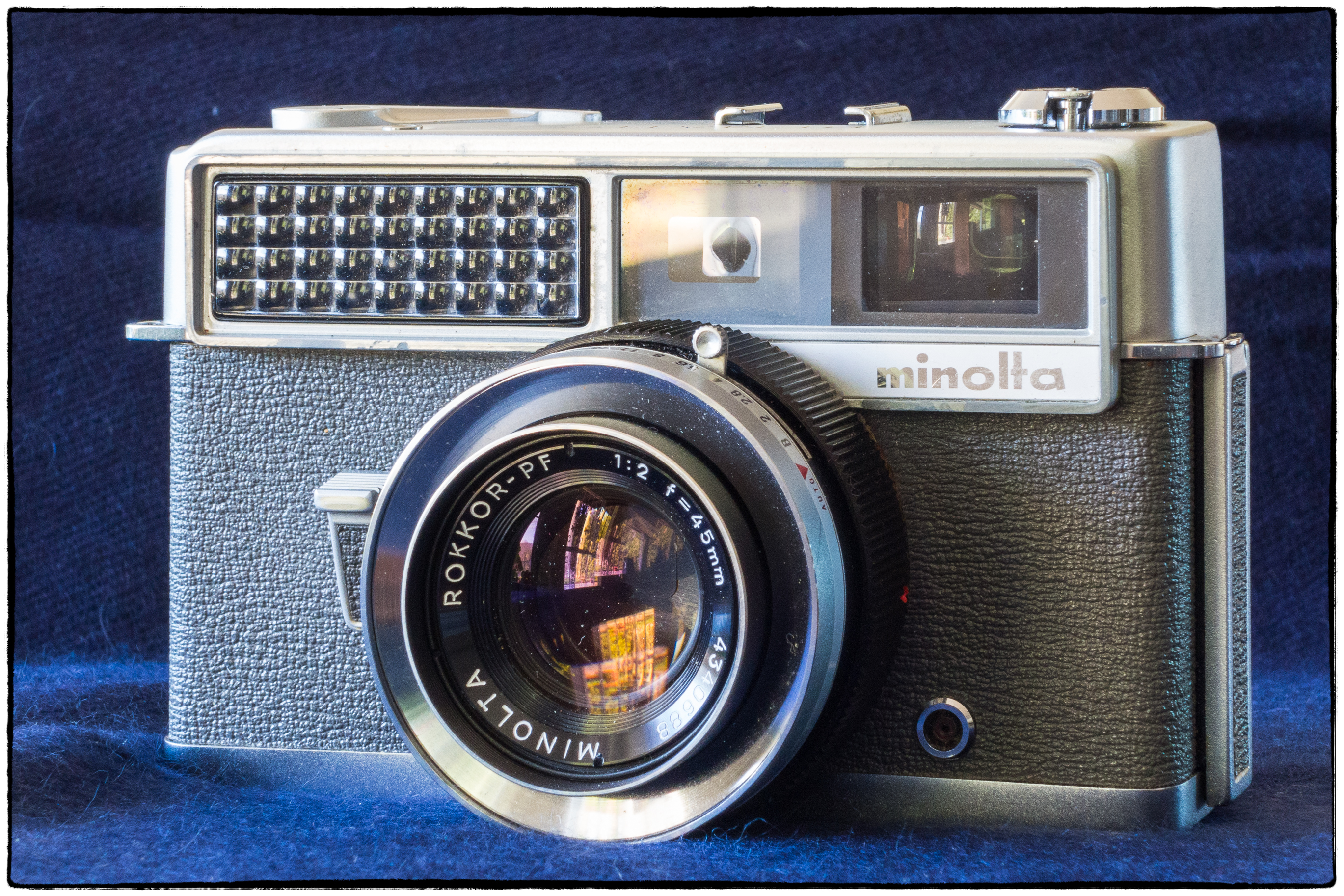
When I started collecting cameras I insisted on getting cameras that worked. After getting a number of them, however, I resigned myself to using only a few. So I don’t really expect to use this camera much – if at all. So why did I get it? I got it because it fits a couple of niches in my camera collection: 1) It’s a rangefinder camera, which I what I originally started collecting; 2) My original camera was a Minolta Hi-matic 7sii and I’ve always had an idea that I might collect all of the cameras in the series and this is the original Minolta Hi-matic, or as the re-badged US version was called: the Ansco Autoset; 3) The Ansco Autoset has an interesting story behind it – it may well have been the first camera in space:

Nearly 50 years ago, John Glenn purchased a camera at a drug store that served as the first astronomical experiment performed by a human in space. That three-orbit voyage for Glenn included two cameras, one the Ansco he purchased and the other a Leica supplied by NASA. The flight not only kicked off decades of orbital experiences for U.S. astronauts, but also science experiments, observations, and thousands of rolls of film and digital files created through hand-held photography. The results of those experiments and the photos taken are what people left on Earth use even today to understand human spaceflight.

Source: Another Journey for John Glenn’s Ansco Camera – AirSpaceAirSpace

John Glenn’s Ansco camera in front of “Friendship 7”

As can be seen in the picture above the camera was much modified. Note that the camera is upside down, with a handle added on top (bottom in the picture) and an additional viewfinder has been added to the bottom (top in the picture). Follow the link above to an article with more information.