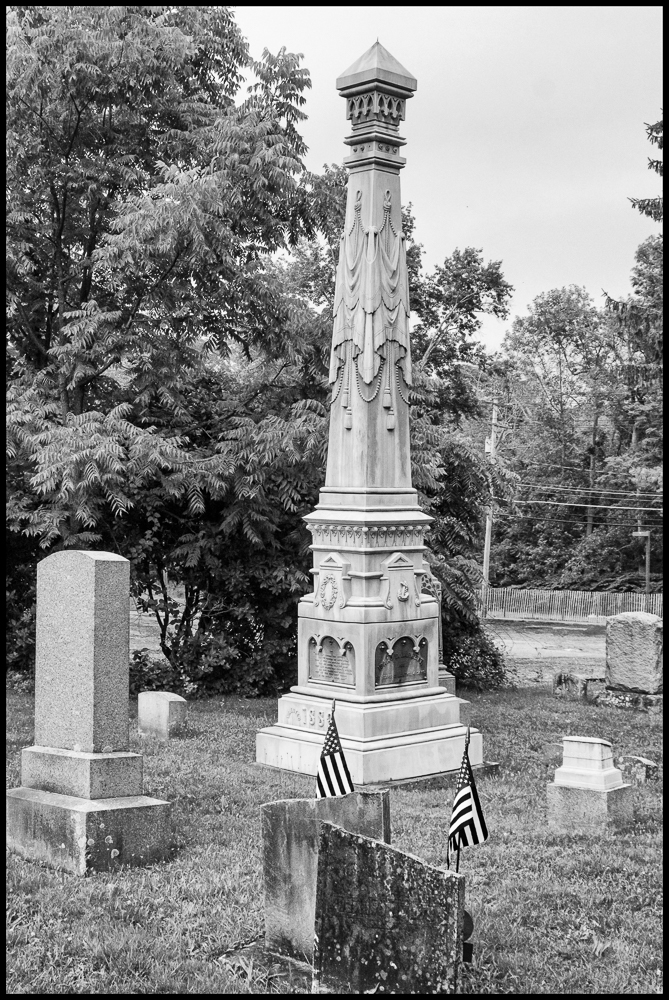
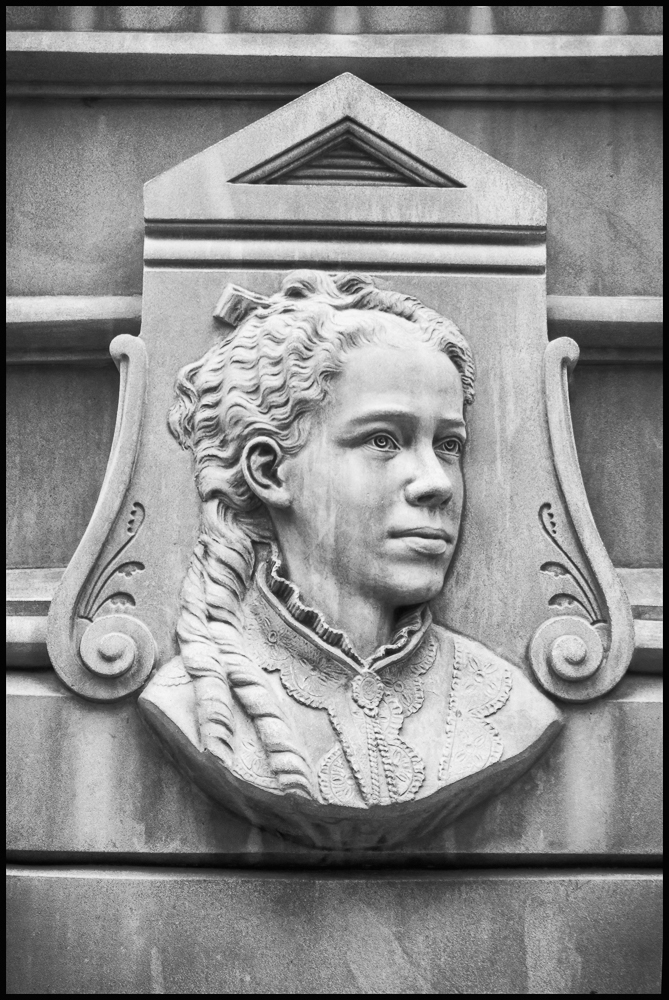
Around Mahopac – Red Mills Baptist Church. Ida E. Barrett Memorial

According to Find a Grave this is a memorial to Ida E. Barrett who died December 11, 1879 Age 22 years, 4 months, 22 days:

History of Putnam County NY Page 478

Isaac Barrett married Tamar, daughter of Abram Cronk, February 14th 1852. They were the parents of one daughter, who died December 11, 1879, at the early age of 22.

This young lady was a general favorite in the community, and a bright and shining ornament in the Baptist chruch of which she was a loved member. Her loss was deeply felt and greatly mourned. The following notice, which appeared in the papers, expressed the feeling of all who knew her: “Barett-At Mahopac Falls, N. Y., Dec. 11, 1879. Miss Ida E., only daughter of Deacon Isaac D. and Tamar A. Barrett, in her 23d year.

“Her life from childhood was devoted to Christ. She was baptized into the fellowship of the Mahopac Falls Baptist church in the 14th year of her age, and her spotless character and pleasant manner won the admiration and love of all. During her sickness of nearly five years her suffering was at times intense, and she had many fears that she would fail to gain heaven, but she never murmured. Her constant prayer was that Jesus might be with her, and Jesus indeed was. Her last days were passed in almost angelic serenity and she passed trustingly into promised rest.”

Taken with a Tamron AF Aspherical LD 28-200mm f3.8-5.6

The other battle of Yorktown – memorials

When we first moved to the Hudson Valley in 1998 I noticed that one of the nearby towns was called Yorktown and I mistakenly thought that this was the famous Yorktown where the battle took place that ended the Revolutionary War. Just shows how little I knew about the Revolutionary War at that time. As my knowledge increased I quickly realized that the famous Battle of Yorktown took place in Virginia and not in New York.

I was therefore intrigued to discover these two memorials when I was wandering around the First Presbyterian Church of Yorktown the other day.

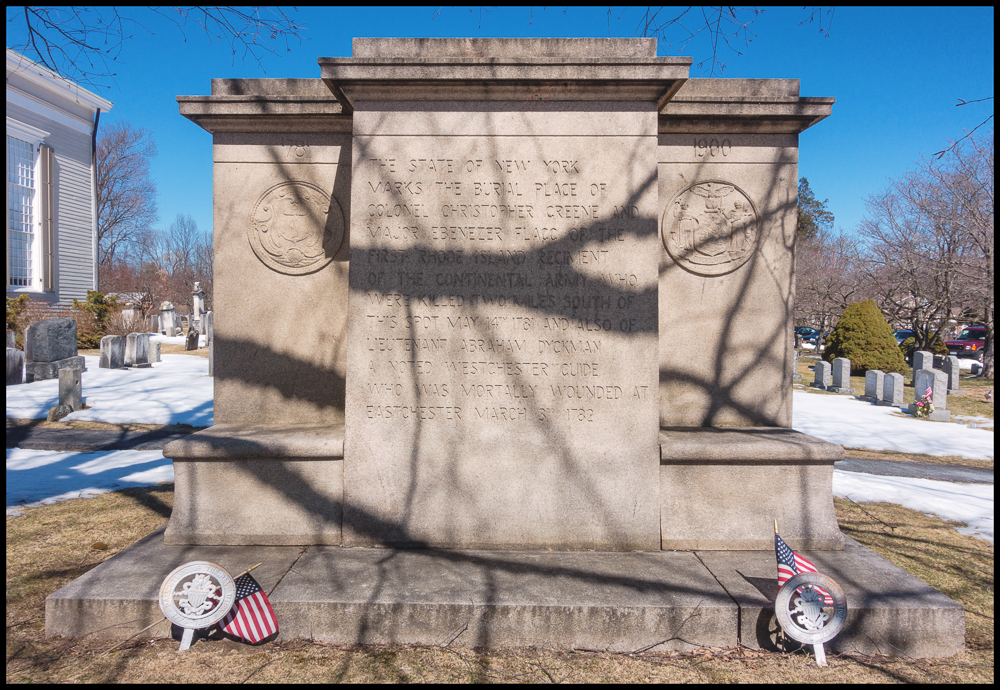
The first (above) reads:

The state of New York marks the burial place of Colonel Christopher Greene and Major Ebenezer Flagg of the First Rhode Island Regiment of the Continental Army who were killed two miles south of this spot May 1th 1781 and also of Lieutenant Abraham Dyckman A noted Westchester guide who was mortally wounded at Eastchester March 3rd 1782.

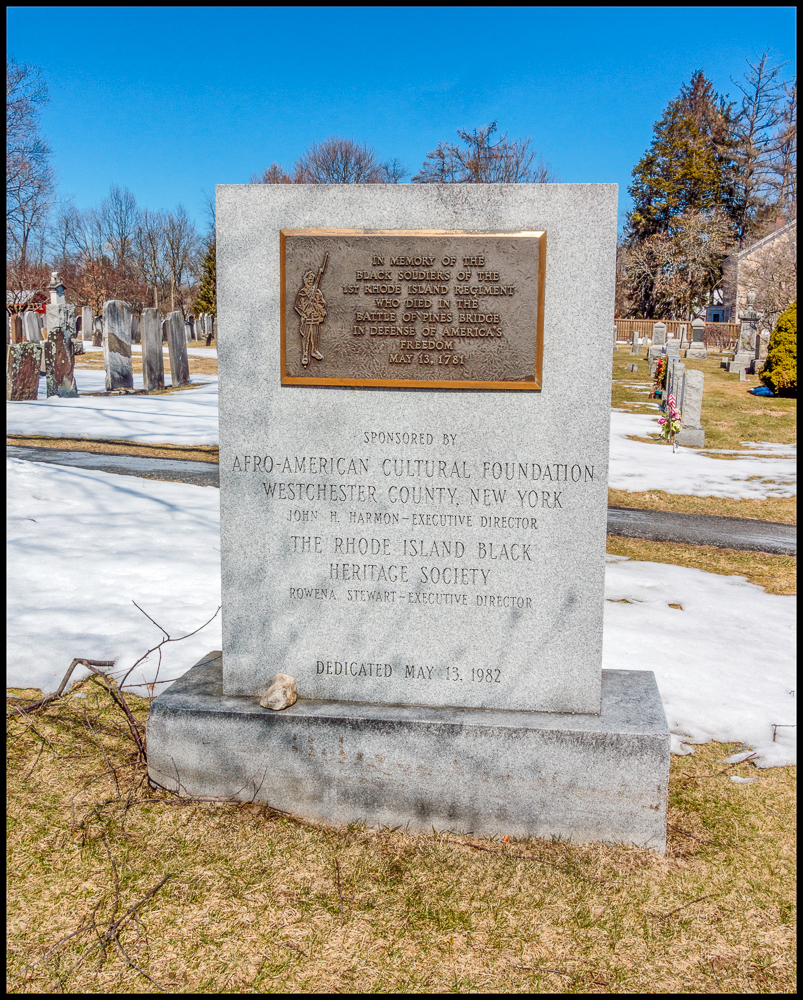
The second (below) reads:

In Memory of the black soldiers of the 1st Rhode Island Regiment who died in the Battle of Pines Bridge in defense of America’s Freedom May 13, 1781.

It seems that there was a Revolutionary War battle in Yorktown after all.

Looking a bit further I came across this interesting piece by Michael J. Kahn on the First Presbyterian Church of Yorktown’s website: The Battle of Yorktown…New York, not Virginia

Many have forgotten Westchester County’s role in the American Revolution.For instance, the Battle of White Plains: It was a major battle in 1776, as well as a major strategic defeat for the Patriots.

Most textbooks and classrooms neglect this battle for the clichéd fables of Lexington, Concord and Bunker Hill, to name a few. When most think of Yorktown, they envision the end of the war on a tiny peninsula on the eastern Virginia coast in October 1781. Contrary to this belief, the war did not end there, but continued for another two years until the Treaty of Paris.

The “other Yorktown,” in New York, did not officially exist yet as the Town of Yorktown was not yet incorporated. The area was composed of hamlets and villages, which for the purposes of our story consisted of Pines Bridge, Crotonville, Crompond and Croton Heights.

Nonetheless, the Battle of White Plains was an insignificant-significant battle. I say insignificant, in part, because the numbers of killed and captured there were far surpassed by many other engagements during the war. What made it significant was that the soldiers who comprised the 1st Rhode Island Regiment, an integrated unit, included free, or freed, blacks and Indians.

The 1st Rhode Island Regiment was quartered both inside the Davenport House (located on what is now Croton Heights Road) and outside around it in tents, as well as at neighboring farmhouses closer to the PinesBridge. The Davenport House also doubled as a command post under the direct orders of Gen. George Washington because the house overlooked Pines Bridge and the Croton River Valley.

Pines Bridge was a unique area for crossing the Croton River, as it wasthe only bridge over the river throughout most of the war. The Croton River was also a vital, natural barrier protecting this area from lower Westchester County.

Needless to say, guarding its crossing was of the utmost importance.Westchester County, itself, was a nightmare from a defensive point of view: It was nearly impossible to defend due to its geographical size, the Continental Army’s lack of manpower and its farming communities were constantly subjected to raids.

A little known fact to our generation, as well as generations past, is that the Bronx was part of Westchester during this period of history.The British soldiers of our story were garrisoned in the Morrisania section of the Bronx. The entire stretch of land between the Croton and Morrisania was nefariously referred to as the “neutral zone, a Godforsaken region to the average God-fearing person, a no-man’s land where the underprivileged inhabitants were frequently raided by robbers from both sides of the war.

The two main antagonists of this story are Lt. Colonel James De Lancey, of His Majesty’s Army, and Lt. Colonel Christopher Greene, of the Continental Army. De Lancey was in charge of a regiment known as the refugees—American-born volunteers, also known as Loyalists.

At the outbreak of the war, about a third of the colonists stayed loyal to England, a situation that made the revolution a civil war as well. These refugees engaged in a war of attrition against their fellow colonists, a style of warfare known as both total and unlimited war.This combat methodology does not discriminate between combatants and noncombatants. It targets civilians and their respective dwellings, businesses and infrastructures. De Lancey, and the men under his command, were probably the most notorious British military presence in Westchester. These same refugees earned the nickname of cowboys for their frequent cattle raids in the county.

Greene, on the other hand, died a hero’s death while fulfilling an officer’s duty. He was a distant cousin of General Nathaniel Greene, who would go on to be commander-in-chief of the Southern Army. Greene was charged with protecting the Pines Bridge crossing. Greene was also personally ordered by Washington to take De Lancey into custody, a mission not unknown to De Lancey. What was not known to Greene, however, was that De Lancey intended to turn his predator into the prey. During the morning of May 14, 1781, De Lancey led a surprise attack on Greene.

Each night the rebel troops stationed at Pines Bridge would remove the bridge’s floor planks as a strategic precaution to halt an enemy’s advance over the river. A guard was left on duty until daylight, when an enemy was least likely to risk a foolish attempt to ford the flooding river, or so the Patriots thought.

Greene possibly underestimated his opponent’s tenacity and assumed that no one would attempt a daylight crossing, especially by fording the river, given how high the water level was. De Lancey did ford the Croton at the Oblenis Ford, but only two-thirds of his troops made their way over.

To add insult to injury, the Continental Army troops stationed on the north side of the bridge left their post for breakfast. Loyalist guides, who knew every rock, tree and ditch, aided De Lancey’s troops. They were able to avoid every Patriot patrol from the river’s edge to the Davenport. As was the case in most of the battles, our generals (or lieutenant colonel, in this case) were more often than not, out-generaled, an observation made famous by John Adams prior to this event.

There were mitigating circumstances that may make me sound like an apologist for Greene. As previously mentioned, manpower was an ongoing crisis. Another enemy frequently struck down the soldiers who were ready and willing to take up the musket and sword: Smallpox. Had scores of men not been bedridden with this epidemic, more men may have been stationed from the river’s edge up to Davenport’s and a better chain of communication may have been maintained, turning the odds into evens.

Triumph, not tragedy, may have been the end result.

The attack happened after sunrise. All archaeological evidence testifies to a westerly advance, including the musket ball holes in the west side of the house. The Patriots were only able to fire a few shots before being overrun. Greene was shot and stabbed several times before he was taken prisoner. In the end, the battle was over before it really ever began. Greene was thrown on a horse and was either discarded, or fell off the horse, and left to die. Regardless, none of the present enemies made any attempt to help or care for him properly as a prisoner of war. Two Continental Army officers discovered his body the next day. According to the late historian Allison Albee, the Patriots suffered 10 dead, 1 seriously wounded and 23 captured. The black soldiers who were caught were later sold into slavery in the British West Indies.

De Lancey and his band of refugees returned to New York City, or York Island as it was then known. De Lancey’s attack and subsequent return to New York added more fuel to the burning fire of hatred in Washington’s heart; he wanted De Lancey arrested and New York retaken from the British. Unfortunately, Washington would never achieve either goal: De Lancey evaded capture throughout the entire war and New York would remain an impregnable British fortress until after the Treaty of Paris was signed in 1783.

Today, the monuments at the First Presbyterian Church, located at 2880 Crompond Road, are some of the very few testaments to the sacrifices of Greene and his troops. The British burned the original church that stood there in 1779, which was being used as a headquarters for the Continental Army. Greene, along with other Continental officers and soldiers, is buried in the church’s cemetery. With the exception of the musket ball holes still in the side of the Davenport House, there is little to show where our Yorktown made its mark in the history of our nation’s birth.

The old Pines Bridge is, I’m told, slightly visible whenever the area suffers a drought. Invisible, however, are any indications of its importance from an era so long ago. There are no landmark signs on the Crow Hill entrenchments (or redoubts as they are also known), which were defensive trenches dug into the ground by the Continentals following the Battle of White Plains in 1776. Washington ordered Gen.Reazin Beall and his Maryland regiments to construct these fortifications to protect the Croton Valley and to guard the critical Pines Bridge crossing below.

This place may not have been Morristown or Valley Forge, but nonetheless, American soldiers spent many a night here, freezing and bearing the intolerable heat of the summer days while manning their posts. Basically, all we Yorktowners have is an oral history. Hopefully, this will one day change.

As was the case with many of the battles of the Revolution, Pines Bridge was a defeat for our side. However, we obviously ended up the victors in a war that lasted eight tumultuous years. The real tragedy would be to forget these brave men, their times and their sacrifices.

So more of skirmish that what I think of as a battle, but a fascinating piece of history nonetheless.

Taken with a Sony RX-100 M3.

First Presbyterian Church of Yorktown, NY

While my wife went to her dentist in Yorktown, NY the other day I decided to check out this church, which I had often passed but never visited.

According to the church’s website:

Our church was born in 1730 as an assembly that convened weekly for the worship of God. The church leased a 220-acre tract in 1737, and built a meeting house in 1738. Itinerant preachers provided worship leadership until the church called its first resident pastor in 1761.

During the Revolutionary War, the church became an arsenal and barracks, and a meeting place for the patriots. British troops destroyed the parsonage and storehouse in early June 1779, and burned the church to the ground shortly after. There is a monument in front of the church, celebrating the all-black First Rhode Island Regiment, which figured prominently in the British raid on Yorktown in 1779.

After the war, the church constructed the second building on this site, in 1785.

Under the leadership of the second pastor, the church gradually took on the Congregational form of government. This led to a division in the church in 1806,with one portion creating a Congregational Church on Granite Springs Road. The two churches were reunited after 60 years, in 1865. Our church still owns and maintains the East Yard Cemetery at the site of the Congregational Church. Among the buried of the East Yard Cemetery are 30-40 black members of that church. Both the East Yard Cemetery and the current church building are listed as sites on the Westchester African-American Heritage Trail.

The present building replaced the 1785 structure in January 1840. Worship and Sunday School services were held in this one building until 1930. Since then, there have been numerous building additions. In 1985, the church restored the 1840 Sanctuary to its original appearance. In 1998, the church expanded the Christian Education Building, and created a passageway between the CE Building and the original Sanctuary.

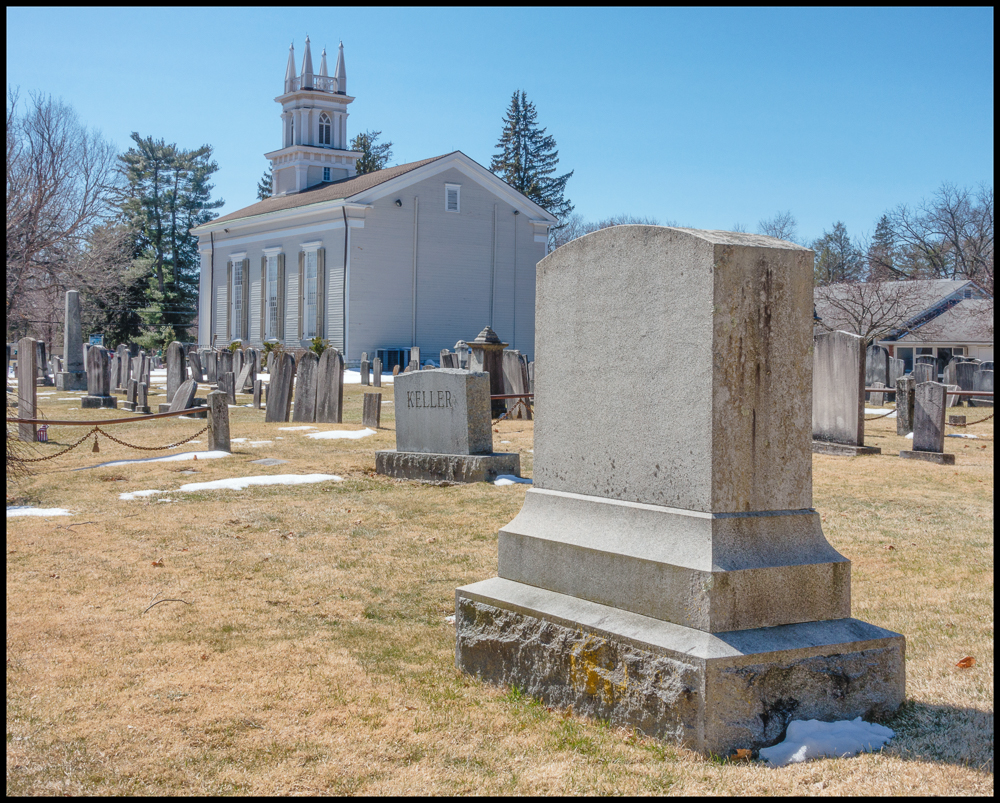
The church as seen from the graveyard.

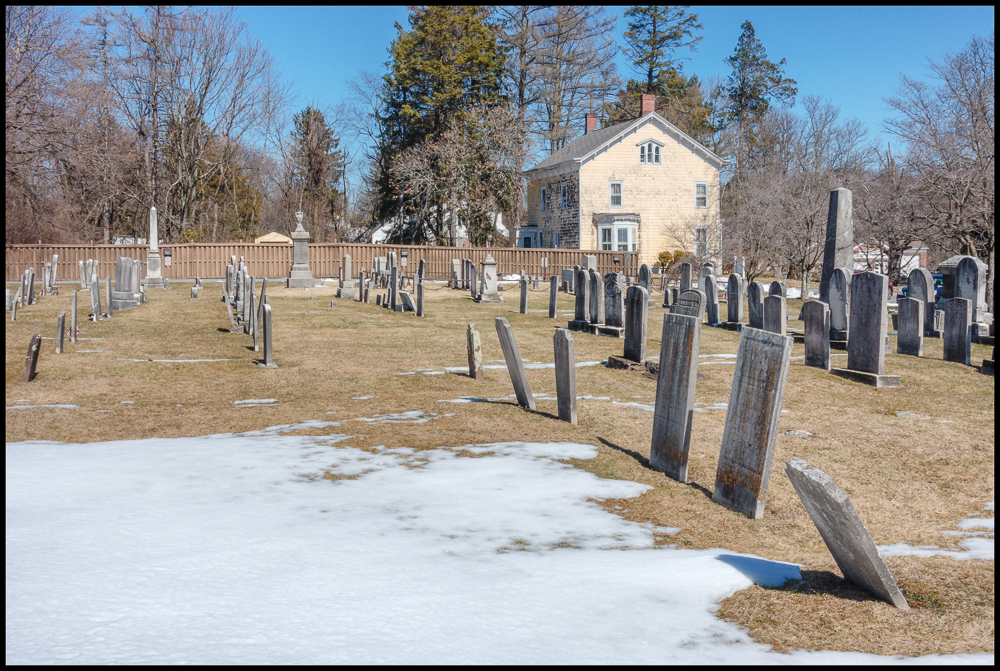
Graveyard with (I’m guessing) the parsonage in the background.

Taken with a Sony RX-100 M3.
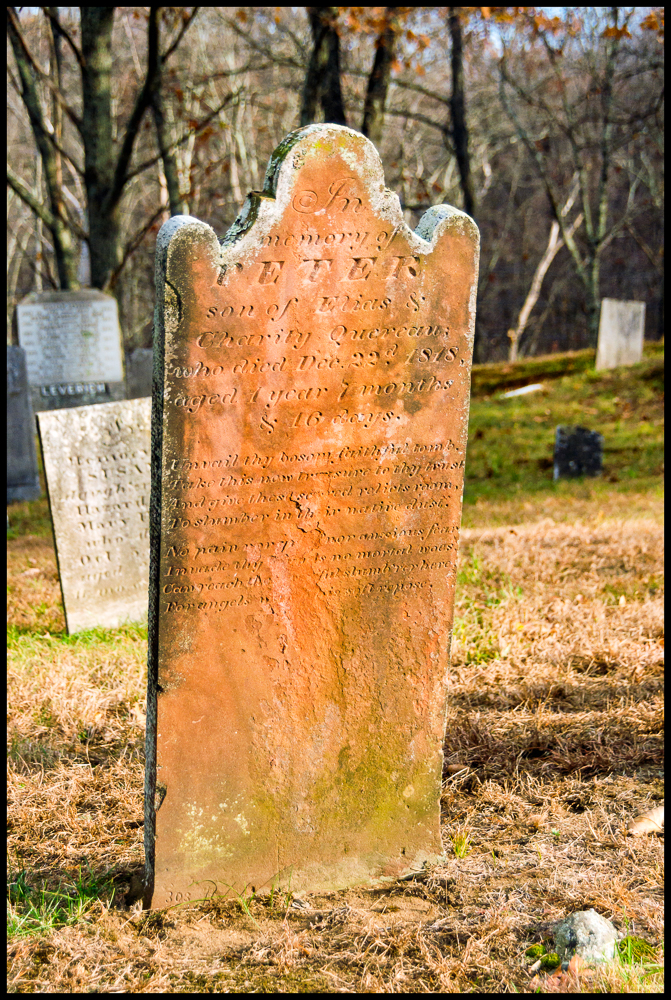
Old Gravestone

The inscription has deteriorated badly in places to the point where it can no longer be read. However, the second part (where most of the damage occurs is taken from a well known hymn “Unveil Thy Bosom, Faithful Tomb” with words by Isaac Watts, 1734 and music from George Frideric Handel. It reads:

In memory of Peter
son of Elias and Charity Quereau;
who died Dec 22d, 1818
aged 1 year 7 months and 16 days.

Unvail thy bosom faithful tomb,
Take this new treasure to thy trust
And give these sacred relics room,
To seek a slumber in their native dust.

No pain, nor grief, nor anxious fear
Invade thy bounds, no mortal woes,
Can reach the lonely slumber here,
For angels watch in soft repose

It seems there are additional verses, one version of which is shown below:

So Jesus slept; Gods dying Son
Passed through the grave, and blessed the bed:
Rest here, fair saint till from His throne
The morning break and pierce the shage;
Rest here, fair saint, till from His throne
The morning break and pierce the shade.

Break from His throne, illustrious morn!
Attend, O earth! His sovereign Word:
Restore thy trust: a glorious form
She must ascend to meet her Lord;
Restore thy trust: a glorious form
She must ascend to meet her Lord!
Restore thy trust: a glorious form
She must ascend to meet her Lord!

I haven’t been able to find much information about Elias Quereau (1777 – 1841) other than that he was a doctor. He married Charity Rhodes (1780 – 1847) and they had eight children, one of which was called Peter. He seems to have been the son of another Elias Quereau: a Tory loyalist and founder of the Yorktown Baptist Church (now the Community Church of Yorktown) where I came across this gravestone.

Taken with a Sony Alpha 500 and Tamron A18 AF 118-250mm f3.5-6.3.

St. Philip’s Church in the Highlands

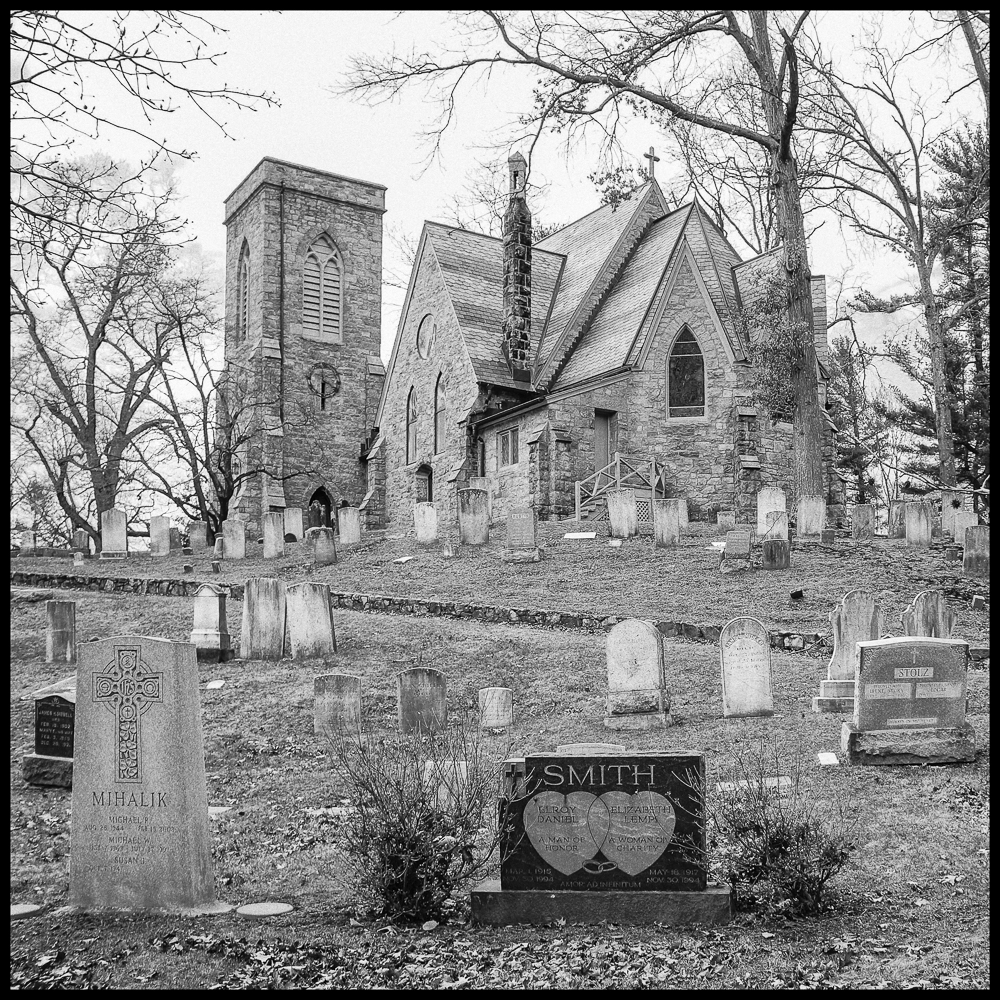
Of all the churches in our area I think this one is my favorite, possibly because it reminds me of St. Mary’s Church in Sandbach, Cheshire, UK where I grew up.

It’s located in Garrison, NY and I’ve posted about it before (see: St. Philip’s Church in the Highlands, Garrison). However, this is a different view and this one is in black and white where the other one was in color.

It has a rich history documented in some detail (accompanied by illustrations) in the history section of the church’s website.

I’ve always been fascinated by Benedict Arnold and so was interested to discover that there is a plaque inside the church which reads:

In memory of Colonel Beverley Robinson
Churchwarden 1770-1777
Who under God was
The founder of this Parish.
Born at Middlesex in Virginia 1722
Died at Bath in England 1792.

I already knew that Arnold was staying at the Beverley House when he fled, but the church’s website provides additional information:

At the outbreak of the Revolutionary War, Beverly Robinson, by then one of the wealthiest and most influential men in North America, was asked by his friend, John Jay, to sign an oath of allegiance to the newly created United States of America. Robinson declined Jay’s invitation.

By all accounts a fine man, a good landlord and devout Christian, Robinson chose to remain loyal to his British heritage, and refused to become part of the rebellion. In May 1777, he raised the Loyal American Legion. He served during the war years as a Loyalist Colonel in British Intelligence, leading agents made up of local citizens that aided the British armed forces. He helped plan and fought in the successful British conquest of Forts Montgomery and Clinton in October 1777.

In 1778, his home in Garrison was taken for the use of the Continental army, and Benedict Arnold came to occupy it in the summer of 1780, when he took up his post as commandant of West Point. Robinson’s entire estates were confiscated in 1779 on the establishment of the State government in New York.

Robinson was part of the plot, conceived by Benedict Arnold and the British spy, Major John Andre, to deliver the fortifications at West Point to the British. Robinson was on board the British ship, HMS Vulture, which Andre left to go ashore near Stony Point to meet Arnold and obtain the plans on Thursday, September 21, 1780. However, American cannon fire drove the Vulture back down the Hudson and Andre was forced to find another way back to British lines.

Dressed in civilian clothes, Andre was captured on Saturday, September 23. On the morning of Monday, September 25, Arnold learned that the plot had been uncovered and rode fullspeed to the landing where his barge waited. He ordered his men to row him to the Vulture, where he told the waiting Beverly Robinson of the plot’s failure.

Robinson and his family left for England at the close of the Revolution. Robinson died there in 1792, never returning to the Hudson River Valley. Some of the most touching early records of our church include letters, written after the war by Beverly Robinson to his old friend, John Jay, pleading for the restitution of his fortune and property. Jay’s letters in response simply say, “I’m sorry. It’s not possible!”

I also discovered that he’s buried in Bath Abbey in the town of Bath, UK where, co-incidentally our eldest daughter studied.

Taken with a Sony NEX 5N and Sony E 18-55mm F3.5-5.6 OSS

.