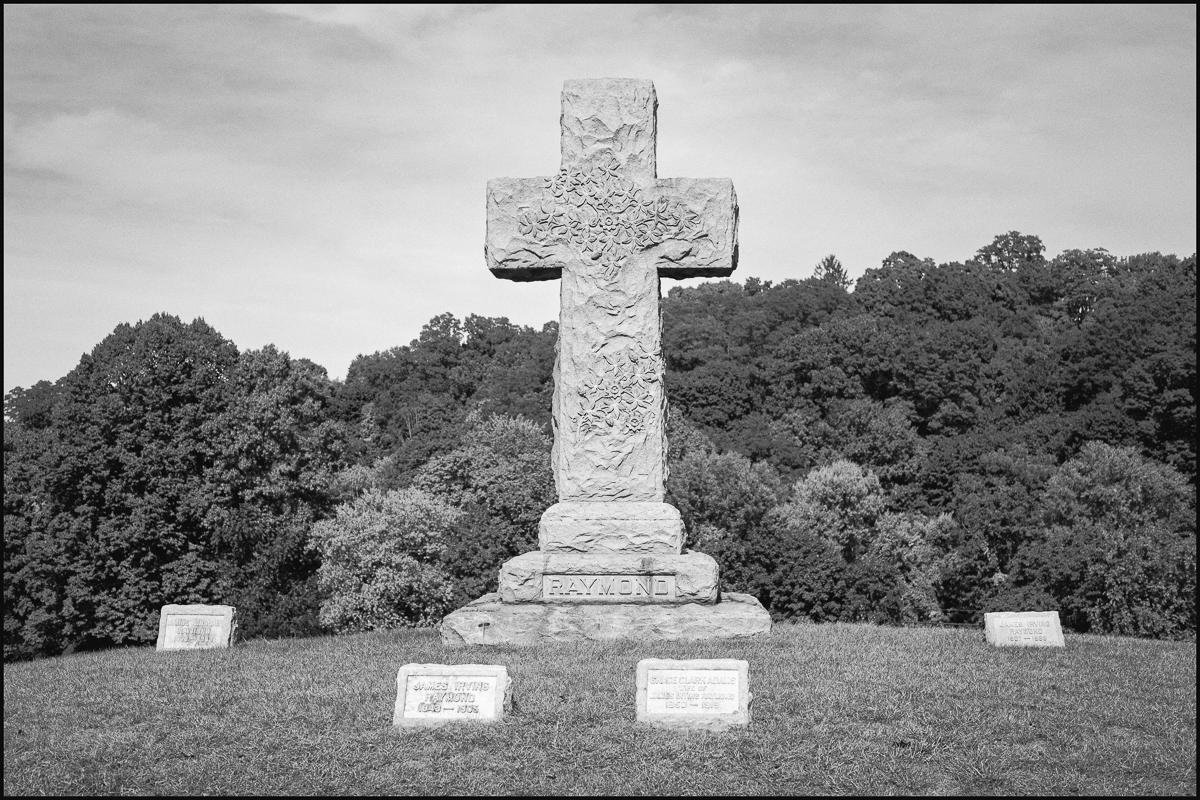
The most prominent grave markers (i.e. the two directly in front of the cross) are for James Irving Raymond and his wife Grace Clark Adams.
According to America’s Successful Men of Affairs: The city of New York, edited by Henry Hall, page 533.
James Irving Raymond, head of the importing house of A.A. Vantine & Co., was born in Bedford, Westchester county, N.Y. August 23, 1843. His father was Edward Raymond, a prosperous farmer. The boy attended the public schools and academy of his native town and spent his time, not needed for study, in the work of the farm. In 1864, he came to New York city to enter commercial life, equipped with a good education and a determination to merit success. His first and only engagement was with the house of A.A. Vantine & Co. Here, he applied himself earnestly, studying the details of the extended business of the firm and evincing a rectitude and capability, which soon brought promotion. In a 1875 he became a partner. After the death of Mr. Vantine, founder of the business, Mr. Raymond purchased the entire interest. He is now the sole owner of an unequaled establishment. The house has been and is today the greatest of the kind in the United States, making a specialty of the finest rugs and other goods of China, Japan, Turkey, India and other Oriental countries. A retail and wholesale business is done, extending to every section of the country and requiring representatives in nearly all the markets of Europe and Asia. While Mr. Raymond is personally of modest and retiring temperament, the fame of his business is world wide and the reputation of the house for solidity and exact business methods is enviable. In 1875, Mr. Raymond married Grace, daughter of Col. John Quincy Adams of Brooklyn, the union resulting in one son, Irving Edward Raymond, now eighteen years of age and preparing for a collegiate course. Mr. Raymond is a member of the Presbyterian church and lives in Stamford, Conn., in a home which exemplifies all which is artistic and tasteful. He is a member of the Union League club and the Stock Exchange, and a director of the New York Real Estate Trust Co.
Curiously, Vantines was acquired in the 1920s by Arnold Rothstein, a gangster, as a front for his drug dealings.
In the mid-1920s, Arnold Rothstein saw illegal drugs as an untapped field, one that could be developed and profited from. The drug traffic was unorganized and there was little competition on the level Rothstein chose to enter. In fact, the only competition at that time was provided by unethical doctors. Rothstein’s plan was to purchase and sell in quantities so large that no one could compete with him. He could regulate supply and demand on an international basis. In 1923, a kilo of heroin, 2.2 pounds, could be purchased for $2,000. It could then be cut and resold for $300,000.
Rothstein’s interest in narcotics was strictly for wholesaling. He would need a network to sell the drugs and the rum running and bootlegging market already in existence would serve as his pipeline. Lucky Luciano and Waxey Gordon were in place in New York City and New Jersey. The Torrio – Capone Empire was interested in Chicago. Charles “King” Soloman was ready in Boston, as well as Harry “Nig Rosen” Stromberg in Philadelphia. In addition, mobsters in Detroit, Kansas City and St. Louis showed an interest.
Among the buyers Rothstein decided to do business with was Jacob Katzenberg, who was already serving the New York mob as a liquor buyer in Europe.
When Katzenberg teamed up with Rothstein in 1926, they began purchasing from European sources. Rothstein purchased “Vantines,” a well-established importing house in New York City. The importing house had an excellent reputation and was known as a legitimate enterprise. When shipments arrived for them, customs officials gave their merchandise only a cursory search. Vantine’s would become a perfect front for the smuggling operation. Rothstein also owned several art galleries and antique shops that would also serve as fronts.
Source: Later in Vantine’s History.
James Irving Raymond must have been turning in his grave!
The cross itself bears an attractive floral decoration of passionflowers (symbolizing Christ’s Passion, Redemption and Crucifixion).
According to Doug Keister:
…the corona ends in thorns reminiscent of Christ’s crown of thorns, the white color of the flower reflects his innocence, the stamen and stigma represent the nails that were driven through his hands and feet, and the tendrils represent the whips.
Taken with a Sony NEX 5N and Sigma 30mm f2.8