Irvington wasn’t always called Irvington. According to a very interesting piece on Irvington in Westchester Daddy:
In 1785, the state of New York confiscated the Phillipse’s land from his grandson, Frederick Philipse III, after he sided with the British in the American Revolution, and sold it to local patriot farmers who had been tenants of the Phillipse family. This is presumably how part of it came to be the farm of William Dutcher. Dutcher sold half of his farm to Justus Dearman in 1817, who then sold it to Gustavo F. Sacchi in 1848 for $26,000. Sacchi sold the parcel to John Jay – the grandson of the American Founding Father by the same name – that same year, and Jay laid it out as a village which he called “Dearman”, after Justus Dearman, and sold lots at auction in New York City starting on April 25, 1850.
…
In 1854 the Dearman and Abbotsford combined, and by popular vite adopted the common name “Irvington”, to honor the American author Washington Irving, who was still alive at that time and living in nearby “Sunnyside” – which is today preserved as a museum. Influential residents of the village prevailed upon the Hudson River Railroad, which had reached the village by 1849, to change the name of the train station to “Irvington”, and also convinced the Postmaster to change the name of the local post office as well. It was thus under the name of “Irvington” that the village incorporated on April 16, 1872
.
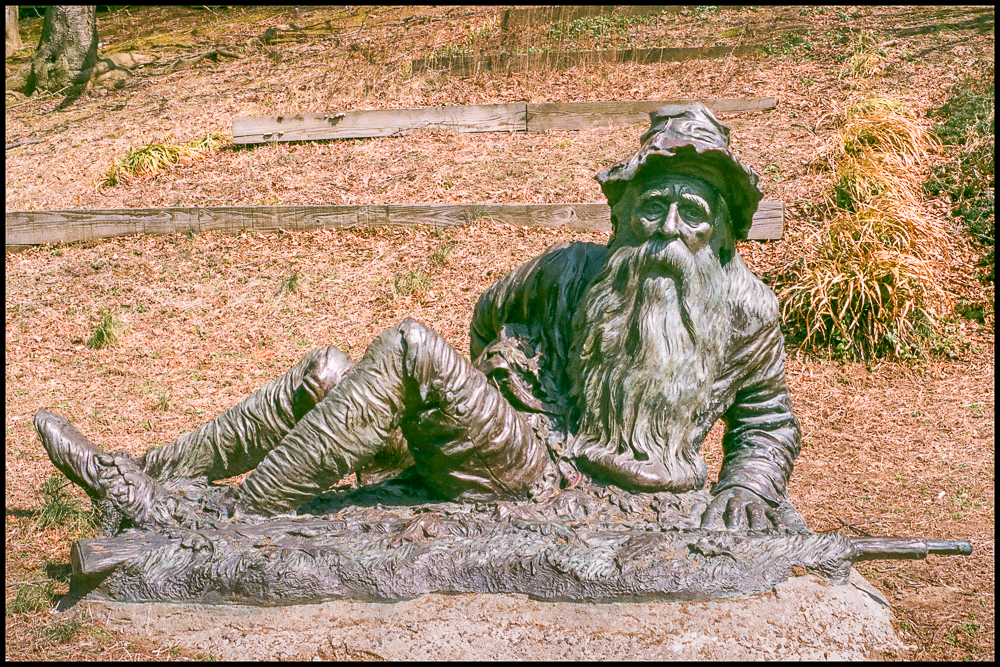
So because of the close connection to Washington Irving it’s fitting that the town should have a statue devoted to one of his creations – in this case Rip Van Winkle. The statue was sculpted by the late Richard Masloski, who passed away in July 2018.
Taken with a Minolta XD and Minolta MD Rokkor-X 50mm f1.7.