Autochromes

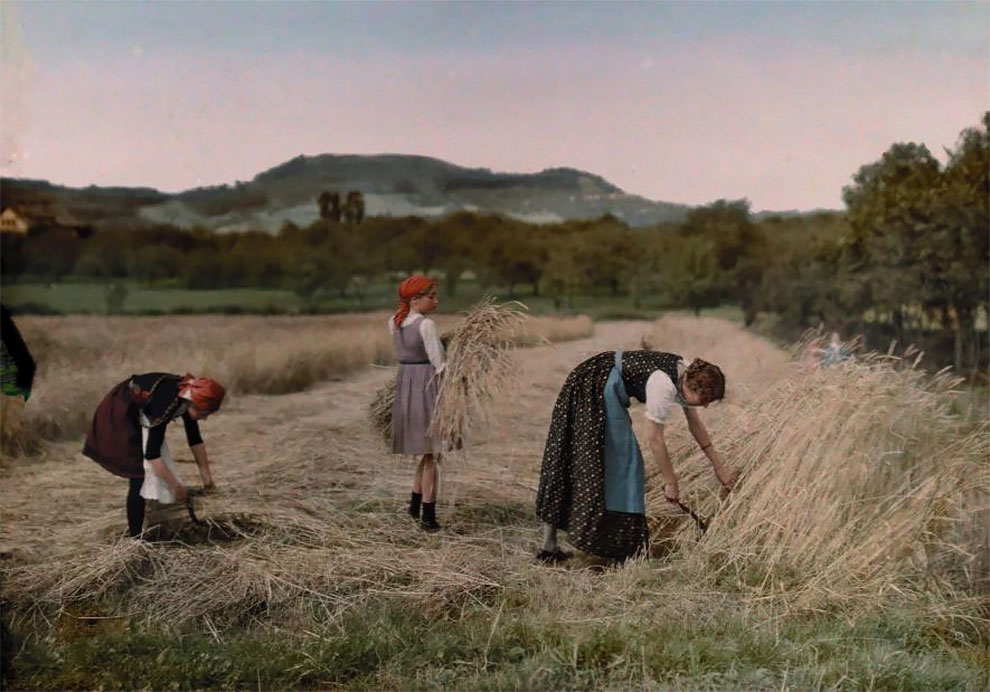
Source: DYT. These Autochrome Photos From The 1920s And ’30s Resulted An A Painting-Like Quality That Not Even Today’s Best Instagram Filters Can Replicate

Source: DYT. These Autochrome Photos From The 1920s And ’30s Resulted An A Painting-Like Quality That Not Even Today’s Best Instagram Filters Can Replicate

A number of years ago I went with a friend to see an exhibition of works by Alfred Stieglitz, Edward Steichen and Paul Strand at the NY Metropolitan Museum. While there I noticed some small photographs with vibrant colors and almost a glow to them. At that moment I fell in love with autochromes.

According to Wikipedia:

The Autochrome Lumière is an early color photography process. Patented in 1903 by the Lumière brothers in France and first marketed in 1907, it was the principal color photography process in use before the advent of subtractive color film in the mid-1930s.

Autochrome is an additive color “mosaic screen plate” process. The medium consists of a glass plate coated on one side with a random mosaic of microscopic grains of potato starch dyed red-orange, green, and blue-violet (an unusual but functional variant of the standard red, green, and blue additive colors) which act as color filters. Lampblack fills the spaces between grains, and a black-and-white panchromatic silver halide emulsion is coated on top of the filter layer.

Unlike ordinary black-and-white plates, the Autochrome was loaded into the camera with the bare glass side facing the lens, so that the light passed through the mosaic filter layer before reaching the emulsion. The use of an additional special orange-yellow filter in the camera was required to block ultraviolet light and restrain the effects of violet and blue light, parts of the spectrum to which the emulsion was overly sensitive. Because of the light loss due to all the filtering, Autochrome plates required much longer exposures than black-and-white plates and films, which meant that a tripod or other stand had to be used and that it was not practical to photograph moving subjects. The plate was reversal-processed into a positive transparency — that is, the plate was first developed into a negative image but not “fixed”, then the silver forming the negative image was chemically removed, then the remaining silver halide was exposed to light and developed, producing a positive image.

The luminance filter (silver halide layer) and the mosaic chrominance filter (the colored potato starch grain layer) remained precisely aligned and were distributed together, so that light was filtered in situ. Each starch grain remained in alignment with the corresponding microscopic area of silver halide emulsion coated over it. When the finished image was viewed by transmitted light, each bit of the silver image acted as a micro-filter, allowing more or less light to pass through the corresponding colored starch grain, recreating the original proportions of the three colors. At normal viewing distances, the light coming through the individual grains blended together in the eye, reconstructing the color of the light photographed through the filter grains.

I’ve tried to re-create the look digitally myself with no success. I’ve acquired filters that professed to produce this look – but they didn’t. I’m forced to conclude that, as the article suggests, you just can’t produce a digital equivalent. And I’m not inclined, nor am I skilled enough, to try the original process myself, so I’ll just have to admire them from afar.

Of the pictures shown in the article my favorites are the one above, and that of the soldiers (I thought at first Austrian because of the double headed eagle flag, but they could also be Russian or one of the other countries that uses such an eagle on its flag).

Focus

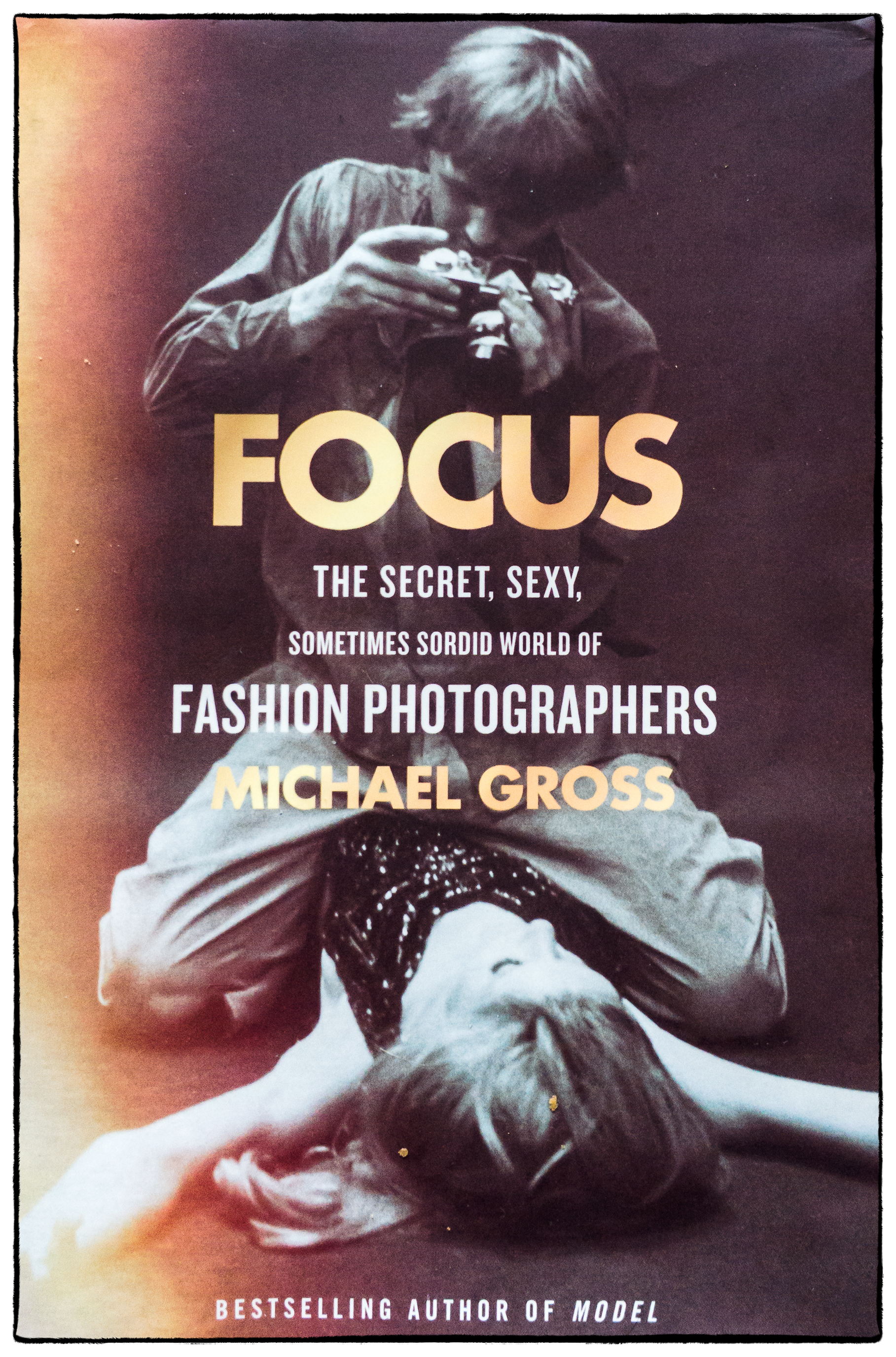
Although I do most of my reading on my Amazon Kindle, I tend to prefer reading photography books in hard copy. I feel that the Kindle does not do justice to the photographs. I was in Barnes and Noble one day and felt like reading something photography related. They didn’t have very much and most of what little they had I had already read.

I’d looked at this book in the past, but since I’m not much interested in fashion photography I hadn’t bought it. I think the cover image and the title: Focus. The secret, sexy, sometimes sordid world of fashion photographers had put me off it a bit too.

But I really wanted to read something photography related, and this was the only option available, so I bought it. I didn’t expect to like it very much and was pleasantly surprised when I did.

Of course I was already familiar with some of the names: Richard Avedon (although I hadn’t realized that he was such a colossus in photography), Irving Penn (who of all the people in the book I was most familiar with), Terry Richardson (whose name I’d heard because of the controversies but whose work I was not familiar with), Helmut Newton, maybe David Bailey but most of the other names (e.g. Melvin Sokolsky, Jerry Schatzberg, Terence Donovan, Brian Duffy, Bert Stern, Bill King, Patrick Demarchelier, Pierre Houlès, Gilles Bensimon, Mike Reinhardt, Arthur Elgort, Steven Meisel, Bruce Weber, Bob Richardson) I’d barely heard of.

Of course the “sexy”, “sordid” aspects of the field come through (e.g. the author mentions the apparently enormous size of Gilles Bensimon’s penis several times). And I found the rather sad lives of some of the photographers (e.g. Ben Stern, Bill King, Bob Richardson) to be rather touching.

For the first time I know a bit about Vogue, Harpers Bazaar (e.g. did you know that until 1929 the magazine was called ‘Harpers Bazar’?), Elle etc. I know who Diana Vreeland and Anna Wintour are/were. And I’m more aware of the important role of the Art Director (e.g. Alexey Brodovitch, Alexander Liberman). I’m also rather more familiar with how fashion magazines have evolved over the years.

An interview with the author can be found at: Michael Gross Discusses His Provocative New Book on Legendary Fashion Photographers.

I thoroughly enjoyed this book.

The Genius of Photography

Jacques Henri Lartigue,

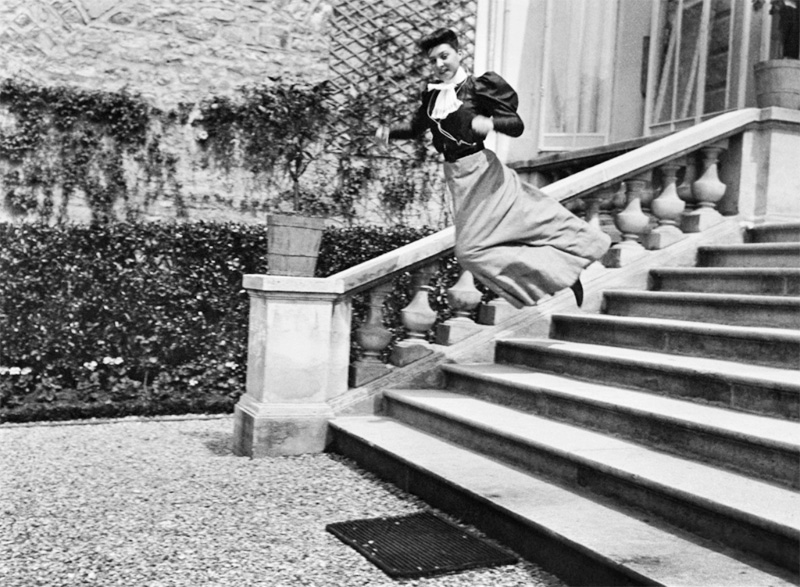
Jacques Henri Lartigue, “Bichonnade”, 40, rue Cortambert, Paris, 1905. Tirage gélatino-argentique. (MINISTERE DE LA CULTURE-FRANCE/AAJHL)

Our eldest granddaughter recently received a reading list for her future studies. One section related to “Art and Photography”. It contained the following items:

  • Steve McCurry, The Iconic Photographs
  • Don McCullin, The Impossible Peace: From War Photographs to Landscapes
  • Tim Walker, Pictures
  • Wells, L, Photography: A Critical Introduction
  • Badger, G, The Genius of Photography
  • Clarke, G, The Photograph: A Visual and Cultural History
  • Jeffery, I, Photography: A Concise History

I pondered the choice of photographers for a while. Three living photographers: a photojournalist (McMullin); a not universally liked and recently criticized photojournalist cum travel photographer (McCurry); and a fashion photographer (Walker). Why, I wondered this particular choice? Unfortunately, the list did not provide enough information for me to reach any conclusion.

Then I noticed The Genius of Photography by Gerry Badger. It turns out that it’s a companion book to a BBC TV series. I further discovered that the entire series is available online here (I believe it’s also available on YouTube).

According to Docuwiki:

In the most comprehensive look at the most influential art form in the world, the series explores every aspect of photography – from daguerreotype to digital, portraits to photo-journalism, art to advertising; in the UK, America, China, Japan, Africa and beyond. It includes interviews and encounters with some of the world’s greatest living photographers including William Eggleston, Nan Goldin, William Klein, Martin Parr, Sally Mann, Robert Adams, Juergen Teller, Andreas Gursky, Jeff Wall and many others. But as well as telling the stories behind the world’s greatest photographs and the photographers who took them, the series examines the ‘genius’ of photography itself, this magical, unpredictable and democratic medium that has transformed the way we see ourselves and our world.

The series culminates in an examination of the impact of the digital post-production techniques that make anything possible, and looks at the rediscovery of techniques which are taking photography back to the 19th century.
With contributions from Jeff Wall, Andreas Gursky, Gregory Crewdson and one of China’s leading photographer Wang Qingsong.

The series consists of six episodes, each about one hour long (the docuwiki page mentioned above provides longer descriptions of each episode):

  1. 1800-1914: Fixing the Shadows. A look at how the problem of ‘fixing the shadows’ was solved by two rival methods.
  2. 1918-1945: Documents for Artists. How, in the decades following the First World War, photography was the central medium.
  3. Right Place, Right Time. How photographers dealt with the dramatic events like D-Day, The Holocaust and Hiroshima.
  4. Paper Movies. A look at the golden age of photographic journeys from the 1950s to the 1970s.
  5. We are Family. How the medium translates personal relationships into photographic ones.
  6. Snap Judgements. A look at the current state of the art, from phone cameras to digital post production.

I’ve just watched all six episodes and I must say that I enjoyed it. Of course I have a few quibbles:

First. I think there was a definite bias towards documentary photography/photojournalism and against “art” photography. “Art” photography barely appears until the last episode, where it’s seen rather negatively as being driven by the market (a point, which I agree with) i.e. what sells, rather than what has artistic merit. The references to “pictorialism” are particularly negative.

Second. While I recognize that you have to make choices when making a documentary of this type, I feel that the passing mention of Alfred Stieglitz, Ansel Adams, Edward Weston (and I don’t think Paul Strand was even mentioned) doesn’t do justice to their contribution to photography. I was pleased to see that my idol, Eugene Atget was given the attention he deserves. Joel Meyerowitz referred to him as being to photography what Mozart was to music – head and shoulders above everyone else.

Third. If space was needed to incorporate some of these seminal figures, maybe a bit less time could have been devoted to the “intimate” photography (e.g. Larry Clark, Nan Goldin, Araki etc.) in episode 5. I’m probably showing my own bias here. I’m not fond of this type of photography. It does, however, provide a hint as to the the type of photography that the creators of this series seem to think of as the best: a kind of a super amateur snapshot taken by a photographer with a kind of innate creativity and very basic equipment.

There were some great moments though. An interview with a wealthy family who had hired Diane Arbus to do some family pictures. I loved a line from the lady of the house, referring to some of the pictures as “Standard ones. The family under the Monet”. There’s also an interview with the boy (now grown up) in the famous “Child with Toy Hand Grenade in Central Park, N.Y.C. 1962” (also by Arbus). There was also an interesting piece in episode 6 about how the late Phlip Jones Griffiths (obviously a strong Cartier-Bresson disciple) had tried (unsuccessfully) to block Martin Parr‘s Magnum membership. And much more…

The England of My Childhood

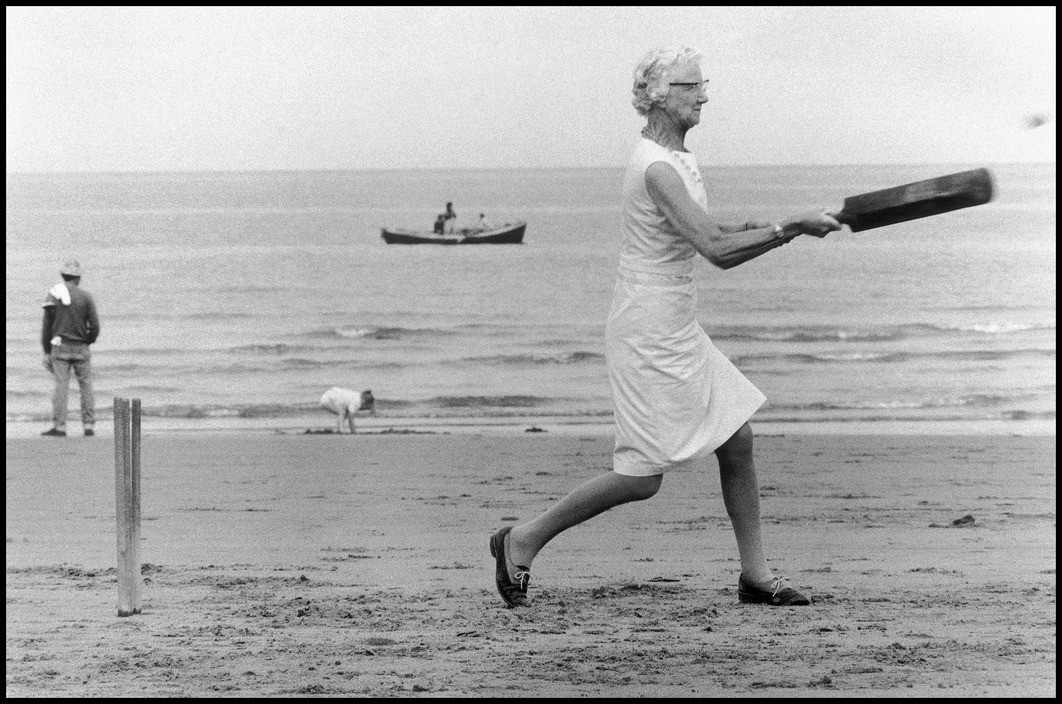
Ian Berry | The English. An elderly woman plays cricket with her family on the beach. Whitby, England. 1974. © Ian Berry | Magnum Photos

Ian Berry’s 1978 book sees him return to his homeland after many years abroad to both document and rediscover the English way of life…After a decade of travelling and living in Africa and then Paris, Magnum photographer Ian Berry conceived of The English as a project that would enable him to both document and rediscover the country in which he was born and grew up. “It seemed like a good idea to do something on the English before my eyes got too jaded,” Berry remembers whilst speaking to us about the project today. Returning to London in the mid-Sixties to become the first contract photographer for the Observer, he received a commission from the Whitechapel Gallery in 1972 to photograph the local area. His images capture the unique character of the East End and the diversity of its residents, both well-established and recent arrivals.

Source: Ian Berry’s Personal Exploration of English Life • Magnum Photos

This is the England I remember from my childhood.

If you’re interested in the early history of photography this site is for you

Wilhelm  Weimar - Maiglöckchen

Wilhelm Weimar – Maiglöckchen

From Petapixel: Europeana Online Gallery Offers you 2.2 million photos from the first century of photography.

If you’re looking for inspiration, knowledge, or want to trace the history of photography, here’s something for you. Europeana Collections’ impressive digital gallery features 2.2 million images, covering the first 100 years of photography. Among the featured names, there are Man Ray, Julia Margaret Cameron, Eadweard Muybridge and Nicola Perscheid, to name a few. The photographs come from 34 countries, and many of them are free for the visitors to download and use.

Photoconsortium, the International Consortium for Photographic Heritage, started this project in collaboration with Europeana. The goal was to promote photography and photographic heritage. As Mr. Douglas McCarthy states in the Europeana blog, over 50 European institutions in 34 countries contributed with the scanned historical photos. As a result, there’s a truly impressive number of images for all of us to browse and use.

When you open the website, you will be able to search it based on different criteria. You can pick the collection and the type of media you want to browse through. Also, you can add the parameters like country, language and institution. What’s very important and useful is that there’s also a criterion about usage. If you need photos for other purposes than personal, you can apply the “Free Re-use” search filter. Lastly, you can explore the website in 23 different languages.