Christmas Presents

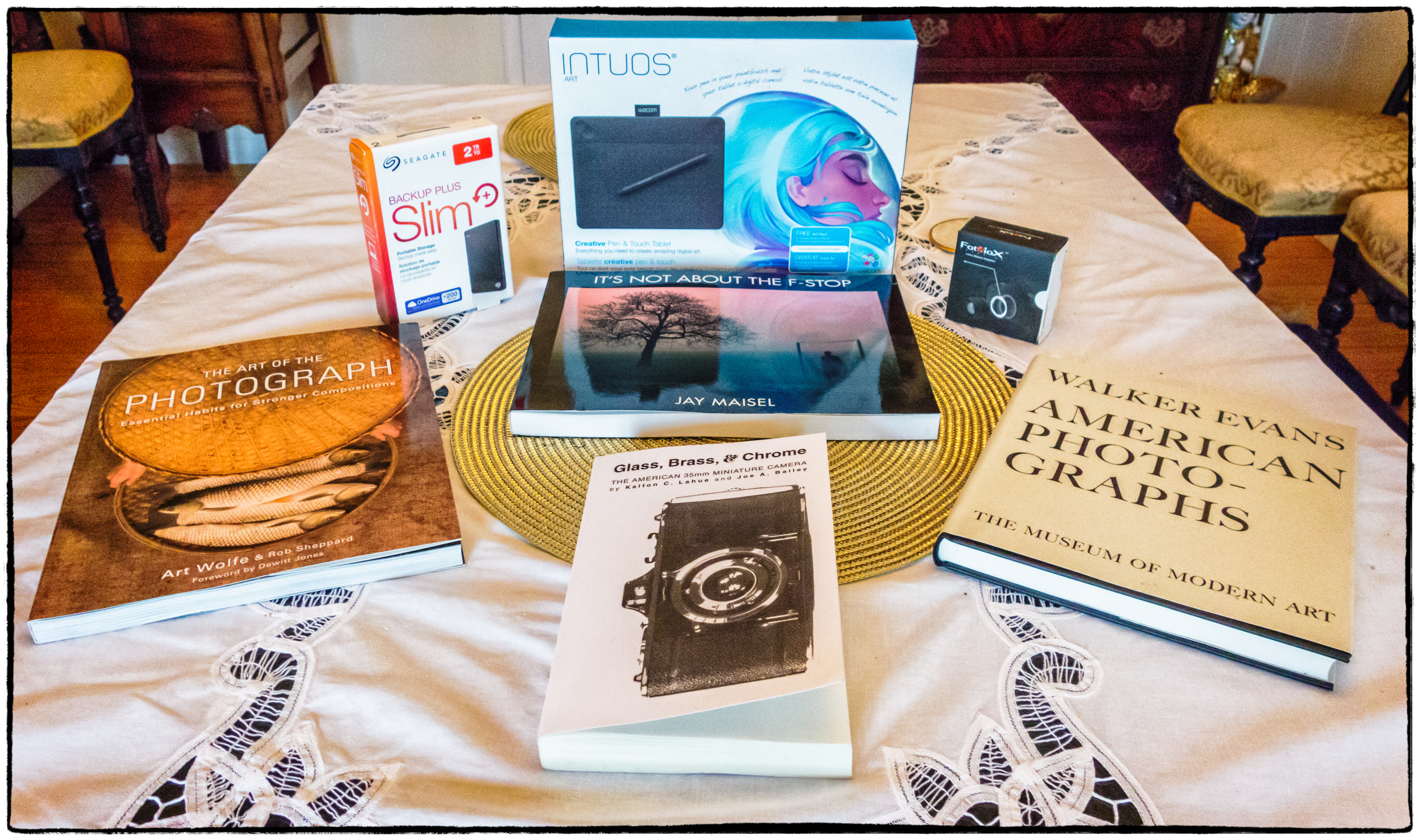
I got a lot of presents this year, many of them photography related. In case you can’t read the titles in the picture above they are (along with my initial reaction):

The Art of the Photograph. Somewhat disappointed with this. I must have put it on my amazon.com wish list a long time ago. A quick browse through it suggests that it won’t tell me much that I don’t already know.

Seagate Backup Plus Slim 2Tb. The hard drive on my laptop is running out of space – mostly because of the large numbers of pictures on it. I haven’t yet used this drive as I need to figure out how you transfer the pictures while still keeping Lightroom working.

Intuos Pen and Touch Small Tablet. The trackpad on my laptop has been acting up for a while so I started to use a mouse. Unfortunately the mouse is now no longer working reliably so I thought I’d try something different. I’ve always found masking to be difficult with a mouse and hope that this will make it easier. I installed the tablet without difficulty (apart from not being able to register as the site won’t take any of the serial numbers and software download codes appearing on the box. Still have to sort that out). It took a while to get used to it but so far so good.

Fotodiox Lens Mount Adapter – Olympus OM to Sony NEX. I bought an Olympus OM2n a while back and thought I’d get an adapter to allow me to use the 50mm f1.8 Zuiko that came with it on my NEX.

“Walker Evans – American Photographs”. Walker Evans is a photographer that I greatly admire. I had a book about him but it was destroyed in a flood at our house a few years ago. It was big and heavy and difficult to hold so I didn’t replace it. I thought I’d replace it with this one.

“Jay Meisel – It’s Not About the F-stop”. A while back someone bought me “Light, Gesture, and Color (Voices That Matter)” by Jay Meisel as a present. I liked it a lot and put this one on my wish list. I like this one too.

“Glass, Brass and Chrome. The American 35mm Miniature Camera” by Kalton C. Lahue and Joe A. Bailey. This one surprised me. It doesn’t look like much, but I’m really enjoying it. I’ve read more than half of it already. I won’t say any more as I’ll probably do a post exclusively on the book at some point.

Ansel Adams’ Pictures of an American Concentration Camp During WWII

Manzanar from Guard Tower, view west (Sierra Nevada in background).

More than 30 pictures in this article.

Ansel Adams is best known for his breathtaking landscape photos, but he photographed much more than nature during his decades-long career. In 1943, already

Source: Ansel Adams’ Pictures of an American Concentration Camp During WWII

Bearing in mind Donald Trump‘s recent comments regarding Muslims I wonder how close we are to this again.

Guardian Photographer of the year – 2015 Shortlist


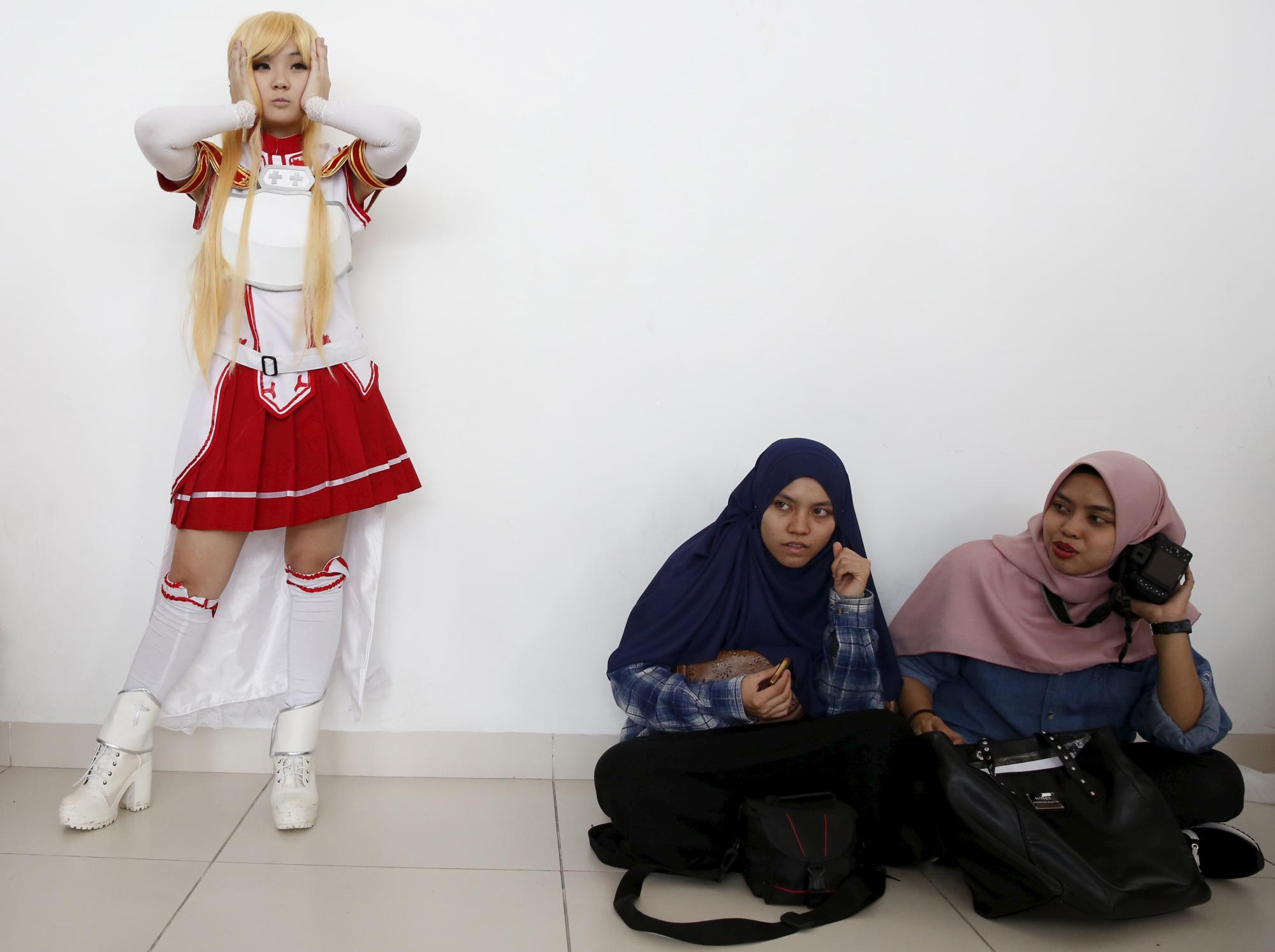
Olivia Harris: A cosplayer poses at the 2015 Comic Fiesta event in Kuala Lumpur, Malaysia. London-born Harris is based in Kuala Lumpur for Reuters. She covered news and features in London before moving to South-east Asia, where her images often make our photo highlights selections.

Some compelling pictures here:

Photographer of the year – 2015 shortlist: atrocities in Paris and Syria, bodybuilders in PalestineSpanning the human cost of air strikes in Syria and the refugee crisis, child jockeys, forest fires and Boris Johnson taking a tumble, here are the most incredible images that agency photographers sent to our picture desk this year. The overall winner will be announced on 21 December

Source: Photographer of the year – 2015 shortlist.

Some 40 plus pictures appear here – all but two of them feature people. Compare that to my pictures almost none of which have any people in them. I guess I shouldn’t look forward to appearing on the Guardian pictures of the year short list any time soon. After all this is the Guardian and newspapers tend to focus on reportage and photojournalism so I suppose I shouldn’t be too surprised.

I look forward to hearing who the ultimate winner is.

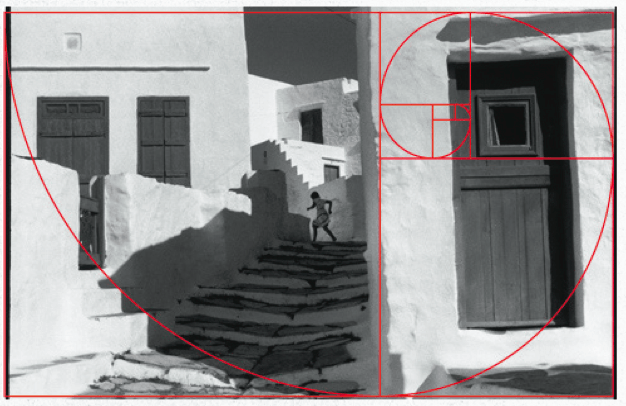
Henri Cartier Bresson on Rules

Fibonacci spiral above a photo by Henri Cartier-Bresson. Source: Eric KimObjectivity vs Subjectivity: What Makes a Great Street Photograph?

Here’s what Mr. Cartier Bresson had to say on the subject in “The Decisive Moment“:

In applying the Golden Rule, the only pair of compasses at the photographer’s disposal is his own pair of eyes. Any geometrical analysis, any reducing of the picture to a schema, can be done only (because of its very nature) after the photograph has been taken, developed and printed – and then it can be used only for a port-mortem examination of the picture. I hope we will never see the day when photo shops sell little schema grills to clamp onto our viewfinders; and that the Golden Rule will never be found etched on our ground glass.

Curiously this is exactly what has happened. All three of my digital cameras allow various grids to be superimposed on the viewfinder. Thenkfully it’s possible to turn off the grids rather than have them etched permanently on “our ground glass”.

The above picture is taken from a long (4000 plus words) post on Eric Kim’s blog. It contains many other pictures, several of which have similar geometrical shapes on them. I guess Mr. Kim is engaged in exactly the kind of “post mortem” that Cartier-Bresson talks about. It seems clear that whatever “rules” Cartier-Bresson followed he wasn’t thinking about them too much at the time he pressed the shutter. Possibly he had absorbed them to such an extent that they were such a part of him and had become intuitive. Or maybe he was just a natural.

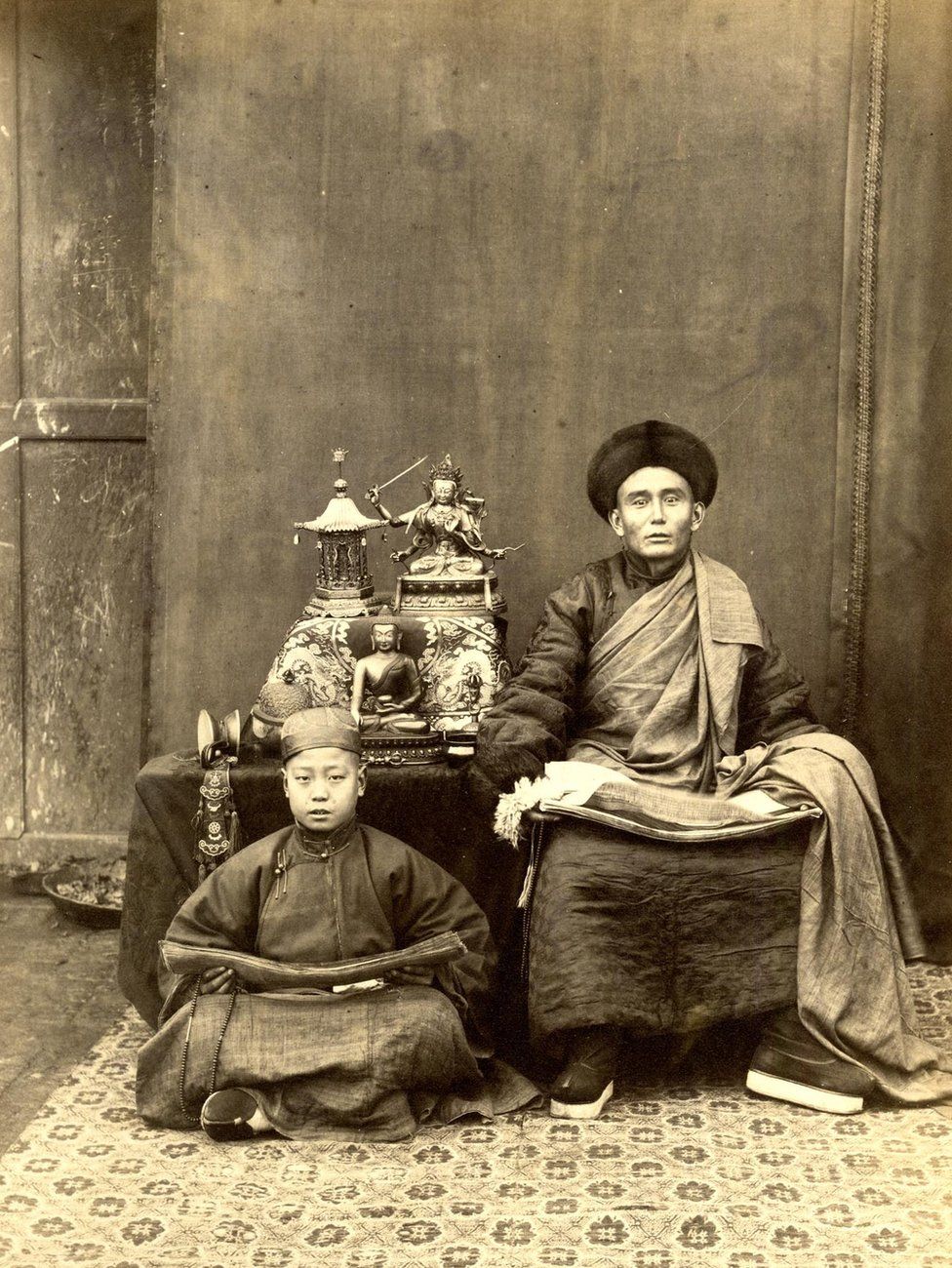
China as it once was – photographs by Thomas Child

This photograph by Thomas Child, titled Mongolian Lama, is one of the earliest photographic portraits of a religious figure in Peking. In the 19th century, the term lama referred to any Tibetan Buddhist monk or teacher. The lama and his pupil both hold prayer beads and bundles of sutras in their laps. Displayed neatly on the table are bronze sculptures and sacred Tibetan ritual objects including a skull cup.

Photographs of Peking, now known as Beijing, made by Thomas Child in the 1870s and 1880s are to go on show in London’s Chinatown as part of Asian Art in London season.More than 30 original photographs from the Stephan Loewentheil Historical Photography of China Collection, the largest holding of historical photographs of China in private hands, are included in the show. During two decades as a resident, Child documented life in the city with his camera.

Source: Rare early photographs of Peking – BBC News